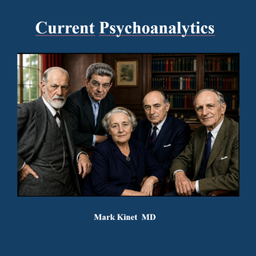
Current Psychoanalytics
Mark Kinet, MD - Psychiatrist and Psychoanalyst
1.0from 1 ratings
- 11
- Episodes
- 1
- Ratings
- Weekly
- Cadence
- 2026
- First episode
About Current Psychoanalytics
Current Psychoanalysis brings together more than 35 books and other writings by psychiatrist and psychoanalyst Mark Kinet. Each episode explores how unconscious meaning, personal history, and the therapeutic relationship illuminate psychiatry, psychotherapy, and culture. Two virtual hosts discuss carefully selected texts, translating complex psychoanalytic ideas into clear, engaging conversations while remaining remarkably faithful to the original work. For clinicians, students, and anyone curious about the human mind.
- Publisher
- Mark Kinet, MD - Psychiatrist and Psychoanalyst
- Category
- health & fitness
- Language
- en
- Explicit
- No
- First episode
- 3 Jun 2026
- Latest episode
- 31 Aug 2026
Latest episodes
11 episodes in the feed.
31 Aug 2026
How Does Psychotherapy Change Us? A Psychoanalytic Journey (2026)
What actually happens when psychotherapy begins to work? This episode returns to Mark Kinet’s Patient Testimonies of Psychodynamic Psychotherapy: Reported and Recorded (Routledge, 2025), but approaches the book from a differentangle. Rather than focusing on the 38 patient testimonies themselves, two 'hosts' explore the book’s opening and concluding chapters: an accessible survey of what psychoanalytic psychotherapy is, how it works, and what kinds of change it hopes to make possible. Psychotherapy is not a wellness spa, nor is it a psychological car wash. People usually enter treatment because they suffer and want to feel better, preferably quickly.Psychoanalytic psychotherapy takes an inevitable detour. It asks what lies beneath recurring symptoms, relationships, conflicts and ways of living, and how the past continues to make itself present. The discussion moves from Freud’s unconscious, free association, resistance and transference to thelater contributions of Melanie Klein, Wilfred Bion, Donald Winnicott and relational psychoanalysis. The therapeutic relationship emerges not simply as a vehicle for treatment but as a place where old patterns can return, become visible and sometimes acquire a different outcome. What begins as being listened to may gradually become something more difficult. The initial “honeymoon” of psychotherapy gives way to resistance, ambivalence, dependency and confrontation with things we would rather not know. The patient and therapist find themselves engaged in a peculiar joint undertaking: part investigation, part relationship, part repetition, and part new experience. The episode also explores what psychoanalytic psychotherapy ultimately aims for. Not immunity from suffering, and not simply symptom reduction, but greater freedom: increased capacity to understand feelings, recognise repetition, tolerate ambivalence, mentalise experience, play, relate to others as genuinely other,and become less governed by unconscious patterns. Perhaps the outcome of psychotherapy is therefore neither happiness nor perfect psychological health. Freud’s patient may become “sadder and wiser.” Yet the testimonies gathered byKinet suggested something unexpectedly more hopeful: many patients felt better and wiser. Based on the opening and concluding chapters of Patient Testimonies of Psychodynamic Psychotherapy: Reported and Recorded (Routledge, 2025). For the book: Patient Testimonies of Psychodynamic Psychotherapy. Reported and Recorded (https://www.routledge.com/Patient-Testimonies-of-Psychodynamic-Psychotherapy-Reported-and-Recorded/Kinet/p/book/9781032854946)(2025) For more information, visit Mark Kinet (https://www.markkinet.be/en/). Current Psychoanalysis brings together more than 35 books and other writings by psychiatrist and psychoanalyst Mark Kinet. Each episode explores how unconscious meaning, personal history, and the therapeutic relationship illuminate psychiatry, psychotherapy, and culture. Two virtual hosts discuss carefully selected texts, translating complex psychoanalytic ideas into clear, engaging conversations while remaining remarkably faithful to the original work. For clinicians, students, and anyone curious about the human mind.
24 Aug 2026
The Psychology of Art. Why Do We Need Art? (2026)
Two hosts discuss the key ideas of Psychology of Art. An Abecedary, an illustrated book published by Mark Kinet in 2013. The podcast is intended as a reading revisited and as a prelude to current work in progress on art, form, and the human need to give shape to experience. Why do human beings make art? And why can a painting, a piece of music, a poem, or an ordinary object sometimes affect us with an intensity that seems disproportionate to what is actually there? Psychoanalysis asks us to look beyond beauty, taste, and artistic intention towards a more fundamental question: What does art do for the human mind? Drawing on Freud, Klein, Winnicott, Lacan and other psychoanalytic thinkers, Mark Kinet approaches art not as a luxury added to life but as one of the ways in which human beings transform inner experience. Fantasy becomes image, anxiety acquires a container, desire finds an object, and what could not yet be thought or spoken may begin to take form. Art belongs to the same human territory as play, dreams, imagination, symbolisation, and sublimation. The abecedary form allows these questions to be approached from many directions. Artist and audience, beauty and the uncanny, creativity and destruction, desire and sublimation, looking and being looked at all become different entrances into the psychology of art. Rather than explaining artworks through the biography or pathology of their creators, psychoanalysis can help us understand the psychological processes through which something comes to matter — both to the person who makes it and to the person who encounters it. Revisiting the book more than a decade after its publication also changes the question. Perhaps art is not only about expressing what is already inside us. Making, playing, imagining, and encountering forms may themselves be ways in which experience becomes possible. We make forms, but forms also shape the ways in which we see, feel, remember, and inhabit the world. This episode invites listeners to approach art not primarily by asking what it means, but by asking what happens when it takes hold of us. Why do human beings surround themselves with images, stories, objects, rhythms, and rituals? Why does form matter? And why, across cultures and throughout history, have we apparently been unable to live without it? For the book: Psychologie van de Kunst. Een Abecedarium (https://www.maklugarant.eu/product/psychologie-van-de-kunst-een-abecedarium-met-voorwoord-van-paul-verhaeghe-en-arnon-grunberg/) [Psychology of Art. An Abecedary (https://www.maklugarant.eu/product/psychologie-van-de-kunst-een-abecedarium-met-voorwoord-van-paul-verhaeghe-en-arnon-grunberg/)] For more information, visit: Mark Kinet (https://www.markkinet.be/en/) Current Psychoanalysis brings together more than 35 books and other writings by psychiatrist and psychoanalyst Mark Kinet. Each episode explores how unconscious meaning, personal history, and the therapeutic relationship illuminate psychiatry, psychotherapy, and culture. Two virtual hosts discuss carefully selected texts, translating complex psychoanalytic ideas into clear, engaging conversations while remaining remarkably faithful to the original work. For clinicians, students, and anyone curious about the human mind.
28 Jul 2026
Group and Gang, Crowd and Mob: The Unconscious on Stage (2026)
Two hosts discuss the key points of a paper by Mark Kinet in the Dutch Journalof Group Dynamics and Group Psychotherapy (https://www.groepspsychotherapie.nl/nvgp/_sitefiles/file/tijdschrift/2022/2022-2/2022_2degroephetonbewuste.pdf) Why do groups sometimes become irrational? Why do workplaces suddenly descend into dependency, conflict, or panic? And why do the same unconscious patterns seemto repeat across families, organisations, politics, and psychotherapy? Drawing on Freud, Bion, Lacan, attachment theory, neuropsychoanalysis, and contemporary clinicalthinking, Mark Kinet presents the unconscious not as a hidden place but as something that continually unfolds between people. Early relationships shape the mental code through which we later experience authority, intimacy, conflict, and belonging. This episode explores the architecture of the unconscious, the formative influence of the primarygroup, Bion's basic assumptions, transference, projective identification, andthe unique role of psychoanalytic group therapy. Rather than viewing groups merely as collections of individuals, it shows how they become living stages on which unconscious histories are replayed, recognised, and, at times, transformed. Visit Mark Kinet (https://www.markkinet.be/)for books, articles, and furtherresources. Current Psychoanalysis brings together more than 35 books and other writings by psychiatrist and psychoanalyst Mark Kinet. Each episode explores how unconscious meaning, personal history, and the therapeutic relationship illuminate psychiatry, psychotherapy, and culture. Two virtual hosts discuss carefully selected texts, translating complex psychoanalytic ideas into clear, engaging conversations while remaining remarkably faithful to the originalwork. For clinicians, students, and anyone curious about the human mind. .
14 Jul 2026
Pornography as a Mask for Guilt (2026)
Two hosts discuss the key points of Pornocracy, a paper by Mark Kinet in the Dutch Journal of Psychoanalysis (https://www.tijdschriftvoorpsychoanalyse.nl/auteurs/overzicht_auteurs/over_de_auteur/Kinet). Pornography is usually discussed in terms of addiction, morality, or sexual liberation. Psychoanalysis asks a different question: What psychological function does pornography serve? Drawing on Freud, Winnicott, Lacan, Michael Bader, Kernberg, and Joyce McDougall, Mark Kinet explores a paradox that challenges many common assumptions. What if pornography is not primarily about unrestrained desire, but about regulating anxiety, guilt, and concern? What if sexual fantasy is less an escape from morality than an attempt to make desire feel psychologically safe? This episode examines pornography as a carefully constructed fantasy world in which sexuality is detached from vulnerability, intimacy, and emotional responsibility. Rather than reducing women to objects out of indifference, some fantasies may function precisely to neutralise excessive concern for the other, allowing sexual excitement to emerge without overwhelming guilt. Sexual preferences are approached not as fixed identities but as personal psychological inventions—creative solutions through which unconscious conflicts, desires, fears, and longings become organised. This episode invites listeners to look beyond the visible content of pornography toward the invisible psychological dramas it conceals. As in dreams, the manifest image tells only part of the story. The real question is not what arouses us, but why this particular fantasy became necessary for this particular person. For the paper in the Dutch Journal of Psychoanalysis: Pornocratie (https://www.tijdschriftvoorpsychoanalyse.nl/inhoud/tijdschrift_artikel/PA-32-1-5/Pornocratie) Visit Mark Kinet (https://www.markkinet.be/)for books, articles, and further resources. Current Psychoanalysis brings together more than 35 books and other writings by psychiatrist and psychoanalyst Mark Kinet. Each episode explores how unconscious meaning, personal history, and the therapeutic relationship illuminate psychiatry, psychotherapy, and culture. Two virtual hosts discuss carefully selected texts, translating complex psychoanalytic ideas into clear, engaging conversations while remaining remarkably faithful to the original work. For clinicians, students, and anyone curious about the human mind.
29 Jun 2026
Unnatural Love. Psychoanalysis on Perversion and Desire (2026)
Two virtual hosts discuss the key points of Unnatural Love, a paper by Mark Kinet in the Dutch Journal of Psychoanalysis (https://www.tijdschriftvoorpsychoanalyse.nl/auteurs/overzicht_auteurs/over_de_auteur/Kinet). He argues that psychoanalysis sees perversion not simply as a sexual deviation but as a complex way of coping with innerconflict. Freud viewed it as an expression of the child's early sexuality and as a defence against deep-seated fears of loss and vulnerability. Klein linked it to primitive anxieties and aggression, while Lacan understood it as a way ofresisting the limits and rules that make social life possible. Stollerdescribed perversion as an attempt to turn the pain of childhood trauma into asense of power and control. More recent thinkers, such as McDougall—who speaksof a self-protective form of sexuality—and Benvenuto, who highlights the lossof mutuality and genuine encounter, have further expanded this psychoanalytic perspective. Ultimately, Kinet suggests that perversion sheds light on universal human struggles with love, desire, control, and vulnerability. For the paper in the Dutch Journal of Psychoanalysis: Onnatuurlijke Liefde (https://www.markkinet.be/maptijdschriftartikelenjournalarticles/Onnatuurlijke_Liefde%20TVPA.pdf) For more information, visit: www.markkinet.be (http://www.markkinet.be/) Current Psychoanalysis presents AI-generated conversations inspired by the 35+ books and writings of psychiatrist and psychoanalyst Mark Kinet. Each episode aims to stimulatereflection and dialogue on contemporary psychoanalytic theory and clinical practice.
16 Jun 2026
Critical Review of Mark Solms' The Only Cure (2025).
Mark Solms is widely regarded as one of the leading figures in contemporary psychoanalysis and neuroscience. As editor of Freud’s New Standard Edition, he has played a major role in restoring psychoanalysis to scientific debate. His latest book bears a characteristically ambitious title: The Only Cure: Freud and the Neuroscience of Mental Healing. Drawing on Mark Kinet’s critical review, two virtual hosts explore the strengths and limitations of Solms’ neuropsychoanalytic vision of psychoanalysis. The stakes are high, although—paraphrasing Freud—every advance may ultimately prove to be only half as great as it first appears. For more information, visit: www.markkinet.be (http://www.markkinet.be/) Current Psychoanalytics presents AI-generated conversations inspired by the books and writings of psychiatrist and psychoanalyst Mark Kinet. Each episode aims to stimulate reflection and dialogue on contemporary psychoanalytic theory and clinical practice.
3 Jun 2026
The Psychodynamics and Psychogenesis of Parentification
Some children learn too early how to care for others—and too late how to care for themselves. Based on Mark Kinet's The Psychodynamics and Psychogenesis of Parentification, this AI-generated conversation explores the hidden costs of growing up with responsibilities that belong to adults. Two virtual hosts discuss role reversal, emotional parentification, family dynamics, resilience, and vulnerability, showing how childhood experiences can continue to shape adult relationships and psychological well-being. An accessible introduction to one of the most significant yet under-recognised themes in contemporary psychotherapy. The Psychodynamics and Psychogenesis of Parentification - 1st Edition (https://www.routledge.com/The-Psychodynamics-and-Psychogenesis-of-Parentification/Kinet/p/book/9781041085096) More information: www.markkinet.be Current Psychoanalytics presents AI-generated discussions inspired by the books and writings of psychiatrist and psychoanalyst Mark Kinet. Each episode offers an accessible introduction to contemporary psychoanalytic thought and practice.
3 Jun 2026
Patient Testimonies of Psychodynamic Psychotherapy. Reported and Recorded
Why is therapy not a car wash? Based on Mark Kinet's Patient Testimonies of Psychodynamic Psychotherapy: Reported and Recorded, this AI-generated conversation explores what psychotherapy looks like through the eyes of those who have actually undergone it. Drawing on 38 patient testimonies, two virtual hosts discuss therapeutic change, emotional insight, human connection, and the complex process through which people come to understand themselves differently. A unique exploration of psychotherapy from the patient's perspective—where outcomes are measured not only in symptoms reduced, but also in lives transformed. Patient Testimonies of Psychodynamic Psychotherapy. Reported and Recorded (https://www.routledge.com/Patient-Testimonies-of-Psychodynamic-Psychotherapy-Reported-and-Recorded/Kinet/p/book/9781032854946) More information: www.markkinet.be Current Psychoanalytics presents AI-generated discussions inspired by the books and writings of psychiatrist and psychoanalyst Mark Kinet. Each episode offers an accessible introduction to contemporary psychoanalytic thought and practice.
3 Jun 2026
Psychoanalytic Psychotherapy in Psychiatric Practice. Premises and Clinical Portraits
What does psychoanalytic psychotherapy actually look like in everyday psychiatric practice? Drawing on Mark Kinet's Psychoanalytic Psychotherapy in Psychiatric Practice: Premises and Clinical Portraits, this AI-generated discussion explores the theory and practice of psychodynamic treatment through a series of vivid clinical portraits. Two virtual hosts examine the therapeutic relationship, transference, resistance, interpretation, and the subtle processes through which psychological change becomes possible. Combining clinical insight with practical experience, this episode offers a rich introduction to contemporary psychoanalytic psychotherapy and its place within modern psychiatry. Ideal for psychiatrists, psychotherapists, psychologists, trainees, and anyone interested in the human encounter at the heart of therapy. Psychoanalytic Psychotherapy in Psychiatric Practice. Premises and Clinical Portraits (https://www.routledge.com/Psychoanalytic-Psychotherapy-in-Psychiatric-Practice-Premises-and-Clinical-Portraits/Kinet/p/book/9781032743318) More information: www.markkinet.be Current Psychoanalytics presents AI-generated discussions inspired by the books and writings of psychiatrist and psychoanalyst Mark Kinet. Each episode offers an accessible introduction to contemporary psychoanalytic thought and practice.
3 Jun 2026
Psychoanalytic Principles in Psychiatric Practice. A Remedy by Truth
Can psychiatry benefit from psychoanalytic thinking without abandoning scientific rigour? Drawing on Mark Kinet's Psychoanalytic Principles in Psychiatric Practice: A Remedy by Truth, this AI-generated discussion explores the fundamental principles that psychoanalysis can contribute to contemporary psychiatric care. Through a lively conversation between two virtual hosts, listeners are introduced to themes such as unconscious meaning, therapeutic listening, transference, subjectivity, diagnosis, and the place of truth in mental health treatment. Rather than opposing psychiatry and psychoanalysis, this episode examines how both perspectives can enrich one another in everyday clinical practice. Ideal for psychiatrists, psychotherapists, psychologists, trainees, and anyone interested in a more humane and reflective approach to mental suffering. Psychoanalytic Principles in Psychiatric Practice. A Remedy by Truth (https://www.routledge.com/Psychoanalytic-Principles-in-Psychiatric-Practice-A-Remedy-by-Truth/Kinet/p/book/9781032686202) More information: www.markkinet.be Current Psychoanalytics presents AI-generated discussions inspired by the books and writings of psychiatrist and psychoanalyst Mark Kinet. Each episode offers an accessible introduction to contemporary psychoanalytic thought and practice.
3 Jun 2026
The Spirit of the Drive in Neuropsychoanalysis
Can neuroscience help us understand what Freud meant by the drive? Drawing on Mark Kinet's The Spirit of the Drive in Neuropsychoanalysis, this AI-generated conversation explores the fascinating dialogue between psychoanalysis and contemporary brain science. Through a lively discussion between two virtual hosts, listeners are introduced to topics such as affective consciousness, SEEKING, motivation, desire, and the future of psychoanalytic thinking. Whether you are a clinician, researcher, student, or simply curious about the human mind, this episode provides an accessible gateway into one of the most exciting developments in contemporary psychoanalysis. The Spirit of the Drive in Neuropsychoanalysis (https://www.routledge.com/The-Spirit-of-the-Drive-in-Neuropsychoanalysis/Kinet/p/book/9781032495446) Visit www.markkinet.be for books, articles, and further resources. Current Psychoanalytics presents AI-generated discussions inspired by the books and writings of psychiatrist and psychoanalyst Mark Kinet. Each episode offers an accessible introduction to contemporary psychoanalytic thought and practice.
Reach and audience
Public platform figures. Ratings count people who left a rating, not total listeners.
- Apple Podcasts (US)
- 1.0 / 5
- 1 ratings
Contact Current Psychoanalytics
- Guest appearances
- Does not typically book guests
Based on episode analysis; this does not confirm that the show is currently accepting guests.




Host of Current Psychoanalytics?
Claim your podcast to manage its listing and keep your show details accurate.
Pod Engine is an independent podcast discovery and analytics service and is not affiliated with or endorsed by this podcast. Artwork and show content belong to their owners. Full legal notice.
Explore this show
Podcast research with Pod Engine