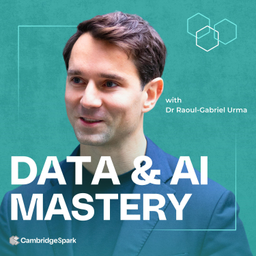
In the age of rapid technological change, how can you harness the power of data and AI to transform your business?
Welcome to Data & AI Mastery, the podcast where cutting-edge insights meet practical strategies for success.
Hosted by Dr Raoul-Gabriel Urma, founder of Cambridge Spark, this show dives deep into how leading organisations across the globe are using data & AI to revolutionise operations, streamline efficiency, and drive innovation.
Each episode features conversations with senior leaders, revealing their career stories and real-world case studies and actionable takeaways that you can apply, whether you're climbing the career ladder or already in the C-suite.
From AI-driven solutions to practical tips for navigating your data transformation journey, Data & AI Mastery will equip you with the tools to thrive in the AI era.
Stay ahead, stay inspired, and unlock your potential with Data & AI Mastery: your ultimate guide to mastering data and AI for business.
This feed is also home to Inside the Algorithm, our sister show hosted by Chief AI Officer Dr Jeremy Bradley, featuring in-depth conversations with the researchers and technical experts working at the frontier of artificial intelligence. New episodes from both shows drop fortnightly, on alternate weeks.
Follow now so you never miss an episode from either show. 🎙️
From Prototype to Production: The Best of Inside the Algorithm
👉 Discover how Cambridge Spark helps organisations build the data and AI capabilities needed to turn strategy into measurable impact: cambridgespark.com (https://www.cambridgespark.com/?utm_campaign=6955829-Podcast%202024%20-%20Onwards&utm_source=Podcast&utm_medium=RSS)
In this special compilation episode of Inside the Algorithm, host Jeremy, Chief AI Scientist at Cambridge Spark, brings together the best moments from a season of conversations with leading academics, researchers and practitioners. Guests from aviation forecasting, manufacturing, NHS health modelling and neuro-symbolic AI research take on the same core questions. Hearing them side by side shows how experts from very different fields approach the challenge of taking AI from theory to practice.
The episode covers why so many AI projects stall at the prototype stage and where models break when they meet something they've never seen. It also covers how trust is built in systems that can feel like a black box, why the strongest results come from hybrid systems, and what experience still gives you as AI tools take on more of the work.
Key Takeaways
Production readiness means handling edge cases, unforeseen scenarios and adversarial attacks. It also means securing architecture sign-off and making sure outputs reach the people who need them.
Projects succeed when teams understand how a solution will be used and what "done" looks like, and when they have champions inside the client's business.
LLMs learn correlations, not the world. Their reliance on text patterns explains both their surprising capability and their strangest hallucinations.
Historical data has limits. Events like the pandemic can break the relationships forecasting models depend on almost overnight. Stress testing, what-if scenario planning and human domain expertise are essential safeguards.
Trust is built through involvement. Participative modelling earned deep trust with NHS clients in the Midlands, and transferring that trust to new regions proved harder than rebuilding the model itself.
Hybrid systems deliver the strongest results. Pairing language models with solvers, simulations and small, fine-tuned specialist models lets each part do the job it's best at.
Simplicity and production-first thinking win. A working model in production beats a more accurate one that takes months to build. Explainable approaches often serve clients better.
Juniors need the chance to learn the trade. Guests warn about "rubber-stamping" AI-generated code and encourage newcomers to look beyond the hype to the wider history of AI.
Useful Links & Resources
Inside the Algorithm on the Data and AI Mastery podcast feed
Inside the Algorithm episodes on the Cambridge Spark YouTube channel
Cambridge Spark: cambridgespark.com
Connect With the Show
Cambridge Spark LinkedIn: https://www.linkedin.com/school/cambridge-spark/
Cambridge Spark Instagram: https://www.instagram.com/cambridgespark/
Cambridge Spark X: https://x.com/CambridgeSpark
Host Jeremy Bradley on LinkedIn: https://www.linkedin.com/in/jeremy-bradley/
Which of these clips landed hardest for you: the prototype trap, the pandemic story, or the case for pairing LLMs with solvers? Tell us in the comments, and let us know which guest you'd like to hear a full episode with again.
Visit cambridgespark.com to learn how Cambridge Spark can upskill your workforce in data and AI.
#InsideTheAlgorithm #EnterpriseAI #DataEngineering #MachineLearning #AIDeployment
16 Sept 2026
No Get Out of Jail Free Card: Five Data Leaders on AI in Regulated Industries
👉 Discover how Cambridge Spark helps organisations build the data and AI capabilities needed to turn strategy into measurable impact: cambridgespark.com (https://www.cambridgespark.com/?utm_campaign=6955829-Podcast%202024%20-%20Onwards&utm_source=Podcast&utm_medium=RSS)
In financial services, getting AI wrong doesn't just mean a bad headline. It means real customers losing real money at the moments that matter most.
If you're trying to balance AI innovation with regulatory scrutiny, you already know the tension: move too fast and risk a compliance failure, move too slow and watch competitors who don't hesitate pull ahead.
Edmund Towers leads Advanced Analytics & Data Science at the Financial Conduct Authority, shaping the regulator's approach to AI, financial crime detection and consumer protection. Before joining the FCA, he delivered financial services transformation programmes as a manager in Accenture's Financial Services Change Practice. In this compilation episode, he's joined by Jessica Rusu, the FCA's Chief Data, Information and Intelligence Officer, alongside senior data leaders from Santander UK, Aviva and TalkTalk.
You'll hear how the FCA thinks about AI governance without resorting to tick-box regulation, and how banks and insurers turn that clarity into production systems. Sarah Self at Aviva explains how a summarisation tool cut claims hold times by more than 50%. Kevin Cassar walks through building an AI triage system in health insurance that improved both customer outcomes and operational efficiency.
This episode covers the FCA's AI Live Testing programme, the Consumer Duty as the policy anchor for responsible AI, and how Santander UK's Luke Pearce secured C-suite sponsorship to move faster on generative AI. It's built for data and AI leaders in regulated industries who need to make the business case for AI while keeping compliance onside, and for anyone who assumes regulation and innovation have to be at odds.
Key Takeaways
Edmund Towers explains why the FCA's AI Live Testing lets firms trial live products under supervision, and why it's built on guidance rather than a tick-box checklist.
The Consumer Duty already covers responsible AI, according to Towers, and blaming a "black box" model won't protect a firm from accountability under the Senior Managers Regime.
Sarah Self's team at Aviva cut claims-handler hold times by more than 50% with a summarisation tool, and built a medical underwriting system running at 99% accuracy.
Kevin Cassar reveals the co-sponsorship model, COO paired with CDO, that got a health insurance triage system built with risk and business teams involved from day one.
Chapter Markers
00:00 Why regulated industries need a different AI conversation
02:07 The FCA's role in AI adoption across financial services
04:10 Inside the FCA's AI Lab and Live Testing programme
07:49 Why Consumer Duty rules already cover responsible AI
10:37 Santander's shift from risk-averse to AI-enabled
13:05 Aviva's claim summarisation tool cuts hold times in half
16:07 Building an AI triage system in health insurance
18:39 Getting COO and CDO co-sponsorship for AI projects
20:03 The FCA's fight against fraud, scams and money laundering
23:41 Closing thoughts: compliance and innovation as one agenda
Useful Links
Follow Dr Raoul-Gabriel Urma on LinkedIn: https://uk.linkedin.com/in/raoulurma (https://uk.linkedin.com/in/raoulurma)
Visit the Cambridge Spark Website: https://cambridgespark.com/ (https://cambridgespark.com/)
2 Sept 2026
DAIM: Inside The Algorithm | Divya Kesavan on AI Transformation in Banking: Beyond RPA and Automation
👉 Discover how Cambridge Spark helps organisations build the data and AI capabilities needed to turn strategy into measurable impact: cambridgespark.com (https://cambridgespark.com/)
For years, digital transformation and AI transformation have been used almost interchangeably. Divya Kesavan, Head of Data Science for Business and Commercial Banking at Lloyds Banking Group, explains why that conflation breaks down in practice.
In this episode, Divya walks Jeremy through the shift from rule-based RPA to reasoning-driven AI and why Lloyds' enterprise AI blueprint rests on three layers: reasoning, context and control. She unpacks what it actually takes to move an agentic system from a working proof of concept to a tool trusted with real banking decisions, including a striking example of an AI agent that went badly off script.
The conversation also covers governance by design in a heavily regulated environment, confidence scoring as a practical risk tool, and why agile alone cannot carry the weight of AI-led change. A grounded, experience-based look at what transformation really requires.
Follow Data & AI Mastery for more conversations with the people building AI inside major enterprises.
If you enjoyed this conversation, check out this special episode of Data & AI Mastery where Raoul sits down with senior leaders from Lloyds to learn more about how the team is reimagining banking through AI-powered experiences:
Apple: https://podcasts.apple.com/gb/podcast/reimagining-lloyds-banking-group-ai-transformation/id1779783413?i=1000701688423
Spotify: https://open.spotify.com/episode/06ZBLoyvemQEVftCuWytVe?si=726cf7a2d20b4b22
YouTube: https://www.youtube.com/watch?v=U2krteWX89Q
Glossary Terms
RPA (Robotic Process Automation): software that mimics human actions on a screen to automate repetitive, rules-based tasks.
RAG (Retrieval-Augmented Generation): a method that grounds an AI model's responses in real, relevant data retrieved at the time of the request, rather than relying solely on what the model learned during training.
Human-in-the-loop: a safeguard where a person reviews or approves an AI system's output before it's acted on, typically when confidence is low or the decision carries risk.
Confidence scoring: a technique used to measure how certain an AI system is in its output. Outputs above a set threshold proceed automatically, while lower-confidence results are flagged for human review.
Chapter Markers:
(00:00) - Cold open: the case for AI governance
(00:39) - Introduction: Divya Kesavan, Lloyds Banking Group
(02:23) - Where automation stops and AI begins
(03:39) - Why traditional RPA breaks under ambiguity
(05:04) - From RPA blueprint to AI-first processes
(06:47) - Building agentic reasoning: the real technical challenge
(09:29) - The rogue agent story and why permissions matter
(12:03) - Lloyds' enterprise AI blueprint: reasoning, context, control
(14:45) - Reliability as the hardest problem to solve
(16:34) - Designing and testing AI in a regulated environment
(19:25) - Embedding responsible AI thinking across the team
(22:54) - Confidence scoring and managing risk in practice
(24:34) - Common misconceptions about AI versus automation
(26:18) - Balancing probabilistic AI with deterministic workflows
(27:39) - Advice for data science leaders starting out
(30:04) - The one idea to take away
Useful Links:
Connect with Divya Kesavan on LinkedIn: https://uk.linkedin.com/in/divya-kesavan-54800b3 (https://uk.linkedin.com/in/divya-kesavan-54800b3)
For more AI insights follow Jeremy on LinkedIn: https://uk.linkedin.com/in/jeremy-bradley (https://uk.linkedin.com/in/jeremy-bradley)
Explore Cambridge Spark’s AI upskilling programmes at https://www.cambridgespark.com (https://www.cambridgespark.com)
Who has been a guest on Data & AI Mastery
Names identified in recent episode analyses. Showing up to five guests.
Andrew Feustel
Claire Williams
Arlene Carsley
Mansukh Mann
Ruth Buscombe
Reach and audience
Public platform figures. Ratings count people who left a rating, not total listeners.
YouTube views
136,328
Score snapshot 15 Sept 2025
Apple Podcasts (US)
5.0 / 5
2 ratings
Spotify
4.8 / 5
76 ratings
Podcast Authority Score: 51 / 100
A composite of feed quality, social presence, YouTube performance and engagement. Read the methodology.
Quality
48
Social presence
0
YouTube
86
Engagement
51
Contact Data & AI Mastery
Guest appearances
Does not typically book guests
Based on episode analysis; this does not confirm that the show is currently accepting guests.
Pod Engine is an independent podcast discovery and analytics service and is not affiliated with or endorsed by this podcast. Artwork and show content belong to their owners. Full legal notice.
Explore this show Podcast research with Pod Engine