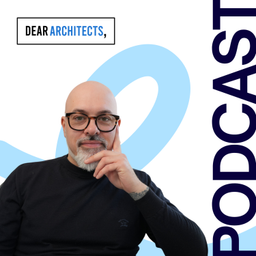
Podcast thumbnail for Dear Architects podcast

Dear Architects podcast

Claim This Podcast

by Luca Mezzalira

6 episodes
Updated Daily
Accepts GuestsHas Sponsors

Podcast Overview

Dear Architects is where software architecture meets the real world. Hosted by Luca Mezzalira, the voice behind Dear Architects, this podcast cuts through the theory to explore how architects actually work. Each episode features conversations with practitioners who are shaping how we think about distributed systems, team topologies, and the evolving role of the architect. Whether you're designing microservices, leading technical strategy, or figuring out how to align engineering with business goals, you'll find practical insights you can apply immediately.

Language

🇺🇲

Publishing Since

2/17/2026

Reach the team behind Dear Architects podcast

Verified contact details for this show aren't on file yet — sign up to get notified when they land.

Recent Episodes

Episode thumbnail for Microservices, AI and.... Chris Richardson

July 8, 2026

Microservices, AI and.... Chris Richardson

<p>This episode is brought to you by IcePanel, a collaborative diagramming and modeling tool for architects. Model your system from business context down to components, keep diagrams in sync automatically, and connect your architecture to your favorite LLM via their MCP server. Try it free: icepanel.io/luca</p><p>In this episode of Dear Architects, Luca sits down with Chris Richardson, author of Microservices Patterns and the creator of microservices.io, for a wide-ranging, no-hype conversation about where microservices actually stand in 2026, and what Gen AI does (and doesn&#39;t) change about how we design systems. Chris and Luca dig into why so many organizations still end up with a &quot;distributed monolith,&quot; the real warning signs of bad service boundaries (hint: watch your services-to-developer ratio), and Chris&#39;s own framework for deciding what belongs together and what should be pulled apart — the Dark Energy and Dark Matter forces. They also get into the social-technical side of architecture: why team topologies, DevOps, and org structure matter as much as the diagrams, and why &quot;the architecture is bad&quot; is often just a symptom of deeper organizational issues.The second half turns to AI: the guardrails that actually make coding agents useful (tests, pre-commit hooks, code scanning), why brownfield modernization is nowhere near as simple as greenfield demos suggest, why Chris still prefers the Strangler Fig pattern over &quot;big bang&quot; AI rewrites, and a healthy dose of skepticism about the claims flooding your LinkedIn feed.If you&#39;re an architect, tech lead, or engineer trying to figure out what&#39;s signal and what&#39;s noise in the current AI moment — this one&#39;s for you.</p><p>Chapters</p><p><br></p><p>00:00 Intro</p><p>01:36 Welcome, Chris Richardson</p><p>03:15 Chris&#39;s career: testing, Spring/Hibernate, the cloud, Cloud Foundry</p><p>06:01 State of microservices in 2026</p><p>07:30 &quot;Living systems&quot; — why boundaries need constant reassessment</p><p>09:47 Software serves two constituencies: users and the organization</p><p>10:19 Team topologies, DevOps, and the success triangle</p><p>12:53 Holistic engineering</p><p>13:36 The &quot;red flag law&quot; anti-pattern</p><p>14:51 Warning signs: the services-to-developer ratio</p><p>16:41 System releases and the distributed monolith trap</p><p>17:41 Service boundaries in practice</p><p>18:18 Default to monolith unless there&#39;s a clear problem to solve</p><p>19:03 Dark Energy &amp; Dark Matter: the forces behind service boundaries</p><p>23:00 Dark Matter forces: runtime coupling, ACID vs. BASE</p><p>24:44 Collocating code isn&#39;t a weakness signalr</p><p>26:25 Ten forces, weighted by your own context</p><p>28:16 Architecture serves the organization, not just the customer</p><p>29:20 Latency-sensitive endpoints and selective distribution</p><p>31:31 AI hype: &quot;we rebuilt it in 48 hours&quot;</p><p>33:43 Best practices matter more, not less, in the Gen AI era</p><p>36:05 Multi-agent architectures and inter-service communication</p><p>37:33 The &quot;agents for everything&quot; trap</p><p>39:29 &quot;SaaS is dead&quot;? Big tech hype and bubble skepticism</p><p>40:26 Brownfield vs. greenfield: the AI modernization gap</p><p>42:02 Guardrails that work: tests, pre-commit hooks, code scanning</p><p>43:14 Legacy code without tests meets a probabilistic system</p><p>44:24 Human accountability for AI-generated code</p><p>45:22 Where architecture fits in the AI era</p><p>47:21 What AI-driven modernization gains — and loses</p><p>50:04 Strangler Fig over the &quot;big bang&quot; rewrite</p><p>53:36 Spec-driven development: waterfall in disguise?</p><p>54:16 Why well-documented systems are easier to AI-rewrite</p><p>56:02 &quot;We are all juniors again&quot;</p><p>57:55 Fundamentals over hype: modularity and loose coupling</p><p>59:47 AI burnout and the &quot;slot machine&quot; effect</p><p>1:01:26 Juniors, hiring, and whether Gen AI is even a profitable business</p><p>1:05:04 Final advice: the architectural mindset</p><p>1:07:21 Wrap-up and thanks</p>

Episode thumbnail for You don't need the Architect title to do architecture

May 29, 2026

You don't need the Architect title to do architecture

<p>subscribe to Dear Architects: https://deararchitects.xyzWhen companies grow through acquisition, architects inherit a mess: multiple teams, different engineering cultures, conflicting tools, and no shared map of the system. In this episode of Dear Architects, Luca sits down with Mahdi, tech leader at Fashion Cloud, a B2B wholesale platform connecting brands and retailers. Mahdi shares the in-the-trench story of how Fashion Cloud is rationalizing a federated socio-technical system after multiple acquisitions, starting bottom-up rather than top-down. They cover where to begin when you have fragmented teams under one CTO, how strategic Domain-Driven Design helps separate common platform capabilities from product-specific verticals, why the C4 model became their visualization backbone, how IcePanel replaced Miro for living architecture documentation, the role of ADRs and RFCs in capturing decisions, and how they handle cross-cutting concerns without killing team autonomy. Mahdi also shares how Fashion Cloud is experimenting with AI in their architecture practice, and the one piece of advice he wishes he&#39;d given himself at the start of the transformation. If you&#39;re navigating a post-merger integration, modernizing a hybrid system, or just trying to build an ownership culture in your engineering org, this conversation gives you a practitioner&#39;s playbook.Chapters00:00 Intro and meet Mahdi from Fashion Cloud00:51 What is Fashion Cloud and the post-acquisition challenge06:40 Where do you start with multiple teams under one CTO13:39 The bottom-up approach: ownership without the architect title17:19 Strategic DDD: common platform vs product verticals21:43 Was it worth it? Reflecting on the transformation26:31 Visualizing systems: why the C4 model30:53 From Miro to IcePanel: choosing the right tool35:39 Architecture Decision Records and capturing the why44:19 Driving adoption: getting buy-in across the org45:19 Handling cross-cutting concerns in a federated model50:35 Building an ownership culture, not enforcing it51:39 AI in architecture practice: what actually works57:59 Advice to your past self58:55 Key takeaways and wrap-up</p>

Episode thumbnail for How to become an architect with James Eastham

April 21, 2026

How to become an architect with James Eastham

<p>What does it take to go from answering support calls in a small town in northern England to advising some of the largest companies on the planet at AWS and then becoming a developer advocate at Datadog? In this episode, I sit down with James Eastham to unpack a career built entirely in the trenches, without a traditional computer science background and without a straight path.We go deep on the real turning points: the crushing imposter syndrome of joining AWS ProServe, the &quot;Magpie syndrome&quot; trap of chasing shiny technology over context, and the moment every architect hits when they realise there is no right or wrong, only trade-offs.James shares a powerful reframe of imposter syndrome as a signal of growth, a practical habit for improving architectural decision-making, and a frank warning about what vibe coding and AI-assisted shipping will do to teams that skip the design thinking.We also get into the broader AI question: LLMs as amplifiers and why context, attitude, and fundamentals are the only things that truly compound over time.</p>

6 total episodes available

Deep-dive analytics for Dear Architects podcast

Frequently asked questions

Have a different question and can't find the answer you're looking for? Reach out to our support team by sending us an email and we'll get back to you as soon as we can.

What is Dear Architects podcast?

Dear Architects is where software architecture meets the real world. Hosted by Luca Mezzalira, the voice behind Dear Architects, this podcast cuts through the theory to explore how architects actually work.

Each episode features conversations with practitioners who are shaping how we think about distributed systems, team topologies, and the evolving role of the architect. Whether you're designing microservices, leading technical strategy, or figuring out how to align engineering with business goals, you'll find practical insights you can apply immediately.

How often does this podcast release new episodes?

This podcast updates daily.

Where can I listen to this podcast?

This podcast is available on 4 platforms including Apple Podcasts, Spotify, and more. You can also use the RSS feed directly.

Does this podcast accept guests?

Information about guest appearances is not available.

Legal Disclaimer

Pod Engine is not affiliated with, endorsed by, or officially connected with any of the podcasts displayed on this platform. We operate independently as a podcast discovery and analytics service.

All podcast artwork, thumbnails, and content displayed on this page are the property of their respective owners and are protected by applicable copyright laws. This includes, but is not limited to, podcast cover art, episode artwork, show descriptions, episode titles, transcripts, audio snippets, and any other content originating from the podcast creators or their licensors.

We display this content under fair use principles and/or implied license for the purpose of podcast discovery, information, and commentary. We make no claim of ownership over any podcast content, artwork, or related materials shown on this platform. All trademarks, service marks, and trade names are the property of their respective owners.

While we strive to ensure all content usage is properly authorized, if you are a rights holder and believe your content is being used inappropriately or without proper authorization, please contact us immediately at hey@podengine.ai for prompt review and appropriate action, which may include content removal or proper attribution.

By accessing and using this platform, you acknowledge and agree to respect all applicable copyright laws and intellectual property rights of content owners. Any unauthorized reproduction, distribution, or commercial use of the content displayed on this platform is strictly prohibited.