- 59
- Episodes
- 3
- Ratings
- Weekly
- Cadence
- 2025
- First episode
- 73K
- YouTube views
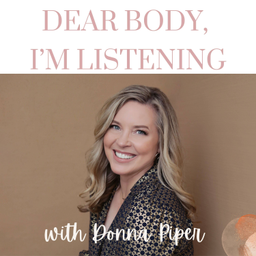
About Dear Body, I’m listening
Dear Body, I'm Listening is the podcast for women living with chronic pain, mysterious symptoms, and invisible illness. Hosted by movement therapist, Pilates instructor, and chronic illness navigator Donna Piper, this show is a sanctuary for those who've tried everything, felt dismissed, and are still searching for answers. If you've ever felt like your body is speaking a language no one else understands—you're not crazy, and you're not alone. In this space, nothing is off the table. We talk openly about swelling, fatigue, brain fog, body shame, and more. We go beyond diagnosis to explore what may be worth investigating—and more importantly, how to reconnect with yourself in the process. Through somatic spirituality, movement, and truth-telling, Donna offers support, insight, and hope. Because healing isn't linear, and neither are we.
- Publisher
- Donna Piper
- Category
- health & fitness · health & fitness
- Language
- en
- Explicit
- No
- First episode
- 25 Jun 2025
- Latest episode
- 10 Sept 2026
Latest episodes
59 episodes in the feed.
10 Sept 2026
Invisible Illness, Visible Clues: Tuning Into Your Skin, Your Labs, and Your Inner Wisdom Differently with Dr. Jonathan Carp
"You are fully capable of becoming your own authority in your health." —Dr. Jonathan Carp Invisible illness rarely announces itself with a clean diagnosis — but the body often leaves clues, if you know where to look. In this conversation, board-certified dermatologist and lifestyle medicine physician Dr. Jonathan Carp joins Donna Piper to talk about what 25 years of practice have taught him about the connection between skin, gut health, and insulin — and why so many of these clues get missed in a rushed appointment. Dr. Carp walks through how conditions like SIBO, celiac sensitivity, and insulin resistance show up on the skin long before they show up on a standard lab panel, and why fasting insulin can flag metabolic problems five to ten years before a diabetes diagnosis. He also shares how he uses mental imagery techniques with patients — including one who healed chronic skin picking using an image she created herself — and why he tells patients to keep major lifestyle changes private from anyone outside their household. This episode is especially for anyone managing chronic illness, invisible symptoms, or the exhausting feeling of not being believed by their own doctor. It's a reminder that visible clues — on your skin, in your labs, in your own instincts — are worth trusting, even when no one else has connected the dots yet. Key takeaways: • Rosacea has a strong documented link to small intestinal bacterial overgrowth (SIBO), and Dr. Carp expects SIBO testing to become standard for rosacea patients within five years. • Fasting insulin can climb for years while blood sugar stays normal, meaning elevated insulin can predict diabetes risk five to ten years before it would otherwise be caught. • A normal fasting insulin range is roughly 15–25; results consistently above 10 are worth discussing with a provider. • Fasting insulin and SIBO tests can both be ordered independently through labs like Quest or LabCorp, without waiting on a doctor's approval. • Only about 1 in 200 patients in Dr. Carp's practice are ready to make a full diet and lifestyle overhaul, which is why he recommends picking one path and going deep rather than jumping between approaches. • Mental imagery — where patients generate their own healing image rather than following a guided visualization — has helped patients manage conditions ranging from neurodermatitis to chronic warts. • Sharing a major lifestyle change with people outside your immediate household often invites judgment that can derail progress before it takes hold. Connect with Donna: Website: https://www.donnapiper.com/ LinkedIn: https://www.linkedin.com/in/donnapiper Instagram: https://www.instagram.com/thedonnapiper Facebook: https://www.facebook.com/thedonnapiper YouTube: https://www.youtube.com/@thedonnapiper Apple Podcast: https://tinyurl.com/Dear-Body-Im-Listening Resources: 🤔Got a question for me? Every month, I do a listener coaching episode—and I'd love to hear from you! Send your questions, stories, or flare-up confessions to donna@donnapiper.com, and you just might hear your answer on the show. 💲Discount Get $20 off the Visible Wrist Band 2.0 Click the link: https://join.makevisible.com/73784699c7db3e **Wearable heart-rate and activity sensor, with charging cable and strap included. 5 days battery life Manufactured by Polar, the world leader in heart-rate monitoring Designed for illness, not fitness HSA/FSA Eligible 💗Springrose Give $20, GET $20 When you share Springrose with friends, they get $20 off their first purchase and you get $20 towards your next purchase!* Share the love. https://oken.do/0l3hpr6v 💗Equip Fuel With Real Food Meet Prime Protein, the original beef protein powder, with over 20g of delicious grass-fed beef protein. No junk or fillers https://www.equipfoods.com/DONNA15 Episode Highlights: 03:28 Meet Dr. Jonathan Carp: From Dermatology to Lifestyle Medicine 07:42 The Gut-Skin Connection: SIBO, Celiac & Psoriasis 10:30 Acne, Insulin Resistance & the Fasting Insulin Test 14:09 Reversing Insulin Resistance Through Diet 18:28 Inside Wednesday Night Live & Miracle Noodle 20:16 How a Trip to Japan Sparked Miracle Noodle 23:34 Why Ordering Your Own Blood Tests Is Empowering 28:48 The 1-in-200 Rule: Why Lifestyle Change Is Hard 36:27 Mental Imagery Healing With Dr. Gerald Epstein 47:10 Final Advice: Pick One Health Path and Go Deep
13 Aug 2026
Dear Body, It Runs in the Family: What Lipedema Genetics is Finally Revealing
"This is fascinating, and is also exactly the kind of science we need to handle responsibly because epigenetics is not a new way to blame yourself. If future research shows environmental or epigenetic factors and how they influence lipedema expression, that is exciting. But that does not mean that you caused the disease to come out when you were stressed, that you ate wrong, that you failed to regulate your nervous system. No. Susceptibility, predisposition, hormones, biology, environment, and gene expression can interact in extraordinary, complicated ways, and this is a very complicated disease. The purpose is understanding that interaction to create better treatments, not better ways to blame yourself." —Donna Piper For most of her life, Donna was told her body was a lifestyle problem — eat less, move more, blah blah blah. In this Dear Body Book Club episode, she opens Lipedema: Principles and Practice of Diagnosis and Treatment, edited by Stanley Rockson, MD, Leslyn Keith, OTD, and Catherine Seo, PhD, and dives into the genetics section — Chapters 3, 4, and 5. Donna doesn't read the book to you line by line. She translates the genome-wide association studies, the acronyms, and the dense clinical language into plain English, then filters it through her own 53 years of living undiagnosed. The question shifts from "why does my body look this way?" to "what's actually happening inside the tissue?" — and that shift changes everything. In this episode, we discuss: Why an estimated 40% to 89% of women with lipedema report a family history — and why that range is so wide Why researchers believe lipedema is often passed down through the paternal line, even though men rarely show visible symptoms What a genome-wide association study (GWAS) actually is, explained without the jargon The UK Biobank study and how researchers built a "proxy lipedema phenotype" to work around chronic underdiagnosis Two genetic regions — VEGFA and GRB14-COBLL1 — linked to blood vessel formation and body fat distribution Findings from a 200-woman UK cohort, including an average age of onset around 16.8 years old The AKR1C1 gene and its connection to progesterone metabolism Why there is still no single validated genetic or blood test for lipedema The TNXB gene and its overlap with a form of Ehlers-Danlos syndrome, connecting hypermobility to lipedema biology What multiomics research (transcriptomics, metabolomics, lipidomics) revealed inside lipedema tissue itself Elevated inflammatory markers, including IL-1beta, IL-6, and TNF-alpha, found in lipedema tissue The "Fat Atlas" concept — why fat in different parts of the body may behave like different tissue entirely How estrogen, progesterone, and major hormonal transitions like puberty and menopause factor into lipedema onset Why epigenetics matters here, and why it is not a reason to blame yourself The real technical reasons lipedema research moves slowly, from liposuction-damaged samples to small patient cohorts 🗒️ Donna's Sticky Notes The highlights I don't want you to miss — if you only remember three things from this episode, remember these: Sticky Note #1: Don't forget dad's side of the family. If lipedema doesn't seem to show up on your mother's line, look to your father's — photos, family members, body shapes. Inheritance appears to run through the paternal line even when fathers show no visible symptoms themselves. Sticky Note #2: There probably isn't one lipedema gene. It's not one gene causing lipedema on its own — it's how genetic predisposition interacts with hormones, fat biology, connective tissue, vascular pathways, metabolism, lymphatic function, and inflammation, all at once and differently in every body. Sticky Note #3: Lipedema tissue appears to be biologically different tissue. Researchers are finding real differences in gene expression, lipids, metabolites, inflammatory signaling, fat cell development, blood vessel pathways, and connective tissue genes. The better question isn't "why do I have so much fat here?" — it's "what is happening inside this tissue to make it behave this way?" 💛 What this means in plain English None of this research hands you a genetic test you can take to your doctor tomorrow. What it does offer is direction. Researchers are seeing real, measurable differences inside lipedema tissue — in genes, lipids, hormones, and inflammation — not just differences in how much fat someone carries. That distinction matters, because it moves the story away from blame and toward biology. It also explains why two women can have the same diagnosis and completely different experiences of pain, swelling, and progression. And it's why looking at your father's side of the family, not just your mother's, can open up a piece of your history you didn't know to look for. Key Takeaways Family history shows up in an estimated 40% to 89% of lipedema cases, but the strongest inheritance signal appears to run through the paternal line, even when fathers show no visible symptoms themselves. Two genetic regions, VEGFA and GRB14-COBLL1, showed significant association with lipedema in UK Biobank research, tied to blood vessel formation and fat distribution rather than a single "lipedema gene." There is currently no validated genetic or blood test for lipedema — diagnosis still depends on clinical evaluation, which is exactly why patient and provider education matters so much. Multiomics research uncovered more than 4,400 gene expression differences, 900 lipid changes, and 600 altered metabolites in lipedema tissue compared to typical fat. Inflammatory markers, including IL-1beta, IL-6, and TNF-alpha, appear elevated in lipedema tissue, suggesting inflammation is part of the tissue environment, not the whole explanation. The TNXB gene, linked to a form of Ehlers-Danlos syndrome, offers an early biological clue for why hypermobility and lipedema so often show up together in the same women. Hormonal transitions — puberty, pregnancy, perimenopause, and menopause — are consistently tied to lipedema onset and progression, pointing researchers toward estrogen and progesterone signaling pathways. Studying lipedema tissue is genuinely difficult because most samples come from liposuction, a process that can damage the very tissue architecture researchers need to examine. A Question to Sit With Have you ever looked at your father's side of the family for the bruises, the heaviness, the body shapes that never quite matched the rest — or has your search always started and stopped with your mother's line? 💛 Connect With Me If this episode resonated with you, I'd love to hear from you. ✨ Follow the podcast. ⭐ Leave a review. 📚 Share this episode with someone navigating lipedema or chronic illness. And if you're reading along with me, let me know: What was your biggest takeaway from this chapter?
6 Aug 2026
Move Smart, Not Hard: The Movement Mindset Chronic Illness Actually Needs with Tyler Bramlett
"It's not about pushing yourself and judging yourself and trying to change how you look. It's about accepting yourself and learning how to appreciate your body and using that as fuel to show up and take care of it at the end of the day." —Tyler Bramlett Chronic illness movement doesn't have to mean choosing between pain and progress — and this episode makes the case for a third option. Donna sits down with Tyler Bramlett, co-founder of WeShape, whose own body forced him to rebuild everything he thought he knew about fitness after two major injuries and five knee surgeries. What emerges is a conversation less about workouts and more about relearning how to trust a body that hasn't always felt trustworthy. This episode is for anyone living with hypermobility, EDS, POTS, migraine, fibromyalgia, lipedema, or any invisible condition where movement helps — but the wrong kind of movement makes everything worse. Tyler and Donna dig into why high-intensity, no-pain-no-gain fitness culture actively harms chronically ill bodies, and what mindful, scalable movement looks like instead. Listeners will walk away understanding why "20-plus failed routines" is the norm, not the exception — and why that's a sign the model is broken, not the person. Key takeaways: Hypermobile joints get injured by overshooting end range of motion, not by moving too much — awareness of that range matters more than intensity. Chronic tension in the neck and traps can worsen migraine symptoms, and learning to engage opposing muscles can help release that tension over time. Self-hatred as a motivator eventually backfires, because it trains the brain to keep disliking the body no matter what changes. Movement scores — tracking strength, mobility, balance, and core function — offer a way to measure progress without relying on the scale. Starting with two 10-minute sessions a week is more sustainable than an hour five days a week, and consistency over years builds capacity that intensity never will. Recovery isn't linear — peaks and valleys are part of the process, not evidence that something has gone wrong. Try Tyler's free movement assessment: www.weshape.com/dearbody Connect with Donna: Website: https://www.donnapiper.com/ LinkedIn: https://www.linkedin.com/in/donnapiper Instagram: https://www.instagram.com/thedonnapiper Facebook: https://www.facebook.com/thedonnapiper YouTube: https://www.youtube.com/@thedonnapiper Apple Podcast: https://tinyurl.com/Dear-Body-Im-Listening Resources: 🤔Got a question for me? Every month, I do a listener coaching episode—and I'd love to hear from you! Send your questions, stories, or flare-up confessions to donna@donnapiper.com, and you just might hear your answer on the show. 💲Discount Get $20 off the Visible Wrist Band 2.0 Click the link: https://join.makevisible.com/73784699c7db3e **Wearable heart-rate and activity sensor, with charging cable and strap included. 5 days battery life Manufactured by Polar, the world leader in heart-rate monitoring Designed for illness, not fitness HSA/FSA Eligible 💗Springrose Give $20, GET $20 When you share Springrose with friends, they get $20 off their first purchase and you get $20 towards your next purchase!* Share the love. https://oken.do/0l3hpr6v 💗Equip Fuel With Real Food Meet Prime Protein, the original beef protein powder, with over 20g of delicious grass-fed beef protein. No junk or fillers https://www.equipfoods.com/DONNA15 Episode Highlights: 02:13 Meet Tyler Bramlett: The Injury That Redefined Fitness 06:44 Hypermobility, EDS, and Overshooting Your Limits 11:34 Why High-Intensity Workouts Fail Chronic Illness Bodies 14:48 Breaking the One-Step-Forward, One-Step-Back Cycle 19:58 Becoming Your Own Guru: Mindful vs Mindless Movement 23:07 Body Image, the Fitness Industry, and Raising Daughters 31:41 Inside WeShape: Personalized Movement Progressions 40:00 Quantifying Progress With Movement Scores 43:03 Start Small: The Power of Two 10-Minute Routines 50:28 Try WeShape Free and Where to Find Tyler
Reach and audience
Public platform figures. Ratings count people who left a rating, not total listeners.
- YouTube views
- 73,319
- Score snapshot 15 Sept 2025
- Apple Podcasts (US)
- 5.0 / 5
- 3 ratings
Podcast Authority Score: 71 / 100
A composite of feed quality, social presence, YouTube performance and engagement. Read the methodology.
- Quality
- 76
- Social presence
- 91
- YouTube
- 85
- Engagement
- 32
Contact Dear Body, I’m listening
- Guest appearances
- Does not typically book guests
Based on episode analysis; this does not confirm that the show is currently accepting guests.
Host of Dear Body, I’m listening?
Claim your podcast to manage its listing and keep your show details accurate.
Pod Engine is an independent podcast discovery and analytics service and is not affiliated with or endorsed by this podcast. Artwork and show content belong to their owners. Full legal notice.
Explore this show
Podcast research with Pod Engine