- 10
- Episodes
- 8
- Ratings
- 2025
- First episode
About Dear Forests
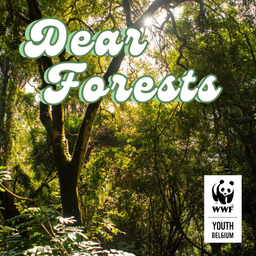
The podcast ’Dear Forests’ is a WWF Belgium Youth Team project that will explore various topics surrounding deforestation with the primary goal of educating the youth and the wider public about the topic. Together with contributors with a wide range of expertise, the host will delve into the primary causes of deforestation; its impacts on people and the climate; and ways in which our global community fights against it. Sponsored By: WWF (World Wildlife Fund for Nature) Belgium in collaboration with DGD (Direction générale Coopération au développement et Aide humanitaire). Forest in Cover Art: Greg Armfield — All Rights Reserved (Interior shot taken in Loita Forest looking up at canopy. Loita, Narok County, Kenya).
- Publisher
- Phatsimo Ditlhong
- Category
- business · education · science
- Language
- en
- Explicit
- No
- First episode
- 27 Feb 2025
- Latest episode
- 20 May 2025
Latest episodes
10 episodes in the feed.
20 May 2025
Episode 9: COP30 is in the Amazon Forest
In this special episode of the Dear Forests podcast, the host has an insightful and thought provoking conversation with Carlos, a Brazilian climate justice advocate and sustainability professional. The significance of COP30 being held in Brazil (specifically in the Amazon Basin (https://colombiaone.com/2025/03/12/brazil-amazon-road-cop30-cut/)) is monumental, especially given the rate of deforestation in one of the world's largest remaining natural forests. Discussions in this episode will be centred around how indigenous and local populations will be affected by the event; who might show up and why; the ways in which current geopolitical shifts may affect the outcomes; and how the relationship between Global North and Global South countries can evolve to enable the creation of an equitable future for us all. Carlos and I connected on the Omek platform which is a global community of bicultural of African descent and allies that is filled with phenomenal people who are doing insanely beautiful things. So feel free to check it out here (https://www.linkedin.com/company/myomek/) — maybe you're our newest community member! A few definitions to note: Carbon market — A specialised type of financial market that facilitates the purchase and sale of carbon credits. Some carbon markets are run and regulated by governments or international bodies, with certain industries required to participate, while others are entirely voluntary. Carbon credits — Permits that allow the purchaser to emit a certain amount of carbon dioxide or other greenhouse gases. We also discussed CO2 tonne emission (https://www.tapio.eco/blog/what-represents-one-ton-co2-emissions/), financial contributions at COP (https://www.sciencespo.fr/psia/chair-sustainable-development/2025/02/14/assessing-cop29-did-the-finance-cop-meet-its-lofty-goals/), the Brandt line (https://bigthink.com/strange-maps/brandt-line-update/), the Rio agreement (https://en.wikipedia.org/wiki/Rio_Convention), and the countries that have fulfilled the Paris agreement ahead of time (https://www.globalcitizen.org/en/content/7-countries-paris-climate-agreeement/). Carlos Eduardo Marques (https://www.linkedin.com/in/carloseduardomarquessustentabilidade/) is a professional with 17 years of experience and 8 years as a leader in the environment, climate, ESG, sustainability, and sustainable finance. He was chosen by CEO Magazine as one of the top 20 global leaders in sustainability, by Exame magazine as Top Voice Sustainability, and by the US State Department to join the selection committee for the Young Leaders of the Americas Initiative Program 2024. On a day-to-day basis, he is responsible for managing and developing Sicoob's National Sustainability Agenda. Sicoob is Brazil's largest credit cooperative, with 14 regionals and more than 300 local cooperatives totaling R$ 190.4 billion in assets, R$ 120 billion in credit operation, and almost 8 million members. On top of this, acting as president and founder of the Ambiafro for 5 years and counting, to change the relationship with the environment/sustainability, making its content more accessible and plural, putting black people and their experiences at the center of the discussion. **Sponsored by the WWF Belgium in collaboration with DGD (Direction générale Coopération au développement et Aide humanitaire).
1 May 2025
Episode 8: AI, Technology and Deforestation
After a little break the Dear Forests podcast is back with a new episode on the impact of AI (Artificial Intelligence) and Technology on Deforestation. Together with Keng, we discuss how long AI has really been in our world; its capacity for both good and bad for forests; the impact of technology (hardware) on forests and the people that rely on them; and how we can move into living harmoniously with forests, people and the technological advancements made thus far. Some good-to-know definitions: Algorithm — A detailed instruction manual that tells a computer or a person what steps to take to solve a problem or complete a task. Artificial Intelligence (AI) — The simulation of human intelligence in machines to make them appear and act in human ways. Machine Learning — A type of Artificial Intelligence that uses algorithms trained on data sets to create self-learning models capable of predicting outcomes and classifying information without human intervention. Natural Language Processing (NLP) — A type of Artificial Intelligence that combines machine learning, linguistics, and text analysis to allow computers to process and analyze text data and translate it. Computer Model — The framework of a plan or design which is created on a computer to discover how to make or improve a product. Computer Vision — A type of artificial intelligence (AI) that applies machine learning to images and videos to understand media and make decisions about them. Computing Power — A measure of the computing resources available to perform specific tasks. Data Centre — A facility used to house computer systems and associated components, such as telecommunications and storage systems. Rare Earth — Minerals that contain the 17 rare earth elements and have diverse applications in electronic components, lasers, glass, magnetic materials, and industrial processes. The term "rare-earth" is a misnomer because they are not actually scarce, but historically it took a long time to isolate these elements. Moratorium — A temporary suspension of an activity or law until future consideration warrants lifting the suspension. We also discussed the Deep Blue programme (https://www.chess.com/terms/deep-blue-chess-computer#what); Google deep mind (AlphaGo game) (https://deepmind.google/research/breakthroughs/alphago/); Amazon mining watch (https://amazonminingwatch.org/en); Gold mining in the Amazon forests (https://www.smithsonianmag.com/smart-news/tree-rings-bear-witness-to-illegal-gold-mining-operations-in-the-amazon-new-study-finds-180986390/); microphones in Malaysia's forests (https://www.seri.my/posts/ai-solutions-for-malaysian-forest-conservation); measuring the environmental impact of AI (https://pulitzercenter.org/blog/measuring-ais-environmental-impact-isnt-easy); data centres (https://www.datacentermap.com); and Fairphone (https://www.fairphone.com). Kuek Ser Kuang Keng (https://www.linkedin.com/in/kuangkeng/) is the data editor at the Pulitzer Center, a non-profit organization based in Washington, DC that supports independent journalists globally. He supports and mentors three fellowships investigating issues related to tropical rainforest, ocean, and AI accountability. He has won several awards, including SOPA Awards, Data Journalism Award, and Fetisov Awards, for his work in data journalism and environmental investigations. Keng began as a reporter at Malaysiakini, the leading online news outlet in Malaysia. He is a Fulbright scholar, Google Journalism Fellow, and Tow-Knight Fellow.
9 Apr 2025
Episode 7: Ecolabels and Greenwashing
When you walk into any shop today, whether it's the grocery store or a clothing store, you are confronted with so many labels on the products, some of which are supposed to be 'eco-labels'. In this episode we discuss what eco-labels are and aren't; how certain companies can get an eco-label and the challenges they face; tips for how you as a consumer can be a more responsible spender; and GREENWASHING! Some concepts of interest for you from this episode: Normative (by the government) — Relating to or dealing with certain standards. Proactive greenwashing — A form of corporate greenwashing that occurs when companies intentionally exaggerates their environmental initiatives to gain a competitive advantage by improving their corporate reputation. Reactive greenwashing — A form of corporate greenwashing used when firms feel compelled to respond to stakeholder demands without making real changes to their practices. This may include selective disclosure and expressive manipulation and is the most common form of greenwashing. We also discussed the EU Ecolabel (https://environment.ec.europa.eu/topics/circular-economy/eu-ecolabel_en), Green Seal (https://greenseal.org), and of course RecyClass (https://recyclass.eu). If you'd like to know what a more complex supply chain looks like, you can watch this explanation (https://youtu.be/fmKgFfyi5wY?si=IoeiWr1XIlzjclwX). Diego Rozo (https://www.linkedin.com/in/diego-rozo/) is an environmental engineer from Colombia with experience in recycling, sustainability, and certification systems. At the the moment he works at RecyClass where his day-to-day involves working to provide certifications to companies in the industry of recycled plastics. He is passionate about creating practical solutions for a more sustainable world by combining technical knowledge with a human perspective. **Sponsored by the WWF Belgium in collaboration with DGD (Direction générale Coopération au développement et Aide humanitaire).
2 Apr 2025
Episode 6: European Union (EU) Deforestation Laws
Following last week's episode on international law, we thought it might be a good idea to introduce you to the idea of binding (compulsory) laws on deforestation. The European Union, better known as the 'EU', is a great case study for how laws can be imposed on a multi-state level in a more effective way. Of course the concept of the EU is very complex so the episode starts off with some of the basics about how it works and then we get into the current EU deforestation law that has been making waves in the media across the 27 member states. We also briefly discussed the idea of planned obsolesce — this sixteen year old YouTube video (https://youtu.be/N2KLyYKJGk0?si=AF5quhria3W-A9Bw) about it is still relevant today. While we may have done our best to cover all the new and complex terms used in this episode, we didn't get to explain them all: Globalisation/Globalization — The speedup of movements and exchanges (of human beings, goods, and services, capital, technologies or cultural practices) all over the planet. (Read more about the 'dark side' of it here (https://archive.unu.edu/unupress/sample-chapters/DarkSideOfGlobalization.pdf)). Sustainable Development Goals (SDGs (https://youtu.be/0XTBYMfZyrM)) — The layout to achieve a better and more sustainable world for all by 2030. These goals are a call for action to address a series of global challenges, such as: poverty, inequality, climate, environmental degradation, and justice. (Legally) Binding — Rules that are passed down by a controlling authority that have real legal force and carry consequences of punishment if they are not followed. Hard Law — Legal obligations that are binding on the parties involved and which can be legally enforced before a court. Soft Law — Guidelines of behaviour, such as those provided by treaties not yet in force, resolutions of the United Nations, or international conferences, that are not binding in themselves but are more than mere statements of political aspiration. Bert Keirsbilck (https://www.linkedin.com/in/bert-keirsbilck-784614113/) is a full professor of Law at the Faculty of Law and Criminology of KU Leuven. He lectures in Commercial Law, EU Law and European Economic Law in Brussels, Leuven and Kortrijk. He is a co-director of Consumer Competition Market (CCM). Bert is a co-author of 'Commercial Practices and Consumer Contracts' (in Dutch) and a co-editor of the CCM series. He is a member of the editorial board of DAOR, DCCR and TEP and serves as a member of the Faculty's doctoral and culture committees (2020-2024). Recent research focuses on sustainable production and consumption, circular economy and servitisation. Salma Nour (https://www.linkedin.com/in/s-nour/) is a fellow WWF Youth Team member and a law student at KU Leuven. **Sponsored by the WWF Belgium in collaboration with DGD (Direction générale Coopération au développement et Aide humanitaire).
27 Mar 2025
Episode 5: International Laws on Deforestation
Laws as we know them are used primarily to protect people and property, in this episode of the podcast we delve into how law is being used to protect forests on an international level. Professor Dr An Cliquet and Evi join the host to discuss what laws exist, whether or not they are effective, the trickle down effects into national law and EU law, as well as the role that indigenous people groups and other stakeholders have to play in the enforcement and implementation of laws. A few interesting terms for you: Logging — The process of cutting down trees and processing them for use in secondary products such as furniture or paper. Litigation — The process of taking legal action. Lobbying — When an individual or a group tries to persuade someone in a government to support a particular policy or campaign. We also discussed the United Nations (https://www.un.org/en/about-us), UNESCO (https://www.unesco.org/en/brief#:), World Heritage Sites (https://whc.unesco.org/en/list/) and Global Witness (https://globalwitness.org/en/campaigns/land-and-environmental-defenders/). Professor Dr An Cliquet (https://www.law.ugent.be/grili/members/faculty/prof-dr-an-cliquet) is a professor of international environmental and biodiversity law at Ghent University (since 2004). Her research is in the field of international, European and national biodiversity law, including both marine and terrestrial biodiversity law. Along with supervising PhD research on various themes, she currently also teaches courses on international and European environmental and biodiversity law, law and ethics on marine nature conservation, international law and sustainable development and public international law. An Cliquet has been involved in several commissions or working groups on nature policy and law. She is the head of the faculty environmental commission, member of the UGent sustainability commission and member of the working group on the UGent biodiversity plan. She is a member of the European Environmental Law Forum (EELF) and member of the IUCN World Commission on environmental law. She is the coordinator of the Legal Working Group of the Society for Ecological Restoration Europe (SERE). Evi Van Paemel is a fellow WWF Youth Team member and works as an Environmental Lawyer in Belgium. Sponsored by the WWF Belgium in collaboration with DGD (Direction générale Coopération au développement et Aide humanitaire).
20 Mar 2025
Episode 4: Your Climate Anxiety is Ours Too
The first solo episode on this podcast will delve into 'climate anxiety' by exploring how the host became more climate conscious, what climate anxiety looks like in her personal life, the other emotions attached to this feeling, and how we can move forward from this as a global collective/community. Our aim is to give you a reflective experience on your own emotions surrounding the current climate crisis and how you experience it through the lens of your own lived experiences. **Sponsored by the WWF Belgium in collaboration with DGD (Direction générale Coopération au développement et Aide humanitaire).
14 Mar 2025
Episode 3: Fashion and Deforestation
Together with Sharifa Jamaldin from Fashion Revolution Belgium (FRB) we will discuss the impacts of the textile industry on the natural environment and garment workers in the Global South as well as how the production, use, and disposal of our clothing can have a devastating impact on our forests. We will also touch on how consumer behaviour is influenced by big marketing machines and debate potential solutions for our current dilemma. A few interesting terms for you to look over once again: Incinerate — Burn something beyond recognition (There is a new EU law about doing this to clothing). Disintegrate — Break up into small parts as the result of impact or decay. Pasture land — A large area of land where animals feed on the grass. Grazing — When animals eat the grass or other plants that are growing in a particular place. We also spoke about the different 'types of recycling (https://pomp.store/blogs/journal/upcycling-vs-recycling-vs-downcycling-in-fashion)', and two of the piles of clothing you can see from outer space, one in Chile (https://www.nationalgeographic.com/environment/article/chile-fashion-pollution) and the other in Ghana (https://www.teenvogue.com/story/how-to-help-kantamanto-the-largest-secondhand-market-in-the-world-after-devastating-fire) (the OR Foundation (https://theor.org) is working on this issue extensively). Sharifa is an editor at GreyishGreen.com, a curator, a fashion activist, and is the Country Coordinator for Fashion Revolution's Belgium chapter. In her day-to-day she works to highlight local solutions and form connections between people and groups. While working to meet with local policymakers, she champions solutions that we can implement today, such as mending, CRAFT, local sustainable shops and designers, reforestation, bamboo, hemp, nettles, regenerative farming, natural dyes, and innovative concepts for a bright future for all. You can check out her other work on Instagram (https://www.instagram.com/sharifajamaldin/) via the link tree in her bio and connect with her on LinkedIn (https://www.linkedin.com/in/sharifa-jamaldin-815314b3/). FASHION REVOLUTION WEEK (https://www.fashionrevolution.org/frw-25/) (22 — 27 APRIL 2025) Participating Belgian Cities: Hasselt, Antwerp, Brussels, Namur, Leuven, Charleroi, Ghent. There are seven days of activities including on Earth Day (22 April 2025) and the wonderful 'Mend in Public' Day, set for Saturday, 26 April 2025. Fashion Revolution is the world’s largest fashion activism movement, campaigning for a fashion industry that values people and the planet over profit and growth. We are a truly people-powered movement, working together in communities around the world to create positive and lasting change. The issues in the fashion industry never fall on any single person, brand, or company. We focus on using our collective voices to transform the entire system. We do this through research, education, collaboration, mobilisation and advocacy. With significant structural change, the fashion industry can lift millions of people out of poverty and provide them with decent and dignified livelihoods. It can conserve and restore our living planet. It can bring people together and be a great source of joy, creativity and expression for individuals and communities. Our vision is a global fashion industry that is fair, clean, and values the environment and people while creating prosperity for all. Feel free to follow their journey on Facebook (https://www.facebook.com/fashionrevolutionbelgium.org/), LinkedIn (https://www.linkedin.com/company/fashion-revolution-belgium/), and Instagram (https://www.instagram.com/fash_rev_belgium/) or visit their website (https://www.fashionrevolution.org) for more information. Don't forget to check out their zines (https://www.fashionrevolution.org/fashion-revolution-fanzine-library/), transparency report (https://www.fashionrevolution.org/transparency/) and fashion transparency index (https://www.fashionrevolution.org/fashion-transparency-index/). **Sponsored by the WWF Belgium in collaboration with DGD (Direction générale Coopération au développement et Aide humanitaire).
6 Mar 2025
Episode 2: Food and Deforestation
In this second episode we start our deep dive into the specifics of things that impact deforestation, starting with our food. Marion Meyvis, the Head of Sustainable Sourcing and Product Marketing at Oxfam Fair Trade, will share more about how the coffee and cocoa industry influence levels of deforestation as well as what her and her company do to promote an alternative form of relationships with Global South farmers that make our coffee and chocolate products possible. The discussion does have a few slightly complex terms so I thought it best to share their meanings for you here: Agroforestry — a method of farming in which trees or shrubs are grown around or among food crops or pastureland for livestock. Mulching — a covering of straw or sawdust that is spread over the ground to protect the roots of plants from heat, cold, evaporation, or to prevent soil loss/degradation. Commodities — a substance that can be bought, sold, or traded like agricultural products (wheat and cattle), energy products (oil and natural gas), and metals (gold and silver). Commodity Market — where you can buy and sell goods taken from the earth, from cattle to gold, oil to oranges, and orange juice to wheat. Stock Market — a system for buying and selling securities, or stocks and bonds. A stock is a share in the ownership of a company. A bond is an agreement to lend money to a company for a certain amount of time. Companies sell securities to people to get the money they need to grow. We also spoke a little bit about live satellite mapping (https://www.globalforestwatch.org) of deforestation, a palm oil campaign (https://youtu.be/LSumTLrJzdU?si=GT9h5QegltohEDlB) from a few years ago (and sustainable palm oil (https://youtu.be/0Lev1mnonUM?si=8WNhpF-8hH6QYU-d)), and a potato harvest crisis (https://www.vrt.be/vrtnws/en/2020/10/04/potato-price-plummets-due-to-corona-and-a-poor-harvest/) in Belgium for those of you who are interested. Marion (https://www.linkedin.com/in/marion-meyvis-3a828092/)'s day to day focus is on marketing the most tasty Fair Trade food products sourced with the highest standards of sustainable sourcing practices together with her amazing team. She does this at Oxfam Fair Trade which is a pioneering Fair Trade food brand, since 1971, that imports and distributes ethically sourced food products from small-scale farmers and cooperatives in the Global South. They operate as part of the broader Oxfam movement, which works to fight poverty, inequality, and social injustice worldwide. You can find their products in your local worldshop (https://oxfambelgie.be/shop-finder) and in different supermarkets world wide. Each month, Oxfam Fair Trade highlights the exceptional products of our trade partners through dedicated campaigns in the Oxfam World Shops. In March, we celebrate Women's Month by featuring Women's Hope Coffee, a premium organic 100% Arabica coffee from the Rebuild Women's Hope cooperative on Idjwi Island in Congo, which empowers women in their community. In May, we turn our attention to our Palestinian partners, inviting you to explore the rich flavours of Palestine. Supporting Palestinian farmers is particularly vital given the current challenges they face, including economic hardships and threats to their livelihoods. Visit our Oxfam World Shops during these months to taste these unique products and support the communities behind them. Feel free to follow their journey on Facebook (https://www.facebook.com/OxfamFairTradeBE/), LinkedIn (https://www.linkedin.com/company/oxfam-fair-trade/), and Instagram (https://www.instagram.com/oxfamfairtrade.be/) or visit their website for more information. **Sponsored by the WWF Belgium in collaboration with DGD (Direction générale Coopération au développement et Aide humanitaire).
28 Feb 2025
Episode 1: What is deforestation?
This first episode of Dear Forests will cover all that you need to know about deforestation, the 'basics' if you will. Together with Tropical Forests Policy Officer Pieter Van de Sype from BOS+, we will define deforestation, explore its impacts on our climate and our daily lives, discuss important geolocations, and get to know different actors in the fight against deforestation. Pieter's overall focus is on the importance of forests for the wellbeing of local communities and a resilient global society in Climate, Cocoa, and Wood. His main work focus however is lobby and advocacy on deforestation (and legislation to prevent it, mainly European Deforestation Regulation - EUDR); advocacy for the support for communities and countries in the global south to protect, restore and sustainably manage, their forests, as well as agroforestry (combinations of trees or shrubs are grown around or among crops or pastureland). BOS+ is an NGO dedicated to sustainable forestry, conservation and afforestation in Flanders and worldwide. A new name in the forest landscape, BOS+ is the integration of 2 existing NGOs: the Association for Forests in Flanders (VBV), which has been promoting forests in Flanders for more then 40 years, and Groenhart, since 10 years doing the same in a number of tropical countries. Their successful collaboration culminated in the creation of BOS+ in 2012. BOS means ‘forest’ in Dutch, and the '+' in the name symbolises togetherness (collaboration), more forests and better forests. Feel free to follow their journey on LinkedIn (https://www.linkedin.com/company/bosplus/about/), Instagram (https://www.instagram.com/bosplus), and Facebook (https://www.facebook.com/@bosplus/) or visit their website (https://bosplus.be/) for more information. **Sponsored by the WWF Belgium in collaboration with DGD (Direction générale Coopération au développement et Aide humanitaire).
27 Feb 2025
Introduction: Welcome to Dear Forests
In this episode of Dear Forests you will get a chance to hear more about the host and what motivated them to start this podcast as well as the background of the show and what will be covered in the next few months. Sponsored by the WWF (World Wildlife Fund for nature) Belgium in collaboration with DGD (Direction générale Coopération au développement et Aide humanitaire. **Since the publishing of this episode, there have been 9 confirmed as having passed on as a result of recent floods in Botswana.
Reach and audience
Public platform figures. Ratings count people who left a rating, not total listeners.
- Spotify
- 5.0 / 5
- 8 ratings
Podcast Authority Score: 29 / 100
A composite of feed quality, social presence, YouTube performance and engagement. Read the methodology.
- Quality
- 46
- Social presence
- 0
- YouTube
- 0
- Engagement
- 32
Contact Dear Forests
- Guest appearances
- Books guests
Based on episode analysis; this does not confirm that the show is currently accepting guests.
Host of Dear Forests?
Claim your podcast to manage its listing and keep your show details accurate.
Pod Engine is an independent podcast discovery and analytics service and is not affiliated with or endorsed by this podcast. Artwork and show content belong to their owners. Full legal notice.
Explore this show
Podcast research with Pod Engine