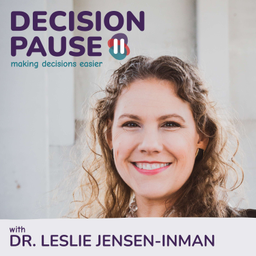
The Decision Pause is a podcast about making real decisions under real constraints — especially when raising neurodivergent children.
Parents of neurodivergent kids make hundreds of high-stakes decisions every day:
Do we push or protect?
Do we keep going or change course again?
Is this helping — or costing too much?
This podcast isn’t about giving advice or telling you what the “right” choice is.
It’s about slowing urgency, naming hidden costs, and making space for decisions that don’t have easy answers.
Each episode explores the realities of decision fatigue, capacity, regret, pressure, and change — with honesty, nuance, and deep respect for the complexity of neurodivergent family life.
If you’re carrying the mental load, second-guessing yourself, or trying to decide without burning out, this space is for you.
The Decision Pause — for real decisions made under real constraints.
Episode Description
What if decision-making isn’t something you finish—but something you return to, again and again?
In this episode of Decision Pause, we explore a shift that can bring real relief: moving from seeing decisions as problems to solve, to understanding them as an ongoing practice. Many parents carry the hope that one day the big decisions will be behind them—that clarity will stick, and things will finally settle.
But for families navigating neurodivergence, decisions don’t arrive once. They evolve. They return in new forms, shaped by changing needs, new information, and shifting capacity.
This episode reframes decision-making as something you practice over time—through noticing, responding, adjusting, and returning—rather than something you get right once and move on from.
In This Episode
Why decision-making often feels like something you’re supposed to “solve”
How decisions naturally return and evolve in changing systems
The difference between solving decisions and practicing them
How reframing decision-making can reduce self-judgment
Why revisiting decisions is a sign of responsiveness, not failure
Key Takeaways
Decision-making is an ongoing practice, not a one-time achievement
Repeated decisions do not mean you’re doing something wrong
Revisiting choices is part of responding to changing conditions
Different seasons require different kinds of decisions
Deciding with care and kindness can reduce pressure and increase sustainability
A Question to Sit With
If deciding is something I practice—not something I master—how might I treat myself differently the next time a decision comes up?
What’s Next
This episode closes this arc of Decision Pause. In the next set of episodes, we’ll continue exploring what it means to make decisions with care, honesty, and respect for real constraints.
Join the Decision Pause Newsletter
Join the free Decision Pause newsletter:
https://decisionpause.com/subscribe-form/ (https://decisionpause.com/subscribe-form/)
2 Jun 2026
Holding Hope Without Pressure
Episode Description
Hope is often described as something we need to hold onto. But what happens when hope starts to feel heavy?
In this episode of Decision Pause, we explore how hope—while comforting—can quietly turn into pressure for parents of neurodivergent children. The expectation to stay hopeful, to believe things will improve, or to anticipate progress can create a sense of urgency, especially when reality doesn’t match those expectations.
This episode offers a gentler way to think about hope. Not as something that demands outcomes or timelines, but as something that can exist alongside uncertainty. A quieter, steadier form of hope—one that supports care, rather than adding pressure.
In This Episode
How hope can shift from support to pressure
The expectations often placed on parents to stay positive and forward-looking
Why tying hope to outcomes can create urgency and self-doubt
The difference between loud, outcome-driven hope and quieter, steadier hope
How comparison can shape and distort what hope feels like
Key Takeaways
Hope does not need to be tied to timelines or specific outcomes
It’s possible to hold hope without forcing optimism
Small, steady changes can be meaningful—even if they aren’t dramatic
Care can come before hope in more difficult seasons
Letting go of comparison allows hope to be more personal and sustainable
A Question to Sit With
If hope didn’t have to prove anything, what might it look like for me right now?
What’s Next
In the next episode, we’ll close this arc by exploring what it means to treat decision-making as an ongoing practice—not something you get right once and move on from.
Join the Decision Pause Newsletter
Join the free Decision Pause newsletter:
https://decisionpause.com/subscribe-form/ (https://decisionpause.com/subscribe-form/)
26 May 2026
When Your Child Changes
Episode Description
What happens when something that used to work… doesn’t anymore?
In this episode of Decision Pause, we explore the moments when a child’s needs shift—sometimes suddenly, sometimes subtly—and how those changes can destabilize even the most thoughtful decision-making. Parents are often encouraged to focus on progress and forward movement, but change doesn’t always look like growth. Sometimes it looks like pulling back, needing more support, or letting go of strategies that once helped.
These moments can bring confusion, self-doubt, and grief. It can feel like losing ground. But change doesn’t always mean regression. Often, it’s a sign that something new is needed.
This episode offers a way to understand change as information—not failure—and to approach evolving needs with flexibility, curiosity, and care.
In This Episode
How children’s needs can shift in both obvious and subtle ways
Why change is often mistaken for regression
The grief that can come with letting go of what once worked
The pressure to return to past routines or strategies
How responsiveness allows decisions to evolve alongside your child
Key Takeaways
Change does not automatically mean loss of progress
Strategies that once worked may not fit new needs—and that’s okay
Decisions are time-bound and can evolve as circumstances change
Adapting to change is a form of responsiveness, not inconsistency
Paying attention to current needs is more helpful than trying to restore the past
A Question to Sit With
If I trusted that change is information, not failure, what decision might shift for me right now?
What’s Next
In the next episode, we’ll talk about holding hope without pressure—how to stay hopeful without turning hope into urgency or expectation.
Join the Decision Pause Newsletter
Join the free Decision Pause newsletter:
https://decisionpause.com/subscribe-form/ (https://decisionpause.com/subscribe-form/)
Reach and audience
Public platform figures. Ratings count people who left a rating, not total listeners.
Apple Podcasts (US)
5.0 / 5
1 ratings
Host of Decision Pause?
Claim your podcast to manage its listing and keep your show details accurate.
Pod Engine is an independent podcast discovery and analytics service and is not affiliated with or endorsed by this podcast. Artwork and show content belong to their owners. Full legal notice.
Explore this show Podcast research with Pod Engine