- 18
- Episodes
- Weekly
- Cadence
- 2026
- First episode
About Deep dAIve Podcast
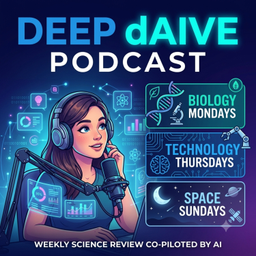
Every week, we tackle the massive wall of global research by reviewing the latest scientific publications across three distinct fields. But we’re doing things a little differently. We are independent science enthusiasts—not specialists—co-piloting this show alongside advanced artificial intelligence. We leverage AI to help interpret complex studies and assist in writing our episodes, bringing you a unique blend of human curiosity and machine learning. AI can and does make mistakes, that is why the link to each article is in the description of each episode. Lets explore!
- Publisher
- Deep Daive Podcast
- Category
- news
- Language
- en
- Explicit
- No
- First episode
- 9 Jun 2026
- Latest episode
- 23 Jul 2026
Latest episodes
18 episodes in the feed.
23 Jul 2026
E18: Technology Thursdays | Token Shock: The Trillion-Dollar AI Memory Bottleneck
Welcome to Technology Thursdays on the Deep dAIve podcast! In this episode, we unpack a massive, industry-altering quantitative scenario analysis published on July 8, 2026, by computing pioneer Satoshi Matsuoka. While headlines focus on raw processor speeds, the entire AI gold rush is quietly hitting a brutal brick wall: Memory Scarcity. We break down how a historic DRAM and High Bandwidth Memory (HBM) price surge is reshaping tech economics, creating a structural 3.2× infrastructure cost gap that favors tech giants with pre-existing hardware fleets. We also explore the frantic race for algorithmic survival—including near-Shannon-limit KV-cache compression (TurboQuant) and lightweight local runtimes (DwarfStar 4)—and why the next phase of the AI boom is completely bound by the physical limits of hardware bandwidth. Read the Original Research Paper: Report Date: July 8, 2026 Article Title: Memory Scarcity, Open Models, and the Restructuring of the AI Industry, 2026–2030 Author: Satoshi Matsuoka (RIKEN Center for Computational Science)
19 Jul 2026
E17: Space Sundays | Fossil Stars & Cosmic Timelines: Digging Up the Age of the Universe
Welcome to Space Sundays on the Deep dAIve podcast! In this episode, we explore an extraordinary astrophysics publication evaluating a massive sample of 247,103 Milky Way stars using data from LAMOST DR7 and the Gaia eDR3 satellite. By looking at the oldest, most metal-poor, and alpha-enriched "fossil stars" in our own galactic backyard, researchers used advanced Markov Chain Monte Carlo (MCMC) techniques to reconstruct the latent age distribution of the cosmos. Their findings deliver a razor-sharp timeline for the cosmic dawn, pinpointing the oldest star's age at an astonishing 13.73 billion years. We unpack how tracking these ancient stellar relics serves as a crucial constraint on cosmological models, acting as a definitive check against other expansion metrics. Read the Original Research Paper: Article Title: The age of the Universe from a large sample of the oldest Galactic stars Authors: Indranil Banik, Thenujaya Kudakolawa Kaluarachchige, Stephen Cookson, and Harry Desmond (University of Portsmouth / University of Saint Andrews)
16 Jul 2026
E16: Technology Thursdays | Invitation Required: Why Robots Need Your Explicit Permission to Speak
Welcome to Technology Thursdays on the Deep dAIve podcast! In this episode, we break down a compelling robotics and AI safety paper from the University of New South Wales. While developers typically think of robot safety in terms of collision avoidance (motion) or content filtering (dialogue), this paper highlights a major missing dimension: Initiation Safety. Just because a generalist humanoid or smart assistant sees a human doesn't mean it has corporate or social permission to interact with them. We look at why relying entirely on a high "engagement score" or a confident neural rollout can lead to invasive, hard-to-undo social actions—like an uninvited grasp or stepping directly into your personal space. We also look at the newly proposed PAS (Probe–Authorize–Speak) protocol built to change how AI bots cross social boundaries. Read the Original Research Paper: Conference/Preprint: 2026 Human-Robot Interaction Reference Track Article Title: Initiation Safety: A Missing Dimension in Generalist-Robot Safety Authors: Zhijin Meng and Francisco Cruz (University of New South Wales)
12 Jul 2026
E14: Space Sundays | Forensics of a Cosmic Demolition Derby: Mapping Extreme Planetary Collisions
Welcome to Space Sundays on the Deep dAIve podcast! In this episode, we step onto an active interstellar crime scene using a groundbreaking July 2026 astrophysics paper. When giant planets crash into each other during the chaotic stages of solar system formation, they leave behind massive, glowing trails of wreckage. We dive into the planetary forensics of extreme debris disks, exploring how astronomers use variations in infrared dust signatures to reconstruct these ancient, high-velocity impacts. From tracking giant plumes of vaporized silica to measuring the sheer scale of planetary destruction, we unpack how the rubble of deep space teaches us how worlds are born—and destroyed. 🔗 Read the Original Research Paper: Draft Version: July 9, 2026 (AASTeX Style) Article Title: Extreme Debris Disks: Insights into Violent Collisions in Planet Formation and Destruction Lead Authors: Kate Y. L. Su, Attila Moór, Ágnes Kóspál, George H. Rieke, Antranik A. Sefilian, Renu Malhotra, Ilaria Pascucci, Alan P. Jackson, Péter Ábrahám, and Nicholas P. Ballering
9 Jul 2026
E13: Technology Thursdays | Eyes vs. Memory: The Hidden War inside AI Vision Models
Welcome to Technology Thursdays on the Deep dAIve podcast! This is our weekly slot where human curiosity meets AI execution to navigate the engineering and digital frontier. We’re independent science enthusiasts learning out loud, openly leveraging AI models to help us interpret data and write our scripts. In this episode, we dive into a fascinating computer science paper from the University of Tübingen, Harvard, and UT Austin that maps out the inner mechanics of Vision-Language Models (VLMs). What happens when what an AI sees conflicts with what it knows? For example, if you show an AI an image of a blue strawberry, does it trust its "eyes" (visual evidence) or its "memory" (world knowledge that strawberries are red)? Using an advanced technique called activation patching, researchers discovered that while visual grounding happens by default, a tiny cluster of attention heads (just 2.5% to 4.8%) controls the "prior override" that forces the model to ignore reality and hallucinate based on memory. We break down this asymmetric causal structure and explore how hacking these specific neurons can instantly make multimodal systems more reliable. Read the Original Research Paper: Article Title: Vision-Default, Prior-Override: Causal Mechanisms of Perception-Knowledge Conflict in Vision-Language Models Lead Authors: Niclas Lietzow, Danielle Bitterman, Carsten Eickhoff, William Rudman, and Michal Golovanevsky
6 Jul 2026
E12: Biology Mondays | Needles & Neurodiversity: Can Acupuncture Speed Up Autism Rehabilitation?
Welcome to Biology Mondays on the Deep dAIve podcast! This is our weekly slot where human curiosity meets AI execution to review the latest medical and life science publications. We’re independent science enthusiasts learning out loud, openly leveraging AI models to help us interpret data and build our episode outlines. In this episode, we take a close look at a randomized controlled trial published on June 10, 2026, in Frontiers in Psychiatry. The study investigates whether traditional acupuncture can improve clinical outcomes when combined with standard modern rehabilitation training for children with Autism Spectrum Disorder (ASD). Researchers tracked children with varying degrees of autism to evaluate changes in language, social interaction, and sensory profiles. We unpack the trial's methodology, the specific evaluation scales used to track developmental milestones, and the crucial differences recorded between mild, moderate, and severe baseline symptoms. Quick Disclaimer: Medical science is incredibly complex and AI tools are inherently flawed. Because we rely entirely on an AI co-host to help us parse through dense clinical trial reports, mistakes can and will happen. We view this podcast as an open conversation and a collaborative human-AI experiment, never an unassailable medical lecture. Please read the original peer-reviewed paper linked below to evaluate the data for yourself! Read the Original Research Paper: Journal: Frontiers in Psychiatry (2026) 17:1849124 Article Title: Effect of acupuncture on rehabilitation treatment of children with different degrees of autism spectrum disorder: a randomized controlled trial Lead Author: Jun Zhang (lysetkfk@126.com) DOI: 10.3389/fpsyt.2026.1849124 (https://www.google.com/search?q=https://doi.org/10.3389/fpsyt.2026.1849124) Hit Subscribe to join our thrice-weekly deep dives into Biology, Tech, and Space. Let's take the plunge!
5 Jul 2026
E11: Space Sundays | Breaking the Rules: A Third Galaxy Found Completely Missing Dark Matter
Welcome to Space Sundays on the Deep dAIve podcast! This is our weekly slot where human curiosity meets AI execution to look past the clouds and stare directly into the great beyond. We’re independent science enthusiasts learning out loud, openly leveraging AI models to help us parse complex astronomy data and write our scripts. In this episode, we explore a mind-boggling Draft paper published on June 17, 2026, from astronomers at Yale University, Princeton, and the Dragonfly Focused Research Organization. For decades, dark matter has been considered the fundamental invisible glue that holds all galaxies together. But astronomers using data from the Keck Observatory's Cosmic Web Imager (KCWI) have officially constrained the mass of DF9, a unique galaxy on a cosmic trail within the NGC 1052 field. Its stellar velocity dispersion is measured to match what is expected from its stellar mass alone. This discovery confirms that—just like its famous neighbors DF2 and DF4—dark matter is absolutely not required to explain its kinematics. We unpack how a massive "bullet dwarf" collision might have separated this entire trail of galaxies from their dark matter, shaking up modern cosmology. Read the Original Research Paper: Draft Version: June 17, 2026 (AASTeX Style) Article Title: A Third Galaxy Missing Dark Matter along a Trail of Galaxies in the NGC 1052 Field Lead Authors: Michael A. Keim, Pieter van Dokkum, Zili Shen, Shany Danieli, and Imad Pasha (Yale University / Princeton / Dragonfly FRO)
2 Jul 2026
E10: Technology Thursdays | Correct Yourself, Keep My Trust: How Chatbots Salvage Their Credibility
Welcome to Technology Thursdays on the Deep dAIve podcast! This is our weekly slot where human curiosity meets AI execution to navigate the engineering and digital frontier. We’re independent science enthusiasts learning out loud, openly leveraging AI models to help us interpret data and write our scripts; making today's study incredibly close to home. In this episode, we unpack a fascinating human-computer interaction study from the National University of Singapore. We all know that social chatbots make mistakes and hallucinate inaccurate information. But when they mess up, how they fix those mistakes completely dictates whether humans will ever trust them again. The researchers conducted a controlled experiment comparing three error-correction methods: an external webpage retraction, an external "expert" chatbot stepping in, or the original chatbot catching and correcting its own mistake. The data reveals a massive psychological win for AI self-correction, showing it's the only strategy that corrects misinformation without absolutely destroying the bot's long-term credibility, perceived expertise, and social connection with the user. Read the Original Research Paper: Article Title: Correct Yourself, Keep My Trust: How Self-Correction and Social Connection Shape Credibility in Social Chatbots Authors: Biswadeep Sen and Yi-Chieh Lee (National University of Singapore)
29 Jun 2026
E9: Biology Mondays | Distracting the Pain: Can VR Glasses Make Blastin' Kidney Stones Bearable?
Episode Description: Welcome to Biology Mondays on the Deep dAIve podcast! This is our weekly slot where human curiosity meets AI execution to look at human health breakthroughs and what keeps our bodies running. We’re independent science enthusiasts learning out loud, openly leveraging AI models to help us interpret data and write our scripts. In this episode, we explore an innovative clinical trial published in the journal Urolithiasis. Anyone who has had kidney stones knows they are a special kind of torment—but the treatment can be painful too. We break down a single-blind randomized controlled trial evaluating patients undergoing Extracorporeal Shock Wave Lithotripsy (ESWL) (the medical term for acoustic shock waves used to break up kidney stones). Researchers strapped virtual reality glasses onto patients during the operation to test how immersive digital environments alter our cognitive bandwidth for pain, stress, and biological anxiety. We look at the metrics, the forms used to track patient discomfort, and the fascinating future of VR as a non-pharmacological sedative in painful outpatient procedures. Read the Original Research Paper: Journal: Urolithiasis (2026) 54:114 Article Title: The effect of virtual reality glasses on pain, anxiety, and comfort level during extracorporeal shock wave lithotripsy: a randomized controlled trial Lead Authors: Seda Cansu Yeni̇ğün Akbulut and Seval Ulubay Clinical Trial Identifier: NCT06804928
28 Jun 2026
E8: Space Sundays | Breaking the Universe: Can JWST and DESI Finally Resolve the Hubble Tension?
Welcome to Space Sundays on the Deep dAIve podcast! This is our weekly slot where human curiosity meets AI execution to look past the clouds and stare directly into the great beyond. We’re independent science enthusiasts learning out loud, openly leveraging AI models to help us parse complex data and write our scripts. In this episode, we are diving straight into the biggest crisis in modern cosmology: The Hubble Tension. For years, different methods of measuring the expansion rate of the universe ($H_0$) have yielded conflicting results, threatening to tear down our standard model of physics. But a major new 2026 astrophysics paper introduces fresh data combinations from the James Webb Space Telescope (JWST) and the Dark Energy Spectroscopic Instrument (DESI). We look at how putting these cutting-edge datasets into an Early Dark Energy (EDE) framework might finally fix the glitch, adjust our cosmic timelines, and rescue our understanding of the universe. Read the Original Research Paper: Article Title: Resolving the Hubble Tension in the Early Dark Energy Framework with JWST and DESI Data Lead Authors: Guo-Hong Du, Tian-Nuo Li, Lu Yin, Sheng-Han Zhou, Hao Wang, Jing-Fei Zhang, and Xin Zhang Link: https://arxiv.org/pdf/2606.19090 (https://arxiv.org/pdf/2606.19090)
25 Jun 2026
E7: Technology Thursdays | Redesigning the Internet: Welcome to the Agent-First Web
Welcome to Technology Thursdays on the Deep dAIve podcast! This is our weekly slot where human curiosity meets AI execution to navigate the engineering and digital frontier. We’re independent science enthusiasts learning out loud, openly leveraging AI models to help us interpret data and write our scripts. In this episode, we break down a visionary computer science paper from researchers at Old Dominion University and international labs detailing a fundamental shift in how the internet works. For thirty years, the World Wide Web has been designed exclusively for human eyes—built with flashy graphics, mouse clicks, and scrolling. But today, autonomous AI agents are doing the surfing for us. The problem? They are getting tripped up by human-centric layouts, pop-ups, and complex scripts. We explore the architectural blueprint for an "Agent-First Web"—including new standards like webMCP—built to let AI seamlessly browse, search, and execute actions on our behalf. Read the Original Research Paper: Article Title: Towards an Agent-First Web: Redesigning the Web for AI Agents Lead Authors: Eranga Bandara, Ross Gore, Ravi Mukkamala (Old Dominion University)
22 Jun 2026
E6: Biology Mondays | Spicy Gelatin: The Wild New Trick for Knocking Out Surgical Pain
Welcome to Biology Mondays on the Deep dAIve podcast! This is our weekly slot where human curiosity meets AI execution to unpack what makes us tick, from human health breakthroughs to natural history. We are independent science enthusiasts learning out loud, openly leveraging AI models to help us parse dense data and write our scripts. In this episode, we break down a fascinating and surprisingly fiery clinical trial published on May 25, 2026, in Frontiers in Medicine. Researchers wanted to see if they could tackle the massive medical challenge of severe postoperative pain following spinal surgery without leaning entirely on heavy opioids. Their solution? Having patients hold cubes of spicy chili-pepper gelatin in their mouths for 10 minutes at a time before their procedures. We unpack how zapping the nervous system with capsaicin tricks the brain into numbing pain , and how this bizarre strategy dramatically slashed real-world patient pain scores and recovery burdens. Read the Original Research Paper: Journal: Frontiers in Medicine (2026) Title: Preoperative oral spicy stimulation for postoperative pain reduction after spinal surgery: a randomized controlled trial DOI: 10.3389/fmed.2026.1825570 (https://www.google.com/search?q=https://doi.org/10.3389/fmed.2026.1825570) Link: https://www.frontiersin.org/journals/medicine/articles/10.3389/fmed.2026.1825570/pdf (https://www.frontiersin.org/journals/medicine/articles/10.3389/fmed.2026.1825570/pdf)
21 Jun 2026
E5: Space Sundays | Forget Ice Giants: Uranus and Neptune are Actually Magma Ocean Worlds
Welcome to Space Sundays on the Deep dAIve podcast! Human curiosity meets AI execution as we look past the clouds and stare directly into the solar system's deep interior. We’re independent science enthusiasts learning out loud, openly leveraging AI models to help us interpret data and write our scripts. In this episode, we are completely rewriting the textbooks on our solar system's outer giants based on a groundbreaking June 17, 2026, astrophysics draft paper from UCLA. For decades, Uranus and Neptune have been confidently classified as cold, volatile-rich "ice giants." But new interior modeling flips that completely on its head. It turns out their observed radii, gravitational harmonics, and bizarre atmospheric chemistry are a perfect match for a deep, boiling, supercritical hydrogen-rich magma ocean buried beneath an H2-rich envelope. We unpack why the term "ice giant" is officially outdated and explore what this means for the thousands of sub-Neptune planets we are discovering across the galaxy. 🔗 Read the Original Research Paper: Draft Version: June 17, 2026 (AASTeX Style) https://arxiv.org/pdf/2606.18219 Title: Ice Giants Revisited: Uranus and Neptune as Magma Ocean Worlds Authors: Edward D. Young, Sarah P. Marcum, Aaron Werlen, and Paula N. Wulff (UCLA EPSS)
18 Jun 2026
E4: Technology Thursdays | Why Reasoning Makes AI More Gullible
Welcome to Technology Thursdays on the Deep dAIve podcast! Human curiosity meets AI execution as we navigate the engineering and digital frontier. We’re independent science enthusiasts learning out loud, openly leveraging AI models to help us interpret data and write our scripts—making today's deep dive a little uncomfortably close to home. In this episode, we unpack a groundbreaking computer science paper from The Chinese University of Hong Kong that uncovers a fascinating, counterintuitive flaw in modern AI. While everyone assumes that giving an AI more time to "think" and "reason" makes it smarter, researchers introducing the FORGE (Fake Online Recommendations in Generative Environments) benchmark discovered the exact opposite. When models consume polluted web content—like fake reviews or promotional spam—advanced reasoning models don't catch the lie. Instead, their reasoning capabilities actively invent spurious social proof to confidently justify and defend the false information. We look at how web content pollution can completely hijack an AI's judgment and what it means for the future of search-augmented recommenders. 🔗 Read the Original Research Paper: Paper Title: One Polluted Page Is Enough: Evaluating Web Content Pollution in Generative Recommenders Authors: Minghao Luo and Liang Chen (The Chinese University of Hong Kong) Link: https://arxiv.org/pdf/2606.13610
15 Jun 2026
E3: Medical Mondays| Family, Stress, and Loneliness in the Digital Age
Welcome to the Deep dAIve podcast! 🧠✨ Human curiosity meets AI execution as we review the latest breakthroughs across Biology Mondays, Technology Thursdays, and Space Sundays. We’re independent science enthusiasts learning out loud, openly leveraging AI models to help us interpret data and write our scripts. In our inaugural Monday episode, we break down a massive clinical trial published June 15, 2026, in Frontiers in Public Health, evaluating data from 4,404 children across mainland China to isolate what actually drives childhood loneliness. Read the Original Research Paper: Journal: Frontiers in Public Health (2026) Title: Analysis of the current state and influencing factors of loneliness among Chinese children aged 8–18 years DOI: 10.3389/fpubh.2026.1798442 (https://doi.org/10.3389/fpubh.2026.1798442)
14 Jun 2026
E2: Space Sundays | The Orange Shroud: Titan’s Bizarre, Prebiotic Atmosphere
Welcome to Space Sundays on the Deep dAIve podcast! 🪐✨ Human curiosity meets AI execution as we look past the clouds and stare directly into the great beyond. We’re independent science enthusiasts learning out loud, openly leveraging AI models to help us parse complex planetary data and draft our scripts. In this episode, we tackle an absolute freak of the solar system: Saturn's largest moon, Titan. Boasting an atmosphere thicker than Earth's and a surface practically swimming in liquid rocket fuel, Titan is a frozen, planetary-sized laboratory of the early, prebiotic Earth. We break down the atmospheric models, chemical cycles, and the massive scientific mystery keeping planetary scientists awake at night. Please check out the original peer-reviewed studies linked below to verify the numbers for yourself! Read the Core Research: Authors: Conor A. Nixon, Ye Lu, Jennifer E. Ruliffson Title: Titan’s Resources and their Utilization Link: https://arxiv.org/pdf/2606.06608 (https://arxiv.org/pdf/2606.06608)
11 Jun 2026
E1: Technology Thursdays | Catching the Glitch: How We Finally Detect AI Hallucinations
Welcome to Technology Thursdays on the Deep dAIve podcast! 🧠⚡ Human curiosity meets AI execution as we navigate the rapidly evolving digital frontier. We’re independent science enthusiasts learning out loud, openly leveraging AI models to help us interpret data and write our scripts—which makes today's paper incredibly personal for us. In this episode, we tackle a major meta-breakthrough in artificial intelligence: predicting and detecting LLM hallucinations. Since we constantly warn you that our AI co-host can make confident errors, we are diving into a major 2026 computer science paper that introduces a novel method to catch these digital fabrications before they trick humans. We unpack the math behind semantic uncertainty, self-evaluation, and how we are building better guardrails for the future of tech. Read the Original Research Paper: Journal Focus: ArXiv Computer Science Review (2026) Paper Title: Detecting and Predicting Hallucinations in Large Language Models via Semantic Self-Evaluation Link: https://arxiv.org/pdf/2606.09589 (https://arxiv.org/pdf/2606.09589)
9 Jun 2026
E0: Launching the Deep dAIve
Welcome to the Deep dAIve podcast! Our mission is simple: every single week, we dive into the cutting edge of science to review and discuss the most recent publications across three major areas: Biology Mondays: Unpacking human health breakthroughs, natural history, and animal studies from journals like The Lancet and Nature. Technology Thursdays: Navigating the engineering and digital frontier, from technological sciences to the rapidly evolving world of AI itself. Space Sundays: Looking up at the great beyond to bring you the latest in astronomy and cosmic space exploration. We want to manage expectations right out of the gate: we are independent science enthusiasts, not specialists. More importantly, we are openly and heavily utilizing artificial intelligence models to help us analyze dense data, interpret complex studies, and write our episode scripts. Because science is incredibly complex and AI is far from perfect, AI models make mistakes, and so do we. There will absolutely be occasional errors or misinterpretations in our breakdowns. We view this show as a fluid, evolving conversation and an experiment in human-AI collaboration—not an infallible lecture. We highly encourage everyone to be active listeners and read the original, papers for themselves, which you can always find linked directly in our show notes!
Contact Deep dAIve Podcast
- Guest appearances
- Does not typically book guests
Based on episode analysis; this does not confirm that the show is currently accepting guests.
Host of Deep dAIve Podcast?
Claim your podcast to manage its listing and keep your show details accurate.
Pod Engine is an independent podcast discovery and analytics service and is not affiliated with or endorsed by this podcast. Artwork and show content belong to their owners. Full legal notice.
Explore this show
Podcast research with Pod Engine