- 14
- Episodes
- Daily
- Cadence
- 2026
- First episode
About deeptech INSIGHTS
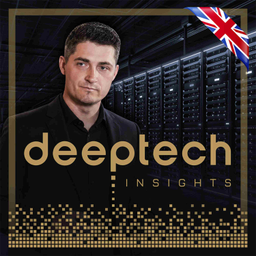
Which technologies will decide where wealth is created over the next ten years? Which bets survive the next venture cycle? And what do insiders see that the public conversation often misses? Deep Tech INSIGHTS is a long-form interview show for people shaping technology and the future. Host Sascha Roehrer talks with executives, investors, researchers, and thought leaders about the forces defining the next phase of progress. Every episode is published in two versions: the English original featuring the guest in the original audio, and a German AI-dubbed version. The podcast is produced by Börsenmedien AG, Germany's leading financial media company and publisher of DER AKTIONÄR, BÖRSE ONLINE, €uro and €uro am Sonntag. Topics range from AI and semiconductors to digital finance, defense tech, and longevity. New episodes are released regularly.
- Publisher
- DER AKTIONÄR
- Category
- business · society & culture · technology
- Language
- en
- Explicit
- No
- First episode
- 13 Jul 2026
- Latest episode
- 7 Oct 2026
Latest episodes
14 episodes in the feed.
7 Oct 2026
The Positioning Expert: Positioning Comes Before Marketing Tactics - April Dunford
April Dunford, author of Obviously Awesome, on why weak positioning costs deals and visibility in AI answers Before any campaign goes out, a company needs to know what it is really up against and what value only it can deliver. April Dunford ran marketing at seven B2B startups and has spent roughly the last twelve years advising technology companies on positioning. She tells Sascha Roehrer how positioning differs from messaging, why every product rests on a positioning thesis the market rarely confirms in full, and how a large company that has made several acquisitions finds one story for seven products. At a company doing about $100 million in revenue, she cut most of the trade shows, scaled up the one that performed and tripled the pipeline. Leads from AI chat close at a high rate, she says, but they are still a small share of the total. Companies that want ChatGPT or Claude to recommend them need positioning sharp enough that nobody can get it wrong. Her example of strong positioning in the AI debate is Microsoft. Chapters 00:00:00 Intro 00:02:12 Positioning as a movie's opening scene 00:02:59 Seven startups: databases, CRM, networking 00:04:24 From blog post to Obviously Awesome 00:08:08 What positioning is, and what it isn't 00:09:40 Positioning first, campaigns second 00:10:41 What the method is built for: B2B with a sales team 00:12:31 What changed in the new edition 00:16:19 Big company: one story for seven products? 00:19:34 Startups vs. big companies 00:21:06 Positioning after an acquisition 00:21:55 Every product rests on a positioning thesis 00:26:03 What founders should write down from day one 00:29:52 Method, not vibes 00:31:27 Marketing tactics come and go 00:35:04 Where founders should start: customers 00:36:59 One channel at a time 00:39:55 Fewer trade shows, triple the pipeline 00:42:28 Investor marketing vs. customer marketing 00:46:30 Why tech is bad at predicting the future 00:51:45 How AI is changing marketing 00:53:45 Showing up in ChatGPT and Claude 00:57:19 Microsoft, SaaS and the best-positioned product 01:00:54 The 20-year prediction Guest: April Dunford spent 25 years as an executive at seven B2B startups. Several were acquired, including DataMirror by IBM and Janna Systems by Siebel Systems. Today she advises growth-stage startups and large tech companies. Her book Obviously Awesome came out in 2019 and in an expanded edition in 2026; Sales Pitch applies the method to the sales conversation. She lives in Toronto. Linkedin: https://www.linkedin.com/in/aprildunford/ Website: https://www.aprildunford.com/ Her book: Obviously Awesome (expanded edition, 2026) https://www.amazon.com/Obviously-Awesome-Product-Positioning-Customers/dp/1999023056/ deeptech Insights: deeptech INSIGHTS is a long-form interview series for people who think about frontier technology and the future for a living. Host Sascha Roehrer sits down with executives, investors, researchers, and the people shaping what comes next. Produced by Börsenmedien AG, Germany's leading financial media house (DER AKTIONÄR, BÖRSE ONLINE, €uro, €uro am Sonntag). Youtube English: https://www.youtube.com/playlist?list=PLGwe6Ab4ZdSc Youtube German: https://www.youtube.com/playlist?list=PLYvuwOqohiSw Spotify English: https://open.spotify.com/show/033ONjPa8CuRZwJ0wZyWPz?si=c6fe9d33623e4418 Spotify German: https://open.spotify.com/show/033ONlTEHwbLHanLrQ6SeC?si=738da62560ed4cd7 Guest suggestions & feedback: team@deeptech-report.de This episode is for informational purposes only and does not constitute investment advice or a recommendation to buy or sell any security.
30 Sept 2026
Robinhood's Crypto Chief: Finance on the Blockchain Is Inevitable.
Johann Kerbrat (Robinhood) on stock tokens, 24/7 trading and why finance is moving onto the blockchain Johann Kerbrat runs crypto and international at Robinhood. With stock tokens and Robinhood Chain he has launched two products that detach stock trading from exchange hours: tokenized stocks structured as debt securities, backed one to one by the underlying shares, tradable through the weekend. In conversation with Sascha Roehrer he explains why almost 70 percent of that trading on decentralized exchanges happens outside market hours, how market makers bridge the weekend, and why Nasdaq and NYSE are now announcing offerings of their own. The conversation covers MiCA versus the US patchwork, where Robinhood can offer staking in only 46 of 50 states, the failure of the Clarity Act, and competition in Europe, where one large German broker still charges a euro per trade. Kerbrat calls the quantum threat to Bitcoin one of the most important problems to solve in the coming year and walks through the open question of what happens to Satoshi's coins. Robinhood Chain passed $1.5 billion in TVL within ten weeks, memecoins are being paired with stock tokens on it, and AI agents already run more than 100,000 accounts at Robinhood. He closes with his read on the next cycle, a marketplace for all real world assets, and his wildest bet for the next twenty years. Chapters 00:00:00 Open 00:02:09 Joining Robinhood in 2021 00:03:19 Fee transparency and the self-custody wallet 00:04:49 Robinhood in the EU 00:05:54 MiCA versus 50 US states 00:08:03 Clarity Act failed 00:09:57 Competition in Europe: one euro per trade 00:11:49 One app for all your finances 00:14:01 Financial education and advice for beginners 00:17:26 Bitcoin at 86K: is the bottom in? 00:18:57 Quantum risk and Satoshi's coins 00:21:46 Real world assets as the driver 00:23:51 What a stock token is 00:25:59 Trading 24/7: 70% after the close 00:27:51 Nasdaq and NYSE follow 00:29:18 "Inevitable": finance on the blockchain 00:29:58 Tokenized real estate 00:32:29 Robinhood Chain: $1.5B TVL in ten weeks 00:33:48 Why Arbitrum 00:36:32 Memecoins versus stock tokens 00:37:31 Developers: numbers and opportunities 00:40:10 Perpetuals in DeFi and in the EU 00:41:18 Decentralization, banks, stablecoins 00:45:43 AI agents: 100,000 accounts 00:47:55 Micropayments for content 00:49:54 Next cycle: consolidation 00:53:42 RWA marketplace and wildest prediction Guest: Johann Kerbrat is Head of Crypto and International at Robinhood. He joined in January 2021 from a layer-1 project and has since led the Robinhood Wallet, the expansion into the EU, the UK and Canada, stock tokens and Robinhood Chain. Linkedin: https://www.linkedin.com/in/johann-kerbrat/ Website: http://www.robinhood.com/ deeptech Insights: deeptech INSIGHTS is a long-form interview series for people who think about frontier technology and the future for a living. Host Sascha Roehrer sits down with executives, investors, researchers, and the people shaping what comes next. Produced by Börsenmedien AG, Germany's leading financial media house (DER AKTIONÄR, BÖRSE ONLINE, €uro, €uro am Sonntag). Youtube English: https://www.youtube.com/playlist?list=PLGwe6Ab4ZdSc Youtube German: https://www.youtube.com/playlist?list=PLYvuwOqohiSw Spotify English: https://open.spotify.com/show/033ONjPa8CuRZwJ0wZyWPz?si=c6fe9d33623e4418 Spotify German: https://open.spotify.com/show/033ONlTEHwbLHanLrQ6SeC?si=738da62560ed4cd7 Guest suggestions & feedback: team@deeptech-report.de This episode is for informational purposes only and does not constitute investment advice or a recommendation to buy or sell any security.
23 Sept 2026
The PostHog Co-CEO: Most of Our Users Aren't Human Anymore. Who Buys Software Next
James Hawkins (PostHog): Why AI agents are now the majority of his users, and humans only do the buying. James Hawkins, co-founder and Co-CEO of PostHog, has grown his product analytics platform to roughly half a million customers in six and a half years, without outbound sales and with a CAC payback of two to three months. Today most dashboards and insights in PostHog are created by AI agents rather than people; onboarding was rebuilt for agents and now takes under an hour instead of a week. In conversation with Sascha Roehrer, Hawkins explains why he doesn't buy claims of AGI while US GDP grows at 1.5%, why the models are only the engine and the rest of the car is missing, and why software companies will soon have to market to agents rather than humans. The second half covers the cost barrier that keeps AI coding at 0.12% of the population, open-source models and inference, advice for founders, the choice between bootstrapping and venture capital, two funding rounds within four months, and a model PostHog is training from scratch on session recordings. He closes with a deliberately negative prediction for the next 20 years. Chapters 00:00:00 Intro 00:00:46 From pro cycling to software development 00:02:45 Six ideas in six months: how PostHog came about 00:04:57 What PostHog does: from analytics tool to "self-driving product" 00:07:24 No sales team until $10M run rate: product-led growth and CAC payback 00:10:06 Marketing without marketers: why writing is the core skill 00:13:40 "We haven't built the rest of the car yet": AI, AGI and 1.5% GDP growth 00:19:30 Vibe coding, infrastructure and the convergence of roles 00:24:11 Agents as users: onboarding from a week to under an hour 00:28:05 How agents use software: three to ten times more intensively 00:31:09 MCP and "bring your own agent" 00:33:14 Why only 0.12% code with AI: cost, inference, open source 00:42:16 Advice for founders: fear, competition and the Friday doc 00:46:37 Bootstrapping or venture capital? 00:51:57 Two rounds in four months: the less you need money, the easier it comes 00:53:48 The next twelve months: desktop app, generative UI, a proprietary model 00:58:40 Wildest prediction: AI will work slower than everyone thinks Guest: James Hawkins is co-founder and Co-CEO of PostHog, an open-source platform for product analytics and "self-driving software" he started with Tim Glaser in January 2020 in Y Combinator's Winter 2020 batch; the company has since raised $182 million. The two run PostHog without separate CEO/CTO titles. Before that Hawkins spent nearly a decade as a professional cyclist, taught himself web development on the side, and was VP of Sales & Channels at Arachnys in London from 2015 to 2019. He is based in San Francisco, ran PostHog's marketing in the early years, and writes publicly about building the company. Linkedin: https://www.linkedin.com/in/j-hawkins/ Website: https://posthog.com/ deeptech Insights: deeptech INSIGHTS is a long-form interview series for people who think about frontier technology and the future for a living. Host Sascha Roehrer sits down with executives, investors, researchers, and the people shaping what comes next. Produced by Börsenmedien AG, Germany's leading financial media house (DER AKTIONÄR, BÖRSE ONLINE, €uro, €uro am Sonntag). Youtube English: https://www.youtube.com/playlist?list=PLGwe6Ab4ZdSc Youtube German: https://www.youtube.com/playlist?list=PLYvuwOqohiSw Spotify English: https://open.spotify.com/show/033ONjPa8CuRZwJ0wZyWPz?si=c6fe9d33623e4418 Spotify German: https://open.spotify.com/show/033ONlTEHwbLHanLrQ6SeC?si=738da62560ed4cd7 Guest suggestions & feedback: team@deeptech-report.de This episode is for informational purposes only and does not constitute investment advice or a recommendation to buy or sell any security.
16 Sept 2026
Blockchain Pioneer Charles Hoskinson: Crypto Will Eat AI. The Data Center Boom Is Going to Bust.
Charles Hoskinson (Input Output): $10 trillion on-chain by 2030 – and why Washington is throwing it away. Charles Hoskinson, Ethereum co-founder, Cardano founder and CEO of Input Output, expects roughly ten trillion dollars of tokenized assets and a billion new users on public blockchains by the end of 2030. In conversation with Sascha Roehrer he lays out why consortium chains like Canton fail by design, how stablecoins are quietly dollarizing Argentina, and why he doesn't expect a Clarity Act to pass before 2029. The second half turns to AI agents as the internet's largest user group, Midnight City, the thesis that crypto will eat AI, a data center boom he expects to bust, and a 20-year forecast of centaurs, hyper-personalization and a cult of optimization. Chapters 00:00:00 Intro 00:00:45 Two mega trends: Web 2.5 and privacy 00:03:12 The fourth generation: privacy, compliance, abstraction 00:05:16 Why banks don't need a private blockchain 00:09:38 Compliance was built for paper: 24/7 markets and composability 00:12:09 BlackRock, Argentina and soft dollarization 00:14:14 Wall Street, gatekeepers and the "PwC tax" 00:17:33 Geopolitics: why a blockchain is the only bridge left 00:19:28 Clarity Act: three fatal sins of the Trump administration 00:21:39 SEC vs. CFTC: security or commodity? 00:26:47 Why Clarity waits until 2029 00:28:07 From London to New York: America's arrogance 00:30:34 What Washington could have learned from MiCA 00:34:10 Google, not JP Morgan: Big Tech takes over payments 00:37:02 Agentic commerce: x402 and micropayments 00:39:29 Government stablecoins? Wyoming, Argentina, T-bills on-chain 00:44:13 Midnight City: more agents than humans 00:46:56 Agent civilizations and economic agency 00:49:50 Cigarettes as money: why agents will invent an economy 00:53:19 Crypto eats AI: alignment, provenance, grid compute 00:58:46 Dark data centers: the boom busts, edge wins 01:00:41 A write-only world: AI, nuance and polarization 01:15:21 Institutions losing legitimacy: the FDA and MDMA 01:22:13 The epistemic anchor: when everything is "AI" 01:24:10 Wildest prediction: centaurs and the cult of optimization Guest: Charles Hoskinson is founder and CEO of Input Output, the research and engineering company behind the Cardano blockchain, and the initiator of the privacy network Midnight. He was part of Ethereum's founding team in 2013. He funds the Hoskinson Center for Formal Mathematics at Carnegie Mellon University and runs a policy center in Wyoming. X: https://x.com/IOHK_Charles Website: https://www.iog.io/ deeptech Insights: deeptech INSIGHTS is a long-form interview series for people who think about frontier technology and the future for a living. Host Sascha Roehrer sits down with executives, investors, researchers, and the people shaping what comes next. Produced by Börsenmedien AG, Germany's leading financial media house (DER AKTIONÄR, BÖRSE ONLINE, €uro, €uro am Sonntag). Youtube English: https://www.youtube.com/playlist?list=PLGwe6Ab4ZdSc Youtube German: https://www.youtube.com/playlist?list=PLYvuwOqohiSw Spotify English: https://open.spotify.com/show/033ONjPa8CuRZwJ0wZyWPz?si=c6fe9d33623e4418 Spotify German: https://open.spotify.com/show/033ONlTEHwbLHanLrQ6SeC?si=738da62560ed4cd7 Guest suggestions & feedback: team@deeptech-report.de This episode is for informational purposes only and does not constitute investment advice or a recommendation to buy or sell any security.
9 Sept 2026
I Found Bitcoin in 2012, I Don't Own Any Today — Santiago Roel Santos
Santiago Roel Santos, CEO of Inversion, on holding no Bitcoin and where crypto value actually accrues. Santiago Roel Santos found Bitcoin in 2012 while pricing private equity deals at JP Morgan. He owns none today. With Sascha Roehrer he runs crypto through the screen he once ran companies through: fees, users, cash flow, multiple. The verdict is uncomfortable. A network carrying a 300 billion dollar market cap while producing less than a billion in fees would be a conversation in any other asset class. Value moves up the stack, he argues: 90 percent of a chain's fees land with the application on top, one percent with the base layer. Stablecoins are the real application, not for ideological reasons but because demand for dollars outside the US runs ahead of supply. On tokenization he gets narrow. Putting a parcel of land in Burkina Faso on a blockchain solves no technology problem; it relocates a legal and coordination problem. Chapters 00:00:00 Intro 00:00:56 2012 at JP Morgan: finding the Bitcoin white paper 00:04:41 Western Union as the benchmark 00:06:38 Why he holds no Bitcoin today 00:08:45 Usability, not scarcity 00:11:06 Token price is not product usage 00:14:33 Fees, valuation and the Ethereum problem 00:19:03 Open source as the engine of innovation 00:21:07 Where value goes: applications over base layers 00:26:13 Privacy: why not everything runs on-chain 00:28:40 Visa as the blueprint, banks with their own chains 00:33:17 Stablecoins, the GENIUS Act and dollar demand 00:36:09 Europe, MiCA and the CBDC question 00:37:56 The case against tokenizing everything 00:44:11 Inversion: a holding company, not a fund 00:45:49 Where AI actually makes a business better 00:50:49 Making good people excellent, not cutting headcount 00:53:38 Four people instead of twenty 01:00:56 Token spend per employee 01:01:52 Advice to owners: your data is the currency 01:03:58 The health passport: AI at the doctor's office 01:09:53 The wildest prediction: ten agents per human Guest: Santiago Roel Santos is Founder & CEO of Inversion, a permanent capital holding company that buys owner-operated businesses and holds them. Before that: investment banker at JP Morgan, growth investor at Sage View Capital, then an early move into a crypto fund. Linkedin: https://www.linkedin.com/in/santiago-rs/ Website: https://www.inversioncap.com/ deeptech Insights: deeptech INSIGHTS is a long-form interview series for people who think about frontier technology and the future for a living. Host Sascha Roehrer sits down with executives, investors, researchers, and the people shaping what comes next. Produced by Börsenmedien AG, Germany's leading financial media house (DER AKTIONÄR, BÖRSE ONLINE, €uro, €uro am Sonntag). Youtube English: https://www.youtube.com/playlist?list=PLGwe6Ab4ZdSc Youtube German: https://www.youtube.com/playlist?list=PLYvuwOqohiSw Spotify English: https://open.spotify.com/show/033ONjPa8CuRZwJ0wZyWPz?si=c6fe9d33623e4418 Spotify German: https://open.spotify.com/show/033ONlTEHwbLHanLrQ6SeC?si=738da62560ed4cd7 Guest suggestions & feedback: team@deeptech-report.de This episode is for informational purposes only and does not constitute investment advice or a recommendation to buy or sell any security.
2 Sept 2026
The TradingView Growth Chief: Savings Accounts Won't Exist in 20 Years – Rauan Khassan
Rauan Khassan, TradingView CGO, on Germany's trading surge, 24/7 markets and why savings accounts won't last Rauan Khassan joined TradingView eleven years ago as a user, in the platform's second or third year, and now runs partnerships and expansion as Chief Growth Officer. With Sascha Roehrer he explains why the German community has outgrown its usual benchmarks, the UK and France, over the past two years: Germany gives retail investors access to several markets at once, US exchanges, Euronext, Xetra, the locally popular certificate trade and crypto, while many other countries make international markets hard to reach. Khassan describes three cohorts growing in parallel, from crypto traders to conservative fixed-income investors, and why TradingView is putting development effort into its yield curve and screeners. Also covered: the AI copilot, in closed beta since April and still oversubscribed; Pine Script as a deliberately narrow language of roughly 100 to 120 operators; the new Spaces section where creators keep 100 percent; and a Korean indicator that spawned more than 30 community versions within two weeks. Khassan files tokenized stocks next to CFDs, products without price discovery of their own, names the oracle problem as the bottleneck for real-world assets, and puts a number on prediction markets: under 10 million users worldwide against roughly 500 million addressable traders. AI trading, in his view, is the next step of algorithmic trading rather than a break with it. His wildest call for 2046: no more savings accounts, only managed accounts tied to specific assets. Chapters 00:00:00 Intro 00:01:13 From user to growth chief: how Khassan joined TradingView 00:02:42 Growth as B2B2C: 40% APAC, India and Thailand 00:05:30 What TradingView is: retail access to markets once reserved for a few 00:08:19 Charting at the core: one click to building your own indicator 00:09:30 Why Germany is surging: US markets, Xetra, certificates, crypto 00:12:40 Three cohorts: crypto, certificates and conservative portfolios 00:17:08 Yield curve and screeners: making fixed income actionable 00:18:26 AI copilot: closed beta, oversubscribed, launching next quarter 00:19:44 Community: 5% post, news feed, ideas and scripts 00:22:03 Pine Script: a custom language of 100 to 120 operators 00:23:03 Vibe coding, Spaces and 100% to creators 00:25:02 What indicators do and where backtesting comes in 00:27:11 Bollinger, MACD, RSI: where beginners should start 00:29:32 The Korean indicator: 30 versions in two weeks 00:30:40 Backtesting: five years of a strategy in minutes 00:32:29 Germany vs. Korea: weekend trading and the road to 24/7 00:34:46 Tokenized stocks: closer to CFDs than to price discovery 00:36:01 Do traditional exchanges fear tokenization? 00:38:11 RWA, wine tokens and the oracle problem 00:41:08 200+ providers: user requests set the pipeline 00:42:32 Prediction markets on a chart: binary, multiple choice, options 00:45:04 Under 10M users against 500M addressable traders 00:46:33 AI trading as the next step of algo trading 00:48:26 Where to start: active vs. portfolio, screeners, local markets 00:51:50 Wildest prediction: no savings accounts in 20 years Guest: Rauan Khassan is Chief Growth Officer at TradingView. He joined in 2015, when the platform had fewer than one million users, grew the CIS community to 100,000 monthly visitors in six months as Regional Manager with no external marketing spend, and today oversees global expansion, user acquisition and strategic partnerships. Linkedin: https://www.linkedin.com/in/rauan-khassan-271a8611/ Website: https://www.tradingview.com/ deeptech Insights: deeptech INSIGHTS is a long-form interview series for people who think about frontier technology and the future for a living. Host Sascha Roehrer sits down with executives, investors, researchers, and the people shaping what comes next. Produced by Börsenmedien AG, Germany's leading financial media house (DER AKTIONÄR, BÖRSE ONLINE, €uro, €uro am Sonntag). Youtube English: https://www.youtube.com/playlist?list=PLGwe6Ab4ZdSc Youtube German: https://www.youtube.com/playlist?list=PLYvuwOqohiSw Spotify English: https://open.spotify.com/show/033ONjPa8CuRZwJ0wZyWPz?si=c6fe9d33623e4418 Spotify German: https://open.spotify.com/show/033ONlTEHwbLHanLrQ6SeC?si=738da62560ed4cd7 Guest suggestions & feedback: team@deeptech-report.de This episode is for informational purposes only and does not constitute investment advice or a recommendation to buy or sell any security.
26 Aug 2026
The Man Behind hundreds of Web3 Investments: "Tokenize or Die" | Yat Siu
Yat Siu (Animoca Brands) on 200 billion AI agents, Europe's stablecoin risk, and why everything gets tokenized. Yat Siu turned Animoca Brands from a mobile games studio into one of the world's largest Web3 investors: more than 600 portfolio companies, EBITDA-positive, with a US listing in the works. He tells Sascha Roehrer how Apple once wiped out Animoca's entire app business overnight, why CryptoKitties proved that people will pay for digital property, and why AI agents need wallets rather than bank accounts. He calls stablecoins one of the defining geopolitical questions of our time – with a clear risk for Europe. Plus: his forecast that at least a third of traditional assets will be tokenized within three to five years, what he looks for in founders today – and his wildest prediction for the next 20 years. Chapters 00:00:00 Intro 00:01:01 A Job Offer From Atari at 13 00:03:39 From MIDI Software to the Early Internet 00:05:28 How the Data Ended Up With Facebook and Google 00:06:47 "We Don't Like You" — Apple Wipes the Business 00:08:09 Outblaze: 90 Million Users, Exit to IBM 00:11:44 CryptoKitties: $40 Million in One Week 00:13:57 What Is an NFT? 00:15:30 Sandbox, Axie, Bored Apes: the Ownership Thesis 00:18:33 Did the Thesis Fail? The Market Since 2021 00:21:03 Tokenized Stocks and the 24/7 Market 00:22:26 Stablecoins as a Geopolitical Question 00:24:08 How Animoca Became an Investor 00:29:39 Animoca Today: 600 Investments and a Listing Plan 00:31:17 How Yat Evaluates Founders 00:33:10 Web4: the Agentic Web 00:35:05 Why Blockchain and Not Just a Bank API? 00:40:52 Hourly Yield Instead of a Savings Account 00:43:58 The GENIUS Act, Dollar Colonialism, Europe's Risk 00:46:24 Europe's Missing Nerve 00:51:51 Advice to Founders: Why Are You Doing This? 00:54:09 AI Makes Everyone a Programmer 00:58:35 Where Do Humans Fit In? 00:59:59 Minds: Earning Money With Your Own AI Agents 01:01:43 "Tokenize or Die" 01:03:15 Financial Literacy: Only Ten Percent Invest 01:07:54 Forecast: a Third of All Assets Tokenized 01:09:53 Bitcoin, Ethereum, Solana: Who Captures the Value? 01:11:57 Wildest Prediction: Dating via AI Agents Guest: Yat Siu is the co-founder and executive chairman of Animoca Brands. He started at Atari Germany in 1990, founded Hong Kong Cybercity/Freenation – Asia's first free web page and email provider – and built Outblaze, an award-winning pioneer of multilingual white-label web services whose messaging unit was sold to IBM in 2009. An early advocate of NFTs in gaming since 2018, he has built Animoca Brands into one of the world's largest blockchain portfolios. He also founded the Dalton Learning Lab, serves on BAFTA's advisory board, and is a director of the Asian Youth Orchestra. Linkedin: https://www.linkedin.com/in/yatsiu/ Website: https://www.animocabrands.com/ deeptech Insights: deeptech INSIGHTS is a long-form interview series for people who think about frontier technology and the future for a living. Host Sascha Roehrer sits down with executives, investors, researchers, and the people shaping what comes next. Produced by Börsenmedien AG, Germany's leading financial media house (DER AKTIONÄR, BÖRSE ONLINE, €uro, €uro am Sonntag). Youtube English: https://www.youtube.com/playlist?list=PLGwe6Ab4ZdSc Youtube German: https://www.youtube.com/playlist?list=PLYvuwOqohiSw Spotify English: https://open.spotify.com/show/033ONjPa8CuRZwJ0wZyWPz?si=c6fe9d33623e4418 Spotify German: https://open.spotify.com/show/033ONlTEHwbLHanLrQ6SeC?si=738da62560ed4cd7 Guest suggestions & feedback: team@deeptech-report.de Note: The English version of this episode uses AI voice synchronization. (Art. 50 EU AI Act, Regulation (EU) 2024/1689) This episode is for informational purposes only and does not constitute investment advice or a recommendation to buy or sell any security.
19 Aug 2026
The Brain Implant Pioneer: 100,000 electrodes in the brain and the question that changed everything
Marcus Gerhardt, CEO of Blackrock Neurotech, on brain implants for healthy people and the path to FDA clearance. In 2007 Florian Solzbacher called with a plan to put a chip in the human brain. Marcus Gerhardt thought he was nuts and said yes anyway. Blackrock Neurotech has since implanted 56 people and gathered 55,000 patient days of brain data, more than any competitor. With Sascha Roehrer, Gerhardt walks through the Utah array, cutting calibration from nine months to minutes, how the company compares with Neuralink, and the design turn behind its next platform: it is built for able-bodied people, not only for tetraplegic patients. Also: why the FDA slows down new materials, how Casey, who has ALS, speaks with his children again at close to 100 characters per minute — and why Gerhardt now considers an implant for himself. Chapters 00:00:00 Intro 00:00:53 The 2007 call: "I thought he was nuts" 00:03:00 2008: the worst-performing sector in VC history 00:04:46 Profitable in nine months instead of three years 00:07:29 What a brain-computer interface actually does 00:10:37 The Utah array: 4x4 millimeters, about 100 pins 00:11:59 Eleven years implanted: longevity as the core problem 00:14:10 The turn: building for healthy people, not only patients 00:15:46 Nine months or minutes — the calibration problem 00:20:22 Casey, ALS: close to 100 characters per minute 00:22:03 Neuralink, 2,000 channels — and the 100,000 goal 00:23:59 Clearance: the five-year horizon 00:28:00 FDA, CE and why new materials get slowed down 00:30:54 AI in the lab and a foundation model for the brain 00:33:23 The Matrix question: downloading a language? 00:35:28 Diagnostics and personalized medicine 00:36:44 The surgery today: craniotomy, several hours 00:38:40 Privacy: control over your own brain data 00:39:45 Salt Lake City, just over 100 people, Europe 00:42:00 Tether as an investor 00:43:21 Competition and collaboration at once 00:46:17 The BCI pioneers: Ian, Nathan, Casey, Michi 00:49:49 Market size: up to three billion people 00:52:26 The wildest prediction for the next 20 years 00:54:56 The guest turns the question around 00:57:28 A fruit fly's brain, running in a computer Guest: Marcus Gerhardt is CEO and co-founder of Blackrock Neurotech in Salt Lake City. He studied at St Andrews and Oxford, co-founded the e-commerce platform Mondus in 1999, then advised technology companies on funding and growth through BBI, and in 2003 co-founded one of the leading frontier market asset managers in the Middle East. Since 2008 he has been building the interface between brain and machine with Florian Solzbacher. Linkedin: https://www.linkedin.com/in/marcus-gerhardt-1583524/ Website: https://blackrockneurotech.com/ deeptech Insights: deeptech INSIGHTS is a long-form interview series for people who think about frontier technology and the future for a living. Host Sascha Roehrer sits down with executives, investors, researchers, and the people shaping what comes next. Produced by Börsenmedien AG, Germany's leading financial media house (DER AKTIONÄR, BÖRSE ONLINE, €uro, €uro am Sonntag). Youtube English: https://www.youtube.com/playlist?list=PLGwe6Ab4ZdSc Youtube German: https://www.youtube.com/playlist?list=PLYvuwOqohiSw Spotify English: https://open.spotify.com/show/033ONjPa8CuRZwJ0wZyWPz?si=c6fe9d33623e4418 Spotify German: https://open.spotify.com/show/033ONlTEHwbLHanLrQ6SeC?si=738da62560ed4cd7 Guest suggestions & feedback: team@deeptech-report.de This episode is for informational purposes only and does not constitute investment advice or a recommendation to buy or sell any security.
12 Aug 2026
The Fusion CEO: We're Building a Mini Sun on Earth.
Warrick Matthews, CEO of Tokamak Energy, on fusion power plants in the 2040s, HTS magnets, and 1 MW per server rack. Fusion energy promises CO2-free baseload power from a fuel so dense that one liter matches ten million liters of crude oil. After 24 years at Rolls-Royce, Warrick Matthews took over Tokamak Energy in January 2023 and rebuilt the business model: no power plant of its own, but high-temperature superconducting magnets as a systems business, with the UK's flagship STEP programme and stellarator developer Type One Energy as customers, backed by the acquisition of Ridgway Machines for industrial-scale production. He explains why pilot plants should prove energy gain by the mid-2030s with commercial rollout starting in the 2040s, why a fusion reactor holding two grams of fuel physically wants to stop rather than run away, how fast China is moving in the global race, and why NVIDIA's Feynman-class chips will need one megawatt per rack from 2029/2030, pulling superconductors into the data center. Also covered: electricity at 100 dollars per megawatt hour heading toward 50, industrial heat as a second market, and a prediction that ends on the Moon. Chapters 00:00:00 Intro 00:01:01 What is fusion energy? 00:03:10 Fuel & waste: seawater instead of uranium 00:05:10 Timeline: pilot plants by the mid-2030s 00:08:12 AI & data centers as accelerants 00:09:22 Safety: a reaction that wants to stop 00:11:05 500 MW: what one fusion plant delivers 00:12:14 Fusion vs. solar 00:13:40 24 years at Rolls-Royce, then fusion 00:17:19 ST40, HTS magnets & Ridgway Machines 00:23:09 Portfolio: fusion, TE Magnetics, Ridgway 00:24:14 Business model: systems provider, not plant builder 00:27:09 The global race: US, China, Germany 00:32:55 Tokamak Energy in numbers 00:34:26 Customers: STEP, Type One Energy, Japan 00:36:26 AI in fusion research 00:38:21 NVIDIA chips: 1 megawatt per rack 00:39:08 Data centers in orbit 00:41:06 Science fiction: a fusion reactor in a truck? 00:43:19 The future energy mix & industrial heat 00:46:21 Cooling, water & fuel supply 00:48:02 A bad day at a fusion plant 00:49:02 Costs: 100 dollars per MWh, target 50 00:50:54 Lifespan & footprint 00:52:07 Where Tokamak Energy is heading 00:55:36 Wildest prediction: industry on the Moon Guest: Warrick Matthews has led Tokamak Energy since January 2023, after 24 years at Rolls-Royce, most recently as Chief Procurement Officer of the Civil Aerospace division. Founded in 2009 as a spin-out from the UK Atomic Energy Authority, Tokamak Energy employs over 300 people in Oxfordshire, with subsidiaries in the US and Japan. The company operates ST40, the highest magnetic field spherical tokamak in the world, and Demo4, a world-first HTS fusion magnet system; its TE Magnetics division, launched in 2024, is already generating multi-million-pound revenues. Linkedin: https://www.linkedin.com/in/warrick-matthews-50bab721/ Website: https://tokamakenergy.com/ deeptech Insights: deeptech INSIGHTS is a long-form interview series for people who think about frontier technology and the future for a living. Host Sascha Roehrer sits down with executives, investors, researchers, and the people shaping what comes next. Produced by Börsenmedien AG, Germany's leading financial media house (DER AKTIONÄR, BÖRSE ONLINE, €uro, €uro am Sonntag). Youtube English: https://www.youtube.com/playlist?list=PLGwe6Ab4ZdSc Youtube German: https://www.youtube.com/playlist?list=PLYvuwOqohiSw Spotify English: https://open.spotify.com/show/033ONjPa8CuRZwJ0wZyWPz?si=c6fe9d33623e4418 Spotify German: https://open.spotify.com/show/033ONlTEHwbLHanLrQ6SeC?si=738da62560ed4cd7 Guest suggestions & feedback: team@deeptech-report.de This episode is for informational purposes only and does not constitute investment advice or a recommendation to buy or sell any security.
5 Aug 2026
Rise of the Robots: Martin Ford on AI, Jobs and Basic Income
Martin Ford, author of Rise of the Robots, on why AI won't take most jobs until models learn on the job. Martin Ford has been writing since 2009 about AI permanently displacing paid work. Here he draws the line between what today's models actually do — mathematical proofs, yes; the daily work of a new graduate, no. The bottleneck is continual learning, the ability to learn in real time on the job, and while it is missing the effect on white-collar work stays narrow. He still considers the break inevitable, and he explains why a basic income would not fail for lack of value creation outside Silicon Valley. Also: what open models from China mean for the business models of OpenAI and Anthropic, why a bursting AI bubble could cost more jobs than automation itself, and where the upside sits that is meant to outweigh all of it. Guest: Martin Ford is a futurist and author. Rise of the Robots won the Financial Times/McKinsey Business Book of the Year Award and has been translated into more than 20 languages; the new edition was published on 2 June 2026. His other books are Rule of the Robots (2021), Architects of Intelligence (2018) and The Lights in the Tunnel (2009). His 2017 TED Talk has been viewed more than three million times. He holds a computer engineering degree from the University of Michigan, Ann Arbor, and a graduate business degree from UCLA. Linkedin: https://www.linkedin.com/in/mfordfuture/ Website: https://mfordfuture.com/ Rise of the Robots (new edition): https://www.amazon.com/Rise-Robots-Technology-Threat-Jobless/dp/1541608860/ Architects of Intelligence (interviews, incl. Ray Kurzweil): https://www.amazon.com/Architects-Intelligence-truth-people-building/dp/1789131510 Rule of the Robots: https://www.amazon.com/Rule-Robots-Artificial-Intelligence-Everything/dp/1541674731/ deeptech Insights: deeptech INSIGHTS is a long-form interview series for people who think about frontier technology and the future for a living. Host Sascha Roehrer sits down with executives, investors, researchers, and the people shaping what comes next. Produced by Börsenmedien AG, Germany's leading financial media house (DER AKTIONÄR, BÖRSE ONLINE, €uro, €uro am Sonntag). Youtube English: https://www.youtube.com/playlist?list=PLGwe6Ab4ZdSc Youtube German: https://www.youtube.com/playlist?list=PLYvuwOqohiSw Spotify English: https://open.spotify.com/show/033ONjPa8CuRZwJ0wZyWPz?si=c6fe9d33623e4418 Spotify German: https://open.spotify.com/show/033ONlTEHwbLHanLrQ6SeC?si=738da62560ed4cd7 Guest suggestions & feedback: team@deeptech-report.de This episode is for informational purposes only and does not constitute investment advice or a recommendation to buy or sell any security.
29 Jul 2026
Sagar Barvaliya: Blockchain, Stablecoins & a VC's AI Thesis
Sagar Barvaliya, Founding Partner at Blockchain Founders Capital, on why crypto never shipped a product. The Blockchain Founders Capital partner breaks down why almost every token project of the past few years failed to ship a real product — and where value actually accrues: stablecoins, tokenized real-world assets, and the application layer of AI. Sagar Barvaliya explains why his fund deliberately avoids foundation models, why capital is scarce again, and why Germany has to carry its automotive-era know-how into robotics before it's too late. Chapters 00:00:00 Intro 00:00:25 From BMW crash engineer to venture capital 00:06:47 Blockchain, not crypto speculation: the application-layer thesis 00:08:10 The first fund: BFC, €10M, launched in Davos 00:09:04 What changed since 2023: hype, crashes, scarce capital 00:16:21 Stablecoins, RWA and the Tether playbook 00:25:44 Blockchain as the internet's trust layer 00:31:52 Investment thesis: application layer and AI-native companies 00:38:22 What BFC looks for in founders 00:46:21 Europe's chance: from automotive to robotics 00:53:12 Germany's self-inflicted decline? 00:58:36 An AI bubble? Valuations under scrutiny 01:00:14 The next 20 years and what won't change Guest: Sagar Barvaliya is Founding Partner at Blockchain Founders Capital (BFC). Previously: BMW, Techstars, BlockRocket. Linkedin: https://www.linkedin.com/in/barvaliyasagar/ Website: https://www.bfc.vc/ deeptech INSIGHTS: deeptech Insights is a long-form interview series for people who think about frontier technology and the future for a living. Host Sascha Roehrer sits down with executives, investors, researchers, and the people shaping what comes next. Produced by Börsenmedien AG, Germany's leading financial media house (DER AKTIONÄR, BÖRSE ONLINE, €uro, €uro am Sonntag). Youtube English: https://www.youtube.com/playlist?list=PLGwe6Ab4ZdSc Youtube German: https://www.youtube.com/playlist?list=PLYvuwOqohiSw Spotify English: https://open.spotify.com/show/033ONjPa8CuRZwJ0wZyWPz?si=c6fe9d33623e4418 Spotify German: https://open.spotify.com/show/033ONlTEHwbLHanLrQ6SeC?si=738da62560ed4cd7 Guest suggestions & feedback: team@deeptech-report.de This episode is for informational purposes only and does not constitute investment advice or a recommendation to buy or sell any security.
22 Jul 2026
Rajeev Singh: AI Agents Are the New Users
Smartsheet CEO Rajeev Singh on which software survives AI — and why agents, not humans, are the new users. Rajeev Singh co-founded Concur and sold it to SAP for $8.3 billion, took Accolade public, and nine months ago became CEO of Smartsheet — shortly after Blackstone and Vista took the company private. He tells Sascha Roehrer why Smartsheet went all in on the Model Context Protocol and now builds software for AI agents, not just people. He lays out the three tests that decide which enterprise software vendors stay relevant, and why handing employees an LLM login is not an AI strategy. Also covered: model costs at enterprise scale, regulation in the EU and the US, his advice for founders, and his predictions on the economy and lifespan. Chapters 00:00:00 Why Rajeev Singh came back for one more run 00:02:25 The engineer in the CEO 00:05:35 What Smartsheet does — and the MCP bet 00:07:40 Agents as project managers 00:10:13 Model strategy: open source, cost, stability 00:12:35 Markets and industries, growth in Germany 00:14:48 Blackstone, Vista and the $20B target 00:16:21 Which software survives the AI wave 00:20:24 Regulation: EU AI Act vs. the US 00:22:59 From Concur to Accolade: the founder years 00:25:08 Starting a company now — but how? 00:28:00 One-person companies and the future of work 00:31:13 Why switching on an LLM is not a strategy 00:34:19 Boards, healthcare AI and longevity 00:38:22 Speed vs. data: 180M automations 00:40:02 Hiring for curiosity and grit 00:44:22 Smartsheet one year from now 00:46:18 Bubble or not? The economic outlook 00:51:00 The application layer and data moats 00:53:19 The wildest 20-year prediction Guest: Rajeev Singh is CEO of Smartsheet, a work management platform with over 100,000 customers, including more than 85% of the Fortune 500. He co-founded Concur (sold to SAP for $8.3 billion in 2014) and served as CEO and Chairman of Accolade (IPO 2020, acquired by Transcarent in 2025). He serves on the boards of Basalt Health and Scala.ai. Linkedin: https://www.linkedin.com/in/rajeevsinghseattle/ Website: https://www.smartsheet.com/ deeptech Insights: deeptech INSIGHTS is a long-form interview series for people who think about frontier technology and the future for a living. Host Sascha Roehrer sits down with executives, investors, researchers, and the people shaping what comes next. Produced by Börsenmedien AG, Germany's leading financial media house (DER AKTIONÄR, BÖRSE ONLINE, €uro, €uro am Sonntag). Youtube English: https://www.youtube.com/playlist?list=PLGwe6Ab4ZdSc Youtube German: https://www.youtube.com/playlist?list=PLYvuwOqohiSw Spotify English: https://open.spotify.com/show/033ONjPa8CuRZwJ0wZyWPz?si=c6fe9d33623e4418 Spotify German: https://open.spotify.com/show/033ONlTEHwbLHanLrQ6SeC?si=738da62560ed4cd7 Guest suggestions & feedback: team@deeptech-report.de This episode is for informational purposes only and does not constitute investment advice or a recommendation to buy or sell any security.
15 Jul 2026
Bradley Duke: Bitcoin Cycle, ETPs & Tokenization
Bradley Duke, Head of Europe at Bitwise, on Bitcoin's late cycle, crypto ETPs and his year-end price call. Bradley Duke brought one of Europe's first Bitcoin ETPs, BTCE, to market in 2020, then as co-founder of ETC Group (acquired by Bitwise in 2024). With Sascha Roehrer he explains why institutional investors are treating this bear market differently than 2022, how Bitwise decides which products to launch, and why he sees real-world asset tokenization as inevitable. Further topics: the quantum risk to Bitcoin and the debate over lost Satoshi wallets, Strategy's roughly 817,000 BTC as a market risk, MiCA and the case for a European stablecoin, his skepticism toward a euro CBDC, and the role of AI agents in the next wave of adoption. He closes with a concrete price call for year-end. Chapters 00:00:00 Intro 00:00:54 The first Bitcoin ETP in 2020 and the doubts 00:02:04 From ETC Group to the 2024 Bitwise acquisition 00:03:50 Clients: from retail to sovereign wealth 00:05:18 $11B AUM and the crypto cycle 00:06:42 Different this time? Institutions in the bear market 00:08:58 What is an ETP — and why not self-custody? 00:12:48 Germany's tax regime 00:14:36 Choosing products: BHYPE, Canton, DA20 00:15:41 From speculation to the application layer 00:18:16 Bitcoin dominance, stablecoins & Hyperliquid 00:21:13 Real-world asset tokenization 00:27:07 Quantum risk and lost Satoshi wallets 00:33:21 Strategy, Saylor and the 817,000 BTC 00:37:12 Where are we in the cycle? 00:39:01 Bitcoin, equities and the AI vacuum 00:42:00 Duke's path from TradFi to crypto 00:45:15 MiCA and global regulation 00:50:11 Does Europe need its own stablecoin? 00:51:58 Privatized money: mini central banks? 00:54:08 CBDC skepticism and the digital euro 00:56:25 AI agents, X402 and agentic commerce 01:00:06 Wildest prediction for the next 20 years 01:02:36 Bitcoin price call for year-end Guest: Bradley Duke is Managing Director and Head of Europe at Bitwise. Previously co-founder of ETC Group (2019), whose Bitcoin product BTCE became the largest and most heavily traded crypto ETP in Europe; after the Bitwise acquisition in August 2024 he joined the executive team to lead the European expansion. Before that: investment bank Jefferies (New York, Paris, London), head of Knight Direct Europe at KCG, co-founder of fintech and payments company Zapper, and CEO of the UK arm of BCS Global Markets. Linkedin: https://www.linkedin.com/in/bradley-duke/ Website: https://bitwiseinvestments.eu/ deeptech Insights: deeptech INSIGHTS is a long-form interview series for people who think about frontier technology and the future for a living. Host Sascha Roehrer sits down with executives, investors, researchers, and the people shaping what comes next. Produced by Börsenmedien AG, Germany's leading financial media house (DER AKTIONÄR, BÖRSE ONLINE, €uro, €uro am Sonntag). Youtube English: https://www.youtube.com/playlist?list=PLGwe6Ab4ZdSc Youtube German: https://www.youtube.com/playlist?list=PLYvuwOqohiSw Spotify English: https://open.spotify.com/show/033ONjPa8CuRZwJ0wZyWPz?si=c6fe9d33623e4418 Spotify German: https://open.spotify.com/show/033ONlTEHwbLHanLrQ6SeC?si=738da62560ed4cd7 Guest suggestions & feedback: team@deeptech-report.de This episode is for informational purposes only and does not constitute investment advice or a recommendation to buy or sell any security.
13 Jul 2026
Stefania Ferrero: Robots for the AI Buildout
Stefania Ferrero, Comau's CMO, on robotics for the AI-driven data-center boom and the trillion behind it. Where does automation actually make money as AI drives a roughly $1 trillion data-center buildout? Stefania Ferrero, Chief Marketing & Solutions Portfolio Officer at Comau, explains why battery storage, fenceless outdoor robots, and application engineering decide who wins. Her counterpoint to the hype: even with robots building robots, the human factor stays the real edge. For decision-makers: concrete demand signals from control systems to inspection to balance of plant, and where Comau is scaling now. Guest: Stefania Ferrero is Chief Marketing & Solutions Portfolio Officer at Comau, the Italian industrial automation and robotics group, a role she has held since 2023. A certified engineer with a Master's in Management Engineering from the Polytechnic University of Turin, she brings close to 20 years across strategy, marketing, and business development in multiple industries. Before returning to Comau she was Head of Strategy and Strategic Marketing at Baker Hughes, shaping the long-range plan of its Industrial Energy Technology unit across gas, digital, and clean technologies; earlier roles include Pininfarina and Comau's Powertrain business. She sits on the board of Automha and on Comau's DEI Committee, and speaks six languages. Linkedin: https://www.linkedin.com/in/stefania-ferrero-5a6a541/ Website: https://www.comau.com/en/ deeptech Insights: Deeptech Insights is a long-form interview series for people who think about frontier technology and the future for a living. Host Sascha Roehrer sits down with executives, investors, researchers, and the people shaping what comes next. Produced by Börsenmedien AG, Germany's leading financial media house (DER AKTIONÄR, BÖRSE ONLINE, €uro, €uro am Sonntag). Youtube English: https://www.youtube.com/playlist?list=PLGwe6Ab4ZdSc Youtube German: https://www.youtube.com/playlist?list=PLYvuwOqohiSw Spotify English: https://open.spotify.com/show/033ONjPa8CuRZwJ0wZyWPz?si=c6fe9d33623e4418 Spotify German: https://open.spotify.com/show/033ONlTEHwbLHanLrQ6SeC?si=738da62560ed4cd7 This episode is for informational purposes only and does not constitute investment advice or a recommendation to buy or sell any security.
Contact deeptech INSIGHTS
- Guest appearances
- Books guests
Based on episode analysis; this does not confirm that the show is currently accepting guests.
Host of deeptech INSIGHTS?
Claim your podcast to manage its listing and keep your show details accurate.
Pod Engine is an independent podcast discovery and analytics service and is not affiliated with or endorsed by this podcast. Artwork and show content belong to their owners. Full legal notice.
Explore this show
Podcast research with Pod Engine