- 15
- Episodes
- 2024
- First episode
About Digital Coffee Sessions
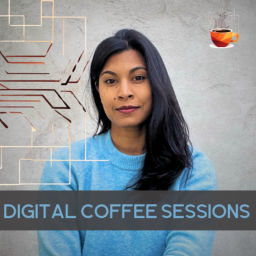
Join me, Prichelle Rugdeo, as I meet with co-hosts and guests to discuss their experiences and knowledge in future technologies and emerging trends. We chat about fascinating fields of research that could shape our future.
- Publisher
- Prichelle Rugdeo
- Category
- technology
- Language
- en
- Explicit
- No
- First episode
- 29 May 2024
- Latest episode
- 9 Apr 2025
Latest episodes
15 episodes in the feed.
9 Apr 2025
Founders journey with Vidar Phoenix Leo Christiansen and Social Vibes
How can we (re)connect, build meaningful relationships and create moments of joy? In this founders journey series, I sit down with Vidar Phoenix Leo Christiansen. He shares his founder's journey within Social Vibes (https://socialvibes.io/) , what he has learnt along the way and why he and the team create immersive experiences with the aim of ‘sparking connections and creating memories’. Vidar Phoenix Christiansen (https://www.linkedin.com/in/vidarphoenix/) is a Danish entrepreneur, leader, and creative strategist dedicated to fostering human connection through technology. As the founder of Social Vibes, he aims to combat loneliness and digital isolation by helping people create meaningful social experiences. With a background in business, leadership, and psychology, he blends creativity, empathy, and strategic execution to scale innovative ventures. Raised in Denmark, Vidar’s journey, from overcoming personal hardships to traveling the world and working in sales, shaped his resilient and visionary mindset. Now based in Sweden with his Moroccan wife, he is passionate about fitness, digital art, travel, and personal growth. With Social Vibes, he envisions building a global movement that empowers people to connect deeply, embrace new experiences, and make lasting memories. Related links Visit Social Vibes (https://socialvibes.io/) website 02:58 Meet Vidar Phoenix Christiansen 05:00 Social Vibes, becoming an app 08:55 Creating adventures 12:30 Developing the technology, keeping the motivation 15:46 Meeting the team, growing the team 22:40 Design choices 26:35 Founder to leader journey 39:32 Finding funding 44:10 Shares some advice Continue listening… Digital ecologies with Attila Márton (https://creators.spotify.com/pod/show/prichelle-rugdeo/episodes/Digital-ecologies-with-Attila-Mrton-e2quhl9) This episode was: Hosted by Prichelle Rugdeo (https://www.linkedin.com/in/prichelle-r-64b3504b/) Edited by Preneil Pillay (https://www.linkedin.com/in/preneil-pillay/) Original music by Jakob Ranum, Studio25 (https://www.studio25.dk/) Produced by Prichelle Rugdeo and Preneil Pillay This podcast is powered by Station (https://www.station.dk/) and the Copenhagen School of Entrepreneurship (https://cse.cbs.dk/).
12 Mar 2025
The Art of Active Allyship with Poornima Luthra
What can we do? I sit down with Dr. Poornima Luthra. She shares her PracAdemic activities within academia and as a practitioner. Whether you listen to this for yourself, as a leader or for your business, she helps us visualise our spaces and places and asks us to consider ‘What can I do?’. She does this through the core pillars within Diversity, Equity, and Inclusion. Dr. Poornima Luthra (https://www.linkedin.com/in/dr-poornima-luthra-she-her-b09128100/) is a recognised author, keynote speaker, business consultant, (https://www.talented.dk/) and leading practitioner-academic in the field of talent management and Diversity, Equity, and Inclusion (DEI). As Associate professor at the Copenhagen Business School, she provides effective DEI thought-leadership from a global perspective, workshops, and consultancy services for organisations who are determined to nurture inclusive workplaces for their diverse talent. She has been ranked as one of the world’s 30 up-and-coming management thinkers by Thinkers50 and is a recipient of the Professional Women of Colour Denmark Impact Award and winner of the Nordic Blaze Inclusion Award. She is the author of Leading Through Bias (https://www.goodreads.com/book/show/204390247-leading-through-bias?from_search=true&from_srp=true&qid=oyIPF7EHe4&rank=1) (2023 (English)/ 2024 (Danish & Italian)), The Art of Active Allyship (https://www.goodreads.com/book/show/65149614-the-art-of-active-allyship) (2022), and Diversifying Diversity (https://www.goodreads.com/book/show/58125954-diversifying-diversity?from_search=true&from_srp=true&qid=eJkO4fEkog&rank=1) (2021) and is a contributor to Harvard Business Review on topics related to DEI. Related links or mentioned in this podcast Selected publications (https://www.cbs.dk/en/research/departments-and-centres/department-of-organization/staff/pluioa) Website (https://poornimaluthra.com/) Seeking qualitative rigor in inductive research: Notes on the Gioia methodology (https://journals.sagepub.com/doi/10.1177/1094428112452151) 02:30 Meet Dr. Poornima Luthra 08:20 PracAdemic, activities as an academic and practitioner 13:50 Understanding the core pillars of her work 20:00 Shares an exercise, asked to visualise… 24:00 What can we do? 31:00 An interesting research idea, would you listen to… This episode was: Edited by Preneil Pillay (https://www.linkedin.com/in/preneil-pillay/) Hosted by Prichelle Rugdeo (https://www.linkedin.com/in/prichelle-r-64b3504b/) Original music by Jakob Ranum, Studio25 (https://www.studio25.dk/) Produced by Prichelle Rugdeo and Preneil Pillay Powered by Station (https://www.station.dk/) and the Copenhagen School of Entrepreneurship (https://cse.cbs.dk/).
26 Feb 2025
Digital independence with Mikkel Flyverbom
How are we seen, known and governed through our visibilities? I sit down with Mikkel Flyverbom. If you are new to this podcast, we host conversations related to technology, research, innovation and the emerging future. This conversation covers all these areas and highlights important topics and emerging ideas that we may benefit from paying attention to. Mikkel Flyverbom (https://www.linkedin.com/in/mikkelflyverbom/) is Professor of Communication and Digital Transformations at the Department of Management, Society and Communication, Copenhagen Business School (CBS), Denmark. Also, he is founding academic director of the BSc in Business Administration and Digital Management program at CBS. His research on digital transformations, data, internet governance, and tech companies has been published in leading international journals, such as Business & Society, The Information Society, Telecommunications Policy, Organization Studies, Management Communication Quarterly, Organization, as well as a number of books. His most recent book, The Digital Prism: Transparency and Managed Visibilities in a Datafied World (https://www.cambridge.org/core/books/digital-prism/46CE745595EA8322B99458F21A7EA39F) has been published by Cambridge University Press. He has been a visiting professor at Stanford University, University of California, Santa Barbara, Rutgers University, Bamberg University and Luiss University. He is a member of the Danish government’s Data Ethics Council, a member of the Expert Group for the AI Task Force (https://via.ritzau.dk/pressemeddelelse/14221434/ny-ekspertgruppe-skal-understotte-den-digitale-taskforce-for-kunstig-intelligens?publisherId=13560322&lang=da&fbclid=PAZXh0bgNhZW0CMTEAAaZZQh6_xeIUcqg_kb_wRQAjiNoVl2rx0movX-DdAqtnmj2Uma86SOa4Gg8_aem_d9VgEFmO2J_kDZCSsTDjyQ) and former chairman of the Expert Group on Tech Giants (https://www.digmin.dk/digitalisering/publikationer/2024/tech-giganters-rolle-som-digital-infrastruktur). He also writes a regular tech column for the Danish newspaper Politiken, and is a widely used media expert on digital transformations and the tech industry. Related links or mentioned in this podcast Selected publications (https://www.cbs.dk/en/research/departments-and-centres/department-of-management-society-and-communication/staff/mfmsc) from Mikkel Flyverbom The Digital Prism: Transparency and Managed Visibilities in a Datafied World (https://www.cambridge.org/core/books/digital-prism/46CE745595EA8322B99458F21A7EA39F) Tech giants' role as digital infrastructure - Report 3 from the government's expert group on tech giants (https://www.digmin.dk/digitalisering/publikationer/2024/tech-giganters-rolle-som-digital-infrastruktur) Shoshana Zuboff’s website (https://shoshanazuboff.com/book/) and publications (https://www.hbs.edu/faculty/research/publications/Pages/default.aspx?faculty=szuboff) 02:00 Meet Mikkel Flyverbom 08:10 As a member of the Data Ethics Council 13:00 Discussing the Expert Group on Tech Giants 18:00 Digital Prism 22:22 Leadership considerations 24:00 Shares his upcoming research interests 29:00 Vinyl This episode was: Edited by Preneil Pillay (https://www.linkedin.com/in/preneil-pillay/) Hosted by Prichelle Rugdeo (https://www.linkedin.com/in/prichelle-r-64b3504b/) Original music by Jakob Ranum, Studio25 (https://www.studio25.dk/) Produced by Prichelle Rugdeo and Preneil Pillay Powered by Station (https://www.station.dk/) and the Copenhagen School of Entrepreneurship (https://cse.cbs.dk/).
12 Feb 2025
Blockchain Healthcare use cases with Filippo Frangioni
Discovering use cases for Blockchain within Healthcare I sit down with Filippo Frangioni. He shares his journey into Blockchain, 3 Blockchain use cases within healthcare and adoption challenges within the industry. We also get to talk about ‘Community of practice’ and the Blockchain Communities of Practice he has started. Filippo Frangioni (https://www.linkedin.com/in/filippo-frangioni-987b9b97/) is a Product Manager at Novo Nordisk, where he has spearheaded innovation in AI and blockchain, driving the development of digital products within the pharmaceuticals sectors. With a blend of technical expertise and commercial insight, he has been instrumental in advancing digital transformation projects within healthcare. Filippo also serves as Head of Partnerships at the Nordic Blockchain Association, fostering connections within the Web3 community through memberships, regulatory initiatives, and events like the Nordic Blockchain Conference. Related links or mentioned in this podcast Decentralized science (DeSci) (https://ethereum.org/en/desci/) Leading on post-quantum technology (https://algorand.co/technology/post-quantum) Communities of practice: A brief introduction (http://hdl.handle.net/1794/11736) (Journal paper) 02:00 Meet Filippo Frangioni 04:25 What is a public and a private Blockchain 05:40 What is a Blockchain distributed ledger 07:16 Background into healthcare and pharmaceutical industry 07:40 Use Case: Product traceability 08:44 Use Case: Clinical trials 11:40 Use Case: Decentralised science (DeSci) 14:30 Encryption 15:40 Adoption challenges 18:30 Blockchain Communities of Practice 28:42 A parting thought, a quote, what do you think This episode was: Edited by Preneil Pillay (https://www.linkedin.com/in/preneil-pillay/) Hosted by Prichelle Rugdeo (https://www.linkedin.com/in/prichelle-r-64b3504b/) Original music by Jakob Ranum, Studio25 (https://www.studio25.dk/) Produced by Prichelle Rugdeo and Preneil Pillay Powered by Station (https://www.station.dk/) and the Copenhagen School of Entrepreneurship (https://cse.cbs.dk/).
5 Dec 2024
Blockchain use cases with Jonas Sveistrup
Blockchain expert Jonas Sveistrup shares insights on emerging use cases, shifts in business models, and the collaborative advantages of blockchain technology.
14 Nov 2024
Digital ecologies with Attila Márton
What society needs to be in place in order for what we observe to be not only acceptable but also desirable? Today I sit down with Attila Márton. We talk about what captures his attention when he is not teaching at the Copenhagen Business School or researching digitalization of core social phenomena. He shares what we can learn from ecological thinking, shares some ecological perspectives, discusses platforms as an organisational form and highlights some guiding principles a business, start up or individual could follow or be aware of in terms of digitalization. Attila Márton (https://www.linkedin.com/in/attila-m%C3%A1rton-b4ab8214/) is a Digital Ecologist. His research focuses on propelling ecosystemic thinking to make digitalization serve humanity. To this effect, he is currently exploring the co-evolutionary dynamics between platforms and their respective ecosystems, the political ecology of digital labour and AI, the sociology of digital knowledge and forgetting, and the re-decentralization of the Internet. This podcast is powered by Station (https://www.station.dk/) and the Copenhagen School of Entrepreneurship (https://cse.cbs.dk/). Related Links A digital future of resilience: What can we learn from ecological thinking? (https://isaconf.confex.com/isaconf/wc2023/mediafile/ExtendedAbstract/Paper143988/ISA_congress_paper.pdf) Selected publications (https://www.cbs.dk/en/research/departments-and-centres/department-of-digitalization/staff/amdigi) Voyant tools (https://voyant-tools.org/) 00:47 Meet Attila Marton 08:07 Shares insights into his writing process 12:05 Attila’s selected publications: Digital, Information, Platforms and New 13:22 Discussing Platforms and Sharing Platforms 16:19 Platforms as an organisational form: changing how we are used to organising 18:10 Social media and labour platforms 19:18 Ecologies, a mind set 27:15 How do ‘ecological systems’ self regulate and what can we learn 28:48 First principles thinking 29:00 Shares an example, it was not the one I was thinking of 31:04 Discussing resilient and robust, within the system itself 33:20 Variety and redundancy 38:25 From an ecological perspective: AI 45:31 Asked to share one thing he would like us to know
16 Oct 2024
Developing 21st century skills with Loes Damhof
What are the skills we could develop to support us in the future? Today I sit down with Loes Damhof. She joins me to discuss her work; within Higher Education and the Emergence Academy, and how futures literacy could be used within a business context. Loes Damhof (https://www.linkedin.com/in/loes-damhof-7ab0813/) was elected as Lecturer of the Year of all higher education in The Netherlands in 2016, and decided to spend the attached prestigious Comenis Award on developing Futures Literacy pilots. As a UNESCO Chair on Futures Literacy in Higher Education, she consults and trains staff of global organizations such as FutureWomenX, UNESCO, UNFCCC, ClimateKIC, FORMS, UN, Copenhagen Institute for Futures Studies and Oxfam in multidisciplinary projects. As a Futures Literacy Expert, she designs, develops and facilitates so-called Futures Literacy Labs: collective intelligence knowledge creation processes across the globe that challenge and raise fundamental questions on leadership, migration, climate change and technology. She is a Future Fellow at Hawkwood College, a steering committee member of the Futures Oriented Museum Synergies and an editor for the Journal of Futures Studies. 1:50 Meet Loes Damhof 3:20 Shares her work as a UNESCO Chair on Futures Literacy in Higher Education 7:16 How is futures literacy used within a business context 13:00 Emergence Academy 19:39 Sensing and sense making 25:36 Could we slow down? 33:15 Shares what she is presently up to
25 Sept 2024
Using the future in the present with Felipe Koch
How can we develop the capability of using the future in the present? Today I sit down with Felipe Koch (https://www.linkedin.com/in/felipekoch/). He joins me to discuss images of the future, anticipation, UNESCO (https://unesdoc.unesco.org/ark:/48223/pf0000264644)’s Futures Literacy and how people experience time. Felipe Koch (https://www.linkedin.com/in/felipekoch/) is an assistant professor of Brazilian Studies and Societal Innovation at the University of Paris-Est Créteil. He has a PhD in Sociology of the Imaginary and has recently been elected as Vice-Dean of the AEI International School, also holding the position of Head of Graduate Studies. He leads undergraduate and postgraduate minors within Management and International Trade at AEI. An expert in; exploring societal impacts of imaginaries, social innovation, and future studies, he is also a senior trainer in Futures Literacy and a keynote speaker. 1:32 Meet Felipe Koch 4:26 What is Futures Literacy and Futures Literacy Labs 7:20 What is ‘anticipation’ and how do we use it 9:00 Felipe's work in Collective anticipation 15:25 The compass game and agency 19:22 Discussing how people experience time 24:56 Felipe's s advice on building Futures Literacy capabilities 28:15 AI and imagination
14 Sept 2024
Futures Literacy Lab with Beatriz Carneiro
Step into a Futures Literacy Lab; Future of… Enterprise 2074. Today I sit down with Beatriz Carneiro (https://www.linkedin.com/in/blrcarneiro/). She joins me to share her journey into Futures Literacy and her academic journey. We get to step into a ‘Time machine’ to consider the Future of … in this case… Enterprise in 2074. Beatriz Carneiro has a degree in Genetics and a MSc in Ecology from the Federal University of Rio de Janeiro (UFRJ). She has experience in the intersection between management, biodiversity and climate change. Currently, she is a PhD candidate in Environmental Sciences and Conservation at UFRJ, researching synergies within post-development philosophies and anticipation for future. She participates in the UNESCO Chair on Futures Literacy (https://museudoamanha.org.br/sites/default/files/CPA_vol%202_pode%20o%20capitalismo_completo_digital.pdf), a partnership between Museu do Amanhã (https://museudoamanha.org.br/)(Museum of Tomorrow - Instituto de Desenvolvimento e Gestão) and UFRJ. 3:10 Meet Beatriz Carneiro 10:25 Understanding Futures Literacy Labs 15:48 Step into a Time machine: Explore Enterprise in 2074 22:40 Discussing a Reframe scenario 30:50 Museu do Amanhã 41:24 How humans process the idea of the future
24 Aug 2024
Quantum startups with Nishta R. Nem
How could Quantum startups begin their business development journey? In this session, I sit down Nishta R. Nem. (https://www.linkedin.com/in/raheestynem/) Since visiting the Center for Quantum Devices at the Niels Institute in Copenhagen, I was interested in understanding the start-up ecosystem for Quantum. I reached out to Nistha, who was available to speak to us and share her experiences in business development for this developing industry. Nishta R. Nem is an experimental physicist with a PhD in fusion energy and a secondary specialisation in quantum physics. During her career, she has designed and built many different diagnostics and hardware. After gaining the necessary technical and scientific understanding of deep tech, she now helps early-stage quantum startups as a business developer. She assists first-time founders with the development of their business plans and fundraising and also leads the Venture Lab, Quantum program at Deep Tech Lab (https://deeptechlab.bii.dk/). It is an accelerator program for early-stage companies. 2: 39 Meet Nishta Nem 5: 43 Business development journey 9:06 Diana program 11:10 Venture lab Quantum program 13:30 Is a working prototype needed to support the application? 16:05 'Founder friendly' and investment cycles 20:47 The funding landscape: Denmark, EU and US 24:52 Understanding founder profiles 28:00 Understanding a ‘call’ for applications 30:30 Connecting to talent 33:03 Advice to founders
25 Jul 2024
Quantum Devices with Saulius Vaitiekenas
What happens at one of the coldest places in the universe? For this session, I visited the Centre for Quantum Devices (https://qdev.nbi.ku.dk/about/)at the Niels Bohr Institute (NBI). I visited my last guest, Michele Burrello (https://www.linkedin.com/in/michele-burrello-6774b8274), and today’s guest, Saulius Vaitiekenas (https://www.linkedin.com/in/vaitiekenas/) at their lab. We took a tour of the lab and of the different quantum devices they develop and test. In this episode, I discuss with Saulius the tangible ways in which quantum devices are created, particularly the technology and processes used to develop these platforms and we unpack some of the concepts we previously discussed with Michele. Saulius Vaitiekenas (https://www.linkedin.com/in/vaitiekenas/)' research combines different materials, such as semiconductors and superconductors, and constructing devices to create rare or non-natural physical settings. He is an experimental condensed matter physicist and studies emergent quantum phases in hybrid material platforms. A Lithuanian physicist, Saulius studied at the Free University of Berlin and got his PhD in Physics from the University of Copenhagen in 2020. 3:38 Meet Saulius Vaitiekenas 5:43 A day in the lab at the Centre for quantum devices 7:30 Working in the clean room 8:30 Using lithography techniques 10:16 Touring the lab 14:40 Energy scales and observing materials 17:15 Dilution refrigerators, a technological marvel 20:10 Semiconductors and superconductors materials 24:20 Saulius's collaborations 24:56 Saulius shares views on how the field could progress: fundamental research, applications
26 Jun 2024
Quantum Computing with Michele Burrello
How does a theoretical physicist design beautiful quantum systems? In this episode I learn how a theoretical physicist designs quantum devices and explores their physical characteristics. These quantum devices can be used as building blocks for quantum computers to solve some class of problems, like cryptography and logistics. While I was on the search for practical applications, I learn that the motivation for pure research often lies in the beauty of the system that is studied and exploring the border between "what is known and what is unknown". Michele Burrello (https://www.linkedin.com/in/michele-burrello-6774b8274) is currently an Associate professor at the Niels Bohr Institute of Copenhagen, Denmark. He works on condensed matter theory and applications of quantum systems. He is an Italian physicist and studied at the Scuola Normale of Pisa (Italy) and got his PhD in statistical physics at SISSA (Trieste, Italy) in 2011. He previously worked at the University of Leiden (The Netherlands), the Max Planck Institute for Quantum Optics (Garching, Germany). For more information, you can read the following: Unbreakable fibre network connection established between DTU and Niels Bohr Institute (https://www.dtu.dk/english/newsarchive/2022/11/ubrydelig-fibernet-forbindelse-oprettet-mellem-dtu-og-niels-bohr-institutet) Quantum key distribution using deterministic single-photon sources over a field-installed fibre link (https://www.nature.com/articles/s41534-023-00800-x) 2:28 Meet Michele Burrello 5:32 Discussing what a theoretical physicist does 6: 37 What is a ‘platform’ and ‘device’ within quantum physic 8:39 Basic research and theoretical aspects 9:00 How basic research could support commercial progress 10:24 How ideas could transfer to application 14:18 ones and zeros… how does information processing change 16:00 What is a ‘platform’ at the level of nano electronics 22:33 Discussing problems quantum computers could solve 27:00 Error correction 31:12 Michele’s interests in studying hybrid systems 33:10 Other branches of quantum technologies 35:00 A feeling of magic
12 Jun 2024
The Fusion Age with Søren Bang Korsholm
ITER, fusion energy supply chains and a case for fusion Søren Bang Korsholm (https://orbit.dtu.dk/en/persons/s%C3%B8ren-bang-korsholm) and I sat down to talk about the ITER project (https://www.iter.org/construction/construction ), fusion energy supply chains and a case for Fusion (https://www.dtu.dk/english/newsarchive/2023/05/the-breakthrough-in-fusion-energy-is-coming-closer-if-denmark-wants-to-participate-we-need-to-get-on ). He is a senior scientist at DTUs Department of Physics, Project manager for the development of the Collective Thomson Scattering (CTS) diagnostic system for ITER under contract with Fusion for Energy. He is also the co-founder and partner in the BigScience.dk initiative. 2:42 Meet Søren Bang Korsholm 4:00 Søren’s research within Plasma diagnostics 8:40 What is the ITER project 15:10 Søren’s role within the ITER project 16:57 A case for Fusion 22:33 Fusion energy supply chains 22:55 Søren’s role within BigScience.dk and DANFusion 25:20 Outlook for the future with respect to Fusion energy
29 May 2024
Fusion Energy with Matthias Wiesenberger
How can we copy the Sun as an energy source here on Earth? In this episode I learn how Fusion is the energy of the Sun and stars and holds the potential for abundant, clean energy for humanity. However, there are challenges that emerge when trying to reproduce conditions similar to the core of a star here on Earth. Matthias Wiesenberger (https://orbit.dtu.dk/en/persons/matthias-wiesenberger) holds a PhD in physics from the University of Innsbruck, Austria and currently works as a researcher at the Danish Technical University in Copenhagen (https://www.fysik.dtu.dk/english/research-sections/ppfe), Denmark. He is the author of several publications in theoretical Fusion physics, numerical analysis and high-performance computing (https://feltor-dev.github.io/). 1:25 Meet Matthias Wiesenberger 4:07 What is Fusion Energy 9:30 How can we model the Sun here on Earth 16:30 Design approaches, Inertial and Magnetic 26:50 Research within theoretical modelling 31:30 Leveraging high performance computing 33:30 Feltor (https://feltor-dev.github.io/), a software to study fluid dynamics (specifically plasma) and turbulence 35:00 Discussing commercial viability 38:46 Start-ups in Fusion Energy
29 May 2024
Welcome to the Digital Coffee Sessions
Welcome to the Digital coffee sessions. I'm your host, Prichelle. Every month I will delve into topics related to technology and the emerging future. In each episode, I sit down with researchers, entrepreneurs or enthusiasts, from various fields, who share their insights and experiences over a warm beverage in our virtual studio. So, grab your favourite drink and get ready to embark on an audio journey. Let's explore together!
Podcast Authority Score: 22 / 100
A composite of feed quality, social presence, YouTube performance and engagement. Read the methodology.
- Quality
- 43
- Social presence
- 0
- YouTube
- 0
- Engagement
- 0
Contact Digital Coffee Sessions
- Guest appearances
- Books guests
Based on episode analysis; this does not confirm that the show is currently accepting guests.
Host of Digital Coffee Sessions?
Claim your podcast to manage its listing and keep your show details accurate.
Pod Engine is an independent podcast discovery and analytics service and is not affiliated with or endorsed by this podcast. Artwork and show content belong to their owners. Full legal notice.
Explore this show
Podcast research with Pod Engine