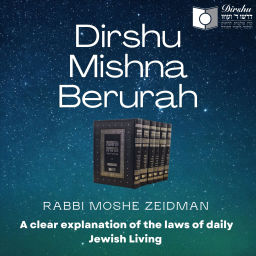
A page a day (amud yomi) of Mishnah Berurah explained and clarified following (roughly) the cycle of the Dirshu program for mastery of the laws of daily Jewish living. Master the text in under 30 minutes a day. For individual application of the laws you should consult with your local Orthodox Rabbi.
Please subscribe to this podcast - you will be notified when each new session is uploaded and you will maximise your daily learning. For feedback or questions you can reach me on mztorahlearning@gmail.com.
This segment explores the laws of tochen (grinding) in food preparation on Shabbos. Crushing salt with standard grinding tools (like a pestle and mortar) is prohibited, but doing so with an unusual method (e.g., knife handle or by hand) is permitted. Pre-ground items may be further broken down, as there is no prohibition of grinding after grinding.
Cooked meat and similar foods may be cut very finely since they are not subject to tochen, whereas raw meat for animals may not be finely chopped unless needed immediately. Grating cheese with a designated grater is prohibited, but cutting it finely with a knife is allowed.
The shiur also discusses distinctions between foods that require preparation to be edible versus those already fit for consumption, and how that impacts permissibility. Finally, it permits moistening detached produce (like vegetables) to prevent drying, but strictly forbids watering anything still attached to the ground due to the prohibition of planting-related activities.
This segment explores the boundaries of salting and grinding on Shabbos. While adding salt for immediate consumption is permitted, salting foods (like meat, eggs, or fish) for preservation—even short-term—resembles tanning or pickling and is rabbinically prohibited. However, salting for the same meal is allowed, and in certain cases (e.g., preventing spoilage on a hot day), leniencies apply.
Raw meat and fish may not be salted to preserve them, even to avoid financial loss, though washing meat is generally permitted if done for immediate use. When necessary to prevent loss (e.g., in commercial contexts), a non-Jew may assist.
The episode also covers grinding: spices like peppercorns may only be crushed with a שינוי (unusual method), such as using a knife handle on a plate or table. Using standard grinding tools or typical methods is prohibited, even for small amounts.
26 Mar 2026
MB 321.3 – MB 321.4 – Salting Foods on Shabbos: When It Becomes “Like Cooking”
Salting certain foods on Shabbos can resemble pickling, which Chazal prohibit because it is considered similar to cooking. The restriction primarily applies when salting multiple pieces (e.g., radishes, onions, garlic, cucumbers) together, as this appears like a preserving process.
However, salting or dipping individual pieces and eating them immediately is permitted, provided they are not left long enough to release significant moisture. Practices that involve leaving salted vegetables to sit (even briefly in a way that mimics pickling or tanning) are prohibited. Adding oil or vinegar right away may mitigate concerns, depending on the method.
Foods not typically preserved through salting (e.g., eggs) may be salted without concern. The accepted practice is to avoid salting in a way that resembles pickling and instead salt each piece individually and consume it promptly.
Reach and audience
Public platform figures. Ratings count people who left a rating, not total listeners.
Apple Podcasts (US)
5.0 / 5
1 ratings
Spotify
5.0 / 5
5 ratings
Host of Dirshu Mishnah Berurah?
Claim your podcast to manage its listing and keep your show details accurate.
Pod Engine is an independent podcast discovery and analytics service and is not affiliated with or endorsed by this podcast. Artwork and show content belong to their owners. Full legal notice.
Explore this show Podcast research with Pod Engine