- 12
- Episodes
- Monthly
- Cadence
- 2026
- First episode
About Disability@Work
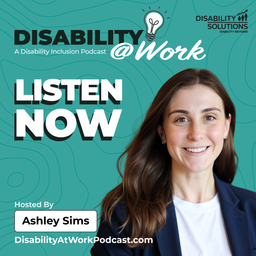
Disability@Work is a podcast focused on disability inclusion, accessibility, and equity in the workplace. Hosted by disability inclusion strategist and Director of Marketing & Communications, Ashley Sims, the show explores the cultural, social, and systemic factors that shape access, opportunity, and employment for people with disabilities. Each episode features thoughtful conversations and practical insights for employers, HR leaders, advocates, and allies working to build more inclusive organizations. Topics include disability in the workplace, inclusive hiring, accessibility, disability culture, ableism, policy, and the lived experiences of disabled people. Whether you’re advancing DEI initiatives, designing accessible workplaces, or learning how to better support disabled talent, Disability@Work offers clear, actionable perspectives to help create environments where everyone can participate and thrive.
- Publisher
- Ashley Sims
- Category
- business · news
- Language
- en
- Explicit
- No
- First episode
- 10 Feb 2026
- Latest episode
- 20 Aug 2026
Latest episodes
12 episodes in the feed.
20 Aug 2026
The Charity Trap: Why Disability Hiring Needs a New Narrative
Why is hiring people with disabilities still so often framed as an act of goodwill rather than a smart business decision? This episode explores the harmful legacy of the charity mindset in disability employment and why it still holds organizations back. Drawing inspiration from a recent article by disability advocate Steve Way, host Ashley Sims examines how low expectations, deficit-based thinking, and employer-centered definitions of success can undermine true inclusion. She challenges leaders to stop viewing disability hiring as philanthropy and start treating it as what it really is: access to talent, innovation, and business value. The conversation also explores an important question for the future of workplace inclusion: Are we measuring disability inclusion based on what employers say they do, or on what disabled employees actually experience? Key Takeaway * Why "giving someone a chance" may be more harmful than helpful * How the charity narrative creates low expectations in hiring and advancement * What disability employment data tells us about trust and employer credibility * The difference between measuring disability inclusion efforts and measuring employee outcomes * Why organizations should focus on removing barriers instead of "helping" disabled workers * How disability inclusion can evolve from a corporate social responsibility initiative into a workforce strategy Mentioned in This Episode * Steve Way's TIME article, The Contradiction at the Heart of Disability in America [https://time.com/article/2026/07/27/the-contradiction-at-the-heart-of-disability-in-america/] * The 2026 Disability at Work Survey Report [https://go.disabilitytalent.org/2026-disability-at-work-survey-report?_gl=1*1xrg09t*_gcl_au*NTA3MTIyNTgzLjE3ODM2MjE2MzQuMTcxMTg4NjgwMi4xNzg1NDQwMTE5LjE3ODU0NDAxODkuMTMzNTI1OTcxMC4xNzg1NDQwMTE5LjE3ODU0NDAxODk.] * The Disability Index [https://portal.disabilityin.org/]
17 Jul 2026
How Employers Can Escape the AI Hiring Loop and Build More Inclusive Hiring Practices
AI is transforming hiring, but is it helping employers find the best talent or creating new barriers for qualified candidates? In this episode of Disability@Work, host Ashley Sims explores the growing reliance on AI hiring tools and the risks that come with automated screening, sourcing, and candidate ranking. Building on insights shared by Beverly Dines, COO of Foxsy and Founder of Beverlytics Consultancy, the conversation examines Stanford research showing how AI hiring systems can unintentionally reinforce systemic bias and filter out talented candidates before a human ever reviews their application. While much of the discussion around AI hiring focuses on job seekers, this episode shifts the spotlight to employers and talent acquisition teams facing overwhelming application volumes and increasing pressure to hire efficiently. Ashley discusses practical strategies organizations can use to balance efficiency with equity, including rethinking what it means to be qualified, auditing AI-driven hiring outcomes, creating human pathways into the hiring process, and building stronger talent pipelines through community partnerships. Learn why AI should be a guide rather than a gatekeeper, how employers can reduce bias in hiring technology, and what it takes to ensure qualified candidates—including people with disabilities and those from nontraditional backgrounds—aren't overlooked by automated systems. In this episode, we cover: * AI hiring bias and its impact on talent acquisition * How applicant tracking systems can unintentionally exclude qualified candidates * Disability inclusion in AI-powered recruitment * Human-centered hiring strategies * Building diverse talent pipelines * The role of community partnerships in inclusive hiring * Creating accountability and transparency in hiring technology Resources & Links: * Changing Minds & Changing Lives: Breaking Out of The AI Hiring Algorithm With Beverly Dines [https://www.changingmindsandlives.org/breaking-out-of-the-ai-hiring-algorithm-with-beverly-dines/] * Stanford Study: AI Hiring Tools Can Yield Racial Bias and Systemic Rejection [https://hai.stanford.edu/news/ai-hiring-tools-can-yield-racial-bias-and-systemic-rejection] * Disability Solutions: Talent Network [https://www.disabilitytalent.org/partners] and Employer Partnership Programs [https://www.disabilitytalent.org/employers] About the Show: Disability@Work [https://www.disabilityatworkpodcast.com/] is a Disability Solutions podcast. Hosted by Marketing & Communications Director Ashley Sims [https://www.linkedin.com/in/ashley-sims-35a23b99/], each episode offers practical insight for employers, HR and talent leaders, and advocates working to build more inclusive organizations. Learn more at DisabilityTalent.org. [https://www.disabilitytalent.org/]
24 Jun 2026
Understanding DEI Rollbacks and Unlawful Discrimination with Dr. ClauDean Kizart
As organizations respond to shifting federal guidance and growing scrutiny around DEI, many are scaling back their efforts due to uncertainty or fear. But what if the real risk isn't doing too much, but not doing enough? In this episode of Disability@Work, host Ashley Sims sits down with Dr. ClauDean Kizart—education leader, author of Beyond Implicit and Explicit Bias, and founder of Lightwork Equitable Solutions—to unpack what's actually changing, what's being misunderstood, and where employers may be getting it wrong. Together, they explore why inclusion should never have been treated as a standalone program, how longstanding civil rights protections continue to shape workplace responsibilities, and what practical, compliant inclusion looks like today. Dr. Kizart also challenges leaders to rethink equity, prioritize lived experience in decision-making, and move beyond performative efforts toward real, sustainable change. If your organization is navigating uncertainty around DEI, this conversation offers a grounded, actionable path forward— rooted in inclusion without exclusion. In this episode, we cover: * Why many organizations are pulling back on DEI—and what's driving the confusion * What federal guidance actually says (and doesn't say) about discrimination and workplace practices * The critical difference between equality and equity—and why it matters for business outcomes * Why treating inclusion as a "program" sets organizations up to fail * How the lack of diverse perspectives can create blind spots and business risk Resources & Links: * Email: dockizart@gmail.com * Book: Beyond Implicit and Explicit Bias [https://a.co/d/08sWh2GV] * Lightwork Equitable Solutions LLC: https://lightworkeq.com/ * Dept of Justice - Office of the Attorney General (July 29, 2025): Memorandum for All Federal Agencies - Guidance for Recipients of Federal Funding Regarding Unlawful Discrimination [https://www.justice.gov/ag/media/1409486/dl] About the Guest: Dr. ClauDean "Dr. K" Kizart [https://www.linkedin.com/in/dr-claudean-kizart-11937622/] is an author, educator, and founder of LightWork Equitable Solutions. She helps organizations uncover bias and build more equitable, inclusive outcomes. About the Show: Disability@Work [https://www.disabilityatworkpodcast.com/] is a Disability Solutions podcast. Hosted by Marketing & Communications Director, Ashley Sims [https://www.linkedin.com/in/ashley-sims-35a23b99/], each episode offers practical insight for employers, HR and talent leaders, and advocates working to build more inclusive organizations. Learn more at DisabilityTalent.org. [https://www.disabilitytalent.org/]
9 Jun 2026
Gen Z, AI & The Future of Entry Level Work
At graduation ceremonies across the U.S., students are pushing back on artificial intelligence. From boos aimed at pro-AI speeches to growing skepticism about job prospects, Gen Z is sending a clear message: the future of work feels uncertain. In this episode of Disability@Work, host Ashley Sims explores how AI is reshaping entry-level jobs, why recent graduates are questioning the hype, and what this means for the next generation of talent. Drawing on recent 2026 workforce data, Ashley unpacks the growing disconnect between rising employer expectations for AI skills and the lack of preparation many graduates feel. She also dives into a critical question: what happens when the "first rung" of the career ladder starts to disappear? From "cognitive debt" to the tension between efficiency and expertise, this episode challenges both job seekers and employers to rethink how early-career growth happens in an AI-driven world. Whether you're a recent grad, employer, or advocate for inclusive hiring, this conversation will help you navigate the future of work—without losing the human skills that matter most. In this episode, we cover: * Why Gen Z is pushing back on AI in the workplace * The shrinking role of traditional entry-level jobs * AI skills vs. real-world readiness * Why human skills (judgment, creativity, communication) are rising in value * What employers must do to redesign early career pathways About the Show: Disability@Work [https://www.disabilityatworkpodcast.com/] is a Disability Solutions podcast. Hosted by Marketing & Communications Director, Ashley Sims [https://www.linkedin.com/in/ashley-sims-35a23b99/], each episode offers practical insight for employers, HR and talent leaders, and advocates working to build more inclusive organizations. Learn more at DisabilityTalent.org. [https://www.disabilitytalent.org/] Sources: * NPR, Advice for 2026 commencement speakers: Don't bring up AI [https://www.npr.org/2026/05/20/nx-s1-5822419/ai-colleges-commencement-booing], 2026 * CNBC, Entry-Level Jobs Calling for AI Skills Nearly Doubled [https://www.cnbc.com/2026/04/29/entry-level-jobs-calling-for-ai-skills-nearly-doubled-from-a-year-ago-report.html], 2026 * ZipRecruiter, Graduate Job Market Report [https://ziprecruiter-investors.com/news/news-details/2026/ZipRecruiter-Finds-Grad-Job-Market-Improving-Despite-Fears-That-AI-Is-Eliminating-Jobs/default.aspx], 2026 * Forbes, College Graduates Face Tight Job Market [https://www.forbes.com/sites/michaeltnietzel/2026/04/28/college-graduates-face-tight-job-market-and-many-blame-ai-finds-survey/], 2026 * MIT Technology Review, Crisis in Entry-Level Work [https://www.technologyreview.com/2026/05/26/1137865/its-time-to-address-the-looming-crisis-in-entry-level-work/], 2026 * National Association of Colleges and Employers (NACE), Job Outlook [https://naceweb.org/research/reports/job-outlook/2026/], 2026
19 May 2026
Why Employees with Disabilities Leave for Leadership Roles: The Sponsorship Gap
Why are top employees with disabilities leaving organizations to grow their careers? In this episode of Disability @ Work, host Ashley Sims explores a critical workforce trend: professionals with disabilities are 4x more likely to reach senior roles by switching companies than through internal promotions. The problem isn't a lack of talent—it's a lack of opportunity. Ashley breaks down the mentorship vs. sponsorship gap, how workplace bias limits advancement, and why organizations are unintentionally becoming "training grounds" for competitors. She also highlights the real cost of inaction: replacing high-performing talent is far more expensive than investing in accessibility and advancement. If you're a recruiter, HR leader, or executive looking to retain and develop inclusive leadership pipelines, this episode offers practical insights you can act on now. Show Notes In this episode, we cover: - Why employees with disabilities leave companies to advance their careers - The growing gap between inclusion and leadership opportunity - How sponsorship vs. mentorship drives promotions - What organizations should do to support high-potential employees About the Show: Disability@Work [https://www.disabilityatworkpodcast.com/] is a Disability Solutions podcast. Hosted by Marketing & Communications Director, Ashley Sims [https://www.linkedin.com/in/ashley-sims-35a23b99/], each episode offers practical insight for employers, HR and talent leaders, and advocates working to build more inclusive organizations. Learn more at DisabilityTalent.org. [https://www.disabilitytalent.org/] Sources: - JAN, Cost and Benefits of Accommodations, [https://askjan.org/topics/costs.cfm] 2025 - SHRM, The Myth of Replaceability: Preparing for the Loss of Key Employees, [https://www.shrm.org/executive-network/insights/myth-replaceability-preparing-loss-key-employees] 2025 - NFP, Inaugural Executive Benefits Trends Study [https://www.nfp.com/media/lphjo0na/nfp-exec-ben-report-2022-2023.pdf], 2023
28 Apr 2026
Job Hugging Isn't Disengagement: What Fear, AI, and DEI Rollbacks Reveal About Today's Workforce
In this episode of Disability@Work, host Ashley Sims breaks down job hugging—a growing workplace trend where employees stay in roles they might otherwise leave because uncertainty feels too risky. This isn't quiet-quitting or a lack of ambition. It's a rational response to economic instability, layoffs, AI disruption, DEI rollbacks, and declining psychological safety at work. Drawing on findings from the 2026 Disability at Work Report, Ashley explores why disabled employees are especially likely to job hug, how fear around disclosure and accommodations shapes career decisions, and why low turnover does not equal engagement. The episode also challenges employers to rethink what job hugging signals about trust, inclusion, and workplace systems. Whether you're an employer trying to understand shifting workforce behavior or an employee feeling stuck for practical reasons, this conversation offers critical insight into how safety, trust, and accessibility shape career mobility today. Show Notes: In this episode, we cover: * What job hugging is—and why it's not quiet quitting or disengagement * Why economic uncertainty, layoffs, and AI disruption are keeping employees in place * How DEI rollbacks and political shifts are affecting psychological safety at work * Why disabled employees are especially likely to job hug * What the 2026 Disability at Work Report reveals about disclosure, accommodations, and trust * Why low turnover doesn't equal engagement * What employers can do to make growth and mobility feel safe again Read the 2026 Disability at Work Report: https://go.disabilitytalent.org/2026-disability-at-work-survey-report [https://go.disabilitytalent.org/2026-disability-at-work-survey-report?_gl=1*km301f*_gcl_au*MTk1NDQ1ODk4My4xNzc0OTk1MTc2LjIwNTk0OTg0NjUuMTc3NzMwMzc3My4xNzc3MzAzNzcy] About the Show Disability@Work is a Disability Solutions podcast. Hosted by Marketing & Communications Director, Ashley Sims [https://www.linkedin.com/in/ashley-sims-35a23b99/], each episode offers practical insight for employers, HR and talent leaders, and advocates working to build more inclusive organizations. Learn more at DisabilityTalent.org. [https://www.disabilitytalent.org/]
31 Mar 2026
Too Many Resumes, Not Enough Humans: AI Slop, Hiring, and Disability Inclusion
Recruiters and hiring managers are drowning in applications, but disabled job seekers are still being overlooked. In this episode of Disability@Work, host Ashley Sims breaks down the growing problem of AI "slop" in recruiting: mass‑produced resumes, keyword‑stuffed applications, and automated screening tools that prioritize volume over viability. While AI is often seen as a solution to hiring overload, the reality is more complicated, especially for candidates with disabilities. Ashley explores how automation can unintentionally amplify bias, flatten lived experience, and filter out qualified candidates who do not follow traditional career paths. She also offers a more practical question for employers: Is there a believable path to success? Instead of searching for perfect matches, inclusive hiring requires judgment, context, and human decision‑making. This episode digs into what helps recruiters move through high‑volume pipelines: why niche job boards and community‑based sourcing matter, where AI can support good hiring decisions, and how employers can refocus on real people instead of resume noise. Show Notes: In this episode, we cover: * Why recruiters are seeing an explosion of applications * How automated screening tools can unintentionally exclude disabled candidates * The difference between "matching criteria" and identifying a believable path to success * Why traditional resumes fail to capture disability‑related career context * When AI helps—and when it makes hiring worse * How niche job boards and targeted sourcing reduce noise and improve outcomes About the show: Disability@Work is a Disability Solutions [https://www.disabilitytalent.org/] podcast about inclusion, accessibility, and equity in the workplace. Hosted by Ashley Sims [https://www.linkedin.com/in/ashley-sims-35a23b99/], each episode offers practical insight for employers, HR/TA leaders, and advocates working to build more inclusive organizations. Find out more at DisabilityTalent.org.
19 Mar 2026
New Workforce Data: The Erosion of Psychological Safety at Work
Feeling safe at work doesn't always come easy for people with disabilities, and for many disabled workers, that psychological safety is disappearing. In this episode of Disability@Work, host Ashley Sims explores what psychological safety really means in today's workplace and why so many employees no longer feel safe disclosing a disability or asking for accommodations. Drawing on early findings from the upcoming 2026 Disability at Work Survey Report, Ashley breaks down what the data reveals about disclosure risk, DEI rollbacks, accommodation breakdowns, and the growing impact of leadership and manager behavior on trust at work. This episode also examines why disability data tracking still matters, how accommodation processes shape long-term trust, and why manager training is one of the most powerful levers organizations have right now. For organizations facing uncertainty, DEI rollbacks, or disclosure concerns, the data tells a clear story: subtle system changes are felt immediately by disabled workers, and safety disappears when trust is not actively maintained. Show Notes: The Disability at Work Survey Report provides data-driven insight into the real experiences of job seekers and employees with disabilities. Its goal is to help employers better understand the barriers disabled individuals face—and to offer actionable solutions that foster workplaces where people feel understood, supported, and safe. Read the 2025 Report Now [https://go.disabilitytalent.org/2024-disability-at-work-survey-report?_gl=1*1cjut73*_gcl_au*MjExNDQzNDMwMS4xNzcyMjE2ODI2LjEwNjQ1OTMwMzEuMTc3MzE3MzI2My4xNzczMTczMjYy]. The 2026 report is out in April 2026. Ashley Sims [https://www.linkedin.com/in/ashley-sims-35a23b99/] is the host of Disability@Work and the Director of Marketing & Communications at Disability Solutions. Disability Solutions [https://www.disabilitytalent.org/] is a nonprofit organization dedicated to advancing disability inclusion in employment. We partner directly with employers to strengthen inclusive hiring practices, improve accommodation processes, and use disability data responsibly. We also support job seekers with disabilities by providing accessible job opportunities, resources, and community outreach through our global network of more than 19,000 talent partners. Learn more at disabilitytalent.org
5 Mar 2026
Physical Disability at Work with Jessica Cox and Pauline Victoria
What happens when talent is overlooked before it's even seen? In this episode of Disability@Work [https://www.disabilityatworkpodcast.com/], host Ashley Sims [https://www.linkedin.com/in/ashley-sims-35a23b99/] explores one of the most damaging barriers disabled professionals face in the workplace: being underestimated. She's joined by Jessica Cox [https://www.linkedin.com/in/rightfooted/], the world's first licensed armless pilot, and Pauline Victoria [https://www.linkedin.com/in/paulinevictoria/], disability inclusion advocate and employment equity leader, to unpack how perceptions—not ability—often shape opportunity. Together, they discuss what it's really like to go into interviews and workplaces with visible physical disabilities, how assumptions impact hiring decisions, and why confidence and representation matter more than most employers realize. The conversation also reframes workplace accommodations—not as burdens, but as practical tools that enable people to do their jobs well. Jessica and Pauline also introduce their new podcast, Living Unlimited, which centers on the lived experiences of limb differences and highlights resources, resilience, and community. Key topics include: * Being underestimated in professional settings * Physical disability and first impressions * Workplace accommodations and self-advocacy * Confidence, representation, and disability inclusion * Lived experience with limb differences This episode is essential listening for employers and HR leaders working to build more inclusive workplaces, disabled professionals navigating interviews and workplace accommodations, and anyone seeking a deeper understanding of physical disability in the workplace. Disability@Work is produced by Disability Solutions [https://www.disabilitytalent.org/], a nonprofit job board and consulting firm dedicated to advancing career success for people with disabilities. We partner with employers to demonstrate the real business value of hiring and retaining talent from the disability community. Join us for honest conversations and bold perspectives on what true disability inclusion looks like in today's workplace. Notes: Living Unlimbited Podcast [https://open.spotify.com/show/1lCPnRhU0FiEQ1z2Y9Po5C] Guests: Jessica Cox [https://www.linkedin.com/in/rightfooted/overlay/about-this-profile/?lipi=urn%3Ali%3Apage%3Ad_flagship3_profile_view_base%3Bqts96ig2RF%2BGm9ERjTgP2Q%3D%3D] Pauline Victoria (Sand) Aughe [https://www.linkedin.com/in/paulinevictoria/overlay/about-this-profile/] Host: Ashley Sims [https://www.linkedin.com/in/ashley-sims-35a23b99/]
26 Feb 2026
Tracking Disability Data: Section 503, Self‑ID, and Retention Strategies
What does it really take to build long‑term disability inclusion at work—and how do organizations know if their efforts are actually working? In this episode of Disability@Work [https://www.disabilityatworkpodcast.com/], host Ashley Sims [https://www.linkedin.com/in/ashley-sims-35a23b99/] is joined by Erin McCann [https://www.linkedin.com/in/erin-mccann-49532564/], PR Compliance Manager at Roche Diagnostics [https://www.roche.com/], for a practical conversation on tracking disability inclusion through self‑identification, Section 503 data, and employee retention. Together, they explore why disability self‑ID campaigns must be ongoing rather than one‑time initiatives, how Section 503's 7% utilization goal should be used as a strategic benchmark—not a quota—and what disability data can reveal about barriers across the employee lifecycle. Erin also shares real‑world insights on retention, challenging the myth that accommodations are costly and highlighting how inclusive workplaces often see stronger engagement and longer tenure among employees with disabilities. The episode offers actionable guidance for employers looking to improve their data practices by building psychological safety, protecting privacy, and shifting toward a culture of trust and transparency. Whether you're a federal contractor, HR leader, or inclusion practitioner, this episode offers clear takeaways on how tracking disability data can drive smarter strategy, stronger retention, and more meaningful inclusion. Disability@Work is produced by Disability Solutions [https://www.disabilitytalent.org/], a nonprofit job board and consulting firm focused on advancing career success for people with disabilities. We partner with employers to highlight the business value of hiring and retaining top talent from the disability community. Tune in for fresh conversations and bold perspectives on disability inclusion in the workplace.
19 Feb 2026
Ableism in Tech: Building Accessible Products with the Founders of Dateability
Ableism is deeply embedded in the tech industry—but it doesn't have to be. In this episode of Disability@Work, Ashley Sims [https://www.linkedin.com/in/ashley-sims-35a23b99/] is joined by Jacqueline and Alexa Child, sisters and co-founders of Dateability [https://info.dateabilityapp.com/], the first dating app built specifically for people with disabilities. Together, they unpack ableism in tech, why accessibility is still treated as an afterthought, and how inclusive design benefits everyone. The conversation also explores disability representation in startups, barriers to VC funding for disabled founders, and what it takes to build accessible technology from the ground up. This episode is a must-listen for tech leaders, designers, founders, and anyone committed to disability inclusion, accessible design, and equitable innovation. Disability@Work is a production of Disability Solutions [https://www.disabilitytalent.org/], a non-profit job board and consulting firm dedicated to helping people with disabilities achieve career success—partnering with corporate employers to help them understand the value in hiring and retaining top talent from the disability community. Tune in for fresh conversations and bold perspectives on disability inclusion.
10 Feb 2026
The Vanishing Act: Why Inclusion Language Is Quietly Disappearing
In this episode of Disability@Work, Ashley Sims [https://www.linkedin.com/in/ashley-sims-35a23b99/] discusses a growing trend: DEI language quietly being removed from federal websites and Fortune 100 companies. With terms like equity, inclusion, and even disability disappearing from public materials, what does this shift mean for accessibility, workplace culture, and disability inclusion efforts? Ashley explores reporting from The New York Times [https://www.nytimes.com/interactive/2025/03/07/us/trump-federal-agencies-websites-words-dei.html]and HR Brew [https://www.hr-brew.com/stories/2026/01/06/more-than-half-of-the-fortune-100-has-changed-public-facing-dei-language-since-the-2024-election], explains how language changes shape priorities and accountability, and shares practical steps for advocates to keep disability visible even as organizations back away from DEI messaging. Language is power—and protecting it protects progress. Disability@Work is a production of Disability Solutions [https://www.disabilitytalent.org/], a non-profit job board and consulting firm dedicated to helping people with disabilities achieve career success—partnering with corporate employers to help them understand the value in hiring and retaining top talent from the disability community. Tune in for fresh conversations and bold perspectives on disability inclusion. Host Ashley Sims explores the cultural, social, and systemic factors that shape access, opportunity, and equity for people with disabilities. Whether you're an employer, advocate, or ally, this podcast gives you quick, practical insights to help build a more inclusive world.
Contact Disability@Work
- Guest appearances
- Books guests
Based on episode analysis; this does not confirm that the show is currently accepting guests.
Host of Disability@Work?
Claim your podcast to manage its listing and keep your show details accurate.
Pod Engine is an independent podcast discovery and analytics service and is not affiliated with or endorsed by this podcast. Artwork and show content belong to their owners. Full legal notice.
Explore this show
Podcast research with Pod Engine