- 20
- Episodes
- 1
- Ratings
- Bi-weekly
- Cadence
- 2026
- First episode
About Dual Force
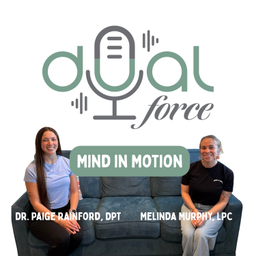
Mental health meets physical therapy. The Dual Force Podcast explores the mind-body connection with practical tools for movement, mindset, and long-term wellness—hosted by Dr. Paige Rainford, DPT, and Melinda Murphy, LPC.
- Publisher
- Dual Force
- Category
- health & fitness
- Language
- en
- Explicit
- No
- First episode
- 4 Mar 2026
- Latest episode
- 19 Oct 2026
Latest episodes
20 episodes in the feed.
19 Oct 2026
why we procrastinate (even when we know better): trauma, trust & getting unstuck
Summary: Dr. Paige and Melinda dive into the gap between knowing what we should do and actually doing it. They explore executive functioning, procrastination as a survival mechanism, the connection to trauma and hyperarousal, and practical strategies for building trust with yourself — from the Eisenhower Matrix to marathon training. Key Topics The "I know what I should do but still don't do it" phenomenon — A universal struggle; Melinda admits she was procrastinating right before recording. Executive functioning explained — The mind craves structure and organization, but not everyone fits the "Type A" mold. Dr. Paige shares her journey from conditioned Type A to embracing her natural Type B tendencies. Tools for task organization: The Eisenhower Matrix — Four quadrants (priority, second priority, want to do, not so important) to break tasks into categories instead of a straight up-down list. The "Three-Layer Cake" method (from podcaster Kacia Ghetmiri) — Your top three priorities are the cake; anything extra is sprinkles on top. Google Calendar — Melinda's lifesaver for time management. Productive procrastination — Doing other useful tasks to avoid the one thing that actually moves the needle. Easier to justify, but still avoidance. "I work well under pressure" — What that really means: living in chronic hyperarousal. Dr. Paige connects this to the window of tolerance concept from their previous episode. Trauma and procrastination — Melinda (a trauma survivor) explains how living in hyperarousal can feel safe when your body learned to prepare for the worst. Procrastination becomes a survival mechanism — proving over and over that you can pull things off at the last minute. Busy culture as a "badge of honor" — Hustle culture conditions us to equate constant motion with worth. When we inevitably crash, burn out, or get sick, we don't know how to regulate — we just jump back into hyperarousal. Building trust with yourself — Dr. Paige shares how committing to a marathon training program (consistent runs, hitting weekly mileage) rebuilt her self-trust. Every completed run was a dopamine hit that carried over into other tasks she used to put off. Motivation follows action, not the other way around — Proving to yourself that you keep promises creates momentum. Dr. Paige links this to why runners keep signing up for races despite hating the training. The procrastination-growth cycle — The longer you put something off, the bigger it feels. Dr. Paige's apartment-cleaning story: what felt insurmountable took 90 minutes once she started. Grief of losing a version of yourself — Dr. Paige discusses the often-unspoken grief of letting go of who you were conditioned to be (Type A) and learning to have compassion for who you actually are. Practical Tips Focus on one task at a time Set achievable goals — flexible, not set in stone (see their SMART goals episode) Work toward your goals incrementally Learn to respond rather than react Integrate multiple steps at a time Explore multiple possibilities Manage your time intentionally Plan and organize in a way that works for your brain Submit your daily struggle — Dr. Paige and Melinda are looking for listener submissions about day-to-day challenges. They'll bring the mental and physical sides together to offer perspective. Leave a comment or email them.
14 Oct 2026
Nervous System & Perfectionism
Episode Description In this episode of The Dual Force, Dr. Paige Rainford (DPT) and Melinda Murphy (LPC) dive deep into the nervous system: Why it's trending everywhere on social media, what's actually happening in your brainstem, and how to understand your own regulation. They break down the Window of Tolerance (hyperaroused, optimal, and hypoaroused zones), share how perfectionism impacts your nervous system, and explore the different types of perfectionism that might be running your life without you even knowing it. Plus, Melinda shares a fiery Taco Tuesday story, and Dr. Paige opens up about navigating a charged friendship moment with the help of therapy. Key Topics Why the Nervous System Is Trending — The gap between social media buzz and real understanding Anatomy of the Nervous System — The brainstem, the reptilian brain, and why it hasn't evolved as fast as the rest of our brain Comfort vs. Growth — Why uncomfortable situations can still be safe, and how challenge expands your nervous system's capacity Regulated vs. Dysregulated Nervous System — What adaptability really means The Window of Tolerance — Three zones explained: Expanding Your Window of Tolerance — Why we need hyper and hypo states, and how to grow your optimal zone over time The Vacation Sickness Phenomenon — Why high achievers crash and get sick when they finally slow down Melinda's Taco Tuesday Fire Story — A real-life example of moving from optimal to hyperaroused and back Perfectionism & the Nervous System — Three core dimensions of perfectionism: Adaptive vs. Maladaptive Perfectionism — Healthy striving vs. the "nothing is ever good enough" mindset How Perfectionism Dysregulates the Nervous System — Anxiety, panic, isolation, and relationship strain Dr. Paige's Friendship Story — Recognizing projection, staying regulated, and the value of therapy Putting Your Health First — Why listening to this podcast is a step in the right direction Window of Tolerance — A framework for understanding nervous system regulation (hyperarousal, optimal arousal, hypoarousal) The Brainstem / Reptilian Brain — The oldest part of the brain; drives fight, flight, freeze, fawn, and hide responses "Sitting is the New Smoking" — How the brainstem's drive for comfort impacts physical health Types of Perfectionism — Self-oriented, socially prescribed, and other-oriented perfectionism Adaptive vs. Maladaptive Perfectionism — The difference between healthy goal-striving and chronic self-defeat Therapy as a Tool — How therapy builds the skills to recognize projection, regulate your nervous system, and respond rather than react Resources & Concepts Mentioned Window of Tolerance — A framework for understanding nervous system regulation (hyperarousal, optimal arousal, hypoarousal) The Brainstem / Reptilian Brain — The oldest part of the brain; drives fight, flight, freeze, fawn, and hide responses "Sitting is the New Smoking" — How the brainstem's drive for comfort impacts physical health Types of Perfectionism — Self-oriented, socially prescribed, and other-oriented perfectionism Adaptive vs. Maladaptive Perfectionism — The difference between healthy goal-striving and chronic self-defeat Therapy as a Tool — How therapy builds the skills to recognize projection, regulate your nervous system, and respond rather than react This podcast is here to educate, empower, and spark insight, but it's not a substitute for personalized medical or mental health care. Everyone's body and mind are different. If something resonated with you and you want individualized support, reach out to us or connect with a licensed provider you trust. Leave a review on Spotify or YouTube — we love hearing from you! Comment on whichever platform you're listening on Have a question or topic you'd like us to cover? Reach out — we may feature it in an upcoming mix-up episode If today's episode sparked something in you, pass it along to someone who needs that reminder
30 Sept 2026
stop chasing calm: why 'regulating your nervous system' isn't what you think
Dr. Paige and Melinda dive into the nervous system — why it's trending everywhere on social media, what "regulation" actually means, and how understanding your own nervous system can help you build resilience. They break down the anatomy of the brainstem (the "reptilian brain"), explain the Window of Tolerance, discuss how perfectionism dysregulates the nervous system, and share personal stories — including a literal kitchen fire during Taco Tuesday. Key Takeaways Your nervous system is unique — there's no universal checklist for regulation The Window of Tolerance can grow — leaning into safe-but-uncomfortable situations expands your optimal zone Hyper and hypo arousal aren't enemies — they're safety features, like airbags in your car Perfectionism dysregulates — it triggers anxiety, damages relationships, and narrows your window of tolerance Therapy gives you tools — recognizing projection and responding intentionally keeps your nervous system regulated Health is your most valuable asset — don't put it on the back burner Follow & Subscribe: Leave a review if you have a few minutes — it means the world to us! And pass this episode along to someone who needs the reminder to drink their water. Need individualized support? Reach out to Dr. Paige or Melinda at hello@dualforcepodcast.com Connect with us! Instagram: @DualForcePodcast (https://www.instagram.com/dualforcepodcast) @thenurturepodtherapy (https://www.instagram.com/thenurturepodtherapy) @persistencedoc (https://www.instagram.com/persistencedoc) YouTube: @DualForcePodcast (https://www.youtube.com/@DualForcePodcast)
Reach and audience
Public platform figures. Ratings count people who left a rating, not total listeners.
- Spotify
- 5.0 / 5
- 1 ratings
Contact Dual Force
- Guest appearances
- Books guests
Based on episode analysis; this does not confirm that the show is currently accepting guests.
Host of Dual Force?
Claim your podcast to manage its listing and keep your show details accurate.
Pod Engine is an independent podcast discovery and analytics service and is not affiliated with or endorsed by this podcast. Artwork and show content belong to their owners. Full legal notice.
Explore this show
Podcast research with Pod Engine