- 15
- Episodes
- 2
- Ratings
- Weekly
- Cadence
- 2025
- First episode
About Early Miles with Steve Gonser
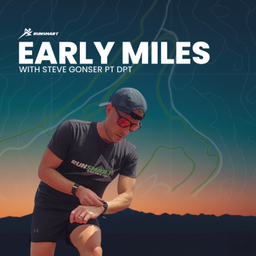
Early Miles with Steve Gonser is about how people are built, not just how they perform. Hosted by physical therapist and RunSmart founder Steve Gonser, the show features real conversations about discipline, health, and the early miles that shape who we become. No hype. No shortcuts. Just stories, science, and perspective for anyone trying to stay in it for the long run.
- Publisher
- RunSmart
- Category
- sports
- Language
- en
- Explicit
- No
- First episode
- 31 Dec 2025
- Latest episode
- 31 May 2026
Latest episodes
15 episodes in the feed.
31 May 2026
#14 Ultra DNF at Cayuga 50
Most race recaps you hear are the highlight reel — the PRs, the podiums, the "everything clicked" days. This one isn't that. In this episode, I walk through a 50-mile mountain ultra in Ithaca's gorge country that I'd trained hard for — the best shape I've been in in a decade — and the day it came apart anyway. I DNF'd at mile 35 with 7,200 feet of climbing already in my legs, then spent the night back at the hotel watching the clock, worried I was sliding into rhabdomyolysis. I pull up my heart rate and elevation data and talk through exactly where it went sideways, why the descents (not the climbs) wrecked me, how I made the call to stop, and the dehydration and rhabdo scare that followed. As a PT, I also break down what rhabdo actually is and the warning signs every endurance athlete should know. If you've ever wondered whether quitting can be the disciplined choice, this one's for you.
27 May 2026
#13 RED-S and the Female Runner with Dr. Kate Ackerman MD MPH
Dr. Kate Ackerman, co-founder and president of the WHSP Institute (Women's Health, Sports & Performance) and head doctor for US Rowing, joins the show to walk through one of the most important and least understood topics in women's endurance sport: Relative Energy Deficiency in Sport, or RED-S. When Dr. Ackerman made the US national rowing team during her first year of medical school over 25 years ago, she opened her sports medicine textbook and noticed something strange — women were a chapter. A single chapter. Every protocol she was training under had been studied in men. That gap shaped her entire career, from founding work in the female athlete space to helping the International Olympic Committee design the RED-S clinical assessment tool used today. In this episode, Steve Gonser sits down with Dr. Ackerman to unpack how the field has evolved — from the original 1990s Female Athlete Triad to the broader, system-wide picture we have now. They walk through the science of what's actually happening when energy availability drops: the body's caveman-era survival logic, the reproductive system going first, and the cascade through thyroid, cardiovascular, GI, cognitive function, recovery, and ultimately performance. Performance is the framing Dr. Ackerman has found resonates with athletes who don't yet care about osteoporosis or missed cycles. The conversation then walks the full female athlete lifespan. Adolescents going through peak height velocity before peak bone mineralization, and why that window is so vulnerable. The social media feeds quietly reinforcing thigh-gap culture for teen girls while the rest of us scroll past entirely different content. Postpartum runners trying to chase a pre-baby body while breastfeeding pulls calcium directly from bone. The bone density arc — 90% of peak bone mass built by age 18 — and what that means for everyone after. Why runners' linear, single-plane loading doesn't build bone as well as multi-directional movement does, and why even elite male cyclists end up with osteoporotic bones. And finally, perimenopause and menopause: the symptom cornucopia, the GLP-1 question, the supplement noise, and the lifestyle levers that actually move the needle. Throughout, Dr. Ackerman makes a clear point: women have real questions, the answers are starting to come, but the space has filled with people on Instagram calling themselves experts. Knowing where to look — and which clinicians, dieticians, and resources are actually credentialed — is half the battle. If you're training through your 40s, raising a young athlete, navigating perimenopause, or trying to make sense of why your body is responding differently than it used to… this episode is the framework you've been looking for. Connect with WHSP Institute: https://www.whspmedical.com/institute https://instagram.com/whsp_institute Connect with Dr. Ackerman: https://www.instagram.com/drkateackerman/ Connect with RunSmart: https://instagram.com/runsmartofficial https://runsmartonline.com
12 May 2026
#12 Clearing the Calendar with Felicia Pasadyn
Saucony pro runner and NYU medical student Felicia Pasadyn returns to Early Miles for the conversation no one wanted to record. Months after signing her first pro contract, Felicia ran a 32:04 PR to win The TEN in late March… and days later was diagnosed with a calcaneal stress fracture. Boston was off the calendar. In this episode, Steve Gonser sits down with Felicia to walk through the full timeline. The delayed symptom onset. The diagnostic journey from a clean X-ray through to the MRI at NYU that finally caught it. The unusual location of the injury and what likely tipped a manageable training load over the edge. Felicia also shares what happened when she fed her entire training log into ChatGPT and got back the word "psychotic"… and what that prompted her to reconsider about living almost exclusively in zones three through five, skipping rest days, and running high-risk, high-reward when the next five years of residency are about to make that style impossible anyway. The conversation also digs into territory most running podcasts skip. As a soon-to-be diagnostic radiologist talking to a PT with fifteen years of running clinical experience, Felicia and Steve land on opposite sides of an honest debate about imaging, conservative care, and when an MRI actually changes management. They cover RED-S and hypothalamic amenorrhea, why a full hormonal workup mattered even when she suspected the injury was purely mechanical, and how the conversation around energy availability has finally started to normalize in elite endurance sport. Felicia then talks through her return-to-run plan with her ortho, the cross-training base that gives her more options than the average injured runner, and the mental traps Steve has seen athletes fall into at every level — the bargaining, the phantom pains, the slow creep of "just ten more minutes." She's heading into a Cleveland Clinic radiology residency in Florida with two weeks of vacation per year for the next five years, and she's clear-eyed that this chapter of her running will look different. Slower, healthier, more patient. And, by her own framing, worth it. If you've ever come back from a stress fracture, wrestled with whether to push for imaging, or felt the tension between training hard now and training sustainably for the long haul… this one will land. Catch Felicia's first appearance on Early Miles here: https://runsmartapp.com/felicia-ep1 (https://runsmartapp.com/felicia-ep1) Connect with Felicia:https://instagram.com/feliciapasadyn (https://instagram.com/feliciapasadyn) https://instagram.com/wellfeliciafit (https://instagram.com/wellfeliciafit) Connect with RunSmart:https://instagram.com/runsmartofficial (https://instagram.com/runsmartofficial) https://runsmartonline.com (https://runsmartonline.com)
28 Apr 2026
#11 NeverSecond with Bill Armstrong
Bill Armstrong, co-founder of Neversecond, joins the show to break down one of the biggest shifts happening in endurance sports today… fueling. For years, endurance athletes were told to take in minimal carbohydrates during training and racing. That approach shaped how runners fueled for decades. But as the sport has evolved, so has the understanding of how much fueling actually impacts performance. In this episode, Steve Gonser sits down with Bill to unpack the full story behind Neversecond and the evolution of modern fueling strategies. From early misconceptions around carbohydrate intake to the breakthrough of multiple transportable carbohydrates, Bill explains how the science has progressed and why athletes are now fueling at levels once thought impossible. The conversation goes beyond theory and into application. They discuss what happens physiologically when you underfuel, how fueling impacts performance late in races, and why consistency and precision matter more than most runners realize. Bill also shares the origin of Neversecond, the gap he saw between research and real-world products, and how the company set out to build a system that athletes could trust and execute on race day. If you’ve ever hit the wall, struggled to maintain pace late in a run, or felt unsure about how to fuel… this episode will give you a clearer framework to work from. Connect with NEVERSECOND: https://instagram.com/never.second/ https://never2.com/ Connect with RunSmart: https://instagram.com/runsmartofficial https://runsmartonline.com
14 Apr 2026
#10 Pushing the Limit with Ethan Shuley
We recorded this episode at 5 a.m. to catch Ethan Shuley while he’s in Japan living and training. Before running 2:07 and landing one of the top 10 fastest U.S. marathon times, Ethan’s start in the sport wasn’t what you’d expect. He talks through the early days of struggling to keep up, skipping races, and not enjoying running… and the moments that shifted his mindset. In this conversation, we get into: His early experience with running and what almost pushed him away from the sport The turning point that changed how he approached training What his current setup looks like training in Japan How his perspective on effort, consistency, and competition evolved This is a look at what actually shaped one of the fastest marathoners in the U.S. right now. Connect with our founder & host: https://www.instagram.com/stevegonserdpt/ (https://www.instagram.com/stevegonserdpt/) Connect with our guest: https://www.instagram.com/ethanshuley/ (Connect with our guest: https://www.instagram.com/ethanshuley/) If you’d like to learn more about runsmart. Personalized running, strength, and recovery plans designed by Physical Therapists. Check us out at: https://runsmartonline.com/ (https://runsmartonline.com/) https://www.facebook.com/runsmartofficial (https://www.facebook.com/runsmartofficial) https://www.instagram.com/runsmartofficial (https://www.instagram.com/runsmartofficial) https://www.tiktok.com/@runsmartofficial (https://www.tiktok.com/@runsmartofficial)
12 Apr 2026
#9 11 Second Miss with Elle Orie
Running a 2:30 marathon while attending medical school is a rare balancing act. In this episode, Steve Gonser sits down with Elle Orie to explore the path from multi-sport athlete in Orchard Park, New York, to Cornell distance runner, Colorado steeplechaser, and emerging elite marathoner. Gabrielle reflects on her late start in competitive running, her development through collegiate track and cross country, and how a strong aerobic base from swimming shaped her endurance progression. The conversation also dives into the realities of pursuing elite-level performance while managing the demands of medical training. Elle discusses waking up at 3 a.m. for runs during clinical rotations, building toward 100-mile weeks, and the emotional swing of missing the Olympic Trials standard by just 11 seconds before breaking through with a 2:30 marathon at the Chevron Houston Marathon. Along the way, she shares lessons on fueling, recovery pacing, staying healthy, and keeping the sport fun even while chasing world-class goals. Connect with our founder & host: https://www.instagram.com/stevegonserdpt/ (https://www.instagram.com/stevegonserdpt/) Connect with our guest: https://www.instagram.com/gabrielleorie/ (https://www.instagram.com/gabrielleorie/?utm_source=chatgpt.com) https://www.linkedin.com/in/elle-orie-5444841a9/ (https://www.linkedin.com/in/elle-orie-5444841a9/) If you’d like to learn more about runsmart. Personalized running, strength, and recovery plans designed by Physical Therapists. Check us out at: https://runsmartonline.com/ (https://runsmartonline.com/) https://www.facebook.com/runsmartofficial (https://www.facebook.com/runsmartofficial) https://www.instagram.com/runsmartofficial (https://www.instagram.com/runsmartofficial) https://www.tiktok.com/@runsmartofficial (https://www.tiktok.com/@runsmartofficial)
23 Mar 2026
#8 Underfueling with Shannon Wilson MS RDN CDN CDCES CSSD
In this episode, we sit down with registered sports dietitian Shannon Wilson to break down the most common fueling mistakes runners make—starting with chronic underfueling. Together, they outline practical ways runners can match intake to training load, recognize red flags of low energy availability, and shift away from weight-loss goals during a marathon build to reduce injury risk and protect performance. The conversation also covers simple, repeatable strategies for long-run prep, carb loading, and during-run fueling—plus how to trial gels, candy, and drink mixes to find what works. We close with recovery basics, including post-run timing, sleep-supportive nutrition habits, and a realistic approach to supplements and caffeine for runners who want better consistency without overcomplicating the process. Connect with our founder & host: https://www.instagram.com/stevegonserdpt/ Connect with our guest: https://www.shannonwilsonrd.com/ https://www.instagram.com/sportsdietitianshannon/ If you’d like to learn more about runsmart. Personalized running, strength, and recovery plans designed by Physical Therapists. Check us out at: https://runsmartonline.com/ https://www.facebook.com/runsmartofficial https://www.instagram.com/runsmartofficial https://www.tiktok.com/@runsmartofficial
10 Mar 2026
#7 Going All In: Joe Whelan
Joe Whelan’s path to 2:09 was not linear. From breaking his kneecap in college to battling recurring stress fractures, he spent years navigating setbacks, under-recovery, and training imbalances. After stepping away from the sport and later returning through self-coached marathon builds, Whelan steadily rebuilt his engine—learning how fueling, sleep, controlled volume progression, and smarter intensity distribution separated 2:15 fitness from 2:09 performance. In this episode, he breaks down the mindset shift that fueled his breakthrough, the decision to leave full-time work to prioritize recovery, and the tactical execution behind his course-record win at the Austin Marathon. Whelan also reflects on Olympic Trials preparation, pacing discipline, race-day strategy, and his goal of climbing into the top 15 all-time U.S. marathon performances as he builds toward 2028. Connect with our founder & host: https://www.instagram.com/stevegonserdpt/ (https://www.instagram.com/stevegonserdpt/) Connect with our guest: https://www.instagram.com/jpwhelan23/ (https://www.instagram.com/jpwhelan23/) If you’d like to learn more about personalized running, strength, and recovery plans designed by Physical Therapists, check us out at: https://runsmartonline.com/ (https://runsmartonline.com/) https://www.facebook.com/runsmartofficial (https://www.facebook.com/runsmartofficial) https://www.instagram.com/runsmartofficial (https://www.instagram.com/runsmartofficial) https://www.tiktok.com/@runsmartofficial (https://www.tiktok.com/@runsmartofficial)
25 Feb 2026
#6 Sleep (And) Traning with Dr. Jeff Durmer MD PhD
In this conversation, Jeffrey Durmer discusses his journey from athlete to sleep expert, explores the evolution of sleep medicine, the impact of consumer technology on sleep tracking, and the significance of heart rate variability (HRV). He emphasizes the effects of sleep deprivation, cultural attitudes towards sleep, and strategies for optimizing sleep for athletic performance, including the importance of circadian rhythms and food timing. In this conversation, Dr. Jeffrey Durmer discusses the significance of chronotypes in determining sleep patterns, the importance of recovery sleep for athletes, and the impact of mood on sleep quality. He emphasizes the benefits of light therapy for enhancing mood and performance, and outlines best practices for creating a sleep-friendly environment. The discussion also covers the effects of alcohol and diet on sleep and concludes with insights into the future of sleep monitoring and the integration of AI to personalize sleep health. Connect with our founder & host: https://www.instagram.com/stevegonserdpt/ (https://www.instagram.com/stevegonserdpt/) Connect with our guest: Website: (https://keiradamato.com/hello/)https://www.happysleep.com/ (https://www.happysleep.com/ ) Instagram: https://www.linkedin.com/in/jeffreydurmer/ (https://www.linkedin.com/in/jeffreydurmer/) If you’d like to learn more about runsmart. Personalized running, strength, and recovery plans designed by Physical Therapists. Check us out at: https://runsmartonline.com/ (https://runsmartonline.com/%E2%81%A0) https://www.facebook.com/runsmartofficial (https://www.facebook.com/runsmartofficial%E2%81%A0) https://www.instagram.com/runsmartofficial (https://www.instagram.com/runsmartofficial%E2%81%A0) https://www.tiktok.com/@runsmartofficial (https://www.tiktok.com/@runsmartofficial)
13 Feb 2026
#5 Don't Call It a Comeback: Keira D'Amato
Keira D'Amato joins Early Miles to unpack one of the most unconventional journeys in American distance running. From five-time Virginia state champion to collegiate All-American at American University, her early trajectory pointed toward elite competition—until injuries, burnout, and an insurance-denied surgery led her to step away from the sport entirely. Nearly a decade later, after marriage, motherhood, and a full professional career, she returned to running with a 90-second effort that would ultimately evolve into an American record in the marathon. In this conversation, she details the mindset shift that fueled her second chapter: embracing failure, prioritizing long-term consistency, rebuilding strength after injury, and redefining success beyond results. She discusses Olympic Trials disappointment, racing strategy, aging as an elite athlete, training adaptations in her 40s, and the value of structured development over chasing quick gains. For runners at any level, this episode reinforces a core principle—progress is built through patience, resilience, and the courage to start again. Don’t Call It a Comeback by Keira D'Amato Official Purchase Link: https://static.macmillan.com/static/smp/dont-call-it-9781250344946 (https://static.macmillan.com/static/smp/dont-call-it-9781250344946) Connect with our founder & host: https://www.instagram.com/stevegonserdpt/ (https://www.instagram.com/stevegonserdpt/) Connect with our guest: Website: https://keiradamato.com/hello/ (https://keiradamato.com/hello/) Instagram: https://www.instagram.com/keiradamato/ (https://www.instagram.com/keiradamato/) If you’d like to learn more about runsmart. Personalized running, strength, and recovery plans designed by Physical Therapists. Check us out at: https://runsmartonline.com/ (https://runsmartonline.com/%E2%81%A0) https://www.facebook.com/runsmartofficial (https://www.facebook.com/runsmartofficial%E2%81%A0) https://www.instagram.com/runsmartofficial (https://www.instagram.com/runsmartofficial%E2%81%A0) https://www.tiktok.com/@runsmartofficial (https://www.tiktok.com/@runsmartofficial)
30 Jan 2026
#4 Training for Spring Races
In this episode, we break down how to structure half or full marathon training so we can build fitness without breaking down. We use the idea of three training “levers” — duration, frequency, and effort — and explain why pulling more than one at the same time is where many runners get hurt. We talk about giving ourselves a long enough training runway, spending the first 50–70% of a plan focused on base building and conversation-pace running, and being careful not to overload our weeks with too much speed work too early. The goal isn’t to crush every workout — it’s to stay consistent, avoid injury, and arrive at race day feeling strong and confident. We also cover smart long-run progression, why big spikes in mileage raise injury risk, and how a simple two-weeks up, one-week down structure helps the body adapt. Along the way, we get into practical topics like adjusting for winter running conditions, practicing race fueling during long runs, improving recovery with carbs plus protein after workouts, and adding efficient strength training to build durability. Whether we’re training for our first marathon or our tenth, this episode is all about making training fit real life, protecting our bodies, and building a sustainable relationship with running for years to come. Connect with our founder & host: https://www.instagram.com/stevegonserdpt/ (https://www.instagram.com/stevegonserdpt/) If you’d like to learn more about runsmart. Personalized running, strength, and recovery plans designed by Physical Therapists. Check us out at: https://runsmartonline.com/ (https://runsmartonline.com/) https://www.facebook.com/runsmartofficial (https://www.facebook.com/runsmartofficial) https://www.instagram.com/runsmartofficial (https://www.instagram.com/runsmartofficial) https://www.tiktok.com/@runsmartofficial (https://www.tiktok.com/@runsmartofficial)
10 Jan 2026
#3 ER to WR: Anne Flower
Anne shares her journey from a childhood filled with outdoor adventures in Cincinnati to becoming a record-breaking ultramarathon runner. She discusses her experiences in various races, including the Leadville 100 and Tunnel Hill, and how her background as an ER physician influences her approach to running and training. Anne emphasizes the importance of balancing her professional life with her passion for the outdoors and running, and her commitment to fostering a love of nature in her family. With aspirations for future races and a focus on her nonprofit work, Anne's story is one of resilience, adventure, and the joy of running.
1 Jan 2026
#2 Ohio to Olympic Trials: Felicia Pasadyn
Felicia Pasadyn is a 2:35 marathoner, former Olympic Trials swimmer, and current NYU medical student who returned to elite-level running by doing almost everything differently than the standard marathon playbook. In this conversation, Felicia talks about growing up in Brunswick, Ohio, competing at Harvard and Ohio State, and how her background in swimming shaped her approach to training, strength work, and injury management. We get into her unconventional buildup to the New York City Marathon, including managing an Achilles issue days before the race and what it was like lining up and racing in the pro field. Felicia also reflects on finishing NYC, the disbelief that followed, and the online debate around her training methods. We talk fueling, community support, balancing medical school with high-level training, her decision to pursue radiology, and how she sees AI playing a role in future patient care. A wide-ranging conversation about durability, adaptation, and building a sustainable path in both running and life.
1 Jan 2026
#1 All About Me?
Steve Gonser shares his journey from a reluctant runner to a passionate marathoner, discussing his experiences, challenges, and the evolution of his training methods. He highlights the importance of context in research, the role of strength training, and his personal health discoveries. The episode sets the stage for future conversations with athletes and experts in the running community.
31 Dec 2025
About This Podcast
Most conversations about running focus on performance. Times. Results. The highlight reel. Early Miles is a long-form conversation podcast about how runners are shaped over time, not just how they perform on race day. Some episodes center on personal stories. Others dive deep with experts. And some are driven by questions from the running community. Hosted by physical therapist and runner Steve Gonser, the show explores the early decisions, struggles, failures, pivots, and quiet habits that compound when no one is watching. From everyday runners to coaches, clinicians, and researchers, Early Miles sits at the intersection of storytelling, real conversation, and science-backed thinking you can actually apply. If running is part of who you are, you’re in the right place.
Reach and audience
Public platform figures. Ratings count people who left a rating, not total listeners.
- Apple Podcasts (US)
- 5.0 / 5
- 2 ratings
Contact Early Miles with Steve Gonser
- Guest appearances
- Books guests
Based on episode analysis; this does not confirm that the show is currently accepting guests.
Host of Early Miles with Steve Gonser?
Claim your podcast to manage its listing and keep your show details accurate.
Pod Engine is an independent podcast discovery and analytics service and is not affiliated with or endorsed by this podcast. Artwork and show content belong to their owners. Full legal notice.
Explore this show
Podcast research with Pod Engine