- 110
- Episodes
- 2
- Ratings
- Daily
- Cadence
- 2026
- First episode
About Echoes of the Past
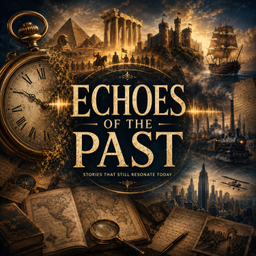
Every age leaves something behind. Echoes of the Past brings history to life through the stories that still resonate today, from world-changing events to the quiet, forgotten lives that history almost left behind. Each episode travels to a different time and place, uncovering what happened, why it mattered, and how it still echoes in our world. Whether you're a lifelong history lover or just curious about where we came from, pull up a chair and listen, the past has a lot to say.
- Publisher
- Prashant Sharma
- Category
- history
- Language
- en
- Explicit
- No
- First episode
- 20 Jun 2026
- Latest episode
- 13 Sept 2026
Latest episodes
110 episodes in the feed.
13 Sept 2026
Episode 110: Fordlândia — The Fungus That Defeated Henry Ford
Henry Ford had built an empire by making machines move. So when he turned his attention to the Amazon, he believed he could make the jungle work for him too. In the 1920s, Ford set out to create something extraordinary in the heart of Brazil: a vast rubber plantation that would supply his growing automobile empire with its own source of latex. The project was named Fordlândia—literally, “Ford-land.” The idea seemed simple. Grow rubber trees. Harvest latex. Ship it to Ford's factories. Reduce dependence on foreign suppliers. But the Amazon was about to teach one of the world's most powerful industrialists a lesson that money and machinery could not easily overcome. Fordlândia was carved out of the rainforest on the banks of the Tapajós River. American managers introduced roads, houses, warehouses, hospitals, schools, power infrastructure, and an entire industrial settlement modeled partly on Ford's vision of modern life. But there was one thing Ford could not manufacture: an Amazonian ecosystem. The plantation's rubber trees were planted in dense rows rather than scattered naturally through the forest. That created an ideal environment for pests and fungal diseases—particularly South American leaf blight. The fungus spread. And once it did, an enormous plantation could become a liability rather than an advantage. The project also faced cultural clashes. Workers accustomed to local conditions resisted aspects of the rigid industrial lifestyle imposed by Ford's managers. Food, working hours, housing, wages, and management practices all became sources of tension. In 1930, frustration erupted into violence during what became known as the Fordlândia revolt. Workers attacked company property, destroyed equipment, and drove managers from the settlement. Fordlândia survived, but the dream was already badly damaged. A second plantation, Belterra, was later established with better conditions and different cultivation methods. Yet the economics of synthetic rubber, wartime changes, disease, and the project's enormous difficulties ultimately made Ford's Amazonian experiment a spectacular failure. Ford's company eventually abandoned the plantations in 1945. The jungle reclaimed much of what had been built. But Fordlândia remains fascinating because its failure was not simply a story about bad luck. It was a collision between industrial certainty and ecological complexity—between an American factory model and an environment that refused to behave like one. Henry Ford had mastered the assembly line. The Amazon had no assembly line. What you’ll learn: Why Henry Ford wanted his own rubber supply in the Amazon How Fordlândia was built as an industrial settlement deep in Brazil Why Ford's plantation design made the trees unusually vulnerable to disease How South American leaf blight devastated the rubber plantations Why Ford's American-style management created conflict with local workers What triggered the Fordlândia revolt of 1930 Why the later Belterra plantation also failed to deliver Ford's original dream How Fordlândia became a classic example of the limits of industrial control over nature Ford arrived in the Amazon believing that modern industry could tame the rainforest. Instead, the rainforest exposed the limits of modern industry. The factories, roads, houses, and machinery could all be built according to plan. But the fungus didn't read the plan. And in the end, one of the world's greatest industrial empires discovered that there are some systems—even enormous ones—that cannot simply be engineered into obedience.
13 Sept 2026
Episode 109: The Light of Reason — Ibn al-Haytham and the Experiment
What if one of the most important breakthroughs in the history of science began with a simple question: How do we see? More than a thousand years ago, in the intellectual world of the medieval Islamic civilization, scholars had already inherited centuries of ideas about vision and light. Some believed that vision occurred because rays emerged from the eyes and reached the objects around us. Then came Ibn al-Haytham. Born in the tenth century and later working in Cairo, Ibn al-Haytham—known in the Latin West as Alhazen—approached the problem differently. Instead of simply accepting the authorities who came before him, he asked how their claims could actually be tested. His investigations into light and vision would transform optics. Through careful observation, geometry, controlled experiments, and ingenious devices, Ibn al-Haytham argued that vision occurs because light travels from objects into our eyes, rather than because the eyes send rays outward. He investigated reflection, refraction, shadows, lenses, and the behavior of light through small apertures. One of his most famous demonstrations involved a darkened room and a tiny opening through which light entered, producing an image of the outside world on the opposite surface—the principle now associated with the camera obscura. But Ibn al-Haytham's importance goes beyond any single discovery. He insisted that ideas about the natural world should be subjected to evidence. Hypotheses needed to confront observation. Mathematical reasoning could be combined with physical experimentation. When an explanation failed to match what nature actually did, the explanation—not nature—had to be questioned. That intellectual attitude would prove extraordinarily influential. His Book of Optics circulated widely and was eventually translated into Latin, helping carry his work into medieval European scholarship. Centuries later, his investigations would be recognized as an important part of the long development of experimental science. Yet the story of Ibn al-Haytham is also deeply human. Tradition holds that he deliberately claimed he could regulate the Nile's flooding, an assertion that brought him into conflict with the Fatimid ruler al-Hakim. Whether every detail of the famous account is reliable remains debated, but Ibn al-Haytham did spend years in Cairo under difficult circumstances—and those years became associated with some of his most important intellectual work. His life reminds us that scientific revolutions do not always begin with powerful institutions or sophisticated laboratories. Sometimes they begin with someone refusing to accept an answer simply because it has been repeated for generations. What you’ll learn: Who Ibn al-Haytham was and why he became one of the great scholars of the medieval world How he challenged prevailing theories about vision and light Why his experiments in optics were so revolutionary How the camera obscura helped demonstrate the behavior of light How observation, mathematics, and experimentation shaped his approach to science What the Book of Optics contributed to the history of optics How his ideas eventually reached European scholars Why Ibn al-Haytham remains an important figure in the long history of scientific inquiry Light was always around him. But Ibn al-Haytham did something remarkable: he turned it into a question. And by refusing to trust an answer until nature itself had been asked, he helped change the way humanity investigates the world. The light he studied illuminated more than the human eye. It illuminated a way of thinking.
13 Sept 2026
Episode 108: Great Zimbabwe — The Houses of Stone and the Denial of Power
Across the highlands of southern Africa, rising from the grasslands are walls that seem almost impossible to explain. Enormous blocks of granite fit together without mortar, forming towers, enclosures, passageways, and sweeping stone walls that have survived for centuries. This is Great Zimbabwe—one of Africa's greatest medieval cities, and one of the most powerful archaeological reminders of a civilization that colonial history once struggled to acknowledge. Between roughly the twelfth and fifteenth centuries, the ancestors of the Shona people built and inhabited this extraordinary urban center in what is now Zimbabwe. At its height, Great Zimbabwe was far more than a collection of ruins. It was a political and economic center connected to a much wider world. Its rulers participated in long-distance trade networks stretching across southern Africa and toward the Indian Ocean. Archaeologists have discovered evidence of imported goods, including Chinese ceramics and Persian and Arabian objects, revealing that Great Zimbabwe was connected to a global trading system centuries before European colonial rule reached the region. And then came a different kind of conquest. When European explorers and colonial authorities encountered the ruins, some found it difficult—or politically inconvenient—to accept that such an impressive stone city had been built by Africans. Instead, fantastical theories emerged. The builders were supposedly Phoenicians. Or Arabs. Or descendants of the biblical Queen of Sheba. Almost anyone except the people whose ancestors had actually lived there. Archaeology eventually dismantled those claims. Evidence from excavations, architecture, artifacts, and regional history established that Great Zimbabwe was an indigenous African achievement, closely associated with the ancestors of the Shona-speaking peoples. But the damage caused by those earlier interpretations was more than academic. The debate over Great Zimbabwe became entangled with colonial ideas about race, civilization, and political legitimacy. If Africans had built sophisticated cities, developed powerful states, controlled trade networks, and created monumental architecture of their own, then the colonial narrative of Africa as a continent without complex civilizations became much harder to sustain. Great Zimbabwe therefore tells two stories. The first is about a remarkable medieval society that built one of Africa's most extraordinary architectural achievements. The second is about what happens when history is interpreted through the prejudices of those who discover it. What you’ll learn: Who built Great Zimbabwe and when the city flourished How its remarkable mortarless stone architecture was constructed Why Great Zimbabwe became an important political and economic center How its trade networks connected southern Africa with the wider Indian Ocean world What archaeological discoveries reveal about the people who lived there Why European observers once attributed the city to foreigners rather than Africans How archaeology challenged the myths surrounding its origins Why Great Zimbabwe became an important symbol of African history and cultural achievement The stones of Great Zimbabwe never needed to announce who built them. They simply endured. For centuries, those walls stood above the landscape while others argued over who could possibly have created them. Today, the evidence tells a different story. The mystery was never that Africans could build Great Zimbabwe. The mystery was why so many people found that possibility so difficult to believe.
Reach and audience
Public platform figures. Ratings count people who left a rating, not total listeners.
- Spotify
- 5.0 / 5
- 2 ratings
Contact Echoes of the Past
- Guest appearances
- Does not typically book guests
Based on episode analysis; this does not confirm that the show is currently accepting guests.
Host of Echoes of the Past?
Claim your podcast to manage its listing and keep your show details accurate.
Pod Engine is an independent podcast discovery and analytics service and is not affiliated with or endorsed by this podcast. Artwork and show content belong to their owners. Full legal notice.
Explore this show
Podcast research with Pod Engine