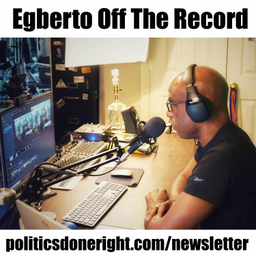
Egberto Off The Record
Hosted by Egberto and Egberto Off The Record · Fact-Based Political News & Opinion
4.5from 8 ratings
- 772
- Episodes
- 8
- Ratings
- Daily
- Cadence
- 2025
- First episode
About Egberto Off The Record
Live versions of my Politics Done Right media/radio show. Included are “Egberto Off The Record” Substack lives with other Substackers. We also include some interviews from the media/radio show with politicians, activists, and engaged citizens. And of course, you get some of my Off-The-Record commentary. egberto.substack.com (https://egberto.substack.com/s/eotr-podcast?utm_medium=podcast)
- Publisher
- Fact-Based Political News & Opinion
- Category
- news · news
- Language
- en
- Explicit
- No
- First episode
- 3 Mar 2025
- Latest episode
- 7 Oct 2026
Latest episodes
772 episodes in the feed.
7 Oct 2026
LIVE! WBAI: Iran War & AI; Sanders’ MAGA Ad Revolt; Mullin’s ChatGPT; Bennet Slams Dems; Water Profits
Thank you Elwyn Hudson (https://substack.com/profile/201404477-elwyn-hudson), EG (https://substack.com/profile/167763372-eg), Lisa randall (https://substack.com/profile/321633453-lisa-randall), Marg KJ (https://substack.com/profile/1105584-marg-kj), John A (https://substack.com/profile/299801940-john-a), and many others for tuning into my live video! * Jenna Flanagan’s WBAI Panel Challenges Trump’s Iran War and the AI Industry’s Power: Jenna Flanagan’s WBAI panel confronts Trump’s Iran war and AI agenda, asking who profits from escalation, who pays for job losses, and why corporate accountability must come first. [More (https://egberto.substack.com/p/jenna-flanagans-wbai-panel-challenges)] * Sarah Huckabee Sanders in trouble with MAGA for ad inferring truth about social programs: Huckabee made a commercial that offended MAGA because it used a white guy getting welfare. * Trump cabinet member gets advice from ChatGPT on how red states turn blue: * Democratic US Senator Calls Establishment-Controlled Democratic Party ‘A Failed Enterprise’: “It’s so hard... to imagine a worse failure than losing two national elections to Donald Trump.” [More (https://www.commondreams.org/news/michael-bennet-democratic-establishment)] * To Ease ‘Rapidly Expanding’ Water Affordability Crisis, Report Calls for Ban on Privatization: “Rampant corporate control of our water systems and federal disinvestment in aging infrastructure are driving up bills, forcing households to pick up the tab.” [More (https://www.commondreams.org/news/water-affordability-crisis-privatization)] Politics Done Right Program/Chat Analysis October 6, 2026 — 3:00 PM CT broadcast Program summary This broadcast connected economic accountability, voting rights, racial scapegoating, and independent journalism through a central argument: democracy requires an informed public that remains organized beyond Election Day. The program challenged Republican policies and the corporate interests they serve while criticizing Democrats for weak communication and their reluctance to confront wealthy benefactors. Its emotional closing brought those political concerns into a deeply personal discussion of grief, solidarity, and the importance of maintaining human connections. The actual broadcast shifted from the advance program lineup. The host explicitly substituted an Arnie Arnesen discussion for the previously aired Jenna Flanagan panel. The substantive segments centered on that conversation, Sarah Huckabee Sanders’ advertisement, and Markwayne Mullin’s use of ChatGPT. Michael Bennet and water privatization did not receive substantive coverage in the supplied transcript. * Economic accountability and Democratic messaging: The host argued that Trump’s tariffs, treatment of trading partners, and Iran war directly harmed farmers, small businesses, and household finances. Responding to a commenter’s point about Congress’ authority, he acknowledged congressional responsibility while emphasizing Trump’s own decisions. He also warned that Democrats could inherit blame for economic damage caused by Republican policies unless they clearly explain who enacted them. * Voting access and sustained organizing: The Arnie Arnesen segment examined delayed transfers of Texas voter-registration information and the administrative burdens counties faced. The discussion emphasized smaller counties’ limited resources and the risk of conflicting registration records. Arnesen and the host argued that winning elections accomplishes too little if campaigns subsequently dismantle their organizing networks. Maintaining engagement, delivering tangible improvements, and explaining those improvements formed the proposed alternative. * Corporate influence, courts, and religious exclusion: The discussion connected the Powell Memo and conservative institution-building to corporate influence over government and the judiciary. It also challenged anti-Muslim rhetoric and education policies in Texas. The host presented the candidacy of a Black Muslim woman for Harris County judge as a counterpoint to exclusionary politics and an example of the possibilities that voter participation could create. * Racial narratives and misuse of AI: The Sanders segment examined MAGA outrage over an advertisement portraying a white man as an undeserving public-benefit recipient. The host interpreted that response as evidence of racial conditioning that divides people with shared economic needs. He extended the critique to Clinton-era welfare messaging. The Mullin segment then challenged the leap from a chatbot’s response about changing voting demographics to an allegation of a Democratic immigration plot. * Independent media and community responsibility: The host explained the program’s AI-assisted transcript and chat summaries as a paid-subscriber benefit that helps keep core political reporting freely available. He emphasized human editing and invited corrections. The closing became a heartfelt reflection on a friend’s death by suicide, followed by an appeal for listeners to communicate, acknowledge distress, and support one another. The broadcast’s unifying message was that political education must lead to participation and solidarity. It paired a forceful critique of concentrated power with a practical call to build communities capable of sustaining the work. Chat sentiment The supplied comments conveyed strong support for the program, anger over political and economic conditions, concern about voting access, and substantial frustration with Democratic communication. The discussion also contained dissent and an isolated authoritarian outburst. Its final emotional turn was unmistakable: listeners responded to the host’s grief with compassion and reassurance. These observations describe the supplied comments, not every viewer. Join notifications establish attendance, not political agreement. Community warmth and support for independent media The Substack discussion showed a strong sense of familiarity and belonging. [Renee Paden] praised the recent programs, while [Brittani] explained that work prevented a call. [John Cotter] expressed concern about the host feeling unwell. [Tim Danahey] offered the clearest endorsement of the program’s value, encouraging paid subscriptions while explicitly noting that agreement on every issue was unnecessary. His comments framed financial support as a way to sustain an informed, caring progressive voice. Exchanges involving [John A], [Vegan Cindy], and [Cheryl 🦅] reinforced the impression of an ongoing community rather than a collection of disconnected viewers. Electoral urgency tempered the host’s optimism [Gene Daigle] forcefully warned against assuming a Democratic victory, emphasizing that turnout determines the outcome. That comment supplied an important counterweight to the host’s confident electoral prediction without rejecting the program’s broader political objectives. [EG] described checking voter registration and choosing to vote in person, conveying anxiety about election administration and mail delivery. [John Cotter] echoed the program’s concern that small Texas counties lack Harris County’s resources to address registration problems. Together, these comments expressed determination alongside distrust: participants wanted to win, but several emphasized the practical work necessary to make voting and turnout possible. Frustration with Democratic communication [John Cotter] strongly endorsed Arnesen’s call for continued engagement and argued that voters had not understood the Biden administration’s accomplishments. [Renee Paden] agreed that Democrats neglect self-promotion. These exchanges reflected dissatisfaction with how Democrats communicate and maintain public involvement. They supported the program’s argument that passing policies and winning elections must accompany sustained public education. Economic anger and disagreement over responsibility In the Facebook-labeled, Restream-style feed, [Paul Fleming] repeatedly posted material challenging Trump’s economic claims and raising concerns about inequality, benefit cuts, environmental conditions, and other public issues. His contributions conveyed anger and urgency while expanding the discussion beyond the immediate segments. [Gene Daigle] questioned the emphasis on trade deficits, pointing toward consumption and service trade. This was a substantive disagreement within a broadly progressive discussion. [@Laketravisanyone] challenged the host from a different perspective, stressing congressional power, blaming radical politics on both sides, and dismissing the likely political impact of the Sanders controversy. [Erik Hz] repeatedly criticized Harris County finances and management. These comments made the cross-platform discussion more contested than the predominantly supportive Substack exchange. The financial figures and external allegations posted in the chat remain participants’ claims; the chat itself does not verify them. Recognition of racial division and material dependence on public programs [Gene Daigle] connected racial disparities in wealth to historical barriers involving the GI Bill and home loans, then supplied a link to a photograph of Clinton signing welfare reform. These contributions extended the host’s discussion of how public policy and political imagery shape racial inequality. [EG] described people defending a hierarchy that works against their own interests. Earlier, [Jo] credited access to low-income housing with making a good life possible. That personal testimony gave the discussion of social programs a concrete human dimension. Interest in AI, accompanied by a demand for correction [EG] asked whether inaccurate AI summaries could be edited. The question prompted the host to explain his review process and invite audience corrections. That exchange distinguished practical use of AI from uncritical reliance on it. [Tim Danahey] later used humor to challenge Mullin’s demographic argument, asking whether changing voter demographics included making everyone poor. An isolated punitive outburst [Steigend Burgerkrieg] moved beyond criticism of Trump into advocating punishment and disenfranchisement of people for voting for him. That comment expressed authoritarian hostility rather than ordinary partisan disagreement. The supplied discussion does not show a broader audience endorsement of that position, and it should not define the community’s overall sentiment. Grief brought the conversation toward mutual care After the host disclosed his friend’s death, [Ilse], [John A], [Vegan Cindy], and [EG] offered condolences or reassurance. [Vegan Cindy] pushed back against the host’s sense of personal responsibility and expressed concern for his health. [Cheryl 🦅] captured the prevailing response with “We got each other!” The closing comments expressed appreciation for the host’s openness and a desire to support him. Political frustration remained part of the conversation, but the final exchange centered on connection, care, and the recognition that the people doing this work also need support. Select effortGPT-6 AstraMediumNoneMinimalLightMediumHighExtra HighMaxUltraPersistent Politics Done Right Program/Chat Analysis This post has bonus content for paid subscribers. Upgrade to get full access. [WP-ROUTING]Site: PoliticsDoneRight.comCategory: Coffee Party ShowsPubDate: 2026-10-06T15:00:00Tags: Politics Done Right, Jenna Flanagan, WBAI, We Decide, Donald Trump, Iran War, Antiwar Politics, Artificial Intelligence, AI Accountability, Corporate Power, Sarah Huckabee Sanders, MAGA, Medicaid, Social Programs, Racial Scapegoating, Welfare Stereotypes, Markwayne Mullin, ChatGPT, Immigration, Red States, Blue States, Michael Bennet, Democratic Party, Democratic Establishment, Democratic Socialists of America, Working-Class Politics, Water Privatization, Water Affordability, Food & Water Watch, Public Ownership, Public Infrastructure, Economic Justice, Progressive Politics This is a public episode. If you'd like to discuss this with other subscribers or get access to bonus episodes, visit egberto.substack.com/subscribe (https://egberto.substack.com/subscribe?utm_medium=podcast&utm_campaign=CTA_2)
6 Oct 2026
LIVE! Trump’s Iran War, AI Profits, GOP SNAP Cuts: WBAI Panel and the Fight for a Post-Capitalist World
Thank you LadyHistorian (https://substack.com/profile/89341314-ladyhistorian), Don Buckter (https://substack.com/profile/202691793-don-buckter), Cheryl 🦅 (https://substack.com/profile/28102858-cheryl), Tamar Kranick (https://substack.com/profile/43632834-tamar-kranick), Judy (https://substack.com/profile/143367321-judy), and many others for tuning into my live video! Join me for my next live video in the app. * Rahm Emanuel’s Medicare for All Stance Is a Clear and Present Danger for Democrats: Rahm Emanuel’s Medicare for All defeatism risks draining Democratic momentum. The party must confront insurance industry power and fight for healthcare as a human right. [More (https://youtu.be/i1Fz4UZ-w9Y)] * A disgraceful Rahm Emanuel continues to slam DSA: It is clear Rahm Emanuel is on a mission for the neoliberals as they fear the unhampered surge of the DSA movement. [More] * Lula Campaign Asks to Probe Sudden US Shutdown of Consular Services as ‘Interference in Brazilian Elections’: “Often at the request of the Bolsonaro family, the US has engaged in a pressure campaign to weaken the Lula government,” explained one analyst. [More (https://www.commondreams.org/news/lula-probe-trump-interference)] * Can America Recover From Trump-World?: For a forest to recover from a fire Politics Done Right Program/Chat Analysis October 6, 2026 | 6:00 AM CT | KPFT 90.1 FM Program summary The broadcast connected war, artificial intelligence, food insecurity, voting access, and healthcare through a central argument: concentrated corporate and political power forces ordinary people to absorb costs while powerful interests protect their profits. Although the host felt ill, the program maintained an assertive, conversational tone. Listener calls broadened the planned agenda, bringing South Korea’s resistance to authoritarianism and Texas voting concerns into the discussion. The opening exchange questioned why the country moves slowly toward renewable energy despite the environmental costs of continued fossil-fuel dependence. That conversation established the program’s larger theme: institutions often protect entrenched economic interests at the expense of public well-being. * Trump’s Iran war and AI accountability: The replay of Jenna Flanagan’s WBAI panel questioned the administration’s military objectives and challenged the transfer of public wealth to defense contractors. Flanagan’s question about AI-driven layoffs opened a discussion about whether an economy can thrive while companies eliminate workers. The host emphasized corporate responsibility, criticized attempts to turn regulation into protection from liability, and supported safeguards against data-center harms. * Democracy and lessons from South Korea: Calling from South Korea, Dr. John Theis described public resistance to martial law and the importance of holding presidents accountable. His account gave the broadcast an international perspective and an example of citizens confronting authoritarian power. The conversation also questioned Trump’s claims about South Korean investment commitments and challenged the normalization of presidential impunity. * Food assistance and manufactured hardship: The SNAP segment examined the consequences of shifting administrative expenses onto states while increasing program requirements. The host argued that staffing shortages, application backlogs, and delayed assistance translate budget decisions into hunger. The discussion rejected narratives that blame individuals for poverty while ignoring the structures that produce insecurity. * Technology, affordability, and voting access: Caller Jimmy compared AI alarmism with Y2K fears, prompting an extended discussion of programming, system access, and responsibility for technological harm. Caller Augie raised gasoline affordability. Caller Richard discussed his family’s educational philanthropy before raising concerns about Texas DPS handling of voter registrations. The host connected those concerns to Republican control of Texas government and resistance to accepting responsibility for its record. * Healthcare and solidarity: The closing segment challenged the idea that one person’s successful experience with private insurance vindicates the entire system. The host discussed personal insurance experiences, advocated Medicare for All, and argued that healthcare must be judged by whether everyone receives needed treatment. The moral appeal centered on empathy: personal security cannot excuse indifference to another person’s suffering. The planned discussion of a post-capitalist world remained a recurring framework rather than becoming a full examination of the advertised book review. Calls and extended exchanges on AI, democracy, and healthcare occupied that space. The broadcast nevertheless sustained its central challenge: economic arrangements should serve human needs, and organized people can demand that change. Videocast-Politics-Done-Right-o… Chat sentiment The supplied chats combined warmth toward the host and community, anger at perceived political and corporate abuses, and active questioning of the program’s arguments. Substack carried most of the visible conversation. The smaller Facebook-labeled feed featured greetings and a sustained series of questions from one participant. These observations describe the supplied comments, rather than the entire listening audience. Community support and concern for the host.[Jane B In NC🌼], [John A], [Lynette], and [sam] expressed concern about the host’s health or wished him a speedy recovery. [Karen 🐜📎], [Bobby K], [Jo], and others exchanged greetings that reinforced the community atmosphere. [LBW] explained that listening through KPFT helped avoid the temptation to text while driving. [learnercurious1] greeted the “Texas and World Family” from Louisiana, illustrating the audience’s reach beyond Houston. Anger over war, hunger, and unaccountable power.[John A] supplied much of the substantive political commentary, calling for accountability over an alleged AI connection to a school bombing in Iran, condemning the Supreme Court, and contrasting food lines with military priorities. Those comments conveyed moral outrage and impatience with institutions perceived as shielding powerful actors. The allegation about AI and the bombing appeared as a commenter’s claim; the chat itself did not establish it. Voting barriers became a discussion of everyday exclusion.[John A] questioned why voting remains difficult when banking, paying taxes, and renewing a passport can happen remotely. [Karen 🐜📎] agreed with his call for accountability over delayed registrations. [LadyHistorian] described the bureaucratic ordeal of obtaining a REAL ID for a disabled son, while [John A] recounted helping people navigate lengthy licensing delays. Their exchange connected democratic access with disability access and showed how personal experiences deepen a policy discussion. Humor about a seven-page poem softened the frustration without diminishing it. AI drew skepticism and requests for explanation.In the Facebook-labeled feed, [@Laketravisanyone] challenged the Y2K comparison, asked about AI and nuclear codes, and identified a sandbox as a controlled environment. These comments reflected concern about technological risk and dissatisfaction with explanations the participant found incomplete. The host responded at length, making this a clear example of chat participation shaping the live program. [SammyD] also responded positively to Jack’s lively presence, adding humor to the exchange. Healthcare generated both agreement and the sharpest conflict.[Judy] strongly endorsed the program’s criticism of profit-driven healthcare. [John A] emphasized a preference for doctors making treatment decisions independently of insurers. [@Laketravisanyone] asked how patients obtain meaningful choice. Meanwhile, [Do U Lie] called the discussion propaganda and repeatedly denied selling insurance after the host attributed that occupation to the commenter. The exchange escalated into profanity and accusations of dishonesty, followed by a hostile response from [Judy]. The participant’s opening remark could read as sarcasm, but the later objection was explicit: the commenter rejected the characterization of their employment. The supplied materials do not establish that occupation. This dispute therefore involved both healthcare arguments and a personal attribution that intensified the confrontation. The audience also sustained its organizing culture.[Cheryl 🦅] shared the upcoming PDR Book Club discussion of Katherine Stewart’s Money, Lies, and God. That announcement, alongside mutual encouragement and shared personal experiences, showed a community using the program for continuing political education and connection. Videocast-Politics-Done-Right-o… The dominant emotional pattern was solidarity within the community and anger directed at systems participants viewed as unjust. The closing healthcare confrontation introduced a distinctly adversarial note, but supportive greetings, substantive questions, personal testimony, and concern for the host defined much of the conversation. The strongest engagement emerged when broad critiques of power connected with concrete experiences of hunger, bureaucracy, voting barriers, and access to care. This post has bonus content for paid subscribers. Upgrade to get full access. [WP-ROUTING]Site: PoliticsDoneRight.comCategory: KPFT ShowsPubDate: 2026-10-06T06:00:00Tags: Politics Done Right, KPFT, KPFT 90.1 FM, Egberto Willies, Jenna Flanagan, WBAI, We Decide, Donald Trump, Iran War, Antiwar, Artificial Intelligence, AI Accountability, Corporate Power, Worker Rights, SNAP, Food Assistance, Republican Budget Cuts, Food Insecurity, Grocery Prices, Capitalism, Post-Capitalism, Sven Beckert, Cynthia Kaufman, Economic Democracy, Worker Ownership, Public Goods, Progressive Politics This is a public episode. If you'd like to discuss this with other subscribers or get access to bonus episodes, visit egberto.substack.com/subscribe (https://egberto.substack.com/subscribe?utm_medium=podcast&utm_campaign=CTA_2)
5 Oct 2026
LIVE! Texas GOP Blame Game; Rahm vs. Medicare for All & DSA; Billionaire Power; WBAI’s Iran & AI Panel
Thank you Fat News Daily 📰 (https://substack.com/profile/32196609-fat-news-daily), Ginger (https://substack.com/profile/370379279-ginger), Sherell (https://substack.com/profile/322392728-sherell), SkyBlueEyes (https://substack.com/profile/251250727-skyblueeyes), Heather A Murphy (https://substack.com/profile/200342652-heather-a-murphy), and many others for tuning into my live video! * Who Broke Texas? Follow Republican Power, Corporate Profits, and the Public Cost: Who governs Texas, and who pays the price? Follow the GOP record on Medicaid, vouchers, utility costs, and abortion restrictions. Working families deserve answers, not another scapegoat. [More (https://youtu.be/6i7-i7kG9e4)] * Rahm Emanuel’s Medicare for All Stance Is a Clear and Present Danger for Democrats: Rahm Emanuel’s Medicare for All defeatism risks draining Democratic momentum. The party must confront insurance industry power and fight for healthcare as a human right. [More (https://youtu.be/i1Fz4UZ-w9Y)] * Rahm Emanuel Attacks DSA With GOP Talking Points—and Undermines His Own Coalition: Rahm Emanuel attacks DSA while preaching coalition politics. This analysis exposes the contradiction and makes the case for healthcare, housing, and working-class power. [More (https://youtu.be/ULSSz1_VP3I)] * The Wealthy Hold More Power Than Ever—Can We Take It Back?: How can government enact and enforce the necessary reforms if it’s under the control of a power elite that won’t permit them? [More (https://www.commondreams.org/opinion/take-power-from-wealthy)] * Jenna Flanagan’s WBAI Panel Challenges Trump’s Iran War and the AI Industry’s Power: Jenna Flanagan’s WBAI panel confronts Trump’s Iran war and AI agenda, asking who profits from escalation, who pays for job losses, and why corporate accountability must come first. [More (https://youtu.be/RJpKywfufnE)] Real Time Chat Analysis The October 5 afternoon Politics Done Right chats combined progressive solidarity, frustration with corporate power, and an energetic debate over socialism, capitalism, and political accountability. Substack participants emphasized community, universal healthcare, and electoral organizing. The section labeled Facebook featured more ideological disagreement, news sharing, and challenges over who bears responsibility for economic hardship. The dominant sentiment was frustrated but mobilized, with participants translating concern into plans to vote, canvass, and phone-bank. Healthcare and Democratic coalition politics generated strong engagement. [Lynette] championed Medicare for All, connected coverage to the survival of hospitals and doctors, and repeatedly rejected leaving people behind. [Ginger] expressed the principle simply: everyone deserves healthcare. Responding to the discussion of Rahm Emanuel, [Lynette] argued that Democrats cannot win without progressives and criticized prioritizing Romney voters over DSA supporters. [Karen Andreasen] voiced pronounced distrust of Emanuel, describing his healthcare approach as disconnected from working families. These comments conveyed impatience with Democratic leadership that narrows its ambitions while people struggle to obtain care. The sharpest disagreement concerned socialism and capitalism. [@Laketravisanyone] questioned whether Latin American experiences undermine the case for socialism, challenged the weight of academic study compared with lived experience, and asked whether disagreement with DSA was acceptable. [@patrickmagner3758] countered with arguments about corporate interference, historical research, and capitalism’s social costs. Their exchange became pointed and occasionally dismissive, particularly when they disputed what counts as knowledge of political conditions. [Steigend Burgerkrieg] posted an emphatically pro-socialist message, although the text alone cannot establish whether its tone was sincere or provocative. The thread revealed substantial disagreement about economic systems alongside a shared concern with whether political promises produce tangible results. Texas accountability and affordability formed another major fault line. [Paul Fleming] repeatedly shared posts criticizing Trump’s economic policies, corporate welfare, fuel costs, and financial insecurity. [@AgolfTwittler] reinforced that criticism through fuel-price comparisons and political sarcasm. [@patrickmagner3758] placed responsibility for Texas conditions on Republican leadership. [Erik Hz] challenged that framing with comments about taxes, county government, and the previous administration. These exchanges closely reflected the program’s central question: whether voters will hold governing officials accountable or accept attempts to redirect blame. Substack participants connected public safety to racial justice and humane treatment. [Lynette], [Elwyn Hudson], and [John A] criticized racist policing and abusive institutions. Their comments emphasized targeting misconduct, protecting communities, and developing accountability systems. [Lynette] also condemned immigration proceedings involving unaccompanied children and detention practices that harm families. [John A] called for shutting down ICE. The prevailing sentiment was moral outrage at institutional abuse, coupled with concern for vulnerable people. Electoral participation supplied the clearest expression of hope. [David Giguere] repeatedly urged viewers to vote, bring another person, and resist complacency driven by polling. His call for compulsory voting reflected especially intense frustration with apathy. [Lori] announced plans to canvass for Angie Nixon and reported that people were engaged. [Lynette] encouraged that work and left the conversation to prepare for phone-banking. These concrete commitments gave the discussion an organizing dimension beyond agreement with the broadcast. The chats also sustained a welcoming social atmosphere. [Lynette] greeted participants throughout the program, while [Elwyn Hudson] joined conversations about solar power, shared meals, and mutual aid. [SkyBlueEyes] discussed visiting family in Houston, helping a son, and navigating the time difference. Greetings from [Evette Avery Herrod], [@debdenny7552], [May Wood], and others reinforced the sense of a recurring community. That warmth coexisted with anger at political leaders rather than disappearing beneath it. Iran and AI generated comparatively little direct discussion in the supplied messages. [Elwyn Hudson] asked about bomber activity, while [Paul Fleming] shared material about AI, economic change, and a potential investment bubble. The record therefore supports a stronger conclusion about audience engagement with healthcare, economic ideology, Texas governance, and organizing than about reactions to the WBAI panel. Overall, the chat showed strong progressive engagement, substantial distrust of Republican governance and corporate influence, frustration with establishment Democrats, and practical optimism rooted in collective action. Dissent remained visible, particularly in the Facebook-labeled section. This assessment describes the supplied comments rather than every viewer: join notifications and blank entries reveal no sentiment, and repeated donation solicitations were excluded as apparent spam. Statistics and allegations shared by commenters remain their claims, not independently verified findings. Real Time Chat Analysis This post has bonus content for paid subscribers. Upgrade to get full access. [WP-ROUTING]Site: PoliticsDoneRight.comCategory: Coffee Party ShowsPubDate: 2026-09-05T15:00:00Tags: Texas Democrats, Texas Republicans, Texas Politics, Republican Accountability, GOP Blame Game, Rahm Emanuel, Medicare for All, Universal Healthcare, Healthcare Is a Human Right, Medicaid Expansion, DSA, Democratic Socialists of America, Democratic Coalition, Working-Class Politics, Billionaire Power, Oligarchy, Wealth Inequality, Corporate Power, Economic Justice, Labor Organizing, Jenna Flanagan, WBAI, We Decide, Iran, Iran War, Diplomacy, Artificial Intelligence, AI Accountability, AI Regulation, Progressive Politics, Politics Done Right This is a public episode. If you'd like to discuss this with other subscribers or get access to bonus episodes, visit egberto.substack.com/subscribe (https://egberto.substack.com/subscribe?utm_medium=podcast&utm_campaign=CTA_2)
Who has been a guest on Egberto Off The Record
Names identified in recent episode analyses. Showing up to five guests.
- Edwin Park
- Thom Hartmann
- Neil Aquino
- Brendan Boyle
- Reverend William Barber
Reach and audience
Public platform figures. Ratings count people who left a rating, not total listeners.
- Apple Podcasts (US)
- 4.5 / 5
- 8 ratings
Contact Egberto Off The Record
- Guest appearances
- Books guests
Based on episode analysis; this does not confirm that the show is currently accepting guests.
Questions about Egberto Off The Record
Who hosts Egberto Off The Record?
Egberto and Egberto Off The Record host the show. Published by Fact-Based Political News & Opinion.
How often do new episodes come out?
The show publishes daily, based on its RSS feed.
Does Egberto Off The Record take guests?
Yes. Guests have been identified in episode analyses.
Host of Egberto Off The Record?
Claim your podcast to manage its listing and keep your show details accurate.
Pod Engine is an independent podcast discovery and analytics service and is not affiliated with or endorsed by this podcast. Artwork and show content belong to their owners. Full legal notice.
Explore this show
Podcast research with Pod Engine