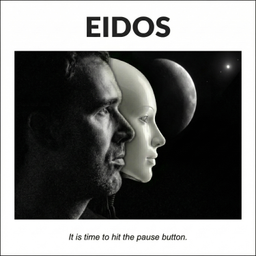
Think of Eidos as a modern dinner party that features photographers, writers, philosophers, and AI chatbots. It's a place where the darkroom alchemist and the AI futurist sit at the same table. Edited by Ira Gardner, this podcast hits the pause button on the modern world to explore the intersection of photography, culture, and technology. Pull up a chair and let's see the world more clearly.
What happens to human consciousness when the words used to describe the living world quietly disappear from our everyday speech?
In this episode of Eidos, we hit the pause button on our high-speed, screen-mediated world to examine a quiet cultural crisis: the steep decline of ecological vocabulary and the resulting phenomenon of environmental generational amnesia. Beginning with the controversial decision by the Oxford Junior Dictionary to excise words like acorn, bluebell, and kingfisher in favor of broadband and voicemail, we trace how losing nature words changes what our visual cortex physically registers when we step outside.
Drawing on cognitive psychology, corpus linguistics, and environmental sociology, we explore how human perception filters out unnamed biodiversity into a generic, static blur—a failure known as plant blindness. We contrast the objectifying, property-focused history of the English language (from the Norman Conquest and the Enclosure Acts to the modern "real estate spreadsheet" grammar) with the high-definition, relational maps embedded in Indigenous languages such as Salish, Scottish Gaelic, Anishinaabemowin, and Māori. Finally, we outline practical protocols for linguistic rewilding, bridging citizen science and ancient place-based wisdom through the framework of Two-Eyed Seeing.
16 Sept 2026
Overcoming Creative Dread
Why does sitting down in front of professional software or a blank project timeline feel less like an artistic opportunity and more like staring down a physical threat?
In this episode of Eidos, we hit the pause button on creative guilt to explore a surprising convergence: evolutionary biology, animal sensory perception, and the psychological mechanics of the creative freeze response. Drawing from cognitive neuroscience and the candid production memoirs of a veteran documentary filmmaker, we unpack why your brain treats an unfamiliar timeline or a blinking cursor with the exact same chemical panic as a prehistoric predator.
We examine the German biological concept of the Umwelt—contrasting the human sensory "black-and-white tube TV" with the high-definition sensory worlds of UV-guided bees, thermal-hunting pit vipers, and stereo-scenting canines. From there, we dismantle the "hoarder's trap" of productive procrastination and present concrete neurochemical hacks: creating an external prefrontal cortex in spreadsheets, practicing studio mise en place, embracing the year-long "cicada rhythm" to decouple cortisol from raw footage, and transforming technical anxiety into an empirical science experiment.
16 Sept 2026
Frederick Wiseman and the Architecture of Observation
What happens when you point a camera at an institution and refuse to look away?
In this episode of Eidos, we hit the pause button on our hyper-edited, algorithmic culture to honor the monumental life and legacy of documentarian Frederick Wiseman (1930–2026). For more than fifty years, Wiseman explored the hidden machinery of American society—from high schools and emergency rooms to state mental hospitals, welfare offices, and ballet companies.
Wiseman's radical method challenged modern media grammar: he forbade narrator commentary, pre-interviews, artificial lighting, and dramatic musical scores. Yet, behind this seemingly passive "fly-on-the-wall" direct cinema lay a paradox Wiseman termed "reality fictions." Entering the cutting room with over 100 hours of 16mm footage, he would spend up to a year discarding 97% of the film in a process of ablative editing, shaping constructed truths out of raw life.
We examine Wiseman’s rigorous observational mechanics, compare his ethos to the engineered melodrama of reality television, and explore the thorny ethics of visual representation alongside legendary photographers like Dorothea Lange, Walker Evans, Richard Avedon, and Philip-Lorca diCorcia.
Reach and audience
Public platform figures. Ratings count people who left a rating, not total listeners.
Apple Podcasts (US)
1.0 / 5
1 ratings
Spotify
5.0 / 5
1 ratings
Host of EIDOS: The Shape and Form Ideas Take?
Claim your podcast to manage its listing and keep your show details accurate.
Pod Engine is an independent podcast discovery and analytics service and is not affiliated with or endorsed by this podcast. Artwork and show content belong to their owners. Full legal notice.
Explore this show Podcast research with Pod Engine