
Embrace Shabbat Weekly- delivered directly to your computer and/or mobile device
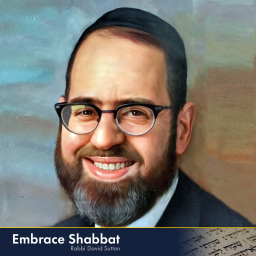
Embrace Shabbat
Claim This Podcastby Rabbi David Sutton
5.0(5 reviews)
24 episodes
Updated Monthly
Accepts GuestsHas SponsorsLocation 🇮🇱
Podcast Overview
Embrace Shabbat Weekly- delivered directly to your computer and/or mobile device
Language
🇺🇲
Publishing Since
4/5/2023
1 verified contact email on file for Embrace Shabbat
Pitch yourself as a guest, propose sponsorships, or reach out directly to the host.
Recent Episodes
March 29, 2024
The Cleansing Power of Shabbat Preparations
The Cleansing Power of Shabbat Preparations The Midrash ( Bereshit Rabbah 56:3) observes that in the Torah'saccount of עקידת יצחק – the story of Avraham Avinu placing his son, Yitzchak, on thealtar and preparing to slaughter him in compliance with Hashem's command – theTorah refers to Avraham's knife with the term מאכולת . A knife is occasionally called מאכולת , a term thatstems from the root א.כ.ל. ("eat"), because it is used to slaughter animals so their meetmay be consumed. In the specific contextof עקידת יצחק , however, the Midrash comments that this term alludes to thefact that the Jewish People, the descendants of Avraham Avinu, continue"eating" and benefiting from the merit of this great act of self-sacrifice andsubservience to the Divine Will, to this very day. The Vilna Gaon ( Kol Eliyahu , Parashat Vayera) raises thequestion of how to reconcile the Midrash's comment with the well-establishedprinciple of שכר מצוה בהאי עלמא ליכא – the reward for mitzvot is grantedin the next world, and not in this world. How do we benefit here in this world from the great mitzvah of עקידת יצחק , if our Sages teach that we receive reward for mitzvot only in the next world? The Gaon answers that the Midrash refers to the mitzvot for allthe extensive preparations that Avraham made to sacrifice his son. Of course, he never actually performed thesacrifice, as at the last moment Hashem ordered him to withdraw his knife. The rewards that we receive, then, are onlyfor the preparations – the three-day journey to Mount Moriah, tying Yitzchakupon the altar, preparing the knife, and so on. Preparing for any mitzvah yields very significant rewards. It is through the efforts we invest beforethe mitzvah is performed, in preparation for the act, that we earn greatmerit. This is especially true of Shabbat. The Torat Hayim (Eruvin 19a) writes that our preparation forShabbat parallels our preparation in this world for our lives in the eternalworld. As Shabbat is מעין עולם הבא – aglimpse of the next world, our preparations for Shabbat are to resemble ourpreparations for the afterlife. In orderfor a person to earn a share in the next world, he must be spiritual pure. Those whose souls have been contaminated inthis world must undergo a "cleansing" process before they earn entry into thenext world. Correspondingly, halachah requires us to bathe with warm water on Erev Shabbat as part of ourpreparations for Shabbat. This cleansingof our bodies represents the cleansing of our souls, a necessary prerequisitefor experiencing the beauty and splendor of the next world. It emerges, then, that preparing for Shabbat has a "cleansing" effectupon our souls. The hard work and effortwe invest in preparing for Shabbat, even bathing, has a very significantspiritual impact, preparing our souls to receive the special kedushah ofShabbat. Further insight into this "cleansing" power can be gleaned from aremarkable comment by the Ben Ish Hai. Halachah requires washing our hands each morning when we awaken in order to remove the tum'ah (impurity) that descends upon our hands as we sleep. The Ben Ish Hai explains this concept by wayof an analogy to the body's circulatory system. When a person's blood is not circulating properly, then this conditionis manifest specifically in the body's extremities – the fingers and feet. They turn blue and do not function properly,because the blood does not reach these outermost regions of the body. Similarly, the Ben Ish Hai writes, when aperson wakes up in the morning, most of the contamination that descended overthe course of the night leaves, but it remains on the body's extremities. Therefore, one is required to washspecifically the hands each morning. However, as the Ben Ish Hai proceeds to note, this gives rise to thequestion of why halachah does not also require washing one's feet eachmorning. If the tum'ah on thebody's extremities remain when one awakens, then why must he wash only hishands? The Ben Ish Hai answers that halachah does not require washingone's feet in the morning because this would not suffice to eliminate the tum'ah . Since the feet tread continuously on theground, the tum'ah on the feet is so powerful that it cannot be removedthrough washing. The exception to thisrule, the Ben Ish Hai adds, is the kohanim in the Bet Ha'mikdash ,who are required to wash their hands and feet before entering the Mikdash . The special sanctity of the Mikdash makes it possible to eliminate the tum'ah even from the feet, and soalthough we are not required to wash our feet each morning, the kohanim are required to wash their feet before entering the Bet Ha'mikdash . Remarkably, there is also a second exception – Erev Shabbat. The Ben Ish Hai writes that halachah requires us to wash, minimally, our face, hands and feet every Erev Shabbat inpreparation for Shabbat. The reason isthat just as the sanctity of the Mikdash makes it possible for the kohanim to eliminate the tum'ah from their feet, the special sanctity of Shabbatsimilarly has this unique ability. Shabbatpreparations offer us an opportunity that is otherwise reserved exclusively forthe kohanim in the Bet Ha'mikdash – to thoroughly cleanse oursouls and achieve a pristine level of spiritual purity. This theme of preparation closely relates to the sefirat ha'omer period, when we spend forty-nine days preparing for Matan Torah . The period of sefirat ha'omer is intended to serve as a period ofintensive preparation, because the more we prepare for the event of Matan Toraah , the greater and more enduringan impact the experience of Matan Torah will have upon us. Our Sages note that although Avraham had numerous servants, he himselfsaddled his donkey and made the necessary preparations for עקידת יצחק . Years later, when Bilam set out to place acurse upon Beneh Yisrael , he specifically saddled his own donkey, ratherthan asking one of his servants to do so, in an effort to "counter" Avraham'senthusiasm. Bilam keenly understood thepower of preparation, and sought to use this power for his evil plot to destroy Beneh Yisrael . We are to followthe inspiring example of Avraham, who utilized the power of preparation for thepurpose of serving Hashem and bringing kedushah into the world. Let us, then, joyfully and enthusiasticallyprepare for Shabbat each week, recognizing the great benefits and impact ofthese efforts.
February 9, 2024
The Great Blessing and Merit of Shabbat
Whenever we involve ourselves in some project or undertaking, it’s a good idea to properly appreciate the value of what we’re doing, in order to sustain our zeal and motivation to accomplish and achieve at the highest standard. This is true of Shabbat, as well. The more we understand and appreciate the immense value of Shabbat, the more driven we will be to enhance our Shabbat observance and bring it to a higher level. This is especially so as we prepare for the final Shabbat of the year. Performing any mitzvah is a great privilege. While we perform mitzvot first and foremost because we are obligated to do so, we must also recognize that it is a great privilege to serve the Almighty and accrue merits through the performance of a mitzvah . And one of the greatest rewards we earn through the performance of a mitzvah is the privilege of performing additional mitzvot . This concept is powerfully conveyed through a story told by the Ponevitcher Rav about a conversation he once had with the Hazon Ish. The Ponevitcher Rav occasionally traveled to the United States to raise money for the yeshiva, and after one of his trips, he asked the Hazon Ish about a curious phenomenon that he experienced. Every so often, when he approached a prospective donor to ask for a contribution, the man would ask him to come back the next day. “I just don’t understand,” the Ponevitcher Rav said. “If he wants to donate, then why doesn’t he just donate, and if he does not want to donate, then why doesn’t he just say so?” The Hazon Ish asked him what he thought the explanation was, and the Ponevitcher Rav said that perhaps people say this because they do not really wish to donate, and so they tell him to return the next day in the hope that he won’t, or that they would not be available when he comes. The Hazon Ish, however, said that this is not correct. The reason why they respond this way, he explained, is because they need a zechut (source of merit) with which to earn the mitzvah of supporting Torah study. If a person does not feel quite ready to donate, and so he asks the Rabbi to return the next day, it is because he needs an additional source of merit, such as another prayer, or another act of kindness, before he earns the great privilege of supporting Torah. Another story that illustrates this point is told by Rav Avraham Mordechai Shapiro, a famous student of Rav Aharon Kotler, in his work Imreh Mordechai . He tells that he was once in Tel-Aviv on a Friday in the 1950s, and he happened to be in front of a small shop. A customer came to the shop and asked to buy a pack of cigarettes. The shopkeeper looked at his watch, and told the man that he could not sell him the cigarettes because of the time. He explained that his practice was not to sell cigarettes after midday on Friday, because he did not want to facilitate Shabbat desecration. Rav Shapiro overheard this exchange, and was intrigued by the shopkeeper. He was further impressed when he saw that the shopkeeper had a volume of Mishnayot – Masechet Ma’aser Sheni – open on his desk as he sat waiting for customers. He approached the man and they started talking. The man told Rav Shapiro that his name was Yaakov, and that he used to be a butcher in the city of Minsk. Rav Shapiro mentioned that he was visiting from the United States. The man then asked if he knew anything about a certain Arkeleh Sislitzer. He had heard that this young man, Arkeleh, who was originally from Minsk, had gone to the United States and became very renowned among American Jewry. He wondered if Rav Shapiro had heard of him. Rav Shapiro soon realized that the man was referring to was his esteemed Rabbi – Rav Aharon Kotler. The man proceeded to tell him that during his years working as a butcher in Minsk, he would donate a few pennies for every kilo of meat he sold to hire tutors for children who had trouble learning. There was one orphan who exhibited an exceptional intellect, and at the age of 14, he was already too advanced for any Torah learning framework available in Minsk. And, as the Enlightenment movement was very influential in the city, he feared that this boy – Arkeleh – might come under the movement’s influence. So, the butcher donated the money to pay for tickets for him and for another student – whose name he did not remember – to travel to Slobodka and learn in the yeshiva there. Remarkably, this man had the privilege of sending 14-year-old Arkeleh Sislitzer to yeshiva, where he would eventually become the great Rav Aharon Kotler. Rav Shapiro told this story to Rav Yaakov Kaminetzky, who learned in Slobodka together with Rav Aharon Kotler. As he told this story, he asked Rav Yaakov if he knew the second boy whose trip to Slobodka was sponsored by this butcher. “You’re looking at him,” Rav Yaakov replied. This butcher obviously had a great zechut previously that enabled him to be the one to send two young men off to learn that eventually became gedolim that changed the face of America. Enhancing our observance of Shabbat has the ability to bring us great merit. The merit of this mitzvah is very powerful, and leads us to additional privileges and opportunity to earn rewards. In 2006, the community of Lakewood, NJ was graced by a visit by Rav Aharon Leib Steinman. This was a difficult time in Lakewood, when the community was struck by an unusually large number of tragedies. When Rav Steinman visited, the people of Lakewood asked what they could do to earn merit to improve the situation. Rav Steinman answered that Shabbat is the source of all blessing in the world, and so by accepting Shabbat a half-hour early, they will earn blessing. That Shabbat, the entire community of Lakewood accepted Shabbat a half-hour early. After the first hour of Shabbat, the local Hatzalah dispatcher noticed that he had not received any phone calls, and feared that there might be a problem with the communications system. Normally, within the first hour of Shabbat, Hatzalah would receive several calls of medical emergencies, but on that Shabbat, everything was silent. He checked the network and found that everything was in perfect working order. The silence continued throughout the night, and even throughout the next day. Hatzalah did not receive a single call that entire Shabbat. After Shabbat, Rav Malkiel Kotler excitedly phoned Rav Steinman and shared with him the news. On a typical Shabbat, he said, Hatzalah receives some 40 calls, but on that Shabbat, it did not receive any. This remarkable story should reinforce our appreciation for the great privilege that we have to observe Shabbat, and for the great blessings that we earn through this mitzvah . If we are looking to end the year the right way, and to begin the new year the right way, the best thing we can do is to enhance Shabbat, by beginning Shabbat a bit early, by spending it the right way, and by making it the spiritual and serene experience that it is meant to be. If we work to raise our standards of Shabbat observance, then we will access the great bounty of blessing that Shabbat offers us, and we will see the fulfillment of the wish תחל שנה וברכותיה – “May the year begin with its blessings.”
January 26, 2024
The Two Angels
Welcome to Embrace Shabbat. The Yaarot Devash teaches that there are seven mazalot , which correspond to the seven days of the week, and Shabbat corresponds to a negative mazal . It is for this reason that other religions celebrate their Sabbath on Friday or Sunday, rather than Shabbat. They believe that connecting their day of rest to Shabbat will bring negativity upon them. However, as Jews, we believe that by celebrating Shabbat, we demonstrate that we do not believe in other forces, such as mazalot , controlling us. Rather, we know that it is HaKadosh Baruch Hu Who is in charge and determines the course of our lives. The Avudraham (as quoted in the Anaf Yosef in Ein Yaakov on Masechet Shabbat 119b) teaches that the mazal of Friday is named “ Tzedek ,” and it is accompanied by the angel Tzadkiel , a good angel. The power of this mazal remains in existence through the final moments of Erev Shabbat. The mazal of Shabbat is mahadim , from the root word edom - red. The Gemara teaches that one who is born under this mazal of redness has a bloodthirsty nature and will have a tendency to direct his energies to being a mohel, shochet, or murderer. Rav Wolbe explains that for such a person, his violent tendencies will not change. However, he can chanel it for a mitzvah , such as milah ; a positive action (though not a mitzvah ), such a preparing kosher meat; or murder. This mazal of redness is the mazal of Shabbat. The power of this mazal comes into effect right from the start of Shabbat and is accompanied by the malach is סמאל , a negative angel (it is preferred not to pronounce the name of this malach and therefore people refer to it as ס-מ ). The Avudarham explains the connection between these two angels and the famous Gemara in Shabbat: two angels accompany a person home from shul on Friday night, a good angel and a bad angel. The Avudarham explains that these two angles are the positive angel of Friday and the negative angel of Shabbat, who “change shifts” and walk a person home as Shabbat begins. When they reach his home, they check if the table is set, the bedroom is made up, and the candles are lit. Then, either the good angel blesses the home and the bad angel answers “Amen,” or vice versa. When we sing שלום עליכם מלאכי השרת on Friday night, we welcome in these two angels: Tzadkiel of Friday and the negative ס-מ of Shabbat. Commenting on the words ה' פֹּ֘קֵ֤חַ עִוְרִ֗ים , G-d opens up the eyes of the blind, the Chidah (Tehillim 146:8) explains that the root of the name ס-מ is סומה , a blind person ; he blinds others from seeing the difference between an aveira and a mitzvah . ה' פֹּ֘קֵ֤חַ עִוְרִ֗ים does not just refer to a blind person who cannot see, but also a person that is blinded by the yetzer hara and can’t see correctly . When a person does Teshuva , Hashem is ה' פֹּ֘קֵ֤חַ עִוְרִ֗ים , He opens up the eyes of the blind. On Shabbat, the angel of ס-מ brings darkness and negativity. Therefore, we light candles to symbolically light up that darkness. The Iyun Yaakov teaches that the two candles as well as the two angels represent Shamor and Zachur . It is our hope that lighting the two candles will bring light into our Shabbat. Have a Shabbat Shalom.
24 total episodes available
Deep-dive analytics for Embrace Shabbat
Frequently asked questions
Have a different question and can't find the answer you're looking for? Reach out to our support team by sending us an email and we'll get back to you as soon as we can.
- What is Embrace Shabbat?
- How often does this podcast release new episodes?
This podcast updates monthly.
- Where can I listen to this podcast?
This podcast is available on 7 platforms including Apple Podcasts, Spotify, and more. You can also use the RSS feed directly.
- Does this podcast accept guests?
Information about guest appearances is not available.
Legal Disclaimer
Pod Engine is not affiliated with, endorsed by, or officially connected with any of the podcasts displayed on this platform. We operate independently as a podcast discovery and analytics service.
All podcast artwork, thumbnails, and content displayed on this page are the property of their respective owners and are protected by applicable copyright laws. This includes, but is not limited to, podcast cover art, episode artwork, show descriptions, episode titles, transcripts, audio snippets, and any other content originating from the podcast creators or their licensors.
We display this content under fair use principles and/or implied license for the purpose of podcast discovery, information, and commentary. We make no claim of ownership over any podcast content, artwork, or related materials shown on this platform. All trademarks, service marks, and trade names are the property of their respective owners.
While we strive to ensure all content usage is properly authorized, if you are a rights holder and believe your content is being used inappropriately or without proper authorization, please contact us immediately at hey@podengine.ai for prompt review and appropriate action, which may include content removal or proper attribution.
By accessing and using this platform, you acknowledge and agree to respect all applicable copyright laws and intellectual property rights of content owners. Any unauthorized reproduction, distribution, or commercial use of the content displayed on this platform is strictly prohibited.