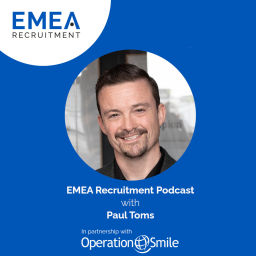
EMEA Recruitment Podcast
Hosted by Paul Toms · EMEA Recruitment & Paul Toms
5.0from 1 ratings
- 175
- Episodes
- 1
- Ratings
- Monthly
- Cadence
- 2019
- First episode
- 92K
- YouTube views
About EMEA Recruitment Podcast
Covering all elements of the recruitment cycle for both job seekers and hirers. The EMEA Recruitment Podcast with Paul Toms will take you through every aspect of recruitment. Looking at both sides of the process, Paul will be offering career-changing advice to the job-seeker and essential exposure to recruitment 'best practice' for the hiring employer, giving each party an insight and understanding into the perspective of the other. This podcast is brought to you by EMEA Recruitment. At EMEA Recruitment we are specialists in Finance, HR, Procurement, Supply Chain and Operations Recruitment at Middle-Management to Executive levels across Switzerland, The Netherlands and the wider EMEA & US region. With offices in Zug, Amsterdam and Nottingham our consultants are well networked and can offer knowledgeable advice within these regions. The podcast is hosted by founder of EMEA; Paul Toms. To find out more about EMEA recruitment visit https://emearecruitment.eu/, follow EMEA Recruitment on LinkedIn or connect with Paul on LinkedIn at https://www.linkedin.com/in/paultomsemea
- Publisher
- EMEA Recruitment & Paul Toms
- Category
- business · business
- Language
- en
- Explicit
- No
- First episode
- 27 Jan 2019
- Latest episode
- 1 Sept 2026
Latest episodes
175 episodes in the feed.
1 Sept 2026
EMEA Recruitment Podcast #175 - The Biggest Career Risk in Finance Isn't AI. It's Becoming Replaceable - Albert Beccu
AI is changing finance fast. But if technology can replicate most of your daily output, the bigger question is: what makes you difficult to replace? In the latest episode of the EMEA Recruitment Podcast, Albert Beccu (Global Head of Finance at Arethia) tears up the traditional career playbook. Drawing on a journey spanning Sweden, the UK, and Switzerland, Albert reveals why he would choose the right boss over the right title every single time, how mentors including a former 20th Century Fox CFO shaped his commercial instincts, the leadership lesson he took from former Disney executive Nina Jacobson, and why modern finance professionals must evolve from scorekeepers into business owners. Tune in to discover: The AI Reality Check: Why automation makes foundational accounting knowledge more valuable, not less, and why knowing what sits behind the numbers could become your career insurance. The Public-to-Private Shock: Why an impressive public-company resume can crash and burn if you don't understand private ownership culture. Scaling Global Growth: How Albert is structuring treasury centralization, FP&A, legal, and a major ERP rollout to ensure finance never becomes a bottleneck at Arethia. Timestamps: 03:30 – Why Albert chose a career in finance 06:40 – How the finance profession has evolved 08:08 – The growing importance of technology, coding, and AI 10:45 – The three mentors who shaped Albert's career 19:42 – Working across Sweden, the UK, and Switzerland 21:13 – Understanding cultural differences in global teams 24:30 – Moving between public and private companies 25:24 – The differences in stakeholder management 31:10 – Albert's first six months at Arethia 32:05 – International expansion and the role of finance at Arethia 33:23 – Treasury centralization, FP&A, and ERP transformation 36:10 – An insight into Albert's leadership approach and team management 38:55 – Giving teams ownership in a fast-growing business 40:00 – Learning from failure 44:00 – Advice for the next generation of finance leaders 45:56 – Why choosing your boss can matter more than choosing your title Finding a fascination with finance Albert's interest in finance started early. From keeping track of his pocket money in a bank book to joining the Young Shareholders Association in Sweden, he developed a genuine curiosity about how money and businesses work. That interest became more practical when his stepfather, then a finance director at a steel plant, gave him a summer job in shipping and accounts payable. What started as a summer role became something Albert returned to throughout his studies. For Albert, finance stood out because of its breadth. It combines logic, mathematics, psychology, creativity, law, argument, and storytelling. That last element has become increasingly important throughout his career. As finance has evolved, understanding the numbers is no longer enough. Finance professionals need to explain what those numbers mean, communicate them to different audiences, and help the wider business understand what action should be taken. The changing role of the finance professional Technology has transformed the finance function. Albert points to the growing importance of skills such as Python and SQL, alongside automation and AI. But he also believes there is a risk in losing sight of the fundamentals. The manual work he completed earlier in his career gave him an understanding of how financial information is built. That experience now helps him recognize when an automated report does not make sense or when something in the numbers is wrong. His view is shared by Paul Toms who emphasis that technology should strengthen financial expertise, not replace it. Finance professionals still need to understand the mechanics behind the numbers and, importantly, be able to tell the story behind them. The mentors who shaped his leadership Three people stand out when Albert reflects on the mentors who influenced his career. The first taught him the importance of commercial thinking. Working with Carl Hosten, formerly CFO for 20th Century Fox Nordic, pushed Albert to understand the purpose behind a forecast rather than simply focus on the spreadsheet. The lesson was to know the numbers, understand why they moved, and be able to explain the story behind them. The second, Jeffrey Musk, helped Albert develop patience and his technical accounting knowledge. Albert believes finance leaders need more than an FP&A background. A strong understanding of accounting fundamentals remains critical, particularly when dealing with areas such as working capital and complex accounting decisions. The third, Fredrik Manse, president of EF Travel, influenced Albert's approach to management. He learned the value of giving people trust and clear responsibility while also holding them accountable for delivering. Together, these experiences helped shape a broader view of finance leadership: commercial awareness, technical depth, and the ability to build trust. What working internationally teaches you Albert's career has taken him across Sweden, the UK, and Switzerland, while also giving him experience working with teams and stakeholders across different regions. One of the biggest lessons has been the importance of understanding how different cultures communicate and make decisions. He reflects on the differences between Sweden and Switzerland, as well as experiences working with colleagues in Germany, China, Southeast Asia, and the US. His conclusion is that international experience is increasingly part of everyday business. Rather than treating "cross-cultural experience" as a separate skill, Albert argues that working across cultures is simply part of being a senior leader in a multinational business. The key, he believes, is to make sure everyone understands why something is being done. A shared purpose can help teams overcome differences in communication styles and ways of working. Moving between public and private companies Albert has also experienced both public and private business environments, giving him a useful perspective on the differences between the two. For him, the biggest difference is stakeholder management. Public company leaders often need to communicate a consistent message to a broad group of stakeholders, including investors and shareholders. In a private business, there may be fewer stakeholders, but the relationship with those individuals can be much more direct and personal. This can make moving from a public company into a private organization particularly challenging. A senior executive may arrive with an impressive resume, but that experience does not automatically transfer. They still need to understand the ownership culture, earn trust, and adapt to the new environment. For Albert, success comes from recognizing that the business needs to be approached on its own terms rather than expecting the culture to adapt to the individual. Building a finance function that supports growth In his current role at Arethia, Albert is operating in a fast-growing and increasingly international business. With expansion across North America, Indonesia, and the UAE, alongside new capacity in Germany, the Finance and Legal functions have a significant role to play in supporting that growth. Albert describes his focus as making sure finance never becomes an obstacle to the wider business. That includes professionalizing treasury and centralizing processes so that transactions between entities work smoothly. It also means building a more business service-minded FP&A function, where finance is seen as a trusted partner across the organization. At the same time, the team is supporting a major ERP rollout. For Albert, his goal for finance is to provide structure, insight, and support the business needs to grow without creating unnecessary friction. Learning from failure and giving people space to succeed Albert also discusses the importance of learning from things that do not go according to plan. Reflecting on a lesson from Nina Jacobson (former president at Walt Disney Motion Picture Group), he emphasizes the value of remembering the projects that failed, not just the successes. Understanding what went wrong can provide valuable insight for future decisions. This mindset also influences his leadership approach. Albert believes teams need clear areas of responsibility and a clear understanding of the end goal. Once those foundations are in place, people can take ownership of their work and move quickly without becoming overwhelmed by every competing priority. The result is a leadership style based on clarity and trust rather than constant intervention or micromanagement. He also emphasizes taking a longer view of personal growth, encouraging people to look inward, challenge their own ego and reflect on how they show up. Think like it's your business Albert's advice to the next generation of finance leaders: act as if the business is your own. That means asking whether you are making rational decisions, focusing on what genuinely helps the business, and taking responsibility rather than waiting for the business to give something to you first. For Albert, curiosity is at the heart of this mindset. Finance professionals need to be interested in the business they support and understand how their work contributes to it. He also offers another piece of advice: if you have the luxury, choose your boss rather than simply choosing the title. A strong manager can have a huge impact on how someone feels about their career, their development, and even the work itself. Ultimately, Albert's career story shows how finance leadership is built from a combination of experiences. Technical knowledge provides the foundation, but commercial thinking, curiosity, cultural awareness, strong mentors, and the ability to build trust are what allow finance professionals to grow into effective business leaders. The EMEA Recruitment podcast is produced in partnership with Operation Smile, an international medical charity that provides life-changing surgery to children born with cleft lip and palate. Find out more about Operation Smile's vital work: https://www.operationsmile.org.uk/partners/emea-recruitment/ If there are any topics you'd like us to cover in future episodes, please get in touch with marketing@emearecruitment.com #emearecruitment #emearecruitmentpodcast #albertbeccu #paultoms #finance #ai #operationsmile #operationsmileuk #recruitment
22 Jun 2026
EMEA Recruitment Podcast #174 - Shaping Renewable Energy: A Career Driven by Curiosity - Christos Kosmas
We were proud to welcome Christos Kosmas, CFO at MorGen Energy, onto the EMEA Recruitment podcast. "The driving force has always been curiosity." Speaking to Paul Toms, the episode begins by exploring what led Christos to the renewable energy sector. In a nutshell, his driving force has always been curiosity. After completing his Engineering studies, Christos recognized optimization problems as an area of interest and sought to work at the intersection between the technical side and the commercial/Finance aspects. Following a role in national gas, Christos went on to complete an MBA, and eventually entered a new territory in Project Finance, where he worked with several new infrastructure and energy-related assets. After his first energy project, he was hooked - energy economics immediately captivated him. After several years in conventional energy, he realized that the future was in renewables and creating a sustainable future. In 2018, he accepted his first role in private equity and has remained in the green sector ever since. A new opportunity arose after becoming a hydrogen subject matter expert. Christos understood the necessity of hydrogen solutions was something the world needed to achieve net zero by 2050 and wanted to play a key role. The renewable energy sector brings challenges, but Christos finds the content of the work and knowing it has a positive societal impact rewarding; it's something he can proudly speak to his children about. Onto his approach to decision-making, Christos believes effective decision-making starts with laying out all available options and assessing them objectively. While tried-and-tested solutions still have value, he emphasizes the importance of questioning the status quo, particularly in cutting-edge industries where there is no established blueprint. Rather than thinking in black and white, instead "think in grey," balancing short-term practicality with long-term impact. Using the example of hydrogen facilities, he explains that the cheapest option is not always the best strategic decision, and that data, modeling, and careful analysis are required to making the most sensible decision. This mindset also shapes his approach to continuous improvement. Christos challenges the tendency, particularly common in Finance, to repeat processes simply because "that's how it's always been done" or because it satisfies audit requirements. He advocates for keeping an open mind and consistently looking for ways to improve year after year. Paul asks about Christos's management style. As a manager, Christos takes a people-first approach. He believes employees are more likely to leave managers than companies, and it's his responsibility to create opportunities for his team to learn, develop, and feel appreciated. Rather than acting as a task manager, he focuses creating a supportive environment so the team can perform at their best. He values collaboration and open dialogue, encouraging team members to share their opinions before he offers his own to avoid hierarchy-driven agreement. Once a decision has been made, the team needs to understand why something is being done - that understanding ensures genuine buy-in across the team, as a shared direction is vital. For professionals hoping to follow a similar path, Christos stresses that there is no single path to success. He encourages people, particularly those early in their careers, to take calculated risks, explore different opportunities, and remain open to changing direction. Above all, he advises individuals to understand themselves, choose managers they genuinely want to work with, and seek organizations that will provide opportunities for growth and development. Listen to the end of the episode to hear Christos' opinions on an MBA, as well as his plans for the future in the renewable sector. If you're looking for a particular part of the episode, please use the timestamps below: 01:20: The last thing that made Christos smile 02:50: Defining moments in Christos' career 07:30: Passion for the renewable energy sector 09:50: The attitude to climate change 10:55: Christos' approach to decision-making 13:55: Mindset requirements 18:05: Christos' leadership style 20:05: Personality types and field considerations 22:10: Advice for those looking to emulate Christos' career 24:50: MBA experience and perspective 28:10: Christos' plans for the future The EMEA Recruitment podcast is produced in partnership with Operation Smile, an international medical charity that provides life-changing surgery to children born with cleft lip and palate. Find out more about Operation Smile's vital work: https://www.operationsmile.org.uk/partners/emea-recruitment/ If there are any topics you'd like us to cover in future episodes, please get in touch with marketing@emearecruitment.com #emearecruitment #emearecruitmentpodcast #christoskosmas #paultoms #finance #operationsmile #operationsmileuk #recruitment
8 Jun 2026
EMEA Recruitment Podcast #173 - Chris Girling – A Pioneering Career in Cybersecurity
We were honored to welcome Chris Girling, Partner, Cyber Risk and Resilience at PwC Switzerland, onto the EMEA Recruitment (https://www.emearecruitment.com/) podcast. "Cybersecurity has become a question of when, not if." Paul Toms asks what ignited Chris' interest in Computer Science and Technology. Growing up in the UK, he describes himself as a "middle of the road" student at secondary school level and was advised not to be too ambitious with further education. Instead, he did the opposite, taking on more subjects than expected and excelling in Economics. For a time, people assumed Chris would head toward a career in Banking or Economics, but his real passion was always Computer Science. He spent evenings building games, coding his own version of Tetris, and teaching himself programming. That passion led him to study Computer Science at the University of Warwick, which he describes as having a pioneering philosophy focused on adaptability, rather than specializing in a single technology. Students were expected to learn huge numbers of programming languages and quickly adapt to change, preparing them for an industry that would constantly evolve. That experience taught Chris how to approach unfamiliar technical challenges with confidence. The conversation then focuses on Chris' career journey. During an internship at Credit Suisse, he combined his interests in Business and Technology by joining the Access Control team. Within days, he had bought textbooks to teach himself the programming languages the bank used and began automating large parts of the team's work. The tools he helped create became the foundation for systems that remained in use until the bank's collapse. He described that period as the moment he realized his career would be built around solving new technical problems and applying technology in practical ways. He later joined Shell's Marine business, supporting around 70 IT applications operating across roughly 80 countries, with only a small team managing the environment. Over several years, he learned multiple programming languages, re-platformed systems, managed outsourcing and offshoring projects, and worked on some of Shell's first .NET deployments when the technology was still brand new. Chris admits that, during those early years, he occasionally had "run-ins" with Security teams because governance was far less mature than it is today, but those experiences ultimately helped shape his interest in Cybersecurity from both the technical and operational side. As his career progressed, Chris moved into Program Management and quickly found himself leading major global initiatives. One of the defining examples was a large European regulatory compliance program at Shell, which was ultimately delivered at around 10% of the cost of competitors because the solution had been designed in a scalable and sustainable way. Chris explains that many organizations continuously add "carbuncles" or layers of complexity onto old systems, whereas he has always enjoyed stripping technology back to build cleaner, more elegant solutions. That mindset naturally led him into Cybersecurity and IT Risk. Chris explains that Shell's internal security policies were among the early foundations that influenced what later became the ISO 27000 Cybersecurity standards. By the late 2000s, Credit Suisse approached him about moving into Cyber and IT Risk full-time, believing Cybersecurity was about to become one of the defining business issues of the next decade. They were looking for someone with both deep technical knowledge and the ability to deliver large-scale programs, which became a major turning point in his career. Paul asks about other defining moments within Chris' career. Looking back on his 16 years in Cybersecurity roles, Chris describes himself as a "troubleshooter" who repeatedly moved into the most challenging areas of Security at the time. He explains that Security technology constantly evolves, with attackers adapting so quickly that solutions can become outdated within only a few years. That gave him opportunities to work across multiple technologies and disciplines, rather than remaining siloed in one specialism. Chris also highlights several defining industry moments during his time at Credit Suisse. Around 2012, he worked with UK regulators to help shift industry thinking away from pure "Security" toward the concept of Cyber Resilience - preparing organizations for how they would respond when incidents inevitably happened, rather than assuming prevention alone was enough. Later, in 2018, he helped architect Quantum Dawn, the first ever global Cybersecurity exercise of all banks worldwide, testing how the industry would respond to a major cyberattack affecting global markets. Chris delves into how Cybersecurity leadership has evolved over time and his recent board position. Earlier in his career, Security leaders often focused purely on technical delivery, whereas accountability increasingly sits at board level today. Since moving into consulting at PwC, he has enjoyed seeing Cybersecurity challenges from a different perspective, helping boards understand how to ask the right questions while still supporting Security teams operationally. He admits the move into consulting and advisory work brought a completely different learning curve, particularly around communication and commercial skills, but one he enjoys developing. A major focus of the discussion centers on the growing speed and complexity of Cyber threats, particularly with the rise of AI. Chris highlights statistics showing phishing attacks increasing by 4,000% in recent years and describes how the time attackers remain undetected inside company networks has reduced from 120 days to 27 minutes. He also points to examples of AI systems escaping testing sandboxes and the growing sophistication of deepfake attacks, including cases where fake video calls have allegedly been used to authorize fraudulent financial transfers. Chris believes one of the biggest challenges organizations now face is adapting to the pace of change. Traditional Security approaches that once allowed weeks or months for testing and deployment are no longer fast enough. Instead, companies increasingly need automated testing, continuous patching, and rapid response capabilities. Chris explains that many organizations still struggle culturally with allowing automation to take over processes that were historically manual, especially when leaders lack deep technical understanding of how those systems work. Despite the growing complexity of Cyber threats, Chris remains optimistic about the future of careers in Technology and Cybersecurity. While AI will continue to transform the industry, he believes strong technical foundations remain essential. He encourages future professionals to understand technology deeply, even if AI increasingly assists with coding and automation, because human creativity and the ability to think beyond existing systems will remain critical for solving the next generation of challenges. Chris shares that his Cybersecurity awareness has simply become part of daily life, rather than something that creates fear or friction. He often finds himself stepping in when friends or family are about to do something risky online, but he also stresses that modern scams and deepfakes have become so sophisticated that almost anyone could be caught out. Rather than blaming victims, he believes organizations and individuals should focus on collective learning and sharing information openly when incidents occur, helping remove the value attackers gain from using those methods again in the future. Listen to the end of the episode to hear the advice Chirs would give his younger self and the advice that has followed him throughout his career. To find a particular part of the episode, please use the timestamps below: 01:30: The last thing that made Chris smile 03:30: Why Chris chose the Computer Science route 08:15: The root of Chirs' passion 09:40: How Chris entered a career in Cyber and Risk 18:20: Defining moments from roles at Credit Suisse 23:05: How Chris' role has evolved to a board leader 26:25: The common blind spots in organizations 32:00: Cyber challenges and growing threats 37:00: Supporting SMEs vs. multinationals 40:45: The skills needed in the next decade 43:00: How Chris' awareness of Cybersecurity affects life outside of work 44:45: The danger of deepfakes and learnings for collective defense 47:55: Chris' advice for his younger self We're proud to partner with Operation Smile, an international medical charity that provides life-changing surgery to children born with cleft lip and palate. We're proud to raise vital funds and awareness of the work they do through the EMEA Recruitment podcast. Find out more: https://www.emearecruitment.com/pages/operation-smile To share the topics you'd like to hear about on the podcast, please reach out: marketing@emearecruitment.com #emearecruitment #emearecruitmentpodcast #chrisgirling #paultoms #cybersecurity #operationsmile #operationsmileuk #recruitment
Who has been a guest on EMEA Recruitment Podcast
Names identified in recent episode analyses. Showing up to five guests.
- Nicolas Carrera
- Dr Aleksandra Jancikova
- Martin Zemp
- Thomas Haeny
- Oriane Minger
Reach and audience
Public platform figures. Ratings count people who left a rating, not total listeners.
- YouTube views
- 91,868
- Score snapshot 15 Sept 2025
- Spotify
- 5.0 / 5
- 1 ratings
Podcast Authority Score: 79 / 100
A composite of feed quality, social presence, YouTube performance and engagement. Read the methodology.
- Quality
- 96
- Social presence
- 91
- YouTube
- 76
- Engagement
- 32
Contact EMEA Recruitment Podcast
- Guest appearances
- Books guests
Based on episode analysis; this does not confirm that the show is currently accepting guests.
Questions about EMEA Recruitment Podcast
Who hosts EMEA Recruitment Podcast?
Paul Toms host the show. Published by EMEA Recruitment & Paul Toms.
How often do new episodes come out?
The show publishes monthly, based on its RSS feed.
Does EMEA Recruitment Podcast take guests?
Yes. Guests have been identified in episode analyses.
Host of EMEA Recruitment Podcast?
Claim your podcast to manage its listing and keep your show details accurate.
Pod Engine is an independent podcast discovery and analytics service and is not affiliated with or endorsed by this podcast. Artwork and show content belong to their owners. Full legal notice.
Explore this show
Podcast research with Pod Engine