- 10
- Episodes
- Weekly
- Cadence
- 2026
- First episode
About Engineered To Lift
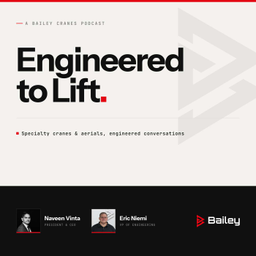
Most lifting equipment wasn't built for where you actually work. Engineered to Lift is the podcast by Bailey Specialty Cranes & Aerials — a U.S. manufacturer of explosion-proof aerial lifts, clean room man lifts, compact handlers, and custom mobile elevating work platforms (MEWPs) for aerospace, defense, semiconductor, pharmaceutical, and industrial environments where standard equipment simply isn't an option. Hosted by President & CEO Naveen Vinta and VP of Engineering Eric Niemi, every episode cuts through the complexity of hazardous environment regulations, aerial lift certifications, and custom engineering decisions — so you can make smarter, safer choices for your facility and your team. Whether you're a procurement agent sourcing specialized equipment for the first time, a production manager trying to improve access and productivity in a regulated environment, or a finance leader carrying the risk of getting it wrong — this show was built for you. We do the calculations. We read the regulations. We tell you what matters. New episodes every two weeks. Questions? Reach us at podcasts@baileycranes.com or visit baileycranes.com.
- Publisher
- Naveen Vinta
- Category
- business · technology
- Language
- en
- Explicit
- No
- First episode
- 21 May 2026
- Latest episode
- 8 Oct 2026
Latest episodes
10 episodes in the feed.
8 Oct 2026
Data Centers Are the New Highways
In 1869 two crews met in Utah and drove a golden spike, and a farmer on the plains could sell to New York. In 1956 Eisenhower signed the interstate bill, and a trucker out of Wisconsin could reach anywhere. Neither project handed anybody a living — it handed everybody a road. The data centers going up across the country right now are that kind of project, and the people who gain the most won't be the ones who lay the track. They'll be the ones who ride it. Bailey is a niche manufacturer in Muskego, Wisconsin. No software department, never much marketing material. Today the shop runs software it wrote itself — SOLIDWORKS macros that get written, used once, and thrown away; a geo-located time clock that feeds payroll automatically; Blender renders that turn STEP files into supercar-grade catalogs — all on tools that ride on those data centers. President & CEO Naveen Vinta and VP of Engineering Eric Niemi walk through exactly what that looks like on the floor, what it costs, what it replaced, and why a company built on engineering can no longer let marketing take a back seat. Watch Now Click here to watch a video of this episode. (https://www.youtube.com/watch?v=fm2-SilWAus) Who This Episode Is For Owners of small and mid-size manufacturers who can't justify a full-time developer but keep losing engineering hours to repetitive work Engineering managers running engineer-to-order shops where no two jobs — and no two macros — are the same Operations and purchasing leads waiting weeks on quotes for one-off parts Anyone whose company does excellent work but has little to show for it, because marketing never penciled out Small business owners who want to bring AI in thoughtfully and need a place to start What You'll Learn Why the railroad and the interstate are the right lens for today's data center build-out — and why riding the infrastructure beats laying it Why a company that excels at engineering, calculations, and ANSI testing never built marketing material, and why "do the work and they will come" no longer holds when attention is the economy The safety case for marketing: somewhere a customer can't find the right machine and is doing the job dangerously instead What a SOLIDWORKS macro actually does — one button replacing 20 to 40 clicks — and why a human-written macro never had the ROI in an engineer-to-order shop How AI makes macros expendable like bullets: write one, use it once, discard it, and skip the maintenance burden every software update used to create Why an engineer checking and blessing the output is reinforcement learning with human feedback, in practice What SendCutSend gets right about instant quoting, why low-volume buyers rarely get treated as cream of the crop, and what removing the human from the loop costs Exporting STEP files into Blender via MCP to produce catalog imagery that used to be reserved for Ferrari or McLaren The full stack behind Bailey's time clock app — Supabase, Railway, GitHub, and a CI/CD loop where Claude writes the code and it auto-deploys — and how payroll now flows straight into the PEO The honest ROI: a roughly $400–500 monthly subscription returning four to five times its cost Using AI to digest 200-page standards and bring newer engineers up to speed, without replacing the judgment of the person reading the output Why AI removes drudgery rather than jobs — the radiology example, the Jevons paradox, and what the tractor was to a farmer who plowed by horse What's next in-house: a custom MCP connecting Claude to Outlook and NetSuite with per-user permissions Post-IMTS demos: Octonomy for engineering documentation and task control, Mech Agents for simulation, and where SOLIDWORKS' own native AI tools stand today Naveen's operating philosophy — relax the people, push the machines — and why a $5–10K desktop with 128 GB of RAM is now a supercomputer Episode Chapters 00:00 — The Golden Spike, the Interstate, and the Data Center 01:00 — Ride the Rails: A Niche Manufacturer Writes Its Own Software 02:00 — Why Great Engineering Never Had Marketing to Match 03:00 — Attention Is the New Economy — and Marketing Is a Safety Issue 04:00 — Macros: Why a Human-Written Script Never Paid Off 05:00 — Expendable Macros: Write It, Use It, Discard It 06:00 — One Button, 40 Clicks: Taking the Drudgery Out of SOLIDWORKS 07:00 — SendCutSend and the Instant Quote 08:00 — Low Volume, Long Waits: The One-Off Parts Problem 09:00 — Speed by Taking the Human Out of the Loop 10:00 — STEP Files to Blender: Supercar-Grade Catalogs 11:00 — From Punch Cards to a Geo-Located Time Clock App 12:00 — Payroll on Autopilot, and the ROI on a Claude Subscription 13:00 — Reading a 200-Page Standard Without the Drudgery 14:00 — AI Takes the Drudgery, Not the Jobs 15:00 — Radiologists and the Jevons Paradox 16:00 — Horses, Tractors, and a Machine That Doesn't Sleep 17:00 — Building an MCP for Outlook and NetSuite, and a Free Consultation Offer 18:00 — Octonomy: Documenting the Whole Engineering Trail 19:00 — Reuse in Six Months, and FUD vs. FOMO 20:00 — Where SOLIDWORKS' Native AI Stands Today 21:00 — Relax the People, Push the Machines 22:00 — A $5–10K Supercomputer on a Desk 23:00 — Why a Manufacturing Podcast Talks About AI Your Hosts Naveen Vinta — President & CEO, Bailey Specialty Cranes & Aerials Naveen comes from an IT background and leads Bailey's in-house AI and software efforts alongside running the company. He's offering a free consultation to small business owners who want a thoughtful path to bringing AI into their operations — reach out at podcasts@baileycranes.com (mailto:podcasts@baileycranes.com). Connect with Naveen on LinkedIn: https://www.linkedin.com/in/nvinta/ (https://www.linkedin.com/in/nvinta/) Eric Niemi — VP of Engineering, Bailey Specialty Cranes & Aerials With over 25 years of experience in mechanical engineering and specialty mobile machinery, Eric has been with Bailey since the beginning — helping design and deliver the industry's first explosion-proof scissor lift in 2004. He leads Bailey's engineering team and is the technical authority behind every certified machine that leaves the Muskego, Wisconsin facility. Connect with Eric on LinkedIn: https://www.linkedin.com/in/eric-niemi-43a8103/ (https://www.linkedin.com/in/eric-niemi-43a8103/) Mentioned in This Episode Bailey's Blender-rendered product catalog: [LINK — TO ADD] SendCutSend — instant quoting for one-off parts Octonomy — engineering documentation and task control Mech Agents — AI simulation tools Supabase, Railway, GitHub, and Claude — the stack behind Bailey's time clock app About Bailey Bailey Specialty Cranes & Aerials is a U.S.-based manufacturer of explosion-proof aerial lifts, clean room man lifts, compact handlers, glass lifting equipment, and fully custom engineered lifting solutions. Headquartered in Muskego, Wisconsin, Bailey is ISO 9001:2015 certified, Factory Mutual approved, and a certified Service-Disabled Veteran-Owned Small Business (SDVOSB). Bailey machines are engineered to ANSI A92.20, FM Class 3600/3610/3615, and UL 583 standards for use in Class I D...
28 Sept 2026
Why Lead-Acid Batteries Die Early
When a customer calls to say their battery is fried, the battery almost never wore out. It got run flat, charged halfway over lunch, topped off with tap water, or left sitting dead through a cold snap. One skipped habit at a time, until the only fix is a replacement. In Episode 9, President & CEO Naveen Vinta and VP of Engineering Eric Niemi take on a problem that comes straight from the field: lead-acid batteries dying years before they should. Eric walks through the most common ways crews kill a deep-cycle battery, the daily checks that prevent it, and how to handle charging across multiple shifts, in hazardous environments, and on machines that sit idle for months. Then they tackle the question customers keep asking now that lithium prices have fallen: why does Bailey still build with lead-acid? The answer runs through the UL industrial truck standard, crush and impact testing, charger compatibility, cost, and the counterweight a lead-acid battery quietly provides in the chassis. Watch Now Click here to watch a video of this episode. (https://www.youtube.com/watch?v=6tkJDExrhv4) Who This Podcast Is For This show exists for three people: - The procurement agent who's been handed a spec they've never sourced before and doesn't know where to start. - The production floor manager who needs to improve productivity and access in a complex or regulated environment — safely. - The finance and risk officer who signs off on equipment purchases and carries the liability when the wrong machine gets approved. If any of those descriptions sound familiar, this is your show. What You'll Learn in This Episode The number one way to kill a lead-acid battery — running it flat — and why a lunch-break charge is only a surface charge, not a true deep cycle What happens inside a battery left sitting discharged: exposed lead plates oxidize and stop charging or discharging properly Why battery-powered machines aren't meant to drive a quarter mile between buildings Why watering matters and why it has to be distilled water — tap water and "pure" water carry trace minerals that ruin the chemistry The daily checklist in the ops manual: water level, state of charge, tight and clean connections, and cracked cases or melted wiring Onboard vs. external charging, what opportunity charging is, and why EX machines must leave the hazardous area to charge When a second battery pack pays for itself: multiple shifts, 8–10 hours per pack, and a shift-handoff routine built on trust but verify Why lead-acid is the only option in explosion-proof environments: the UL industrial truck standard and its crush and impact testing Why lithium-ion still costs five to ten times as much once you add fire suppression, a battery control module, and a dedicated charger The counterweight problem: lithium weighs about a third as much, so a one-for-one swap cascades into a new machine design Storing a machine you only use once a quarter: corrosion protectant on terminals, trickle charging, and keeping batteries from freezing Why the wrong or undersized charger cooks wires, terminals, and the battery itself Episode Chapters 00:00 — Cold open: fall weather, IMTS in Chicago, and a CH10 compact handler ships 01:00 — Today's topic from the field: fried lead-acid batteries, and why not lithium? 02:00 — The number one killer: running it flat; deep cycle vs. surface charge 03:00 — Oxidized plates and the lunch-break charge that never finishes 04:00 — Driving between buildings, forgetting to water, and why it has to be distilled 05:00 — The five-minute habit: swappable battery packs and charge indicators on CH and EX 06:00 — PMCS and the daily checklist: water, state of charge, connections, and cracked cases 07:00 — Onboard vs. external charging, and what opportunity charging means 08:00 — EX charging outside the hazardous area; when a second battery makes sense 09:00 — Multiple shifts: 8–10 hours per pack, and why lithium won't get you 16 10:00 — The shift handoff: check water at the start, plug in at the end, trust but verify 11:00 — Why only lead-acid works in explosion-proof environments: the UL industrial truck standard 12:00 — Crush and impact testing, and why mass-market lithium doesn't qualify 13:00 — EV and semi-truck batteries: specialized chargers and higher voltages 14:00 — Proven and available: why lithium still costs five to ten times more 15:00 — Smart chargers, no battery control module, and lead-acid as the industry standard 16:00 — Snorkel's move to lithium scissor lifts, and what it does for runtime 17:00 — Cycle life, and why lead-acid typically needs replacing in four to five years 18:00 — Weight and counterweight: lithium is about a third as heavy 19:00 — The butterfly effect of a one-for-one swap; storing a machine used once a quarter 20:00 — Corrosion protectant on the terminals, and trickle charging through the off-season 21:00 — Frozen batteries, cracked cases, and matching the charger to the battery 22:00 — Undercharging cooks the wiring; the takeaway: it's a habit problem, not a technology problem 23:00 — Lithium is coming, but the battery you own is the cheapest one you'll ever buy About Your Hosts Naveen Vinta — President & CEO, Bailey Specialty Cranes & Aerials A Service-Disabled U.S. Army Veteran and experienced operations leader, Naveen acquired Bailey in August 2024 and has since modernized operations, reduced lead times, and expanded Bailey's reach into commercial space, defense, and data center markets. Connect with Naveen on LinkedIn: https://www.linkedin.com/in/nvinta/ (https://www.linkedin.com/in/nvinta/) Eric Niemi — VP of Engineering, Bailey Specialty Cranes & Aerials With over 25 years of experience in mechanical engineering and specialty mobile machinery, Eric has been with Bailey since the beginning — helping design and deliver the industry's first explosion-proof scissor lift in 2004. He leads Bailey's engineering team and is the technical authority behind every certified machine that leaves the Muskego, Wisconsin facility. Connect with Eric on LinkedIn: https://www.linkedin.com/in/eric-niemi-43a8103/ (https://www.linkedin.com/in/eric-niemi-43a8103/) About Bailey Cranes Bailey Specialty Cranes & Aerials is a U.S.-based manufacturer of explosion-proof aerial lifts, clean room man lifts, compact handlers, glass lifting equipment, and fully custom engineered lifting solutions. Headquartered in Muskego, Wisconsin, Bailey is ISO 9001:2015 certified, Factory Mutual approved, and a certified Service-Disabled Veteran-Owned Small Business (SDVOSB). Bailey machines are engineered to ANSI A92.20, FM Class 3600/3610/3615, and UL 583 standards for use in Class I Division 1 hazardous locations, ISO Class 5–8 cleanrooms, aerospace facilities, defense installations, semiconductor manufacturing environments, and data centers. Trusted clients include Boeing, NASA, Lockheed Martin, Northrop Grumman, Raytheon, the U.S. Air Force, Disney, and the Smithsonian Institution. Safety engineered. Performance delivered. Resources & Links Bailey Cranes Website: https://baileycranes.com (https://baileycranes.com/) Send us your questions: podcasts@baileycranes.com (mailto:podcasts@baileycranes.com) Naveen Vinta on LinkedIn: https://www.lin... (https://www.linkedin.com/in/nvinta/)
11 Sept 2026
The Machine Got Safer. The Job Didn't.
Last year, 76 people died working from powered access platforms worldwide. That number is down about a quarter from the year before, and it didn't fall by accident: the industry spent 15 years engineering out tip-overs, entrapment, and overloads. Machines got safer. The leading cause of death wasn't any of those things. It was electrocution. A boom touching a power line. Twenty people, most of them in the United States. And the industry's answer to that one is still a training poster and a distance table. In Episode 8, President & CEO Naveen Vinta and VP of Engineering Eric Niemi take on the hazard the machine can't sense: live power. Eric walks through what actually happens in the instant a boom contacts a distribution line, why the ground rescuer is often the second casualty, and why no on-board sensor can tell you a wire is live without touching it. Then they get into how Bailey builds insulated boom lifts and scissor lifts for utility and tree-trimming crews who need to work inside the 10-foot radius: sizing the fiberglass section to the kVA rating, insulated buckets, liners, and hydraulic hoses, and moving platform controls off copper entirely with fiber optic or Bluetooth. Along the way: why a fully insulated 110-foot utility truck is the wrong answer for a 40-foot job on soft ground, why explosion-proof engineering doesn't translate to live-line work, and the three things every crew should do before the lift shows up. Watch Now Click here to watch a video of this episode. (https://www.youtube.com/watch?v=jmnrGac7wbk) Who This Podcast Is For This show exists for three people: The procurement agent who's been handed a spec they've never sourced before and doesn't know where to start. The production floor manager who needs to improve productivity and access in a complex or regulated environment — safely. The finance and risk officer who signs off on equipment purchases and carries the liability when the wrong machine gets approved. If any of those descriptions sound familiar, this is your show. What You'll Learn in This Episode Why electrocution is now the leading cause of powered-access deaths — and why 15 years of tilt sensing, load sensing, and secondary guarding never touched it What happens in the instant a steel boom finds a path to ground: fried controls, arc distance that grows with voltage, and why the operator and the ground rescuer are the ones who die Why a live power line is the one hazard no on-board sensor can detect — you can't check it without touching it The ANSI A92 minimum-approach rule OSHA adopted into federal code: 10 feet at standard voltage, with the envelope growing as the voltage climbs Who actually needs an insulated lift — utilities and tree-trimming crews — and why "I'll just be up there quick" keeps killing people How Bailey scopes an insulated build: what kVA you're working around, whether you're handling the wire, and what the job actually is Where the insulation goes: a certified fiberglass boom section between platform and structure, an insulated bucket and liner, and non-conductive hydraulic hoses — all calculated, tested, and certified by a third party Getting the wiring out of the boom: why fiber optic was the original solution, why Bluetooth has overtaken it, and why radio control is the most interference-prone option Why explosion-proof engineering (contain the spark inside the machine) doesn't apply to live power (the threat is outside the machine) Why a fully insulated utility truck isn't always the answer: 20,000 extra pounds, 110 feet of reach you don't need, and terrain it can't cross Before the lift shows up: find the lines, call the utility, get them de-energized or covered, and put one person on the ground whose only job is that wire Episode Chapters 00:00 — Cold open: Labor Day, garage cleanouts, and a day trip to New York 01:00 — Welcome: electrocution still leads powered-access deaths 02:00 — 15 years of engineering out tip-overs and overloads — and the cause that's left 03:00 — What happens the instant a boom touches a distribution line 04:00 — Operator contact, multi-person platforms, and the ground rescuer problem 05:00 — Nothing in the environment is negotiable: de-energize or modify the machine 06:00 — When shutting off power isn't feasible: insulated boom trucks 07:00 — How the 2018 standards cut entrapment and overturns — but not electrocution 08:00 — Why no sensor can detect a live line from a distance 09:00 — Who buys insulated lifts: utilities, tree trimming, and the 10-foot rule 10:00 — ANSI A92 distances, OSHA adoption, and why "it'll be quick" kills 11:00 — The right equipment for the job: convenience vs. an insulated boom 12:00 — Start with the end goal: kVA rating, gloves, and what the crew is actually doing 13:00 — Sizing the insulated section, composite standards, and third-party testing 14:00 — Fiberglass booms and buckets; fiber optic vs. Bluetooth controls 15:00 — Bluetooth vs. radio interference; hazardous locations vs. live power 16:00 — Contain the spark inside vs. a threat outside: why a full utility truck isn't the answer 17:00 — Terrain, weight, and reach: a 110-foot truck for a 40-foot job 18:00 — Tabletop illustration: the 10-foot radius and where the insulated section goes 19:00 — Insulated baskets, hoses, and certified components 20:00 — When a Versa-Lift makes more sense — and when it doesn't 21:00 — Before the lift shows up: find the lines, call the utility, one spotter — and wrap-up About Your Hosts Naveen Vinta — President & CEO, Bailey Specialty Cranes & Aerials A Service-Disabled U.S. Army Veteran and experienced operations leader, Naveen acquired Bailey in August 2024 and has since modernized operations, reduced lead times, and expanded Bailey's reach into commercial space, defense, and data center markets. Connect with Naveen on LinkedIn: https://www.linkedin.com/in/nvinta/ (https://www.linkedin.com/in/nvinta/) Eric Niemi — VP of Engineering, Bailey Specialty Cranes & Aerials With over 25 years of experience in mechanical engineering and specialty mobile machinery, Eric has been with Bailey since the beginning — helping design and deliver the industry's first explosion-proof scissor lift in 2004. He leads Bailey's engineering team and is the technical authority behind every certified machine that leaves the Muskego, Wisconsin facility. Connect with Eric on LinkedIn: https://www.linkedin.com/in/eric-niemi-43a8103/ (https://www.linkedin.com/in/eric-niemi-43a8103/) About Bailey Cranes Bailey Specialty Cranes & Aerials is a U.S.-based manufacturer of explosion-proof aerial lifts, clean room man lifts, compact handlers, glass lifting equipment, and fully custom engineered lifting solutions. Headquartered in Muskego, Wisconsin, Bailey is ISO 9001:2015 certified, Factory Mutual approved, and a certified Service-Disabled Veteran-Owned Small Business (SDVOSB). Bailey machines are engineered to ANSI A92.20, FM Class 3600/3610/3615, and UL 583 standards for use in Class I Division 1 hazardous locations, ISO Class 5–8 cleanrooms, aerospace facilities, defense installations, semiconductor manufacturing environments, and data centers. Trusted clients include Boeing, NASA, Lockheed Martin, Northrop Grumman, Raytheon, the U.S. Air Force, Disney, and the Smithsonian Institution. Safety engineered. Performance delivered.
13 Aug 2026
From Phone Call to Serial Plate
One of the biggest names in aerial lifts just decided the market wasn't worth staying in. Terex is merging with REV Group and moving to exit its aerials segment — Genie — to reduce its exposure to cyclical end markets. Bailey builds aerial work platforms too. The cyclicality doesn't bother us. That isn't a contradiction, and this episode explains why. President & CEO Naveen Vinta is joined by Timothy Cooley, Director of Sales, for a look at what actually happens between a customer's first phone call and the serial plate on a finished machine. Two custom compact handlers are on the floor right now: a CH1 with a magnetic attachment for a steel producer whose safety standard caps manual lifting at 50 pounds, and a CH6SP being re-rated to place 950 pounds at 14.5 feet for a canning plant that's been sending people over 20-foot drops to reach equipment. Along the way: why most customers arrive by accident through a Google search, why a purpose-built machine is sometimes the cheap option next to a $15 million dock replacement, how the feasibility study keeps a custom project from stalling in an approval chain, and why federal rated contracts can legally jump the queue. Watch Now Click here to watch a video of this episode. (https://www.youtube.com/watch?v=nfCVyd7ubQs) Who This Episode Is For Production and facility managers with a lift problem no catalog machine solves — heavy load, narrow aisle, no overhead capacity Procurement teams sourcing a custom machine for the first time and unsure how the process is supposed to work Safety leaders trying to design manual handling and fall exposure out of a process rather than train around it Rental houses fielding customer requests for equipment they've never heard of Owners and operators at small manufacturers watching the large OEMs retreat from cyclical markets What You'll Learn Why Terex's exit from aerials is a commodity-market story — and why the niche end of the same industry runs on a different cycle How most Bailey customers actually arrive: a Google search, a problem they can't name, and a call that opens with "do you have any idea what this is?" What a constrained lift looks like in practice — 40 feet of reach inside a five-foot-wide aisle, for an automaker's energy division Why custom is frequently the cheaper option: a steel producer weighing a purpose-built lift against a $15 million dock replacement Inside the CH1 build: a magnetic attachment engineered around a facility rule capping one-person lifts at 50 pounds and two-person lifts at 100 Inside the CH6SP: what "special purpose" means, and what it takes to raise a base machine to 950 pounds at 14.5 feet with added counterweight Why every Bailey machine is tested to 150% of rated capacity before it ships How the feasibility study phase works — a concept report you can walk into your approval chain — and why some projects should end right there How Bailey's model naming works: the number after CH indicates capacity, and SP means special purpose Why the first custom unit carries the engineering and units two through eight get the economies of scale The real sales cycle: inquiries in January and February become purchase orders in September and October, six to twelve months later Why federal rated contracts can legally move ahead of an order already in build — and what that means for your delivery date Episode Chapters 00:00 — A Major Aerials Player Exits, and Bailey Doesn't Flinch 01:00 — Meet Tim Cooley: Seven Years in Ranger Regiment to Director of Sales 02:00 — The Trade Show Booth, the Coffee Chews, and a Very Good Day 03:00 — No Résumé, No Interview: Hire for Attitude, Teach Aptitude 04:00 — Terex's Numbers: $537M in Q3, Down 13%, and "Cyclical End Markets" 05:00 — Q4 Rebounds, JLG's Backlog, Skyjack's Booms — Aerials Aren't Dying 06:00 — How Customers Actually Find Us: A Google Search and a Long Shot 07:00 — "I've Been Looking for Months": The Constraints Nobody Else Solves 08:00 — Forty Feet of Reach Inside a Five-Foot Aisle 09:00 — When a Custom Machine Beats a $15 Million Dock Replacement 10:00 — The CH1 Build: A Magnetic Attachment and a 50-Pound Lifting Limit 11:00 — Design Review Before Build: The White-Glove Approach 12:00 — The Feasibility Study: Concept First, Full Project Second 13:00 — Phased Approvals, and Why Some Projects Should End at Concept 14:00 — The CH6SP: A Canning Plant's Reach and Fall-Hazard Problem 15:00 — Re-Rating a Base Machine: 950 Pounds at 14.5 Feet 16:00 — Testing to 150%, and One Unit That Becomes Six or Eight 17:00 — Economies of Scale: You're Not Starting From Scratch 18:00 — Real Cyclicality: July Is Slow, and Even Apple Feels It 19:00 — September and October: The Federal Fiscal Year Rush 20:00 — Engineered Access and Lifting: Bring Us the Problem 21:00 — January Inquiry, September PO: Six Months to a Year 22:00 — Why Every Quote Carries an "As Of" Date 23:00 — Rated Contracts, the Queue, and What's Coming Up With Tim Your Hosts Naveen Vinta — President & CEO, Bailey Specialty Cranes & Aerials Timothy Cooley — Director of Sales, Bailey Specialty Cranes & Aerials About Bailey Bailey Specialty Cranes & Aerials designs and manufactures custom aerial work platforms for hazardous, classified, and mission-critical environments — explosion-proof lifts, clean room man lifts, compact handlers, and specialty MEWPs. ISO 9001:2015 certified and Factory Mutual approved, Bailey serves aerospace, defense, pharmaceutical, semiconductor, and industrial clients including Boeing, NASA, Lockheed Martin, Northrop Grumman, Raytheon, and the U.S. Air Force. Safety engineered. Performance delivered. Connect New episodes every two weeks — subscribe wherever you listen. Web: baileycranes.com (https://baileycranes.com/) Email: podcasts@baileycranes.com (mailto:podcasts@baileycranes.com) YouTube: @baileycranes Naveen Vinta: https://www.linkedin.com/in/nvinta/ (https://www.linkedin.com/in/nvinta/) Timothy Cooley: https://www.linkedin.com/in/timothy-cooley-931844310/ (https://www.linkedin.com/in/timothy-cooley-931844310/)
30 Jul 2026
You Can't Buy Your Way to the Front of the Manufacturing Line
In Memphis, one of the best-capitalized operations in the country trucked in a fleet of trailer-mounted gas turbines — roughly 1,500 megawatts of temporary power — and rented them. Not because they couldn't afford the real thing. Because they couldn't get in line for it. That's the whole story of the AI build-out in one image. The headlines are political. Underneath the politics, it's physical. In this episode, President & CEO Naveen Vinta and VP of Engineering Eric Niemi make the case that the AI race has quietly become a manufacturing race — where money is no longer the constraint, the queue is. Pick any critical component and it's backordered past your finish line. A bigger check doesn't move you up the line; it only gets you in it. Along the way: why stopping technology has never been a winning proposition, what happens when you go looking for a wheel drive whose manufacturer has been sold twice in ten years, the backyard paradox of Wisconsin hosting a manufacturing-scale build-out after losing manufacturing as its top employer, and how a niche manufacturer splits a part in two to build a supply chain that didn't exist yesterday. Watch Now Click here to watch a video of this episode. (https://www.youtube.com/watch?v=sdtIYdua_vA) Who This Episode Is For Procurement agents staring at a 26-week lead time on a component the schedule needed last quarter Data center developers, GCs, and project managers whose critical path now runs through a factory floor Engineering and operations leaders deciding whether to wait for the catalog part or redesign around what's actually available Niche manufacturers and component suppliers who make hard-to-find parts and are hard to find themselves Anyone watching the AI build-out and wondering where the real bottleneck sits What You'll Learn Why money stopped being the constraint on the AI build-out — and why a place in the queue is all a check can buy you What renting 1,500 megawatts of trailer-mounted turbines tells you about the state of industrial lead times Why efforts to stop a technology have historically only slowed it down, from 1920s battery trucks to the electric Hummer How a discontinued wheel drive turns into an engineering project: changed bolt patterns, changed capacities, changed speeds The backyard paradox — Wisconsin lost manufacturing as its top employer and is now hosting the largest industrial construction in state history Why skilled labor is the second queue nobody talks about, and how the right machine lets five technicians do a ten-technician job safely The adaptation play: splitting a single drive unit into a hub and a hydraulic motor, sourcing each separately, and doubling your supply chain in the process Why a 30-week finished assembly can often be beaten by four-to-six-week components and skilled hands in-house How AI is clearing rote work off engineers' desks so they can spend the time on what the customer actually needs Why a manufacturing race is won by the whole bench — giants, niche manufacturers, and small shops together Episode Chapters 00:00 — Memphis: 1,500 Megawatts of Rented Turbines, and Why 01:00 — Money Isn't the Constraint Anymore — the Queue Is 02:00 — The Giants Scale, the Niche Manufacturers Solve + Welcome 03:00 — Stopping Technology Has Never Been a Winning Proposition 04:00 — From the Wheel to Nanometer Chips: Speed to Market 05:00 — The Tech-Stack Arms Race and GM's First Electric Cars 06:00 — Ahead of Its Time: The Stylus, the BlackBerry, and Catching Up 07:00 — The Backyard: Offshoring and Wisconsin's Top Employer 08:00 — Chasing a Discontinued Wheel Drive Through Two Ownership Changes 09:00 — An Open Call to Niche Manufacturers: We Pivot on a Dime 10:00 — The Backyard Paradox: Mount Pleasant, Port Washington, and Not Enough People 11:00 — Adapting a Base Model the Big OEMs Can't Touch 12:00 — AI Takes the Rote Work; Engineers Take the Customer's Problem 13:00 — Industry and Healthcare Go Hand in Hand 14:00 — AI as a Thought Partner on the Drive to a Customer Meeting 15:00 — From Physical Effort to Cognitive Load 16:00 — Fargo, 2005: Booting a Desktop to Check the Weather 17:00 — Humanoid Robots and the Wrench: Keep the Skill, Lose the Walk 18:00 — Dig Three Layers Down and the Supply Chain Still Points Overseas 19:00 — How You Adapt: Splitting the Drive Unit Into Hub and Motor 20:00 — Doubling the Supply Chain and Designing Around the New Part 21:00 — 30-Week Assemblies vs. Four-to-Six-Week Components 22:00 — Engineers and Technicians Under One Roof, No Meeting Required 23:00 — The Bottom Line: Every Path Runs Through a Sold-Out Factory 24:00 — SMRs, the Grid, and Water: The Problems That Get Solved Next Your Hosts Naveen Vinta — President & CEO, Bailey Specialty Cranes & Aerials Eric Niemi — VP of Engineering, Bailey Specialty Cranes & Aerials About Bailey Bailey Specialty Cranes & Aerials designs and manufactures custom aerial work platforms for hazardous, classified, and mission-critical environments — explosion-proof lifts, clean room man lifts, compact handlers, and specialty MEWPs. ISO 9001:2015 certified and Factory Mutual approved, Bailey serves aerospace, defense, pharmaceutical, semiconductor, and industrial clients including Boeing, NASA, Lockheed Martin, Northrop Grumman, Raytheon, and the U.S. Air Force. Safety engineered. Performance delivered. Connect New episodes every two weeks — subscribe wherever you listen. Web: baileycranes.com (https://baileycranes.com/) Email: podcasts@baileycranes.com (mailto:podcasts@baileycranes.com) YouTube: @baileycranes Naveen Vinta: https://www.linkedin.com/in/nvinta/ (https://www.linkedin.com/in/nvinta/) Eric Niemi: https://www.linkedin.com/in/eric-niemi-43a8103/ (https://www.linkedin.com/in/eric-niemi-43a8103/)
18 Jul 2026
Speed Without Compromise: Hitting the Data Center Schedule While Safety Stays the Standard
Every data center in the country is racing two clocks at once. Investors want it powered up yesterday — and every day of delay can mean hundreds of millions of dollars. The safety standard, meanwhile, doesn't budge an inch, and it shouldn't. So what happens when a builder adopts a novel, fire-rated construction method that's genuinely safe — but slows the entire interior build to a crawl? In this episode, President & CEO Naveen Vinta and VP of Engineering Eric Niemi take on the interior-panel bottleneck of the AI build-out: why fire-rated panels once used only on the outside of a building are now going up inside, why a big telehandler can't do the job in a finished space, and how the CH4 Omni Lift places a 20-foot, 1,000-pound panel in 20 minutes or less. Along the way: 360-degree spin and crab walk, proportional "turtle mode" controls, floor loading, the aerospace problem that started it all — and why closing the productivity gap is never allowed to touch the safety standard. Watch Now Click here to watch a video of this episode. (https://www.youtube.com/watch?v=_XRpSe9mAJQ) Who This Episode Is For Data center developers and general contractors racing the speed-to-power clock, where every day of delay carries real cost Construction and production managers placing fire-rated interior panels safely and on schedule Finance, procurement, and risk leaders weighing a specialty-equipment CapEx against the OpEx it eliminates Rental fleet owners looking for the right equipment to win data center business Anyone who's watched a crew place one 20-foot panel before lunch and wondered where the day went What You'll Learn Why fire-rated interior panels — materials once used only on the outside of a building — have become the choke point of data center construction How the CH4 Omni places a 20-foot, 1,000-pound panel in 20 minutes or less, versus two to three an hour with a telehandler Why 360-degree spin, crab walk, and proportional "turtle mode" controls deliver inch-perfect placement on every pick How remote-control operation gives the operator a better vantage point — improving safety, precision, and panel protection all at once Why footprint and floor loading rule a big telehandler out, and how Bailey's machine rides the crane or freight elevator to the next floor The real CapEx-versus-OpEx math, and why the right machine can break even in 12 to 14 months Why this is a productivity solution, not a safety shortcut — and why Bailey won't ship a machine that trades one for the other Episode Chapters 00:00 — The Data Center Dilemma: "Up Yesterday" vs. Safety That Never Budges 02:00 — The Market Force: 100 GW and a $3 Trillion Build-Out by 2030 03:00 — Why Fireproof Panels Moved from the Exterior to the Interior 04:00 — The Interior Bottleneck: No Overhead Crane, No Room to Maneuver 05:00 — This Isn't a Safety Gap — It's a Productivity Gap 06:00 — Why Hanging Panels from Lifting Straps Kills Precision 07:00 — The Hidden Cost: More People, Tighter Labor, Lost Momentum 08:00 — The Numbers: 2–3 Panels an Hour vs. One Every 20 Minutes 09:00 — Remote-Control Operation and a Better Vantage Point 10:00 — Precision in Action: 360° Spin and Pick-Behind, Place-in-Front 11:00 — Proportional Joysticks and "Turtle Mode" 12:00 — The Omni Line: Matching CH4, CH6, and CH10 to the Job 13:00 — Crab-Walking the Wall and Smarter Material Positioning 14:00 — Floor Loading: Getting the Machine Up to the Next Floor 15:00 — Where Omni + Crab Steering Came From (a 1940s Cadillac) 16:00 — The Aerospace Origin Story: Solving a Boeing Problem 17:00 — CapEx vs. OpEx: How to Frame the Investment 19:00 — Why the Wrong Equipment Keeps OpEx High Forever 20:00 — The ROI Math: Breaking Even in 12–14 Months 21:00 — Bring Us Your Challenge: Builders and Rental Fleets 22:00 — Safety Is Still Paramount: ANSI Testing, No Compromise 23:00 — Coming Up: Safety Standards, Regulation, and the Training Gap Your Hosts Naveen Vinta — President & CEO, Bailey Specialty Cranes & Aerials Eric Niemi — VP of Engineering, Bailey Specialty Cranes & Aerials About Bailey Bailey Specialty Cranes & Aerials designs and manufactures custom aerial work platforms for hazardous, classified, and mission-critical environments — explosion-proof lifts, clean room man lifts, compact handlers, and specialty MEWPs. ISO 9001:2015 certified and Factory Mutual approved, Bailey serves aerospace, defense, pharmaceutical, semiconductor, and industrial clients including Boeing, NASA, Lockheed Martin, Northrop Grumman, Raytheon, and the U.S. Air Force. Safety engineered. Performance delivered. Connect New episodes every two weeks — subscribe wherever you listen. Web: baileycranes.com (https://baileycranes.com/) Email: podcasts@baileycranes.com (mailto:podcasts@baileycranes.com) YouTube: @baileycranes Naveen Vinta: https://www.linkedin.com/in/nvinta/ (https://www.linkedin.com/in/nvinta/) Eric Niemi: https://www.linkedin.com/in/eric-niemi-43a8103/ (https://www.linkedin.com/in/eric-niemi-43a8103/)
3 Jul 2026
The Compact Handler: Telehandler Versatility Where a Crane Won't Fit
This July 4th, America turns 250. So here's a fair question for a manufacturing podcast: walk onto any job site in this country, find the compact crane doing the tight-access lifting, and read the data plate. Odds are it says Made in Japan. Italy. The Netherlands. This entire segment of machines is almost entirely imported — except for the ones built in Muskego, Wisconsin. In this episode, President & CEO Naveen Vinta and VP of Engineering Eric Niemi take on the compact handler: the machine that installs glass on the 30th floor when there's no room left for a tower crane, fits through a standard 36-inch door, rides the freight elevator, and swaps between a hook, jib, winch, glass manipulator, and man basket. Along the way: green concrete and floor loading, the regulations that surprise buyers, omnidirectional steering, aerospace-grade precision — and why a service-disabled veteran-owned shop building in America isn't a flag on the wall, it's a qualification criteria. Watch Now Click here to watch a video of this episode. (https://www.youtube.com/watch?v=WW582KcaZ4M) Who This Episode Is For General contractors and glazing companies installing glass, panels, or structural pieces inside high-rises where a tower crane isn't an option Procurement agents chasing Buy American / Build America federal contract requirements Data center builders racing schedules and lifting interlocking firewall panels into place Aerospace and defense teams who need precision material placement in tight, restricted spaces Anyone who's rented a telehandler without asking the structural engineer about floor loading first What You'll Learn Why the tower crane is the wrong tool for installing glass — and how crews used to do it before compact handlers existed The green concrete problem: how Bailey calculates wheel loads and pounds per square foot with your structural engineer before a machine ever touches the slab The footprint that changes everything: 34.5 inches wide, through a standard 36-inch door, up the freight elevator Which standards actually apply — ASME B30 for winch work, the telehandler standard for glass and forks, and ANSI A92.20 the moment you add a man basket How per-attachment load charts and onboard sensors keep the machine from being overloaded, plus the 1.5× safety factor on man basket testing What omnidirectional steering is (and isn't — it's not crab walk), and why it matters for aircraft glass, interlocking panels, and quarter-inch window gaps Why customized equipment costs more up front but wins on OpEx: parts availability, uptime, and a job site that isn't down for a week waiting on overseas parts Episode Chapters 00:00 — America at 250: Read the Data Plate 02:00 — The Problem: Installing Glass Inside a High-Rise 04:00 — LEED, Refurbs, and Why Speed Is Everything 06:00 — Where Compact Handlers Come In 07:00 — Green Concrete and the Floor Load Challenge 09:00 — Custom Builds and Two Crews Per Floor 10:00 — Through a 36-Inch Door, Up the Freight Elevator 11:00 — In-House Engineering vs. Lost in Translation 12:00 — Which Standards Apply: ASME B30, Telehandler, ANSI A92.20 14:00 — Swappable Attachments + the Regs That Surprise Buyers 16:00 — Hook vs. Jib: Reaching Up and Over 17:00 — What We Ask Your Structural Engineer 19:00 — Omnidirectional Steering, Explained 21:00 — Aerospace Precision and the Side Shift 23:00 — Data Centers: Lifting Firewall Panels 25:00 — Bring Us Your Challenge (and Why Rental Houses Fall Short) 27:00 — CH Tracks: Taking It Outdoors 28:00 — CapEx vs. OpEx: The Real Cost of Downtime Your Hosts Naveen Vinta — President & CEO, Bailey Specialty Cranes & Aerials Eric Niemi — VP of Engineering, Bailey Specialty Cranes & Aerials About Bailey Bailey Specialty Cranes & Aerials designs and manufactures custom aerial work platforms for hazardous, classified, and mission-critical environments — explosion-proof lifts, clean room man lifts, compact handlers, and specialty MEWPs. ISO 9001:2015 certified and Factory Mutual approved, Bailey serves aerospace, defense, pharmaceutical, semiconductor, and industrial clients including Boeing, NASA, Lockheed Martin, Northrop Grumman, Raytheon, and the U.S. Air Force. Safety engineered. Performance delivered. Connect New episodes every two weeks — subscribe wherever you listen. Web: baileycranes.com (https://baileycranes.com) Email: podcasts@baileycranes.com (mailto:podcasts@baileycranes.com) YouTube: @baileycranes (https://youtube.com/@baileycranes) Naveen Vinta: https://www.linkedin.com/in/nvinta/ (https://www.linkedin.com/in/nvinta/) Eric Niemi: https://www.linkedin.com/in/eric-niemi-43a8103/ (https://www.linkedin.com/in/eric-niemi-43a8103/)
19 Jun 2026
Semiconductors, Satellites, and Cosmetics: The Cleanroom Lift Problem
A satellite finds its way by reading the stars. Get one speck of dust on it during assembly, and it can mistake that speck for a star — and lose its bearings in orbit. That's the cleanroom problem in a sentence. And it's exactly why the lift you roll into that room can't shed a single particle. In Episode 2, the job was keeping the spark in — making sure the lift was never the source of ignition in a hazardous environment. This week, President & CEO Naveen Vinta and VP of Engineering Eric Niemi flip the problem on its head: in a cleanroom, the lift can't be the source of contamination. From ISO 14644-1 classification to nanoscale semiconductor fabs, satellite assembly at Cape Canaveral, and L'Oréal's cosmetics lines, they break down what "clean" actually means — and what it takes to build a lift that belongs in the room. Watch Now Click here to watch a video of this episode. (https://www.youtube.com/watch?v=UJabEbAbR34) Who This Episode Is For Purchasing and procurement agents sourcing specialty lift equipment for a classified environment for the first time Facility, production, and plant managers running cleanroom operations who need to maintain certification Engineers and contamination/quality specialists in semiconductor, aerospace, pharmaceutical, medical device, and cosmetics manufacturing Anyone who's ever been asked "what's the classification of your cleanroom?" and gone quiet What You'll Learn How ISO 14644-1 classifies a cleanroom by airborne particle size and count — and why it's measured in particles per cubic meter, not parts per million The ISO Class ladder (1–9) and which industries live at each level: semiconductors, spacecraft, pharma, medical devices, and cosmetics Why a single micron-scale particle can short out a nanoscale chip — or send a satellite chasing a false star What it actually takes to make a lift cleanroom-compliant: paint and off-gassing, motor enclosures and filtration, battery ventilation, and why retrofitting an off-the-shelf JLG is rarely the answer How cleanroom equipment gets certified — certificates of conformance, customer testing, and third-party labs like UL and Factory Mutual Why battery power is the only viable option, and what ongoing maintenance keeps a lift cleanroom-compliant over its life Episode Chapters 00:00 — "I Just Need Another Scissor Lift" 01:00 — What a Cleanroom Actually Is (ISO 14644-1) 03:00 — The ISO Class Ladder: Class 1 Through 9 05:00 — Chips, Fabs, and Spacecraft: Where Each Class Lives 06:00 — The T100CR Story (Fox 6 News Feature) 09:00 — Why Semiconductors Demand Nanoscale Cleanliness 10:00 — Satellites, Pharma, and "You Brought It With You" 11:00 — Dr. Dirt: Meet the Contamination Engineer 13:00 — How Do You Keep a Cleanroom Clean? 14:00 — Custom-Built vs. Retrofitting an Off-the-Shelf Lift 20:00 — The Real Cost of Contamination + 24/7 Uptime 21:00 — Certification: Conformance, UL, and Factory Mutual 24:00 — Recap + Why Battery Power Is the Only Option 27:00 — Next Episode: ATEX, IECEx, and Global Standards Coming Up Next episode continues the certification thread: Factory Mutual covers North America, but what about the rest of the world? Naveen and Eric break down ATEX (Europe) and IECEx (Asia and other regions), and how Bailey translates regulations across all three — essential listening if you're sourcing equipment across borders. Your Hosts Naveen Vinta — President & CEO, Bailey Specialty Cranes & Aerials Eric Niemi — VP of Engineering, Bailey Specialty Cranes & Aerials About Bailey Bailey Specialty Cranes & Aerials designs and manufactures custom aerial work platforms for hazardous, classified, and mission-critical environments — explosion-proof lifts, clean room man lifts, compact handlers, and specialty MEWPs. ISO 9001:2015 certified and Factory Mutual approved, Bailey serves aerospace, defense, pharmaceutical, semiconductor, and industrial clients including Boeing, NASA, Lockheed Martin, Northrop Grumman, Raytheon, and the U.S. Air Force. Safety engineered. Performance delivered. Connect New episodes every two weeks — subscribe wherever you listen. Web: baileycranes.com (https://baileycranes.com) Email: podcasts@baileycranes.com (mailto:podcasts@baileycranes.com) YouTube: @baileycranes (https://youtube.com/@baileycranes) Naveen Vinta: https://www.linkedin.com/in/nvinta/ (https://www.linkedin.com/in/nvinta/) Eric Niemi: https://www.linkedin.com/in/eric-niemi-43a8103/ (https://www.linkedin.com/in/eric-niemi-43a8103/)
5 Jun 2026
Class, Division & Group: How Hazardous Environments Get Classified
Flour. Sugar. Sawdust. Harmless in a bowl — and explosive the second it's airborne. That's not a hypothetical. In 2008, sugar dust leveled a refinery in Georgia and killed 14 people — and it's exactly the kind of risk that gets missed when standard equipment goes into a space that was never properly classified. Welcome to Engineered to Lift — the podcast by Bailey Specialty Cranes & Aerials where we do the calculations, read the regulations, and tell you what actually matters when it comes to custom aerial work platforms, explosion-proof lifts, clean room man lifts, and specialty lifting equipment. In Episode 2, President & CEO Naveen Vinta and VP of Engineering Eric Niemi break down how a hazardous environment actually gets classified — the Class, Division, and Group system — and why the environment, not the equipment, always comes first. Watch Now Click here to watch a video of this episode. (https://www.youtube.com/watch?v=IUexWJh2aLk) Who This Podcast Is For This show exists for three people: The procurement agent who's been handed a spec they've never sourced before and doesn't know where to start. The production floor manager who needs to improve productivity and access in a complex or regulated environment — safely. The finance and risk officer who signs off on equipment purchases and carries the liability when the wrong machine gets approved. If any of those descriptions sound familiar, this is your show. What You'll Learn in This Episode - Why everyday materials — flour, sugar, sawdust, even fabric fibers — turn into explosive fuel the moment they're airborne - The three-part system that classifies every hazardous location in North America: Class (gas, dust, or fibers), Division (how often it's present), and Group (which fuel, and how volatile) - Why temperature is the critical fourth factor — and how Factory Mutual's 8-hour continuous burn test proves a machine won't become an ignition source - The real-world cost of getting it wrong: the 2008 Imperial Sugar dust explosion that killed 14 people - Why every piece of equipment in a classified space — AC units, filters, forklifts, control cabinets, even digital displays — has to be rated, not just the lift - The containment philosophy behind every Bailey machine: you don't stop the spark, you contain it - How North America's Class/Division/Group system compares to Europe's ATEX zones and the worldwide IECEx standard - Who actually classifies your site — the Authority Having Jurisdiction, usually your local fire marshal or a nationally recognized testing lab — and why you start there before buying anything - A look ahead: how regulations translate between global zones, and next episode's deep dive into clean rooms Episode Chapters 00:00 — The pizza-dough problem: why flour becomes fuel 01:00 — Why processing plants are at risk: the 2008 Imperial Sugar explosion 02:00 — Start with the environment, not the lift 03:00 — Welcome + the Class, Division & Group framework 04:00 — Class I vs Class II, Division 1 vs Division 2, and Groups A–G 05:00 — Classifying dusts (NFPA 70) and the fourth factor: temperature 06:00 — How heat ignites dust & the Factory Mutual 8-hour burn test 07:00 — Who needs this: aerospace, mining, oil & gas, and dust testing at Purdue 08:00 — Garment fibers, and the principle: contain the spark, don't stop it 09:00 — Every machine in the room has to be rated — not just the lift 10:00 — Beyond North America: Europe's ATEX & the worldwide IECEx 11:00 — People over equipment + a future guest on translating zones 12:00 — Authority Having Jurisdiction: start with your fire marshal 13:00 — One company, many sites, different jurisdictions 14:00 — Coming up: clean rooms — keeping particulate out 15:00 — Clean-room certification basics & wrap-up About Your Hosts Naveen Vinta — President & CEO, Bailey Specialty Cranes & Aerials A Service-Disabled U.S. Army Veteran and experienced operations leader, Naveen acquired Bailey in August 2024 and has since modernized operations, reduced lead times, and expanded Bailey's reach into commercial space, defense, and data center markets. Connect with Naveen on LinkedIn: https://www.linkedin.com/in/nvinta/ (https://www.linkedin.com/in/nvinta/) Eric Niemi — VP of Engineering, Bailey Specialty Cranes & Aerials With over 25 years of experience in mechanical engineering and specialty mobile machinery, Eric has been with Bailey since the beginning — helping design and deliver the industry's first explosion-proof scissor lift in 2004. He leads Bailey's engineering team and is the technical authority behind every certified machine that leaves the Muskego, Wisconsin facility. Connect with Eric on LinkedIn: https://www.linkedin.com/in/eric-niemi-43a8103/ (https://www.linkedin.com/in/eric-niemi-43a8103/) About Bailey Cranes Bailey Specialty Cranes & Aerials is a U.S.-based manufacturer of explosion-proof aerial lifts, clean room man lifts, compact handlers, glass lifting equipment, and fully custom engineered lifting solutions. Headquartered in Muskego, Wisconsin, Bailey is ISO 9001:2015 certified, Factory Mutual approved, and a certified Service-Disabled Veteran-Owned Small Business (SDVOSB). Bailey machines are engineered to ANSI A92.20, FM Class 3600/3610/3615, and UL 583 standards for use in Class I Division 1 hazardous locations, ISO Class 5–8 cleanrooms, aerospace facilities, defense installations, semiconductor manufacturing environments, and data centers. Trusted clients include Boeing, NASA, Lockheed Martin, Northrop Grumman, Raytheon, the U.S. Air Force, Disney, and the Smithsonian Institution. Safety engineered. Performance delivered. Resources & Links Bailey Cranes Website: https://baileycranes.com (https://baileycranes.com) Send us your questions: podcasts@baileycranes.com (mailto:podcasts@baileycranes.com) Naveen Vinta on LinkedIn: https://www.linkedin.com/in/nvinta/ (https://www.linkedin.com/in/nvinta/) Eric Niemi on LinkedIn: https://www.linkedin.com/in/eric-niemi-43a8103/ (https://www.linkedin.com/in/eric-niemi-43a8103/) New episodes drop every two weeks. Subscribe wherever you listen to podcasts.
21 May 2026
Built in a Goldilocks Zone: The Lift Company Too Niche for Large OEMs, Too Technical for Your Machine Shop
A scissor lift. In a hazardous environment. With nothing but EX tires protecting it. That's a real story — and it's exactly the kind of mistake that happens every day when procurement teams, production managers, and finance leaders don't have the right information about aerial work platforms in hazardous, classified, or mission-critical environments. Welcome to Engineered to Lift — the podcast by Bailey Specialty Cranes & Aerials where we do the calculations, read the regulations, and tell you what actually matters when it comes to custom aerial work platforms, explosion-proof lifts, clean room man lifts, and specialty lifting equipment. In Episode 1, President & CEO Naveen Vinta and VP of Engineering Eric Niemi introduce the company, the podcast, and lay out exactly who this show is built for. Watch Now Click here to watch a video of this episode. (https://www.youtube.com/watch?v=qcaEoTvBZYk) Who This Podcast Is For This show exists for three people: The procurement agent who's been handed a spec they've never sourced before and doesn't know where to start. The production floor manager who needs to improve productivity and access in a complex or regulated environment — safely. The finance and risk officer who signs off on equipment purchases and carries the liability when the wrong machine gets approved. If any of those descriptions sound familiar, this is your show. What You'll Learn in This Episode Why a standard scissor lift in a hazardous environment — even one with EX tires — is an open invitation for a serious accident How Bailey built the first explosion-proof scissor lift for Boeing in 2004 and launched an entire market segment Why Bailey operates in a precise Goldilocks zone: too niche for Genie, Skyjack, and Oshkosh — and too technically complex for a standard machine shop to enter What ISO 9001:2015 certification and Factory Mutual (FM) approval actually require — including destructive explosion testing on purpose The Disney Maleficent custom lift: a one-off machine that launches an actor 40 feet from under the stage in 30 seconds How Bailey's explosion-proof battery systems allow equipment to be charged and operated continuously inside hazardous zones — up to 24 hours back-to-back Custom engineering capabilities: if you need more height, more capacity, or a non-standard configuration, Bailey builds it in-house New frontiers: Lockheed Martin refurbishments, data center lifting solutions, the Omni Motion Drive system, and robotics partnerships for aircraft spraying and washing Why having engineering and manufacturing under the same roof creates faster feedback loops and better outcomes for customers Episode Chapters 00:15 — A scissor lift in a hazardous environment — the real story 01:15 — Welcome to Engineered to Lift & who this show is for 02:45 — Bailey's origin story: the first explosion-proof lift for Boeing (2004) 04:45 — The Goldilocks zone: why only Bailey can build this equipment 05:45 — ISO 9001 & Factory Mutual certification: what it really takes 07:15 — The Disney Maleficent lift: 40 feet in 30 seconds 08:45 — How FM approval works (yes, they actually blow things up) 10:45 — Charging inside hazardous zones & 24-hour continuous battery runtimes 11:15 — Custom modifications: height, capacity, reach — all built in-house 12:15 — Data centers, Lockheed Martin refurb & the Omni Motion Drive system 14:15 — Lifting the robots that spray and wash aircraft 15:45 — Bailey's full product lineup 16:15 — In-house engineering + manufacturing = faster, better solutions About Your Hosts Naveen Vinta — President & CEO, Bailey Specialty Cranes & Aerials A Service-Disabled U.S. Army Veteran and experienced operations leader, Naveen acquired Bailey in August 2024 and has since modernized operations, reduced lead times, and expanded Bailey's reach into commercial space, defense, and data center markets. Connect with Naveen on LinkedIn: https://www.linkedin.com/in/nvinta/ (https://www.linkedin.com/in/nvinta/) Eric Niemi — VP of Engineering, Bailey Specialty Cranes & Aerials With over 25 years of experience in mechanical engineering and specialty mobile machinery, Eric has been with Bailey since the beginning — helping design and deliver the industry's first explosion-proof scissor lift in 2004. He leads Bailey's engineering team and is the technical authority behind every certified machine that leaves the Muskego, Wisconsin facility. Connect with Eric on LinkedIn: https://www.linkedin.com/in/eric-niemi-43a8103/ (https://www.linkedin.com/in/eric-niemi-43a8103/) About Bailey Cranes Bailey Specialty Cranes & Aerials is a U.S.-based manufacturer of explosion-proof aerial lifts, clean room man lifts, compact handlers, glass lifting equipment, and fully custom engineered lifting solutions. Headquartered in Muskego, Wisconsin, Bailey is ISO 9001:2015 certified, Factory Mutual approved, and a certified Service-Disabled Veteran-Owned Small Business (SDVOSB). Bailey machines are engineered to ANSI A92.20, FM Class 3600/3610/3615, and UL 583 standards for use in Class I Division 1 hazardous locations, ISO Class 5–8 cleanrooms, aerospace facilities, defense installations, semiconductor manufacturing environments, and data centers. Trusted clients include Boeing, NASA, Lockheed Martin, Northrop Grumman, Raytheon, the U.S. Air Force, Disney, and the Smithsonian Institution. Safety engineered. Performance delivered. Resources & Links Bailey Cranes Website: https://baileycranes.com (https://baileycranes.com) Send us your questions: podcasts@baileycranes.com (mailto:podcasts@baileycranes.com) Naveen Vinta on LinkedIn: https://www.linkedin.com/in/nvinta/ (https://www.linkedin.com/in/nvinta/) Eric Niemi on LinkedIn: https://www.linkedin.com/in/eric-niemi-43a8103/ (https://www.linkedin.com/in/eric-niemi-43a8103/) Naveen on Acquiring Minds with Will Smith: https://youtu.be/l03B1dYyiMI?si=N11ULBZdBLM58ElH (https://youtu.be/l03B1dYyiMI?si=N11ULBZdBLM58ElH) New episodes drop every two weeks. Subscribe wherever you listen to podcasts.
Contact Engineered To Lift
- Guest appearances
- Does not typically book guests
Based on episode analysis; this does not confirm that the show is currently accepting guests.
Host of Engineered To Lift?
Claim your podcast to manage its listing and keep your show details accurate.
Pod Engine is an independent podcast discovery and analytics service and is not affiliated with or endorsed by this podcast. Artwork and show content belong to their owners. Full legal notice.
Explore this show
Podcast research with Pod Engine