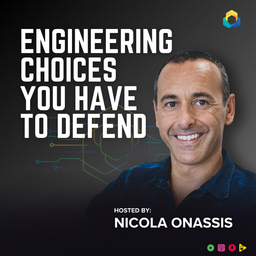
Real-world engineering decisions in AI, compliance, and production systems

Engineering Choices You Have to Defend
Claim This Podcastby Nicola Onassis
Podcast Overview
Real-world engineering decisions in AI, compliance, and production systems
Language
🇺🇲
Publishing Since
3/3/2026
Reach the team behind Engineering Choices You Have to Defend
Verified contact details for this show aren't on file yet — sign up to get notified when they land.
Recent Episodes

August 5, 2026
How Bill Boulden Defends Engineering Speed Without Sacrificing Quality
<p><strong>Episode Summary:</strong></p><p>In this episode of Engineering Choices You Have to Defend, host Nicola Onassis sits down with Bill Boulden, a fractional CTO and longtime startup engineering leader, to discuss why adding more processes after mistakes can sometimes create bigger problems than the original failure.</p><p>After working as an early engineering leader across more than two dozen startups, Bill has seen founders respond to bugs, downtime, and customer complaints by adding approval meetings, checklists, and deployment gates. He explains why engineering teams should instead focus on an acceptable defect rate and use automated systems to improve quality without sacrificing development speed.</p><p>Bill shares practical approaches including CI/CD, unit testing, observability, automated regression testing, canary deployments, and instant rollbacks. He also explains why good processes should reduce human involvement rather than create additional layers of oversight.</p><p>The conversation explores how AI is changing software engineering, with Bill emphasizing that while AI can make writing code easier, engineers remain responsible for understanding and approving what reaches production. He argues that judgment, critical thinking, and accountability are becoming even more important as AI-assisted development becomes standard.</p><p>For startup founders and engineering leaders, this episode offers practical lessons on balancing speed, quality, automation, accountability, and innovation without allowing unnecessary processes to slow down the entire team.</p><p><strong>Key Takeaways:</strong></p><ul><li>Engineering teams should not automatically add process after every mistake.</li><li>Teams need to establish an acceptable defect rate instead of pursuing perfection.</li><li>Automated systems can improve quality without slowing development.</li><li>Good processes should reduce human involvement rather than add approval layers.</li><li>AI makes coding faster, but engineers remain accountable for production code.</li><li>Engineering judgment and critical thinking are increasingly important in AI-assisted development.</li><li>Excessive processes can discourage innovation and initiative.</li><li>Leaders should balance engineering quality with business needs and development speed.</li><li>CI/CD, testing, observability, and automated deployments can reduce production risk.</li><li>The best engineering systems make quality the default without sacrificing velocity.</li></ul><br/><p><strong>Connect with Bill Boulden:</strong></p><ul><li>LinkedIn: <a href="linkedin.com/in/billboulden" rel="noopener noreferrer" target="_blank">linkedin.com/in/billboulden</a></li><li>Email: <a href="mailto:bill.bolden@gmail.com" rel="noopener noreferrer" target="_blank">bill.bolden@gmail.com</a></li></ul><br/><h3><strong>Listen Now & Subscribe:</strong></h3><p>Apple Podcasts, Spotify, Amazon Music, YouTube, iHeartRadio, Captivate, or wherever you get your podcasts.</p><p><strong>Engineering Choices You Have to Defend</strong> explores the real technical decisions behind AI systems, enterprise architecture, and scalable software engineering.</p>

July 31, 2026
How Mona Chitnis Defended Building Custom AI Models When Foundation Models Weren't Enough
<h3><strong>Episode Summary:</strong></h3><p>In this episode of <strong>Engineering Choices You Have to Defend</strong>, host <strong>Nicola Onassis</strong> sits down with <strong>Mona Chitnis</strong>, engineering leader at <strong>Boon</strong> and former engineering manager at <strong>Apple</strong>, to discuss one of the most important AI engineering decisions facing modern software teams: knowing when foundation models are no longer enough for production use.</p><p>Working on AI systems for the commercial construction industry, Mona quickly realized that general-purpose foundation models struggled to accurately understand complex construction plans and domain-specific workflows. Rather than immediately building custom models, her team first invested in developing a comprehensive evaluation framework to identify performance gaps, measure business outcomes, and determine whether fine-tuning proprietary models would deliver meaningful improvements.</p><p>One of Mona's most significant engineering decisions was choosing to build a hybrid AI architecture instead of relying entirely on off-the-shelf foundation models. By combining proprietary computer vision models with large language models, her team created a system capable of understanding construction documents, extracting measurements, and helping customers generate more accurate project estimates. She explains why data quality, customer collaboration, and continuous evaluation ultimately proved more valuable than simply adopting larger or newer AI models.</p><p>The conversation also explores Mona's experience leading privacy-preserving machine learning initiatives at Apple, where federated learning enabled AI models to improve without collecting sensitive user data. She discusses why enterprise AI success depends on representative datasets, thoughtful evaluation frameworks, and engineering systems designed around real customer outcomes rather than benchmark performance alone.</p><p>For engineering leaders building AI products in specialized or regulated industries, this episode offers practical lessons on evaluation strategy, production AI architecture, data quality, privacy-preserving machine learning, and building AI systems that deliver measurable business value.</p><h3><strong>Key Takeaways:</strong></h3><ul><li>Evaluation frameworks should be established before deciding to build custom AI models.</li><li>Foundation models often require domain-specific fine-tuning to solve specialized business problems.</li><li>Business outcomes matter more than benchmark scores when evaluating AI systems.</li><li>High-quality, representative datasets are critical to successful production AI.</li><li>Hybrid AI architectures can outperform relying on a single foundation model.</li><li>Customer collaboration plays a key role in improving enterprise AI performance.</li><li>Privacy-preserving machine learning enables AI improvements while protecting sensitive user data.</li><li>AI benchmarks should complement—not replace—real-world product evaluation.</li><li>Engineering leaders must balance technical performance with customer value and business objectives.</li><li>Successful AI products are built through disciplined engineering, continuous evaluation, and strong data strategies.</li></ul><br/><h3><strong>Connect with Mona Chitnis:</strong></h3><p><strong>LinkedIn:</strong><u><a href="http://linkedin.com/in/monachitnis" rel="noopener noreferrer" target="_blank"> linkedin.com/in/monachitnis</a></u></p><p><strong>Company:</strong> Boon</p><h3><strong>Listen Now & Subscribe:</strong></h3><p>Apple Podcasts, Spotify, Amazon Music, YouTube, iHeartRadio, Captivate, or wherever you get your podcasts.</p><p><strong>Engineering Choices You Have to Defend</strong> explores the real technical decisions behind AI systems, enterprise architecture, and scalable software engineering.</p>

July 22, 2026
How Hal Eisen Led a High-Stakes PCI Migration Under an Impossible Deadline
<h3><strong>Episode Summary:</strong></h3><p>In this episode of <strong>Engineering Choices You Have to Defend</strong>, host <strong>Nicola Onassis</strong> sits down with <strong>Hal Eisen</strong>, engineering leader and technology executive, to discuss one of the most challenging infrastructure decisions of his career: leading a company-wide PCI compliance initiative under an aggressive six-month deadline after the business had already committed to a major enterprise customer.</p><p>With no prior experience leading a PCI compliance project, Hal began by learning the standards from the ground up before systematically mapping every system, identifying security risks, and designing an architecture capable of protecting sensitive payment data. Rather than immediately writing code, he invested heavily in understanding the regulatory landscape, consulting compliance experts, and building a shared framework that allowed engineering teams across the organization to understand the migration strategy.</p><p>One of the project's most controversial decisions was choosing a "big bang" migration instead of the incremental approach most engineering teams naturally preferred. Although incremental migrations typically reduce risk, Hal realized that the complexity of tightly coupled legacy systems and the aggressive business deadline made that approach impossible. Through extensive planning, detailed migration playbooks, sandbox testing, and multiple rehearsal runs, his team successfully transitioned the platform while minimizing operational disruption.</p><p>The conversation also explores how AI is changing software engineering. Hal shares how recreating a document redaction service with ChatGPT in under thirty minutes fundamentally changed his perspective on AI-assisted development. He explains why senior engineers consistently achieve better results with AI, why engineering judgment remains irreplaceable, and why Agile principles continue to matter even as AI dramatically accelerates software development.</p><p>For engineering leaders managing compliance initiatives, large-scale infrastructure migrations, and AI-enabled development teams, this episode offers practical lessons on balancing risk, planning, technical leadership, and long-term engineering success.</p><h3><strong>Key Takeaways:</strong></h3><ul><li>Successful compliance initiatives begin with deeply understanding the regulatory requirements before implementing technical solutions.</li><li>Visual architecture models and shared language help align engineering teams during complex infrastructure migrations.</li><li>Big bang migrations can be the right decision when business constraints make incremental approaches impractical.</li><li>Thorough planning, rehearsals, and migration playbooks significantly reduce operational risk during major system cutovers.</li><li>Strong communication and stakeholder alignment are just as important as technical implementation.</li><li>AI dramatically accelerates software development but still requires experienced engineering judgment.</li><li>Senior engineers achieve better AI outcomes because they understand architectural trade-offs and code quality.</li><li>Engineering leaders remain accountable for AI-generated software and the business decisions behind it.</li><li>Agile principles continue to deliver value even as AI transforms software development workflows.</li><li>Engineering success depends on optimizing for business outcomes, not simply writing code faster.</li></ul><br/><h3><strong>Connect with Hal J Eisen:</strong></h3><ul><li><strong>LinkedIn:</strong><a href=" linkedin.com/in/haleisen" rel="noopener noreferrer" target="_blank"> linkedin.com/in/haleisen</a></li><li><strong>Website:</strong> <a href="haleisen.com" rel="noopener noreferrer" target="_blank">haleisen.com</a></li><li><strong>Organization:</strong> AppDev for All</li><li><strong>Website:</strong> <a href="appdevforall.org" rel="noopener noreferrer" target="_blank">appdevforall.org</a></li><li><strong>Email:</strong> haleisen@appdevforall.org</li></ul><br/><h3><strong>Listen Now & Subscribe:</strong></h3><p>Apple Podcasts, Spotify, Amazon Music, YouTube, iHeartRadio, Captivate, or wherever you get your podcasts.</p><p><strong>Engineering Choices You Have to Defend</strong> explores the real technical decisions behind AI systems, enterprise architecture, and scalable software engineering.</p>
19 total episodes available
Deep-dive analytics for Engineering Choices You Have to Defend
Frequently asked questions
Have a different question and can't find the answer you're looking for? Reach out to our support team by sending us an email and we'll get back to you as soon as we can.
- What is Engineering Choices You Have to Defend?
- How often does this podcast release new episodes?
This podcast updates daily.
- Where can I listen to this podcast?
This podcast is available on 4 platforms including Apple Podcasts, Spotify, and more. You can also use the RSS feed directly.
- Does this podcast accept guests?
Yes, this podcast regularly features guests.
Legal Disclaimer
Pod Engine is not affiliated with, endorsed by, or officially connected with any of the podcasts displayed on this platform. We operate independently as a podcast discovery and analytics service.
All podcast artwork, thumbnails, and content displayed on this page are the property of their respective owners and are protected by applicable copyright laws. This includes, but is not limited to, podcast cover art, episode artwork, show descriptions, episode titles, transcripts, audio snippets, and any other content originating from the podcast creators or their licensors.
We display this content under fair use principles and/or implied license for the purpose of podcast discovery, information, and commentary. We make no claim of ownership over any podcast content, artwork, or related materials shown on this platform. All trademarks, service marks, and trade names are the property of their respective owners.
While we strive to ensure all content usage is properly authorized, if you are a rights holder and believe your content is being used inappropriately or without proper authorization, please contact us immediately at hey@podengine.ai for prompt review and appropriate action, which may include content removal or proper attribution.
By accessing and using this platform, you acknowledge and agree to respect all applicable copyright laws and intellectual property rights of content owners. Any unauthorized reproduction, distribution, or commercial use of the content displayed on this platform is strictly prohibited.
