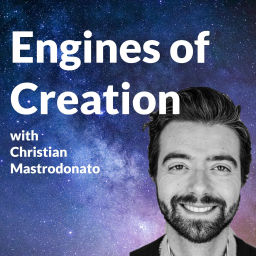
Podcast thumbnail for Engines of Creation

Engines of Creation

Claim This Podcast

by Christian Mastrodonato

5.0(2 reviews)
45 episodes
Updated Bi-weekly
Accepts GuestsHas SponsorsLocation 🇬🇧
17

Podcast Authority

Beta
PoorBased on show quality, social media presence, reviews, charts, and more
Pod Engine
Quality9
Social0
YouTube0
Engagement60

Podcast Overview

<p><b>Engines of Creation: Where Complexity Meets Reality</b></p><p>What do quantum computing, the evolution of democracy, and modern product strategy have in common? They are all emergent phenomena of complex systems.</p><p>Hosted by Christian Mastrodonato, <i>Engines of Creation</i> is a sanctuary for the anti-disciplinary thinker. We move beyond tech buzzwords to explore the applied systems theory and deep patterns that actually shape our world.</p><p>Whether we are analyzing the ethics of future-tech, unpacking collective intelligence, or applying ergodicity to daily decision-making, our goal is to understand how successful creations truly come to life.</p><p>Expect deep-dive conversations focusing on:</p><ul><li><b>The Frontiers of Tech:</b> Navigating first principles in AI, quantum mechanics, and technological progress.</li><li><b>Social Innovation:</b> Designing better frameworks for education, democracy, and collective intelligence.</li><li><b>The Builder’s Mindset:</b> Exploring flow states, asymmetric risk, and the philosophy of creation.</li></ul><p>If you are a systems thinker, social innovator, or future-tech scout, join us to cut through the noise and discover the hidden engines driving our complex world.</p>

Language

🇺🇲

Publishing Since

2/8/2023

Unlock The Full Podcast Authority Score Report

See how your podcast performs across key metrics

17

Podcast Authority

Beta
PoorBased on show quality, social media presence, reviews, charts, and more
Pod Engine
Quality9
Social0
YouTube0
Engagement60
4
Excellent Areas
2
Good Performance
13
Growth Opportunities
excellent
Episode Length
39 minutes
Performing excellently!
good
Show Notes Quality
3.0/5

Recommendations available

Unlock the full report to see detailed tips

poor
Publishing Consistency
Every 37 days

Recommendations available

Unlock the full report to see detailed tips

+16 More Metrics

Unlock comprehensive insights including:

  • • YouTube presence analysis
  • • Social media reach metrics
  • • RSS compliance scoring
  • • Podcast 2.0 features
  • • Technical standards
What's Included in Your Full Report

Detailed Analytics

  • Complete breakdown of all 19 authority metrics
  • Personalized recommendations for each metric
  • Industry benchmarks and comparisons
  • Technical RSS feed analysis and compliance scoring

Growth Strategies

  • Step-by-step action plans for improvement
  • Quick wins to boost your score immediately
  • Pro tips from successful podcasters
Get your free podcast insights report

See how your show performs across every key metric

Instant delivery
No spam
Attract Better Guests

High authority scores make your podcast more attractive to industry leaders and influencers who want to appear on credible shows.

Secure Sponsorships

Sponsors look for podcasts with proven authority and engagement. Your score demonstrates your podcast's value to potential partners.

Grow Your Audience

Understanding your strengths and weaknesses helps you make data-driven decisions to expand your listener base effectively.

2 verified contact emails on file for Engines of Creation

Pitch yourself as a guest, propose sponsorships, or reach out directly to the host.

Recent Episodes

Episode thumbnail for #30 | On the Consequences of Design and Building Systems That Last | Alexandra Deschamps-Sonsino

March 3, 2026

#30 | On the Consequences of Design and Building Systems That Last | Alexandra Deschamps-Sonsino

<p>In the tech world, we are obsessed with the shiny launch and the initial optimization. But what happens on Day One Million? In this episode, Christian sits down with Alexandra Deschamps-Sonsino, a pioneer in the design, tech, and climate spaces. From her early days bringing Arduino to the UK to her work on tech ethics and the right to repair, Alex challenges the "move fast and break things" narrative. We explore why the current generative AI boom is treating the general public like an unpaid research experiment , how to balance system efficiency with human agency , and why building without considering long-term consequences is a failure of mature design.</p><p></p><p><b>Key Takeaways:</b></p><ul><li><b>The Problem with Frictionless Tech:</b> Designing all friction out of a system often removes human agency; if optimization were the only goal, we would all exclusively use microwaves. People often need friction for care, time, or cultural meaning.<p></p></li><li><b>AI as a Mass Experiment:</b> Companies are currently deploying generative AI to the public without knowing why people want to use it, effectively treating society as a massive, paid research experiment.<p></p></li><li><b>Venture Capital vs. Risk Registers:</b> Private VC funding rarely requires founders to build a risk register or account for the negative societal consequences of their products, whereas public funding demands it.<p></p></li><li><b>The Illusion of the Smart Home:</b> The negotiation between public and private spaces in the home is constantly shifting, and poorly designed smart devices can become tools for domestic abuse if dark use-cases are ignored.<p></p></li><li><b>Right to Repair:</b> Making systems disassemblable and repairable by consumers is a necessary step forward, as the craft of repair slowly becomes an endangered skill.<p></p></li></ul><p><b>People, Projects &amp; References Mentioned:</b></p><ul><li><b>The Good Night Lamp:</b> Alex's ambient computing project, created in 2005 at the Interaction Design Institute Ivrea and now in the London Design Museum's permanent collection.<p></p></li><li><b>Smarter Homes:</b> Alex's book exploring the history and future of the smart home genre (second edition coming soon).<p></p></li><li><b>Better IoT (</b><a target="_blank" rel="noopener noreferrer nofollow" href="http://betteriot.org"><b>betteriot.org</b></a><b> / </b><a target="_blank" rel="noopener noreferrer nofollow" href="http://iot.london"><b>iot.london</b></a><b>):</b> A free 30-40 question checklist developed by Alex and the community to help founders build ethical, secure, and repairable IoT products.<p></p></li><li><b>Human Values (</b><a target="_blank" rel="noopener noreferrer nofollow" href="http://humanvalues.io"><b>humanvalues.io</b></a><b>):</b> A 72-question framework developed with BBC R&amp;D to help builders respect key human values in digital solutions.<p></p></li><li><b>Stewart Brand:</b> Mentioned in relation to his long-term thinking, the Clock of the Long Now, and his books <i>How Buildings Learn</i> and <i>The Maintenance of Everything</i>.<p></p></li><li><b>The Restart Project:</b> A right-to-repair campaign organization where Alex served as a trustee, pushing for EU and UK laws to make objects more repairable.<p></p></li><li><b>Ding vs. Ring:</b> A smart doorbell business by London design studio Ohm that emerged alongside Ring, illustrating how multiple companies build the "possibility space" for a market.<p></p></li><li><b>Juicero:</b> Cited as an example of over-engineered "efficiency" where a complex, expensive machine did the exact same job as pressing a juice pouch between two heavy objects.</li></ul>

Episode thumbnail for #29 | On Community Intelligence in the Age of AI | Interview with Jake McKee

February 3, 2026

#29 | On Community Intelligence in the Age of AI | Interview with Jake McKee

In the age of Generative AI, the temptation to automate customer feedback is immense. Why deal with the friction of human users when you can test against "synthetic data"? In this episode, Christian sits down with veteran community strategist Jake McKee to deconstruct the physics of community. Jake argues that we are fundamentally misunderstanding the role of community in the enterprise. It is not a cost center for support deflection; it is a Central Nervous System—an "Octopus" with tentacles reaching into product, marketing, and strategy. We discuss the "Octopus Theory," why the role of a Community Manager is actually that of a CIA Intelligence Analyst, and the dangerous trap of "retroactive" AI tools that can iterate on patterns but cannot invent the future. Key Topics &amp; Mental Models: The Octopus Theory: Why community is not a silo but a system that connects disparate organs of the company (Product, Advocacy, Support). The Intelligence Analyst Model: Moving beyond "raw data" to "intelligence." Why leadership needs interpreted insight, not just a raw feed of customer complaints. The Synthetic User Trap: Jake explains why AI is a "retroactive tool" that excels at pattern recognition but fails at "forward-looking" innovation, creating a risk for companies that replace human friction with synthetic testing. Platform Thinking &amp; Emotional Texture: How to design products that avoid commoditization by building "emotional texture" (the Yeti Mic and British Candy examples). The "Everyone Goes Home Happy" Principle: Structuring mutual value exchange so that community participation is impactful for the user, not just extraction for the brand. Select Quotes: "The problem is that AI fundamentally is a retroactive tool. It looks backwards at what exists and creates pattern... We can't come up with innovative products looking forward if all we're doing is relying on what people have already thought about." — Jake McKee "I think about community work as the 'Octopus Theory'... anything we do has eight tentacles that expand out into other parts of the organization indirectly." — Jake McKee "We are building a relationship... I don't just say, 'I'm only going to meet you to have this podcast and never talk to you again.' I want our conversation today to lead to the better next one tomorrow." — Jake McKee About the Guest: Jake McKee is a long-time community strategist and builder who specializes in helping disparate groups—companies and customers, engineering and creative—talk to one another. He focuses on the structural and relational dynamics that turn "users" into partners. Website: Jake McKee's Website

Episode thumbnail for #28 | On Plural Futures and Anti-Fragility | Interview with Pascal Finette

January 6, 2026

#28 | On Plural Futures and Anti-Fragility | Interview with Pascal Finette

In a world defined by exponential change and unprecedented uncertainty, the traditional "five-year plan" is worse than useless—it is a comforting fiction. We tend to optimize our organizations for a singular "Official Future," only to be blindsided when reality diverges from our spreadsheets. In this episode, we explore how to move beyond fragile planning and mere resilience. I am joined by Pascal Finette, co-founder of be radical and former executive at Singularity University, eBay, and Mozilla. Together, we deconstruct the buzzword of "disruption" and replace it with a more useful framework: Anti-Fragility. We discuss why nature loves chaos while corporations fear it, why you need more "heretics" in your boardroom, and how to navigate the "Jagged Frontier" of Artificial Intelligence—where the line between human and machine competence is constantly shifting. If you are tired of the "tofu" of empty business jargon and want to understand the physics of organizational change, this conversation is for you. What We Discuss Disruption as "Tofu": Why the word has lost its meaning and how to redefine it as a "State Change" in the "Job to be Done". The Anti-Fragile Organization: Moving beyond resilience (surviving the shock) to anti-fragility (getting stronger because of the shock). The Myth of the Official Future: Why even the creators of AI (like Sam Altman) admit "nobody knows" what happens next, and why we must plan for a cone of "Plural Futures" instead. The Chaordic System: Lessons from Dee Hock (founder of Visa) on balancing chaos and order to create fluid, responsive organizations. The Jagged Frontier of AI: Understanding why AI is a "stochastic parrot" that excels at some tasks and fails spectacularly at others—and why discovering that boundary is a human task. Curiosity as a Competitive Advantage: Why the ability to "learn how to learn" (meta-learning) is the only skill that won't become obsolete. Quotes from the Episode "Disruption has become what I like to call 'tofu'... it tastes like absolutely nothing until you put sauce on it." — Pascal Finette "Nature tends to be anti-fragile. It grows stronger through shock. We don't do this in companies... companies love order." — Pascal Finette "The true sign of genius is your ability to hold two competing ideas in your head at the same time." — Pascal Finette (referencing F. Scott Fitzgerald) About the Guest Pascal Finette is the co-founder of be radical, an organization that helps leaders anticipate the future and build anti-fragile organizations. He previously held leadership positions at eBay, Mozilla, and Google, and led the entrepreneurship and open innovation tracks at Singularity University. He is the author of the book Disrupt Disruption. Resources Mentioned Book: Disrupt Disruption by Pascal Finette Concept: The Innovator's Dilemma (Clayton Christensen) Concept: Anti-Fragile (Nassim Nicholas Taleb) Concept: Chaordic Organizations (Dee Hock/Visa) Concept: The Jagged Frontier of AI (Ethan Mollick/Wharton)

45 total episodes available

Recent guests on Engines of Creation

Guests from recent episodes — sign up to see every guest that has ever appeared on this show.

Nick Cawthon

Guest

Gurpreet Muctor

Guest

Deep-dive analytics for Engines of Creation

Frequently asked questions

Have a different question and can't find the answer you're looking for? Reach out to our support team by sending us an email and we'll get back to you as soon as we can.

What is Engines of Creation?
<p><b>Engines of Creation: Where Complexity Meets Reality</b></p><p>What do quantum computing, the evolution of democracy, and modern product strategy have in common? They are all emergent phenomena of complex systems.</p><p>Hosted by Christian Mastrodonato, <i>Engines of Creation</i> is a sanctuary for the anti-disciplinary thinker. We move beyond tech buzzwords to explore the applied systems theory and deep patterns that actually shape our world.</p><p>Whether we are analyzing the ethics of future-tech, unpacking collective intelligence, or applying ergodicity to daily decision-making, our goal is to understand how successful creations truly come to life.</p><p>Expect deep-dive conversations focusing on:</p><ul><li><b>The Frontiers of Tech:</b> Navigating first principles in AI, quantum mechanics, and technological progress.</li><li><b>Social Innovation:</b> Designing better frameworks for education, democracy, and collective intelligence.</li><li><b>The Builder’s Mindset:</b> Exploring flow states, asymmetric risk, and the philosophy of creation.</li></ul><p>If you are a systems thinker, social innovator, or future-tech scout, join us to cut through the noise and discover the hidden engines driving our complex world.</p>
How often does this podcast release new episodes?

This podcast updates bi-weekly.

Where can I listen to this podcast?

This podcast is available on 9 platforms including Apple Podcasts, Spotify, and more. You can also use the RSS feed directly.

Does this podcast accept guests?

Information about guest appearances is not available.

Legal Disclaimer

Pod Engine is not affiliated with, endorsed by, or officially connected with any of the podcasts displayed on this platform. We operate independently as a podcast discovery and analytics service.

All podcast artwork, thumbnails, and content displayed on this page are the property of their respective owners and are protected by applicable copyright laws. This includes, but is not limited to, podcast cover art, episode artwork, show descriptions, episode titles, transcripts, audio snippets, and any other content originating from the podcast creators or their licensors.

We display this content under fair use principles and/or implied license for the purpose of podcast discovery, information, and commentary. We make no claim of ownership over any podcast content, artwork, or related materials shown on this platform. All trademarks, service marks, and trade names are the property of their respective owners.

While we strive to ensure all content usage is properly authorized, if you are a rights holder and believe your content is being used inappropriately or without proper authorization, please contact us immediately at hey@podengine.ai for prompt review and appropriate action, which may include content removal or proper attribution.

By accessing and using this platform, you acknowledge and agree to respect all applicable copyright laws and intellectual property rights of content owners. Any unauthorized reproduction, distribution, or commercial use of the content displayed on this platform is strictly prohibited.