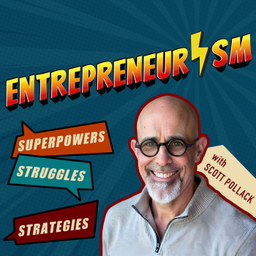
What makes a successful entrepreneur? It’s certainly not just about spotting opportunities. The entrepreneurial journey is full of tensions that must be managed. The most successful master the balance between vision and execution, short-term demands and long-term goals, opportunities and distractions. ENTREPRENEURISM unpacks what separates great entrepreneurs from the rest, mining the entrepreneurial journey for practical insights. Hosted by CEO coach Scott Pollack, this podcast brings you candid conversations, bold ideas, and actionable strategies from entrepreneurs who have built thriving ventures. Ready to unlock your full potential? This is the show for you.

ENTREPRENEURISM
Claim This Podcastby Scott Pollack
Podcast Authority
Beta
Podcast Overview
What makes a successful entrepreneur? It’s certainly not just about spotting opportunities. The entrepreneurial journey is full of tensions that must be managed. The most successful master the balance between vision and execution, short-term demands and long-term goals, opportunities and distractions. ENTREPRENEURISM unpacks what separates great entrepreneurs from the rest, mining the entrepreneurial journey for practical insights. Hosted by CEO coach Scott Pollack, this podcast brings you candid conversations, bold ideas, and actionable strategies from entrepreneurs who have built thriving ventures. Ready to unlock your full potential? This is the show for you.
Language
🇺🇲
Publishing Since
3/19/2025
Unlock The Full Podcast Authority Score Report
See how your podcast performs across key metrics
Podcast Authority
Beta
Recommendations available
Unlock the full report to see detailed tips
Recommendations available
Unlock the full report to see detailed tips
Unlock comprehensive insights including:
- • YouTube presence analysis
- • Social media reach metrics
- • RSS compliance scoring
- • Podcast 2.0 features
- • Technical standards
Detailed Analytics
- Complete breakdown of all 19 authority metrics
- Personalized recommendations for each metric
- Industry benchmarks and comparisons
- Technical RSS feed analysis and compliance scoring
Growth Strategies
- Step-by-step action plans for improvement
- Quick wins to boost your score immediately
- Pro tips from successful podcasters
See how your show performs across every key metric
High authority scores make your podcast more attractive to industry leaders and influencers who want to appear on credible shows.
Sponsors look for podcasts with proven authority and engagement. Your score demonstrates your podcast's value to potential partners.
Understanding your strengths and weaknesses helps you make data-driven decisions to expand your listener base effectively.
1 verified contact email on file for ENTREPRENEURISM
Pitch yourself as a guest, propose sponsorships, or reach out directly to the host.
Recent Episodes

May 21, 2026
Beyond Ticketing: Ritesh Patel on AI, Capital, and the Future of Live Events
<p>Ritesh Patel shares an entrepreneurial journey that started with coding as a child, building software as a teenager, and hacking together DIY livestreams for club nights long before that was mainstream. In this episode, he explains how those early instincts grew into Ticket Fairy, a company that began by applying ad-tech and gamification to event growth and is now expanding into working capital, AI-powered workflows, and banking infrastructure. He also shares why better software alone was not enough to win in a crowded market, how he and his brother make a co-CEO model work across continents, and what founders can learn from focusing on product, customers, and real sources of competitive advantage.</p><p><strong>Show Notes</strong></p><ul><li><strong>[00:00]</strong> Teaser: Ritesh recounts rigging a DIY livestream for a club event in 2000.</li><li><strong>[00:53]</strong> Show Intro</li><li><strong>[03:27]</strong> Early entrepreneurial wiring: coding at 9, building products at 13, and incorporating a company at 16.</li><li><strong>[05:02]</strong> Bristol, house parties, club nights, and the leap from student events to real audience-building.</li><li><strong>[09:24]</strong> The original Ticket Fairy concept: turning ticket buyers into affiliates using ad-tech logic, attribution, and fan rewards.</li><li><strong>[11:26]</strong> Bootstrapping, repeated VC rejection, landing Justin Kan as an early investor, and then getting into Y Combinator.</li><li><strong>[13:32]</strong> Building software for independent promoters by encoding best practices they could not afford to build themselves.</li><li><strong>[15:13]</strong> Why the co-founder relationship worked better as co-CEOs than as separate conventional titles.</li><li><strong>[19:35]</strong> How the co-CEO model works in practice across a distributed company split between San Francisco and Dubai.</li><li><strong>[22:45]</strong> A deliberate “build year” and the strategic work streams that converged into a new growth phase.</li><li><strong>[24:45]</strong> The real reason competitors won deals: access to working capital, not just product strength.</li><li><strong>[27:05]</strong> Launching a capital product through private credit to compete for larger, more established clients.</li><li><strong>[27:58]</strong> Moving beyond ticketing into AI agents, workflow automation, and banking rails.</li><li><strong>[31:11]</strong> Quick Fire: book recommendation, tool/app, grounding habit, and startup advice.</li><li><strong>[35:53]</strong> Show Outro</li></ul><p></p><p><strong>Quick Fire Resources</strong></p><ul><li><strong>Book:</strong> Shantaram by Gregory David Roberts — <a href="https://www.amazon.com/s?k=Shantaram+Gregory+David+Roberts" target="_blank">Amazon</a></li><li><strong>Tool/App:</strong> <a href="https://claude.ai/" target="_blank">Claude Code</a></li></ul><p></p>

April 5, 2026
From Employee to Owner: Morgan O’Hara’s Path to the Top
<p>Morgan O’Hara didn’t found The Hutong, but over 16 years he helped shape it, scale it, and ultimately become its largest shareholder. In this episode, he talks candidly about joining the company in its earliest days, bringing structure to a highly creative business, and helping steer its evolution from a Beijing cultural space into a leading educational travel company working with schools across Greater China and Southeast Asia. The conversation also explores leadership growth, culture-building, pandemic survival, and what it really takes to rise inside a company you believe in.</p><p><strong>Show Notes</strong></p><p><strong>[00:00]</strong> Show Teaser & Intro</p><p><strong>[02:03]</strong> Morgan’s unconventional path begins</p><p>Fresh out of his MBA, Morgan lands in China during the financial crisis, visits a hutong courtyard on a school trip, and decides to stay in Beijing rather than head home.</p><p><strong>[04:59]</strong> Early days at The Hutong</p><p>He joins a tiny team, wears many hats, and starts bringing structure to a business that was initially more experimental and community-driven than operationally defined.</p><p><strong>[06:34]</strong> From cultural courtyard to educational travel business</p><p>What began as events, workshops, and community programming gradually evolved into a focused B2B educational travel company serving international schools.</p><p><strong>[08:19]</strong> Spotting the real growth opportunity</p><p>Morgan and the team realize their real edge is in designing and delivering experiential learning programs, then begin expanding from Beijing into Shanghai, Hong Kong, and beyond.</p><p><strong>[10:26]</strong> Earning equity, not inheriting it</p><p>Morgan explains how performance, sweat equity, and reinvestment created his path into ownership — and how a revenue milestone helped formalize the partnership.</p><p><strong>[13:02]</strong> Morgan’s real entrepreneurial focus</p><p>Rather than claiming a “superpower,” he points to two enduring obsessions: building a great place to work and relentlessly protecting program quality.</p><p><strong>[14:18]</strong> Turning mistakes into learning</p><p>Morgan shares an internal mantra — “turning negatives into positives” — and the role that positivity plays in entrepreneurial resilience.</p><p><strong>[17:30]</strong> The pandemic nearly breaks the business</p><p>For a company built around in-person experiences, Covid was existential. Morgan reflects on hard choices, preserving the team as long as possible, and leading through uncertainty.</p><p><strong>[18:42]</strong> How The Hutong survived</p><p>By shrinking to a core team, operating opportunistically in open markets, and developing localized programs where restrictions allowed, the company made it through and came out stronger.</p><p><strong>[20:59]</strong> Morgan’s evolution as a leader</p><p>He describes the shift from intense operator to steward of the company — and the growing importance of lifting others up rather than staying at the center of everything.</p><p><strong>[22:22]</strong> Escaping founder-style bottlenecks</p><p>Moving to Hong Kong forced Morgan to step back from day-to-day details and operate with more perspective, which helped the company scale.</p><p><strong>[24:29]</strong> Hiring, values fit, and leadership development</p><p>Morgan explains The Hutong’s approach to hiring, why bringing in senior outsiders is not always the answer, and how they develop leaders from within.</p><p><strong>[25:40]</strong> The management forum</p><p>One of the standout practices in the business: a recurring learning forum built around management principles and shared leadership development.</p><p><strong>[28:13]</strong> Quick Fire: book recommendation</p><p>Morgan recommends Mastering the Rockefeller Habits by Verne Harnish, now more widely associated with Scaling Up.</p><p><strong>[28:44]</strong> Quick Fire: morning routine</p><p>He starts early, makes coffee, plans the day, and tackles high-focus work before the family gets up.</p><p><strong>[29:17]</strong> Quick Fire: tool he can’t live without</p><p>Morgan names Asana as both a team project-management tool and a personal reminder system.</p><p><strong>[29:37]</strong> Quick Fire: habit that keeps him grounded</p><p>Exercise — running, swimming, biking, or the gym.</p><p><strong>[29:50]</strong> Quick Fire: best business advice</p><p>“Nothing is ever as good or as bad as it seems.”</p><p><strong>[31:19]</strong> Final advice for ambitious employees</p><p>If you love the business you’re in, prove your worth, make yourself indispensable, and create the kind of value the company cannot ignore.</p><p><strong>[33:00]</strong> Show Outro</p><p><strong>Quick Fire Resources</strong></p><p><strong>Book:</strong> Mastering the Rockefeller Habits by Verne Harnish</p><p><strong>Tool/App:</strong> Asana</p><p><strong>Related hiring book mentioned by Scott:</strong> Who: The A Method for Hiring by Geoff Smart and Randy Street</p>

January 24, 2026
Crossing the River by Feeling the Stones: How Roberta Lipson Built Premium Healthcare in China
<p>Roberta Lipson (李碧菁) walks us through a rare founder story: spotting a gap in China’s healthcare market, persuading stakeholders that a foreign-invested hospital could work, and then financing the first facility through an early-stage IPO that many would have advised against. We explore the practical realities of building trust—first with top doctors, then with patients—how a mission-driven culture becomes operational, and why the “right” capital market for a business like hers is the one closest to its patients. </p><h3>Timestamped Show Notes (key topics & takeaways)</h3><ul><li><strong>[00:00] Teaser</strong> — Catching the moment: why the early IPO mattered and what “conventional wisdom” would have missed.</li><li><strong>[00:40] Show Intro</strong> (no summary)</li><li><strong>[02:12] Welcome & framing</strong> — Roberta’s arc: China, healthcare, and building something that didn’t exist yet.</li><li><strong>[03:29] Early fascination with China</strong> — From studying Chinese history/language to deciding she wanted to “do things,” not just study them.</li><li><strong>[05:07] Landing in Beijing</strong> — The trading-company job that became a platform for opportunity exploration.</li><li><strong>[05:33] First entrepreneurial wedge</strong> — Importing U.S. medical equipment into Chinese hospitals; learning the market from the inside.</li><li><strong>[06:15] Founding the company (1981/82)</strong> — Building a business by sourcing relevant technology and convincing U.S. firms China could be a real customer.</li><li><strong>[07:46] Insight from hospital floors</strong> — Seeing both the “beautiful things” and the systemic gaps: overcrowding, underpaid doctors, limited tools.</li><li><strong>[08:22] The unmet customer need</strong> — Watching expats leave China for care and realizing a local solution could be built.</li><li><strong>[09:00] Creating the category with regulators</strong> — No clear rulebook: “crossing the river by feeling the stones.”</li><li><strong>[09:56] The winning narrative</strong> — Healthcare as part of China’s ability to attract foreign investment and experts (alongside education).</li><li><strong>[10:23] The capital panic</strong> — Approval seemed close, but where would the funding come from? No usable capital markets in China then.</li><li><strong>[10:54] The “mini IPO” (1994)</strong> — Why going public early unlocked the first hospital—and first-mover advantage.</li><li><strong>[11:13] The first hospital</strong> — Small beginnings: 26 beds, 11 doctors, ~60 nurses; initially almost 100% expat clientele.</li><li><strong>[12:40] Market evolution</strong> — Over time, the patient base shifts heavily local; growth across major eastern cities.</li><li><strong>[14:33] Founding partnership</strong> — Why complementary skills and shared values with Elyse Silverberg mattered (and still did years later).</li><li><strong>[17:24] Operating rules for China</strong> — Persistence + legality: don’t “take no” easily, but treat compliance as essential.</li><li><strong>[18:43] Mission as a management system</strong> — “In the heart” culture: hiring for belief, not just capability—especially in healthcare.</li><li><strong>[21:07] Founder struggles</strong> — Financing/valuation challenges and the difficulty of communicating the real value proposition to U.S. investors.</li><li><strong>[21:48] Privatization lessons</strong> — The shift from distant shareholders to hands-on investors; what changes operationally when investors are “in your life.”</li><li><strong>[23:09] Back to public markets (2019) and re-privatizing (2021)</strong> — Why “the right” public market should be near patients.</li><li><strong>[24:20] The personal trade-offs</strong> — Work–life balance, raising kids while scaling, and the role of an unusually supportive partner at home.</li><li><strong>[26:46] Frugality vs. professionalism</strong> — Early scrappiness, then learning when to invest (“spend money to make money”).</li><li><strong>[28:04] Digitalization, AI, and automation</strong> — Why the organization made the bet—and why she’s glad they did.</li><li><strong>[29:11] Trust-building playbook</strong> — Start with doctors (credibility), then deliver exceptional patient experiences (childbirth as an early trust engine).</li><li><strong>[32:00] Quick Fire</strong> — Books, habits, tools, and founder advice.</li><li><strong>[35:32] Show Outro</strong> (no summary)</li></ul><h3></h3><h3>Quick Fire Recommendations</h3><p></p><p><strong>Books (Roberta):</strong></p><ul><li><a href="https://www.amazon.com/Spirit-Catches-You-Fall-Down/dp/0374533407" target="_blank">The Spirit Catches You and You Fall Down</a><a href="https://www.amazon.com/Spirit-Catches-You-Fall-Down/dp/0374533407" target="_blank"> — Anne Fadiman</a></li><li><a href="https://www.amazon.com/Gods-Hotel-Hospital-Pilgrimage-Medicine/dp/1594486549" target="_blank">God’s Hotel</a><a href="https://www.amazon.com/Gods-Hotel-Hospital-Pilgrimage-Medicine/dp/1594486549" target="_blank"> — Victoria Sweet</a></li><li><a href="https://www.amazon.com/Transforming-Health-Care-Virginia-Experience/dp/1563273756" target="_blank">Transforming Health Care: The Virginia Mason Medical Center’s Story</a><a href="https://www.amazon.com/Transforming-Health-Care-Virginia-Experience/dp/1563273756" target="_blank"> — Charles Kenney</a></li></ul><p></p><p><strong>Apps/Tools (Roberta):</strong></p><ul><li><a href="https://www.feishu.cn/" target="_blank">Feishu</a> (飞书 / <a href="https://www.larksuite.com/" target="_blank">Lark</a>)</li><li><a href="https://openai.com/chatgpt/" target="_blank">ChatGPT</a></li></ul><p></p><p><strong>Habit (Roberta):</strong></p><ul><li>Exercise (when she does it, her day goes much better)</li><li>Checking in with family (husband/children)</li></ul><p></p><p><strong>Advice (Roberta):</strong></p><ul><li>Follow your heart; don’t be discouraged; don’t take “no” for an answer.</li></ul><p></p>
23 total episodes available
Recent guests on ENTREPRENEURISM
Guests from recent episodes — sign up to see every guest that has ever appeared on this show.
Minesh Pore
Guest
Vanessa Hendriadi
Guest
Jaeson Ma
Guest
Andy Klump
Guest
David Steele
Guest
Rich Robinson
Guest
Michele Ferrario
Guest
Lin Lin Jacobs
Guest
David San Roman
Guest
Sophie Chen
Guest
Alvin Wang Graylin
Guest
Scott Empringham
Guest
Deep-dive analytics for ENTREPRENEURISM
Frequently asked questions
Have a different question and can't find the answer you're looking for? Reach out to our support team by sending us an email and we'll get back to you as soon as we can.
- What is ENTREPRENEURISM?
- How often does this podcast release new episodes?
This podcast updates daily.
- Where can I listen to this podcast?
This podcast is available on 4 platforms including Apple Podcasts, Spotify, and more. You can also use the RSS feed directly.
- Does this podcast accept guests?
Yes, this podcast regularly features guests.
Legal Disclaimer
Pod Engine is not affiliated with, endorsed by, or officially connected with any of the podcasts displayed on this platform. We operate independently as a podcast discovery and analytics service.
All podcast artwork, thumbnails, and content displayed on this page are the property of their respective owners and are protected by applicable copyright laws. This includes, but is not limited to, podcast cover art, episode artwork, show descriptions, episode titles, transcripts, audio snippets, and any other content originating from the podcast creators or their licensors.
We display this content under fair use principles and/or implied license for the purpose of podcast discovery, information, and commentary. We make no claim of ownership over any podcast content, artwork, or related materials shown on this platform. All trademarks, service marks, and trade names are the property of their respective owners.
While we strive to ensure all content usage is properly authorized, if you are a rights holder and believe your content is being used inappropriately or without proper authorization, please contact us immediately at hey@podengine.ai for prompt review and appropriate action, which may include content removal or proper attribution.
By accessing and using this platform, you acknowledge and agree to respect all applicable copyright laws and intellectual property rights of content owners. Any unauthorized reproduction, distribution, or commercial use of the content displayed on this platform is strictly prohibited.