
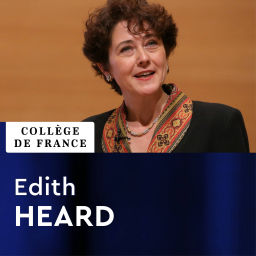
Épigénétique et mémoire cellulaire - Edith Heard
Claim This Podcastby Collège de France
Podcast Overview
<p>Née le 5 mars 1965 à Londres (Angleterre).</p><p></p><p>Edith Heard est généticienne de formation. Elle a suivi des études en sciences naturelles à l'Université de Cambridge au Royaume-Uni et a préparé son doctorat au « Imperial Cancer Research Fund » à Londres. Edith Heard est arrivée en France, à l'Institut Pasteur en 1990. Elle dirige aujourd'hui à l'Institut Curie, l'Unité de Génétique et biologie du développement et l'équipe « Épigenèse et développement des mammifères ».</p><p></p><p>Elle a reçu de nombreuses distinctions pour ses travaux de recherche, comme la Médaille d'argent du CNRS, en 2008, le prix Jean Hamburger de la ville de Paris, en 2009, l'ERC Advanced Investigator Award du Conseil européen de la recherche en 2010 et le Grand Prix de la FRM en 2011. Elle est en outre membre élu de la prestigieuse Organisation européenne de biologie moléculaire (EMBO) depuis 2005. En 2012, elle a été nommée Professeure au Collège de France.</p><p></p><p>Edith Heard se consacre depuis plusieurs années à l'étude des processus épigénétiques, tel que l'inactivation du chromosome X chez les mammifères, un modèle classique dans ce domaine. Ses travaux ont contribué à la compréhension des premiers événements qui accompagnent l'inactivation du chromosome X au cours de l'embryogenèse. Son équipe a mis en évidence une dynamique remarquable des changements épigénétiques au cours du développement précoce et a élucidé une partie des mécanismes responsables du processus d'inactivation du X. Elle a aussi démontré la diversité de stratégies mises en œuvre dans ce processus entre des mammifères mêmes très proches au cours de l'évolution. L'ensemble de ces travaux sont largement reconnus dans le domaine, car des mécanismes similaires semblent être impliqués dans d'autres processus épigénétiques.</p>
Language
🇫🇷
Publishing Since
12/13/2012
1 verified contact email on file for Épigénétique et mémoire cellulaire - Edith Heard
Pitch yourself as a guest, propose sponsorships, or reach out directly to the host.
Recent Episodes
September 22, 2025
Conférence - Stephen Quake : Medical Innovations from the Genome Revolution: Liquid Biopsies
<p>Edith Heard</p><p>Collège de France</p><p>Epigénétique et mémoire cellulaire</p><p>Année 2024-2025</p><p></p><p>Conférence - Stephen Quake : Medical Innovations from the Genome Revolution: Liquid Biopsies</p><p></p><p>Stephen Quake</p><p>Head of Science at the Chan Zuckerberg Initiative and Lee Otterson Professor at Stanford University</p><p></p><p>Stephen Quake est invité par l'assemblée du Collège de France sur proposition de la Pr Edith Heard.</p><p></p><p>Résumé</p><p></p><p>One of the most important medical innovations to arise from the genome revolution is the development of liquid biopsies: simple blood tests which replace the need for invasive sampling in fields as diverse as pregnancy, transplant medicine, infectious disease, and cancer. Virtually all of these liquid biopsies are based on a physiological phenomenon discovered in Strasbourg in 1948: circulating cell free nucleic acids. Despite more than a half century of research, this phenomenon did not have a clinical use until it was paired with high throughput sequencing and knowledge of the human genome sequence. I will describe how our lab developed a variety of diagnostic tests which have replaced invasive biopsies and are now used by millions of patients each year.</p><p></p><p>Stephen Quake</p><p></p><p>Stephen Quake is Head of Science at the Chan Zuckerberg Initiative, where he oversees CZI's science grant programs, technology development, and the CZ Biohub Network. He has received numerous awards for his contributions to science and is one of only two dozen scientists elected to all three National Academies. Steve also holds a faculty position at Stanford University, where he is the Lee Otterson Professor of Bioengineering and Applied Physics. Previously he was the founding co-president of the Chan Zuckerberg Biohub (2016-2022), investigator of the Howard Hughes Medical Institute (2006-2016), and professor at the California Institute of Technology (1996-2005).</p>
September 8, 2025
Conférence - Stephen Quake : Understanding the Mysteries of the Cell: Our Immune Repertoire Viewed Through the Darwin's Eyes
<p>Edith Heard</p><p>Collège de France</p><p>Epigénétique et mémoire cellulaire</p><p>Année 2024-2025</p><p></p><p>Conférence - Stephen Quake : Understanding the Mysteries of the Cell: Our Immune Repertoire Viewed Through the Darwin's Eyes</p><p></p><p>Stephen Quake</p><p>Head of Science at the Chan Zuckerberg Initiative and Lee Otterson Professor at Stanford University</p><p></p><p>Stephen Quake est invité par l'assemblée du Collège de France sur proposition de la Pr Edith Heard.</p><p></p><p>Résumé</p><p></p><p>The nature of the immune system's antibody repertoire has been a subject of fascination for more than a century. This repertoire is highly plastic and can be directed to create antibodies with broad chemical diversity and high selectivity. There is now a good understanding of the potential diversity available and the mechanistic aspects of how this diversity is generated. Antibodies are formed by a mixture of recombination among gene segments, sequence diversification at the junctions of these segments, and point mutations throughout the gene. However, certain very elementary questions have remained open more than a half-century after being posed: It is still unclear what fraction of the potential repertoire is expressed in an individual at any point in time and how similar repertoires are between individuals who have lived in similar environments. Moreover, because each individual's immune system is an independent experiment in evolution by natural selection, experiments about repertoire similarity also inform our understanding of evolutionary diversity and convergence. I will discuss how we have used high throughput sequencing to sequence immune repertoires in both humans and model organisms to address these questions.</p><p></p><p>Stephen Quake</p><p></p><p>Stephen Quake is Head of Science at the Chan Zuckerberg Initiative, where he oversees CZI's science grant programs, technology development, and the CZ Biohub Network. He has received numerous awards for his contributions to science and is one of only two dozen scientists elected to all three National Academies. Steve also holds a faculty position at Stanford University, where he is the Lee Otterson Professor of Bioengineering and Applied Physics. Previously he was the founding co-president of the Chan Zuckerberg Biohub (2016-2022), investigator of the Howard Hughes Medical Institute (2006-2016), and professor at the California Institute of Technology (1996-2005).</p>
June 11, 2025
Colloque - L'inactivation du chromosome X : Closing words
Professor Edith Heard of the Collège de France delivers closing words on X chromosome inactivation at the Epigenetics and Cell Memory Conference.
83 total episodes available
Similar Podcasts
Discover related shows you might enjoy



Deep-dive analytics for Épigénétique et mémoire cellulaire - Edith Heard
Frequently asked questions
Have a different question and can't find the answer you're looking for? Reach out to our support team by sending us an email and we'll get back to you as soon as we can.
- What is Épigénétique et mémoire cellulaire - Edith Heard?
<p>Née le 5 mars 1965 à Londres (Angleterre).</p><p></p><p>Edith Heard est généticienne de formation. Elle a suivi des études en sciences naturelles à l'Université de Cambridge au Royaume-Uni et a préparé son doctorat au « Imperial Cancer Research Fund » à Londres. Edith Heard est arrivée en France, à l'Institut Pasteur en 1990. Elle dirige aujourd'hui à l'Institut Curie, l'Unité de Génétique et biologie du développement et l'équipe « Épigenèse et développement des mammifères ».</p><p></p><p>Elle a reçu de nombreuses distinctions pour ses travaux de recherche, comme la Médaille d'argent du CNRS, en 2008, le prix Jean Hamburger de la ville de Paris, en 2009, l'ERC Advanced Investigator Award du Conseil européen de la recherche en 2010 et le Grand Prix de la FRM en 2011. Elle est en outre membre élu de la prestigieuse Organisation européenne de biologie moléculaire (EMBO) depuis 2005. En 2012, elle a été nommée Professeure au Collège de France.</p><p></p><p>Edith Heard se consacre depuis plusieurs années à l'étude des processus épigénétiques, tel que l'inactivation du chromosome X chez les mammifères, un modèle classique dans ce domaine. Ses travaux ont contribué à la compréhension des premiers événements qui accompagnent l'inactivation du chromosome X au cours de l'embryogenèse. Son équipe a mis en évidence une dynamique remarquable des changements épigénétiques au cours du développement précoce et a élucidé une partie des mécanismes responsables du processus d'inactivation du X. Elle a aussi démontré la diversité de stratégies mises en œuvre dans ce processus entre des mammifères mêmes très proches au cours de l'évolution. L'ensemble de ces travaux sont largement reconnus dans le domaine, car des mécanismes similaires semblent être impliqués dans d'autres processus épigénétiques.</p> - How often does this podcast release new episodes?
This podcast updates bi-weekly.
- Where can I listen to this podcast?
This podcast is available on 8 platforms including Apple Podcasts, Spotify, and more. You can also use the RSS feed directly.
- Does this podcast accept guests?
No, this podcast does not typically feature guests.
Legal Disclaimer
Pod Engine is not affiliated with, endorsed by, or officially connected with any of the podcasts displayed on this platform. We operate independently as a podcast discovery and analytics service.
All podcast artwork, thumbnails, and content displayed on this page are the property of their respective owners and are protected by applicable copyright laws. This includes, but is not limited to, podcast cover art, episode artwork, show descriptions, episode titles, transcripts, audio snippets, and any other content originating from the podcast creators or their licensors.
We display this content under fair use principles and/or implied license for the purpose of podcast discovery, information, and commentary. We make no claim of ownership over any podcast content, artwork, or related materials shown on this platform. All trademarks, service marks, and trade names are the property of their respective owners.
While we strive to ensure all content usage is properly authorized, if you are a rights holder and believe your content is being used inappropriately or without proper authorization, please contact us immediately at hey@podengine.ai for prompt review and appropriate action, which may include content removal or proper attribution.
By accessing and using this platform, you acknowledge and agree to respect all applicable copyright laws and intellectual property rights of content owners. Any unauthorized reproduction, distribution, or commercial use of the content displayed on this platform is strictly prohibited.