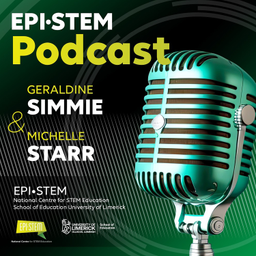
The EPI•STEM podcast comes to you from EPI•STEM The National Centre for STEM Education at the School of Education, University of Limerick. The co-hosts, Professor Geraldine Simmie and Dr. Michelle Starr, chat with their guests about the Research and Partnership projects at the Research Centre in STEM (science, technology, engineering and mathematics) and STEAM education in UL for inclusive STEM practices with the Arts (e.g. Ethics, Music, & Politics). The focus is on supporting teachers' knowledge and CPD within a need for Social Justice, Climate Justice and Sustainability.
Geraldine Simmie PhD and Michelle Starr PhD welcome everyone back to the start of another academic year 2026-2027 in the EPI∙STEM research centre in the School of Education at the University of Limerick.
Geraldine and Michelle open the discussion through recallingsome of the summer events and chatting about their summer readings in educational policy and in research. This is particularly of interest given the frenzy today in the world of education about the rise of AI tools in learning, teaching and research and issues in the wider world that are threateningdemocracy.
We finished up the summer with a summer school in UL for ourESAI Critical and Feminist Special Interest group that was well attended and had keynotes from Professor Emeritus Kathleen Lynch from UCD and Professor Emeritus Helen Gunter from the University of Manchester. In the last few days, we started the new year with a milestone celebration by the Sixmilebridge Historical Association marking Minister Donogh O’Malley’s free education scheme in 1966. The plaque was unveiled by the Minister for Education and Youth Hildegarde Naughton T.D.
What is of greatest interest here is that democracy alwayscomes into being in every country through its education system. That makes for a very special question today: how and in what ways are we bringing democracy into being in our education system today, in Ireland elsewhere.
Geraldine introduced the listeners to a book by Kyriazi etal. published earlier this year by Elgar publishing entitled ‘The Biological Turn in Education Policy’. While in the last century there may have been competition or peaceful co-existence between a humanistic paradigm in education and a more economistic-technical paradigm, it is clear that in this century the production of knowledge in education has started to migrate from the social sciences and humanities to the life sciences, and the deeper connection to the individual body and brain. Michelle and Geraldine tease out some of theimplications of this, both for general education and for STEM education now andinto the future.
The musical performance today is by Rosemary O’Malley andEstaban Flores, both graduates of the Master’s in Traditional Music in the Irish World Academy of Music and Dance in UL. Rosemary, originally from Chicago, works in the European Centre for the Study of Hate in the School of Law in UL. Esteban, from France works in SAVINS music store in Limerick city. Here Rosemary and Esteban play a set of three jigs, My Darling Child, The Piper’s Picnic and The Munster Bacon.
17 Sept 2026
EPI•STEM PODCAST EPISODE 42
In this replay episode of the EPI·STEM podcast, Geraldine Simmie PhD and Michelle Starr PhD welcome Professor Laura Colucci-Gray as their special guest. Professor Colucci-Gray is Professor of Science Education in the School of Education at Moray House, University of Edinburgh, Scotland.
Originally recorded following Professor Colucci-Gray's keynote address at the European Science Education Research Association (ESERA) 2025 Conference in Copenhagen, this conversation explores her perspectives on the importance of positioning the arts alongside the sciences in science education and sustainability.
Professor Colucci-Gray takes a feminist and new materialist approach to science education, highlighting the significance of affectivity beyond evidence and advocating for social and emotional development as essential not only for human flourishing but also for nurturing the capacity to care for others and for the wider world. She discusses how these perspectives contribute to the sustainability of democratic society, the economy and the environment.
Drawing on her extensive work in science education research, Professor Colucci-Gray offers rich insights into the transdisciplinary nature of science education and the vital role of the arts in learning. She also discusses research and development projects that support embodied and place-based learning practices. Among these is the STEAM education project Garden as a Provocation, developed with a team of teacher educators and artists at the University of Edinburgh. The project invites science teachers to engage with the garden both as a metaphor and as a real-world learning space, inspiring arts-based pedagogies that encourage ethical, open, contemplative and democratic approaches to science learning while fostering care for self, others and the environment.
The music featured in this episode is by Caoimhe Fitzpatrick, then a first-year student on the BA in World Music at the Irish World Academy of Music and Dance, University of Limerick. Caoimhe performs her original composition, Liberties Baby, an acoustic reflection on human freedom.
Originally released in 2025. We are delighted to share this conversation again with our listeners as part of our EPI·STEM podcast replay series.
9 Sept 2026
EPISTEM PODCAST EPISODE 41
EPI•STEM PODCAST — Conversation with Professor Sara Tolbert Originally recorded in June 2025 and republished as part of our continuing EPI•STEM series.
In this episode, co‑hosts Geraldine Simmie PhD and Michelle Starr PhD speak with Professor Sara Tolbert, Professor of STEM Education at the University of Melbourne (Monash), where she co‑leads the Science Education in the Anthropocene Impact Lab. The lab is dedicated to reimagining humanity’s relationship with the natural world and exploring how science education must evolve in response to planetary challenges.
Professor Tolbert, formerly Professor of Science Education at the University of Canterbury in New Zealand, discusses how the Impact Lab positions science education at the intersection of nature, culture, and society. This framing opens up new questions about how we teach science and how we prepare young people to navigate complex ecological, political, economic, and sociocultural systems shaping contemporary planetary conditions.
The conversation explores emerging and contested literature reshaping science education as both a theoretical and social movement. Professor Tolbert highlights new strands within the European Science Education Research Association (ESERA)—including futurism, intersectionality, inclusion, and expanded knowledge systems—that signal a shift in how science education’s purposes, histories, and practices are being reimagined.
Today’s musical selection is “Tears,” a Cape Breton waltz composed by Gerry Holland and performed by Dr. Avril McLoughlin, Lecturer in Music Education at Mary Immaculate College, Limerick.
Who has been a guest on EPISTEM PODCAST
Names identified in recent episode analyses. Showing up to five guests.
Keelin Leahy
Merrilyn Goos
Nicolaas Blom
Dr Sarah Hayes
Patrick J Dundon
Reach and audience
Public platform figures. Ratings count people who left a rating, not total listeners.
Spotify
5.0 / 5
24 ratings
Podcast Authority Score: 36 / 100
A composite of feed quality, social presence, YouTube performance and engagement. Read the methodology.
Quality
73
Social presence
0
YouTube
0
Engagement
0
Contact EPISTEM PODCAST
Guest appearances
Books guests
Based on episode analysis; this does not confirm that the show is currently accepting guests.
Questions about EPISTEM PODCAST
Who hosts EPISTEM PODCAST?
Geraldine Simmie and Michelle Starr and Geraldine Simmie PhD and Michelle Starr PhD host the show. Published by Geraldine Simmie and Michelle Starr.
How often do new episodes come out?
The show publishes bi-weekly, based on its RSS feed.
Does EPISTEM PODCAST take guests?
Yes. Guests have been identified in episode analyses.
Host of EPISTEM PODCAST?
Claim your podcast to manage its listing and keep your show details accurate.
Pod Engine is an independent podcast discovery and analytics service and is not affiliated with or endorsed by this podcast. Artwork and show content belong to their owners. Full legal notice.
Explore this show Podcast research with Pod Engine