- 8
- Episodes
- Monthly
- Cadence
- 2026
- First episode
About ESL Traveling Teacher
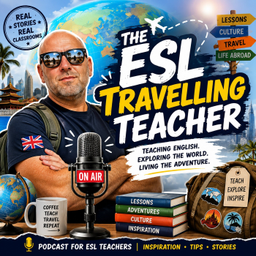
An ESL teacher in Asia, 9 years in China 🇨🇳 and now Cambodia 🇰🇭. What's it really like to teach in Asia?… I will tell you some tricks and tips. With a sprinkle of memories!
- Publisher
- ESL Traveling Teacher
- Category
- society & culture
- Language
- en
- Explicit
- No
- First episode
- 10 Jul 2026
- Latest episode
- 17 Oct 2026
Latest episodes
8 episodes in the feed.
17 Oct 2026
Know Your Worth Before You Teach Abroad
A Shanghai school offered me 32,000 RMB a month, while a South African teacher claiming native-speaker status took 22,000 for basically the same job. After ten years in ESL, I think teachers create a good part of that gap themselves. In China, pay often follows your passport and your face. My first training centre job in Fujian started at 13,000 RMB and jumped to 18,000 within a month because I was the only native-speaking teacher in the building and the school used me as a marketing tool. Accepting a local offer just to get out of your country sets a figure that becomes acceptable, and it's part of why China has so many teaching vacancies. In Cambodia, two people on TikTok called $1,100 a month a good salary. It's easy to live on, but the jobs I found for native English-speaking teachers ran from $1,400 to $2,200 depending on degree and experience. I work part-time at an international school, 7:30 to 12:30, five days a week, and the hourly rate is what you have to work out before you say yes. I also cover the things nobody told me up front, like two or three parent evenings a year and the occasional weekend day. Back in China, the double reduction policy around 2020 or 2021 closed training schools overnight. In my city I lost roughly 2,700 expats in a week, and the man I worked for had 2,500 to 2,600 schools across Fujian. I moved online to Palfish and earned 22,000 to 25,000 RMB a month, until free after-class lessons in public schools, new apps and changing family habits cut me from just over 100 lessons a week to 37 to 40. Salaries start low, go high and fall again, and the rules can change in a week, so research what the job pays in that city before you sign. Published on Subwave https://subwave.app/@e3113/post/know-your-worth-before-you-teach-abroad
10 Oct 2026
A 120-hour TEFL won't get you hired in Cambodia
A man landing in Phnom Penh at midnight with a 120-hour TEFL, £3,000, and a Gemini-researched plan to find a low-tier training centre is the starting point. I've spent a year riding around this city on my bike looking for those centres, and I can't find them. After ten years of teaching, nine of them in China, I'm no guru, but the TEFL-and-off-you-go pitch sounds great and the reality is very different. China set the pattern by demanding a 120-hour TEFL, then a bachelor's degree in education or a home-country teaching certificate, and Thailand, Vietnam, Korea and Japan followed. Teachers who can't get jobs there are moving to Cambodia, which is why I call it saturated, and why a school choosing between a basic online TEFL and a degree plus teaching qualification plus five years of experience won't pick the first one. If you've been applying for months with no interviews, I'd check three things: whether your qualifications match what schools ask for, whether your targets are drowning in applications, and whether you've gone in person. Telegram and email got me no replies, but walking in wearing trousers and a shirt got me conversations. Visas are where plans fall apart too. Visa on arrival usually means a tourist visa that can be extended once. I hold a self-employed work permit, and my school paid half the cost, while other schools expect you to arrange your own or to arrive on a business visa. My advice is to start teaching online first so you have a backup plan. I also cover TEFL certificates, including a free web-based one South Africans are using that five online employers told me they don't accept, and that I finished in four hours instead of 120. Looks still count in this industry, and the classroom is not coffee by the beach: my international school classes have 6 to 11 students, compared with 25 to 40 in China, which means more time per child and more challenges. Lesson prep the night before, quizzes to mark, and a day of "concentrate, sit down, be quiet, please stop talking" is what I'll be showing in this series. Published on Subwave https://subwave.app/@e3113/post/a-120-hour-tefl-wont-get-you-hired-in-cambodia
23 Aug 2026
Teaching English in the Age of AI Doubt
Gary has spent a decade teaching English as a second language, first in China and now running a summer camp in Cambodia with roughly thirteen kids split across two grade levels. Saturday mornings that used to run back-to-back classes sometimes hold just one now, and he takes that as a sign that families are carving out space for something other than study. Teaching in China once allowed room to go off-script; friends still there tell him teachers are handed a textbook and expected to follow it precisely. Cambodia lets him teach Minecraft Education, where he walked a skeptical principal through building a hospital, planting a rooftop garden, and hiring workers to harvest crops for the patients. The principal came around. Gary asked his students to log one week honestly: homework time on one side, screen time on the other. One boy logged twenty minutes of homework against three hours thirty of YouTube. A fair number of kids say they want to be influencers, and Gary's response is a genuine question rather than a dismissal: why would anyone watch you? The first generation of successful influencers got there because one video did something genuinely different, and that edge is harder to find now. His alternative suggestions, doctor, police officer, firefighter, land with a predictable reply: too much hard work. On AI in language learning, Gary used one tool to build an interactive grammar workbook with four deliberate mistakes baked in, treating it as a preparation aid rather than a stand-in for a teacher. A robot in his classroom sends reports with suggestions after each lesson, and he doesn't mind the feedback. What he keeps returning to is that AI hasn't lived anywhere. It hasn't managed a student so angry he threw furniture, and it hasn't spent a Saturday morning with one class instead of twelve and found the quiet useful. The student who arrived at camp with a reputation for throwing chairs settled once Minecraft became something worth behaving for. Published on Subwave https://subwave.app/@e3113/post/teaching-english-in-the-age-of-ai-doubt
16 Aug 2026
My 10th Year Teaching ESL in Asia Starts Differently
My summer got cut short by two days, and I'm already heading into my tenth year teaching ESL in Asia with a clear list of things I'm doing differently. TEFL certificates keep getting sold as a ticket to well-paid international school jobs, but that's not the market I'm looking at. Schools in Cambodia and across Asia are increasingly asking for degrees, real teaching qualifications, and classroom experience. A free online certificate puts you on a pile of CVs with everyone else who did the same course. The biggest change I'm making this year is keeping the grammar books closed for the entire first week. Last year I spent too much time firefighting, students taking zeros rather than submitting late, not understanding what a timed activity meant, asking for five more minutes on an hour-and-a-half quiz. That pattern started in week one because I let it. So week one now belongs to how the classroom works: expectations, consequences, what's acceptable from students and from me, and the difference between a teacher and a friend. There's a lot of space between running a tight classroom and making students feel terrified, and that's where good classroom management actually lives. I'm also going in with interactive notebooks this year, built around cutting, folding, and physically constructing sentences rather than answering ten grammar questions and closing a book. And I'm treating time management as a taught skill, not a personality trait. Most students don't know what to do on days one through six of a seven-day project. We give them the deadline and assume the rest. Nine years of teaching across China and Cambodia, in training centers, international schools, and online, has made one thing clear: experience only counts if you're actually asking what went wrong and changing it. Published on Subwave https://subwave.app/@e3113/post/my-10th-year-teaching-esl-in-asia-starts-differently
26 Jul 2026
My First Four Days Teaching English in Fuzhou
Seven hours on a train, an hour in a car with a 19-year-old admin assistant asking about chicken feet, and a seafood dinner in a seafood capital when I'm allergic to fish. That was my first 24 hours in Fuzhou. The recruiter had told the school I had an allergy. He had very obviously not passed that on. I ate the chicken and the spicy beef noodles and learned fast that Chinese food in China shares almost nothing with Chinese food in the UK, except that most of it is very spicy. The apartment search turned up five places, all with squat toilets, before I signed on a one-room flat five minutes from school with a shower mounted directly above the squat toilet and a fridge that could hold a chicken and a bottle of Coke. My training consisted of three days shadowing a teacher named John Hankin, a legend in Fuzhou who was leaving for a public school on Saturday. He handed me a notebook of games and one piece of advice: run one game across every class for a week, drop the ones that don't land, never retry a failure. That system carried me through two and a half years. My first night alone in the apartment, I came home to find the previous tenant sitting on my sofa, screaming intermittently because the landlord hadn't returned her deposit. I rang my teaching assistant Nana, who arrived, sorted it out, and guaranteed the deposit through the school. I never once got a housing deposit back in China. What I eventually learned to do was give notice, let the landlord expect a final month's rent, and simply not pay it, because they already had the deposit and were never giving it back. Published on Subwave https://subwave.app/@e3113/post/my-first-four-days-teaching-english-in-fuzhou
19 Jul 2026
Phones in the Classroom Are Winning
A girl sat through an entire graduation ceremony tapping her fingers on her lap, mimicking a phone game she'd played so many times the muscle memory had taken over. That image sits at the center of what I'm talking about today: what doom scrolling is actually doing to kids' ability to concentrate, communicate, and just be present in a room. Fourteen students at a classroom party, sitting in a row, silent, all staring at their iPads and saying nothing to each other. Social skills erode quietly, and the devices are a big part of why. Responsibility is the harder question. I know students whose parents made them earn screen time through good grades rather than handing over a device and walking away. That approach works. The problem is that young teenagers want adult-level freedom, and some parents give it to them before the limits are anywhere near established. Governments are starting to respond, with restrictions on gaming hours for minors in mainland China and bans on TikTok and similar platforms for under-16s in countries around the world. Whether those bans hold is another question, but the direction is clear. The phone itself is not the problem. Writing postcards, describing a place in real sentences, the physical act of forming characters by hand: these are skills that fade when digital becomes the only mode. Even in China, secondary students are showing up unable to recognize basic characters because typing has replaced writing entirely. A child who can't stop tapping their fingers even after the phone is taken away hasn't just developed a bad habit. They've never been taught that there's a time to put it down. Published on Subwave https://subwave.app/@e3113/post/phones-in-the-classroom-are-winning
16 Jul 2026
My First Day in a Chinese Tier-Three City
Six or seven hours south of Hong Kong on a train to Fuzhou, I had no briefing beyond a WeChat message telling me to find a young woman holding a sign at the exit. I cover what WeChat actually is for people unfamiliar with it: not just a messaging app, but the infrastructure of daily life in China, handling payments, tax records, train tickets, hotel bookings, and food orders in one place. Fuzhou in 2016 was classed as a tier-three city, meaning no metro system yet, and the tier system works simply by infrastructure improvements moving a city up the rankings. None of that prepared me for what I saw out the train window: tower blocks, office blocks, a McDonald's, a KFC. The China I had pictured from the outside, mountains, rice fields, people in straw hats, had nothing to do with the China I was arriving in. A 20-year-old Mercedes S-Class was waiting in the car park, driven by a woman of about 19 or 20 who would be my chauffeur for the next hour. She asked me within minutes whether I had ever tried spicy chicken feet. I had not. My entire prior experience of Chinese food was chicken balls, sweet and sour sauce, and fried rice. She had never left China, mentioned London the way you would mention somewhere you had never seriously imagined reaching, and told me that for many people, especially older generations, the world beyond China simply was not something they knew much about. She told me to close my eyes and rest. I did not rest. Published on Subwave https://subwave.app/@e3113/post/my-first-day-in-a-chinese-tier-three-city
10 Jul 2026
One Suitcase to China on £1,495
In 2016, I was unloading containers of chilli powder on a forklift in Felixstowe, six in the morning to six at night, living in a caravan, when one of my boxing students messaged from Asia: "I got you a job in China." I left with one suitcase, a backpack, an iPad, a phone, a passport, and £1,495 after paying for the flight. Getting there was its own ordeal. A 12-hour layover in Mumbai where I couldn't leave the terminal, a lost suitcase that contained my only clean boxer shorts, and a work visa process that involved handing my passport to a man with glasses and a brown bag at the top of an escalator in a Hong Kong underground station. I had a one-way ticket and no backup plan, so I handed it over. Two days later I had my passport back, a visa stamped inside it, and a WeChat message with a train booking number. My bags arrived at 2 p.m. and I needed to be at the border crossing by 3. Standing there, about to step into mainland China for the first time, I had no idea what the next ten years were going to look like. Ten years on, I'm writing this from a rented apartment in Phnom Penh, Cambodia, having just left China after a decade of teaching English as a second language. Published on Subwave https://subwave.app/@e3113/post/one-suitcase-to-china-on-1495
Contact ESL Traveling Teacher
- Guest appearances
- Does not typically book guests
Based on episode analysis; this does not confirm that the show is currently accepting guests.
Host of ESL Traveling Teacher?
Claim your podcast to manage its listing and keep your show details accurate.
Pod Engine is an independent podcast discovery and analytics service and is not affiliated with or endorsed by this podcast. Artwork and show content belong to their owners. Full legal notice.
Explore this show
Podcast research with Pod Engine