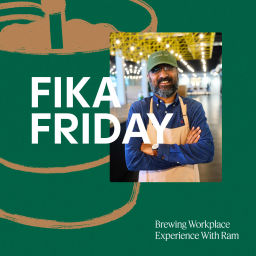
Welcome to FIKA Friday At the Office. I'm your host, Ram Puranam, and I'm thrilled to host this Season2 for you. Every fortnight, I'll be catching up Workplace Leaders & Thought Leaders on the Future of Work from around the globe and share stories, insights, and perspectives aimed at enhancing our work lives. From fostering collaboration to boosting employee engagement, we'll cover all the intricacies of workplace experience.
But here's the twist, we're not just diving into the nitty-gritty of corporate jargon. Instead, we escape the daily grind and appreciate a small break called FIKA. Because, let's face it, the best conversations at office happen over coffee. <br/><br/><a href="https://ramtherocket.substack.com?utm_medium=podcast">ramtherocket.substack.com</a>

FIKA Friday : Brewing Workplace Experience with Ram
Claim This Podcastby Ram Puranam
Podcast Authority
Beta
Podcast Overview
Welcome to FIKA Friday At the Office. I'm your host, Ram Puranam, and I'm thrilled to host this Season2 for you. Every fortnight, I'll be catching up Workplace Leaders & Thought Leaders on the Future of Work from around the globe and share stories, insights, and perspectives aimed at enhancing our work lives. From fostering collaboration to boosting employee engagement, we'll cover all the intricacies of workplace experience. But here's the twist, we're not just diving into the nitty-gritty of corporate jargon. Instead, we escape the daily grind and appreciate a small break called FIKA. Because, let's face it, the best conversations at office happen over coffee. <br/><br/><a href="https://ramtherocket.substack.com?utm_medium=podcast">ramtherocket.substack.com</a>
Language
🇺🇲
Publishing Since
4/24/2024
Unlock The Full Podcast Authority Score Report
See how your podcast performs across key metrics
Podcast Authority
Beta
Recommendations available
Unlock the full report to see detailed tips
Recommendations available
Unlock the full report to see detailed tips
Unlock comprehensive insights including:
- • YouTube presence analysis
- • Social media reach metrics
- • RSS compliance scoring
- • Podcast 2.0 features
- • Technical standards
Detailed Analytics
- Complete breakdown of all 19 authority metrics
- Personalized recommendations for each metric
- Industry benchmarks and comparisons
- Technical RSS feed analysis and compliance scoring
Growth Strategies
- Step-by-step action plans for improvement
- Quick wins to boost your score immediately
- Pro tips from successful podcasters
See how your show performs across every key metric
High authority scores make your podcast more attractive to industry leaders and influencers who want to appear on credible shows.
Sponsors look for podcasts with proven authority and engagement. Your score demonstrates your podcast's value to potential partners.
Understanding your strengths and weaknesses helps you make data-driven decisions to expand your listener base effectively.
1 verified contact email on file for FIKA Friday : Brewing Workplace Experience with Ram
Pitch yourself as a guest, propose sponsorships, or reach out directly to the host.
Recent Episodes

July 17, 2026
Building the Office People Actually Want to go to
<p><strong>Hello friends,</strong></p><p>If you want to understand what it actually takes to build a workplace people choose to show up for, you want to talk to someone who has done it at scale, with data, inside some of the fastest-growing tech companies on the planet. That person is Daaf Serné.Daaf Serné is the Founder of Placeworks Advisory, based in Amsterdam. His career spans nearly two decades in corporate real estate and workplace strategy, including a decade at <strong>ServiceNow</strong> as Director, Global Real Estate and Workplace Services, overseeing a global portfolio across three continents, and more than four years as Global Head of Workplace at <strong>Miro</strong>, where he built the company's entire real estate function from scratch and launched what became one of the most talked-about workplace experiments in the industry: the Living Lab. </p><p>I sat down with Daaf for a conversation that covered baristas, Alaska glaciers, sustainable design and why real estate is a product and should be treated like one.</p><p><strong>What stood out</strong><strong>The barista beats the machine. Every time.</strong>At Miro’s Amsterdam HQ, Daaf’s team added a barista to a space that already had coffee machines throughout. The barista became the most popular option almost immediately, with most employees skipping the machines entirely. The lesson was not really about coffee.<strong>The Living Lab was a hypothesis.</strong><strong></strong>When Daaf joined Miro in 2022, the company had grown from a few hundred to 1,700 people entirely through the pandemic, with 13 office locations built during a period when nobody was going into them. His pitch to leadership was simple: if we work closer with employees, we can drive better workplace outcomes. Higher experience scores. Better occupancy. Lower attrition. He ran work style studies, workshops and experiments across six locations before feeding all the data into the new HQ project. When the results came in, occupancy was up, experience scores were above four on a five-point scale, and attrition had dropped in locations with active workplace communities.<strong>Sustainability came from watching glaciers melt.</strong>One of the more unexpected origin stories on this show. Daaf was on parental leave with his family in Alaska when he stood in front of retreating glacier fields and decided he needed to do something about it from within his industry. He came back, kept his global real estate role at ServiceNow, and added corporate sustainability on top of it. That work eventually led to ServiceNow’s commitment to Net Zero by 2030.<strong>Footprints are shrinking but building quality needs to rise.</strong>On the future of the office, Daaf was measured. Companies are not walking away from real estate, but they now have the post-COVID data to make meaningful decisions about how much they actually need. Smaller footprints, better buildings. The challenge, he noted, is that there are simply not enough high-quality, sustainable buildings to meet that demand yet.<strong>Ask for help!</strong>His advice to young professionals starting out in facilities management and workplace was direct: stop trying to figure everything out with AI tools alone. The industry is still a people business. Relationships, mentorship and human judgment are things no model can replicate. Ask around. Let people help.</p><p><strong>One thing I’ll keep thinking about</strong>Daaf described a shift he kept running into at ServiceNow: whenever the business added headcount, the reflex was to add square meters. He started questioning that reflex out loud. His core belief, backed by four years of Living Lab data at Miro, is that the answer is rarely more space. It is almost always better use of the space you already have.Enjoyed this episode? <a target="_blank" href="https://ramtherocket.substack.com/podcast">Subscribe to Fika Friday at the Office </a>and share it with someone still measuring workplace success in square meters and don’t forget to </p><p><strong>Connect with us on LinkedIn:</strong></p><p>* Daaf Serne : https://www.linkedin.com/in/daaf-sern%C3%A9-mcr-slcr-3664079/</p><p>* Ram Puranam : https://www.linkedin.com/in/puranamram/</p><p>Cheers, Ram</p><p><p>Thanks for reading FIKA Friday At the Office! Subscribe for free to receive new posts and support my work.</p></p><p><p>Thanks for reading FIKA Friday At the Office! This post is public so feel free to share it.</p></p><p></p><p></p> <br/><br/>This is a public episode. If you would like to discuss this with other subscribers or get access to bonus episodes, visit <a href="https://ramtherocket.substack.com?utm_medium=podcast&utm_campaign=CTA_1">ramtherocket.substack.com</a>

June 19, 2026
It's the End of 9-to-5
<p>Hello friends,</p><p>Some guests come to this show with frameworks and theory. Ravi Nanduri comes with parking complaints, cold coffee and a story about getting lost on his first week in a new role.</p><p><strong>Ravi Nanduri</strong> is Vice President, Real Estate Services at HSBC GSC, based in Hyderabad. With over 15 years of experience across corporate real estate and workplace services in Asia Pacific and India, he brings a perspective that is rare in this field: he started in hospitality, working in food & beverages and hotels before moving into the corporate world. That background, it turns out, is exactly what workplace experience needs more of. I finally got him on the show after months of trying, and the conversation did not disappoint.</p><p>What stood out!</p><p><strong>Getting lost on the way to the coffee machine led to his best onboarding moment.</strong> Ravi had just joined HSBC and was still finding his feet on a new floor. He asked a colleague for directions to the pantry. That colleague locked their system, walked with him, introduced themselves, told him what they did at the company, and picked up a coffee along the way.</p><p><p>“That encapsulates everything that an office stands for. The collisions that happen, the experiences that are created. People go out of their way to walk along with you. That speaks a lot.”</p></p><p><strong>Every touchpoint matters, even the ones you can’t control.</strong> Ravi’s hospitality lens comes through most clearly here. The workplace experience begins the moment an employee enters the campus and ends when they leave. Parking. The lift. The monitor connecting to the laptop. The walk to the coffee point. None of these feel like strategic decisions, but all of them shape how someone shows up to do their work.</p><p><p>“Imagine driving 45 minutes into the office and not getting a parking spot. That triggers a negative thing and it rolls into your work. Your interactions change. The way you respond changes. In the end, your entire day is gone.”</p></p><p><strong>Intentionality is the word that has changed everything.</strong> Pre-pandemic, offices were designed for presence. Post-pandemic, the question has flipped: what is the actual reason for coming in? Ravi described the shift from assigned desks with family photos and soft boards full of personal touches, to activity-based spaces where the sense of ownership has gone. The familiarity that made offices feel safe has had to be rebuilt from scratch.</p><p><strong>Purpose-driven offices, not presence-driven ones.</strong> On the future of work, Ravi was direct: if someone is coming into the office to spend eight hours on Zoom calls, they could do that from home, from a coffee shop, from anywhere. The office has to earn its place.</p><p><p>“Looking busy is not being productive. Just because you come into the office and sit in front of a screen from 9 to 5 doesn’t mean you’re being productive. That should never come back.”</p></p><p><strong>Hyper-personalization is coming to the workplace.</strong> Ravi pointed to the latest Mercedes UX system as an analogy — a car that learns your driving style, temperature preferences and music choices over time and has everything ready the moment you get in. His prediction for the office of the near future: workplace apps acting as digital concierges, understanding your habits, your preferred desk zone, your coffee order, and getting things ready before you arrive.<strong>One thing I’ll keep thinking about:</strong></p><p>Ravi mentioned that the most vocal feedback corporate real estate teams receive is not about strategy or culture. It is about parking, cold coffee and food. The gap between what leaders think matters and what employees actually experience in the building is wider than most organizations want to admit. Closing that gap, touchpoint by touchpoint, is the whole job.Enjoyed this episode? Subscribe to Fika Friday at the Office and share it with someone who still thinks the office is just a place to sit.</p><p>Connect with us on LinkedIn:</p><p>* Ravi Nanduri : https://www.linkedin.com/in/ravinanduri/</p><p>* Ram Puranam : https://www.linkedin.com/in/puranamram/</p><p>Cheers, Ram</p><p><p>Thanks for reading FIKA Friday At the Office! Subscribe for free to receive new posts and support my work.</p></p><p></p><p></p> <br/><br/>This is a public episode. If you would like to discuss this with other subscribers or get access to bonus episodes, visit <a href="https://ramtherocket.substack.com?utm_medium=podcast&utm_campaign=CTA_1">ramtherocket.substack.com</a>

May 28, 2026
Friction by Design & Why Socializing Is Work
<p>Hello friends,</p><p>If you’ve ever wondered who actually thinks deeply about why offices feel the way they do, Corinne J. Murray is one of those people.</p><p>Corinne is a work futurist and workplace strategist based in Long Island, New York, with a career spanning WeWork, American Express, Gensler, CBRE and RXR. She is also co-author of ‘‘Work Then Place: Navigating Modern Work & Where it Happens’’, a newly released book she wrote alongside Sara Escobar that offers a practical framework for navigating workplace transformation. I caught up with Corinne around the time of the book launch, and the conversation that followed covered everything from the right amount of elevator friction to what a hybrid workforce actually means when AI agents are in the mix.</p><p><strong>What stood out</strong></p><p><strong>Socializing deserves a seat at the table alongside the serious stuff </strong>: Corinne laid out a four-part framework for knowledge work: individual focus, synchronous collaboration, asynchronous collaboration, and socializing. Most organizations invest in the first three. The fourth tends to get dismissed as a nice-to-have.</p><p><p>“That socializing piece is the connective tissue that makes sure we are all moving in lock step with one another. Otherwise, you might have the same initiative running in four different parts of your organization because no one talked to one another.”</p><p></p></p><p><strong>Good friction versus bad friction : </strong>One of the sharpest ideas in this episode. Corinne described a scenario where a slightly slow elevator meant two colleagues ended up in the lobby at the same time and went to lunch together. Design that elevator to arrive in five seconds every time and that conversation never happens. The real design challenge is knowing which friction to keep and which to strip out.</p><p><strong>Offices are staying — their function is what evolves : </strong>Corinne was clear - offices are not going away. We are communal beings. But the case for coming in cannot rest on heads-down work that people do perfectly well from home. The office earns its place as the environment for connection, collaboration and the kind of serendipitous interaction that does not survive a calendar invite.</p><p><strong>What Corinne actually learned at WeWork: </strong>She was quick to separate her experience there from the broader narrative. Her team used the headquarters as genuine lab space, testing how far people would go from their home base to access an amenity, what noise levels made open-plan one-on-ones feel safe, and how much density was too much. She called it a Goldilocks experimentation process. That framing stuck.</p><p><strong>On AI and the workplace of 2028: </strong>Corinne and Sarah made a deliberate choice in the book: acknowledge AI as the instigator of transformation without trying to predict exactly where it lands. The bigger conversation, she said, is about the blended workforce of humans and AI agents, and the socioeconomic shifts around labor, compensation and social safety nets that nobody inside a single organization can control. Worth being aware of. Not something any one company can solve.</p><p>One thing I’ll keep thinking about</p><p>Corinne’s advice at the close of the episode was simple: think of change as a snowball. Start smaller than feels comfortable, stick with it, and build gradually. In a moment where most organizations are trying to do too much with too little, the instinct to transform overnight is exactly the wrong move.</p><p><strong>One percent at a time. Exactly!</strong></p><p>Enjoyed this episode? Pick up a copy of ‘Work Then Place: Navigating Modern Work & Where it Happens’ by Sara Escobar and Corinne Murray, subscribe to ‘Fika Friday at the Office’, and share it with someone who thinks socializing at work is a waste of time.</p><p>Connect with us here on LinkedIn</p><p>* Corinne Murray : https://www.linkedin.com/in/corinnejmurray/</p><p>* Ram Puranam : https://www.linkedin.com/in/puranamram/</p><p>Cheers</p><p></p><p></p> <br/><br/>This is a public episode. If you would like to discuss this with other subscribers or get access to bonus episodes, visit <a href="https://ramtherocket.substack.com?utm_medium=podcast&utm_campaign=CTA_1">ramtherocket.substack.com</a>
40 total episodes available
Recent guests on FIKA Friday : Brewing Workplace Experience with Ram
Guests from recent episodes — sign up to see every guest that has ever appeared on this show.
Emmanuel Daniel
Guest
Jason Shearer
Guest
Luis Morejon
Guest
Anne Sofie Fedders
Guest
Claus Sneppen
Guest
Henrik Jarleskog
Guest
Sabine Spoelstra
Guest
Ram
Guest
Anjali Raghuvanshi
Guest
Lisa Gill
Guest
Tica Masuku
Guest
Deep-dive analytics for FIKA Friday : Brewing Workplace Experience with Ram
Frequently asked questions
Have a different question and can't find the answer you're looking for? Reach out to our support team by sending us an email and we'll get back to you as soon as we can.
- What is FIKA Friday : Brewing Workplace Experience with Ram?
- How often does this podcast release new episodes?
This podcast updates weekly.
- Where can I listen to this podcast?
This podcast is available on 6 platforms including Apple Podcasts, Spotify, and more. You can also use the RSS feed directly.
- Does this podcast accept guests?
Information about guest appearances is not available.
Legal Disclaimer
Pod Engine is not affiliated with, endorsed by, or officially connected with any of the podcasts displayed on this platform. We operate independently as a podcast discovery and analytics service.
All podcast artwork, thumbnails, and content displayed on this page are the property of their respective owners and are protected by applicable copyright laws. This includes, but is not limited to, podcast cover art, episode artwork, show descriptions, episode titles, transcripts, audio snippets, and any other content originating from the podcast creators or their licensors.
We display this content under fair use principles and/or implied license for the purpose of podcast discovery, information, and commentary. We make no claim of ownership over any podcast content, artwork, or related materials shown on this platform. All trademarks, service marks, and trade names are the property of their respective owners.
While we strive to ensure all content usage is properly authorized, if you are a rights holder and believe your content is being used inappropriately or without proper authorization, please contact us immediately at hey@podengine.ai for prompt review and appropriate action, which may include content removal or proper attribution.
By accessing and using this platform, you acknowledge and agree to respect all applicable copyright laws and intellectual property rights of content owners. Any unauthorized reproduction, distribution, or commercial use of the content displayed on this platform is strictly prohibited.