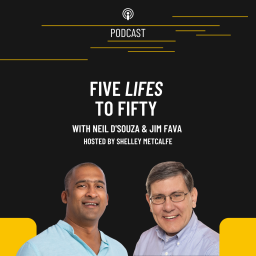
Five Lifes to Fifty
Neil D'Souza and Jim Fava
4.9from 9 ratings
- 18
- Episodes
- 9
- Ratings
- 2023
- First episode
About Five Lifes to Fifty
The average product has five innovation lifecycles to 2050. We discuss the intersection between society, business, environment, and technology and how to negotiate the path to sustainable products.
- Publisher
- Neil D'Souza and Jim Fava
- Category
- business
- Language
- en
- Explicit
- No
- First episode
- 12 May 2023
- Latest episode
- 9 Sept 2025
Latest episodes
18 episodes in the feed.
9 Sept 2025
Episode 16: How William Lepercq at Schneider Electric Uses Data to Scale Sustainability
In this episode, we dive into what happens when sustainability data flows through your organization as seamlessly as financial metrics. William Leperque from Schneider Electric shares how his team solved the massive challenge of scaling environmental impact calculations across 200,000+ products, transforming LCA from a time-consuming reporting exercise into a real-time design tool.
15 Apr 2025
Episode 15: Chemours’ Jenny Liu on the Power of Chemistry to Shape a Sustainable Future
In this episode of Five Lifes to Fifty, we sit down with Jenny Liu, Head of Sustainability for the Advanced Performance Materials business at Chemours. Jenny takes us inside the world of chemistry — not just as a science, but as a powerful enabler of sustainability, innovation, and everyday life. From electric vehicles to semiconductors and the hydrogen economy, we explore how advanced materials are quietly shaping the future, and how Chemours is leading the charge through bold sustainability goals and data-driven decision-making. In this Episode Shelley: I'm wondering if you could just tell us how you see it and tell us more about the advanced performance materials category that you work in. [00:59] Jenny: Thanks so much, Shelley. It's a great question. You know, Chemours is a global company and we provide trusted chemistry to make lives better and to, you know, really help communities thrive. [01:10] And I don't think that many people realize the role that chemistry plays in their everyday lives, our everyday lives. You know, more than 95% of all manufactured goods are touched by the business of chemistry. [01:24] So really, chemistry is essential for everything that we depend on in modern society. And I believe it's really essential for decarbonization as well. If you think about the computers that we're speaking into, your cell phones that you use for stay connected to the world, but all the semiconductors and advanced electronics that underlies that and enables that, [01:45] right? And then as again, as we head towards green economy, electric vehicles, batteries, hydrogen economy, you know, ultimately and you know, all the electrolyzers and fuel cells, so we make the membranes and the materials that underpins all of that and really brings that to life. [02:02] A little bit more about Chemours. You know, innovation really is at our core, so we're focused on how we can make our products and applications, how they can really enable sustainability, not only in terms of our own operations, but but also for our customers. [02:16] So we tend to have very high-performance materials that our customers use because they need them in the application, whether it's, you know, chemical resistant, temperature resistant for the electrical properties, inert. [02:26] So they'll use them to solve their problems, which are usually very high-performance application needs. But then also those are enabling things to make society better and to reduce environmental footprint. [02:38] So we have three businesses. We have a thermal solutions and refrigerant business so that's refrigerants, heat pumps, et cetera. We have our titanium dioxide pigments business. And so that's coatings and performance, coatings and materials and paints. [02:53] And then we have the advanced performance materials business for which I lead sustainability. You know, some of the brands you might know, you know, Teflon, Krytox, Nafion, these are high performance materials that go into critical medical applications, electronics, we talked about some of the consumer advanced electronics, clean energy, electric vehicle batteries. The hydrogen economy is a big growth area. And then a lot of areas of transportation. [03:18] So whether it's a safety feature on an airplane, for instance, or the space shuttle, or many, many valves and hoses and other sensor coatings and things that underpin automotive, you know, both a traditional combustion engine as well as a lot of materials in the EV space. Those are the types of...
13 Feb 2025
Episode 14: Freeport’s Andrea Vaccari: Designing for Disassembly
Episode 14: Sustainable Mining & the Future of Copper In this episode, we sit down with Andrea Vaccari from Freeport to explore the rising demand for copper and its crucial role in the clean energy transition. From electric vehicles to wind turbines, copper is everywhere—but how will we meet skyrocketing demand sustainably? We discuss challenges in mining, the shift toward responsible sourcing, and why designing for disassembly is key to a circular economy. Whether you're in product design, manufacturing, or just curious about the future of sustainable materials, this episode is packed with insights you won’t want to miss! In this Episode Shelley: One of the things I think is interesting and I think would be great to have you introduce to the listeners is the role of copper in the clean energy transition, because I don't think everyone appreciates how much metal is going to be needed to make that work. And it's also great context for those listening who might use copper or metal in their products. [00:44] Andrea: That's right. Copper and molybdenum especially are really, really critical for the energy transition. When you think about all of our low carbon or zero carbon forms of energy. So we think about solar, when we think about wind, when we think about hydrothermal, even just thinking about LNG and how LNG actually provides power to a grid, copper's in all of that. In wind turbines, offshore wind turbines need lots of copper. I think actually a few tons of copper per wind turbine to be able to not only power the wind turbine, but then the deep sea cables that connect them and that connect them back to the grid. We think about solar power and it’s not just a solar cell; there are batteries involved. And how do you tie a battery storage device to infrastructure and to the Internet? That's copper. [01:02] The simplest things, like developing nations, as they come along in the energy transition in a just way and we improve their grids, those are full of copper. Transformers, cabling in houses, as we improve green buildings, it's just everywhere. It really is. And then molybdenum is used in stainless steel and it's used in a number of other applications, but stainless steel especially and we know how much that's used in building and construction, bridges, all kinds of different applications for the energy transition. [02:07] Shelley: Is it possible to give us any numbers for that, like forecasting 5, 10, 30 years, like how much is needed? [02:36] Andrea: Right now the total refined copper market annually is in between 25 to 30 million tons a year and we expect that to double by 2050. Now you hear all kinds of different things. So, you hear people talk about doubling, tripling, quadrupling. I don't know, the way that I look at it is whatever number we come up with, we're always going to have the wrong number. But I think there's general consensus that it is at least twice. Just take like an electric car. So, if you take an internal combustion engine vehicle and then you take a fully battery electric car like a Tesla or a Mercedes, you're talking about three to four times the amount of copper per vehicle. And then you've got charging stations which are full of copper. [02:44] Neil:. Some of these models don't even consider the development that you see in countries which are not electrified yet. So, India for the largest part isn't really electrified and in the next 10 years we will see a huge part of that also taking shape. So, I think you're right. Some of the numbers that I have in my mind, more short term where we'll be needin...
21 Nov 2024
Episode 13: Merck's Jeffrey Whitford on why optimism is opportunity and how to use serendipity to become systematic
Merck's Jeffrey Whitford shares how his company uses optimism and serendipity to systematically drive sustainability across its 300,000 products, transforming the life science industry.
26 Sept 2024
Episode 12: HowGood’s Ethan Soloviev on how to think beyond sustainability: Regenerative agriculture, supply systems and technology
In episode 12, we welcome Ethan Soloviev, Chief Innovation Officer at HowGood, to Five Lifes to Fifty. Ethan is also an owner of High Falls Farm, and is the author of "Levels of Regenerative Agriculture" and "Regenerative Enterprise: Optimizing for Multi-Capital Abundance." Ethan is an international expert on regenerative agriculture, regenerative business, and innovation, with experience in 34 countries. He is the founder of the Regenerative Enterprise Institute, an Associate of the Carol Sanford Institute, and a member of the Regenerative Business Alliance. Ethan holds a B.S. from Haverford College and an M.S. in Eco-Social Design from Gaia University. At HowGood, Ethan's focus is on driving product sustainability and business model innovation for Fortune 500 Retail and CPG companies. HowGood is an independent research company and SaaS data platform with the world's largest database on food product sustainability. In this Episode Shelley: This is the first time we've had a guest from a technology company on the podcast. Could you tell us a bit about what HowGood is and who it serves? [00:33] Ethan: HowGood, as you mentioned, has the world's largest database on food, product and ingredient sustainability. We're a non-traditional startup in that we're 17 years old right now. So, we've really spent the better part of two decades building out a massive picture of what global supply chains look like and what are the impacts that happen in three key areas: carbon, nature and human rights. From that massive amount of data that we've gathered for 33,000 ingredients, we've built up the capability to, automatically, using AI, calculate the impact of any food ingredient or product in the world. We've built it all into a software platform that is, I think, fun and easy to use and we have six of the ten largest food companies in the world using the platform to understand their impacts and to automate reduction strategies. We have major retailers around the world, from Ahold Delhaize in the USA to Carrefour in the Middle East, and we even have ingredient suppliers like Ingredion and the Kerry Group, who use the platform to understand their impacts and communicate downstream to their consumers. So overall, you can think of HowGood as a social network for impact data on food and agriculture. It’s the place where the industry comes together, whether you're a formulator or a procurement specialist, or someone in marketing and sales or a sustainability team needing to do reporting; everyone comes to us for a single source of sustainability data truth, so that they can coordinate, collaborate, network, engage with suppliers to transform the impacts of their products. [00:41] Shelley: Thinking about the broader picture, you're bringing all these groups together, what do you think the role technology does play? Because it sounds like you're playing a role already, but what role do you think it plays for these food formulators and food companies? And what is it doing for them to achieve sustainability? [02:27] Ethan: I'll just tell a little story that is part of how we got to where we're at now to answer that question. This was a number of years ago in San Francisco, it was at a co-lab, a sort of weeklong sprint event and I met somebody from Danone who said, look, I have 1000 product formulators globally at Danone and every day they are innovating and they are renovating new yogurts, new plant based beverages and those people, many of them really care about sustainability, but many of them weren't trained in it. They are food scientists. They are formulators. They are making deliciou...
19 Jul 2024
Episode 11: Global Electronics Council CEO Bob Mitchell on understanding supply chain leverage and market-credible ecolabels
In episode 11, we welcome Bob Mitchell, CEO of the Global Electronics Council (GEC), to Five Lifes to Fifty. Before beginning his tenure at the GEC in 2023, Bob worked at the Responsible Business Alliance (RBA) where he served as Vice President, Human Rights and Environment from 2016. He also has previous experience with Hewlett-Packard (HP) and Hewlett Packard Enterprises (HPE). The GEC is is a mission-driven nonprofit that leverages the power of purchasers to create a world where only sustainable technology is bought and sold. GEC manages the EPEAT ecolabel, a free resource for procurement professionals to identify and select more sustainable products. In addition, the EPEAT ecolabel is a resource for manufacturers to demonstrate that their products conform to the highest sustainability standards. Since its launch in 2006, procurement professionals have reported purchases of over 2.7 billion EPEAT products, generating cost savings exceeding $30 billion USD and a reduction of over 30 million metric tonnes of greenhouse gas emissions. In this episode Shelley - With your deep experience with supply chain, I thought we could start with how product sustainability changes in a company that has a fully outsourced supply chain compared to one that might have a more vertically integrated supply chain. Bob - That's a great question. The supply chains of multinational companies has evolved quite dramatically over the last few decades. Ones that were more vertically integrated and the manufacturing owned by, especially in the electronics field, by companies and brands that we know quite well in the late nineties into the early aughts [2000-2010], was outsourced both from an efficiency perspective, cost perspective, and that really led to a complete shift in terms of the leverage that companies have. [00:54] That's been, I think, further changed by the supplier community beginning to evolve their capabilities as well, going from pure contract manufacturers where they were provided designs by the brands, into moving up that ladder from contract manufacturers into original design manufacturers. So, they actually own the designs in many cases and engage with the brands after the fact. And so that began to change both that leverage within the supply chain, but also very key components of business relationships, like who owns the intellectual property. It's completely changed how companies engage when it comes to specific standards, but in this case, social environmental responsibility standards specifically. [01:29] <li data-le
7 Jun 2024
Episode 10: Interface's Connie Hensler on how to break traditional product development thinking
In episode 10, we welcome special guest Connie Hensler, Global Director of Environmental Management and Product Stewardship at global flooring manufacturer Interface. A long-term and passionate advocate of a more sustainable approach to design and manufacturing, Connie joins Neil, Jim and Shelley to discuss how to break traditional product development thinking with moonshot goals, all while achieving financial - and sustainable - success. In this Episode Shelley - For the sake of our listeners who may not know much about Interface, can you describe what Interface manufactures and its history with sustainability, because it's got a bit of a unique history. [00:34] Connie - Interface is a global flooring manufacturer. We make modular flooring, like carpet tiles, resilient and rubber flooring and we're a mid sized company with annual sales of just over a billion dollars. We're headquartered in Atlanta, Georgia, but we have manufacturing sites in many countries across Europe and the Asia Pacific region. But we aren't really known for our flooring as much as we are known for our design and sustainability leadership. We're more of a sustainability company who happens to make flooring. That's the perception of us in the marketplace, I think. [00:47] Neil - But you do it well, and that's the point at the end, right? Connie - We were lucky to be put on a mission many years ago, back in 1994, when our founder, Ray Anderson, had his environmental epiphany about the damage that the company does to the environment. And he really turned the entire company's mission towards eliminating that environmental impact. Of course, we still have to make flooring and we have to make money to support that sustainability habit, but that's really where all of our focus is and has been since 1994. Neil - Do you remember how big of a company you were back in 1994? [01:54] Connie - I don't remember the exact figure. We were certainly a lot smaller than we are today. We have acquired a lot of companies and we have had organic growth. Back in 1994, carpet tile was our only flooring. We didn't have the other businesses. And carpet tile was just in its infancy. Most carpet wasn't modular back then. It was broad loom and so it's been a real revolution in the flooring industry to move from, you know, giant rolls of flooring down to the modular concept, which is so much more sustainable. So we've grown a lot since 1994. Neil - The reason I asked is flooring has been around for a long time. The kind of flooring has changed and as you described, the products have evolved over time, but it's not nuclear fusion, it is not artificial intelligence; these kinds of themes that everybody focuses on. It's quite unique to find something that makes you stand out and it's not often that a company finds it. It seems you guys banked on being the most sustainable company of your kind. Would that be fair to say? Connie - Oh, yeah, definitely. We just did it so early in the game before anybody else was doing it. I think that's what really made us originally stand out. Neil - So how did it start? [03:21] Connie - That was so long ago. We began with Mission Zero - our goal to eliminate all of our environmental impact. And it wasn't just a top-down initiative, it was driven by the chairman CEO of the company, which is immeasurable in the impact that can provide. But it was also a groundswell on the factory floor because we engaged all employees in it. Because let's face it, anybody who's in the company who's doing anything, whether you're answer
12 Apr 2024
Episode 9: Esteé Lauder's Al Iannuzzi on future trends, circularity and simplicity
In episode 9, the latest in our ongoing series of guest-centric features, we’re pleased to welcome Al Iannuzzi to the podcast. Al is Vice President of Sustainability at Esteé Lauder Companies. Al has made his career as an Environmental, Health, Safety and Sustainability Executive and author, and has over 30 years of experience as a subject matter expert in the EHS&S field. His 2017 book ‘Greener Products’ is a must-read – insightful, engaging and a fitting accumulation of the wealth of knowledge Al has picked up in his career. In this episode, Al, Neil and Jim discuss what product managers should be paying attention to right now, how they can cut through the noise and get to the route of the matter at hand – and what the true goal of ‘greener’ products should be. In this Episode Shelley: Al, as you know, our listeners are product managers and others who have a role developing sustainable products. You're active in this space; you teach, you write, and you work in this space. Right now, what do you think is the most relevant thing for our listeners to know? [01:00] Al: I have done quite a bit of research on making products more sustainable or greener. Whenever I speak, I like to say this: There's no such thing as a green product. And the reason I say that is if you think about a product, like think of the greenest product in your mind right now, and what I typically tend to think about are, like 7th generation products or Method products, because I think of household laundry detergent or dish detergent, those type of things. And those products are very sustainably minded when it came to bringing them to be. But even those products can be improved. If you think about the raw materials it takes to extract from the earth and the manufacturing of those raw materials and then further manufacturing and then transportation to distribution centers and then from there to the place where it's being sold, the use phase of the product, and then the end of life of the product and the packaging, there are improvements that still could be made for a product that some people would call green. [01:15] What does green mean anyway? There's no obvious definition for green, so that's why I say there's no such thing as a green product, because every product can be improved. That's why in the book that I wrote called Greener Products: The Making and Marketing of Sustainable Brands. I call it greener. It's a journey. And you can always make a product or a process more efficient, better. The other thing I like to focus in on is when it comes to product developers, is that a lot of people are in different places when it comes to thinking how important sustainability is to bring a product to market. But perhaps the strongest case for product developers to get their mind around is future trends. And there is a study by the consulting firm McKinsey. They actually wrote this book called Resource Revolution. I cite that in my book. Some of the things that they are stating will happen is by 2030 there will be 3 billion more people in the middle class and primarily that will be coming from India and China. Anybody who's visited those countries, you see tremendous growth. And if you think about the growth of the middle class, so what does that mean? People coming into more prosperity, so they have more availability, more income to spend on things besides just basic living needs, right? So that means that these 3 billion people moving into the middle class are going to want the same thing that the listeners have. They're going to want cars, they're going to want cell phones, they're going to want iPads, TVs, you name it, new clothing and home goods. Wit
8 Mar 2024
Episode 8: Stanley Black & Decker's Dan Fitzgerald on customers and de-risking and integrating sustainable innovation
In episode 8, we’re pleased to welcome another guest to the podcast – Stanley Black & Decker’s Product Sustainability Senior Director Dan Fitzgerald. If you don't know about Stanley Black & Decker, it is the largest tool company in the world with over 100 manufacturing facilities worldwide. In his role, Dan leads the ‘innovate with purpose’ pillar under the corporate social responsibility strategy, which includes goals focusing on addressing unmet societal needs, circular design, and sustainable supply chain. In this episode, Dan, Neil and Jim discuss the problems product managers have in embedding sustainability into products, recycling quotas and design requirements and the growing demand for a ‘greener’ approach. In this episode Shelley - Dan, could you start by telling us what you think is hindering product managers from embedding sustainability into products? [01:09] Dan - It's not that product managers don't want to. I just think the nature of the job has been so granularly focused on the details of the product itself in operation. How much does it weigh for a tool? How much power does it have? Does it rest nicely on my belt hook, right? We're talking personal preferences on how you use a product and gathering those requirements of what is going to make a winning product. [01:22] It's not that end users don't care about sustainability. I think there's an assumption from an end user that things of that nature, such as following the laws, and minimizing impact when you create things that companies are doing that already. And it's not on them to tell product managers, even if they know how to communicate that in the first place, because sometimes if you're not in that space, you just don't know the details. What I think misses a little bit is that the follow up because the end-user is not saying anything about it [sustainability]. So, it doesn't get placed in a high priority in the product specification because the end user isn't directly saying it. But we all know it is needed at some point to either pass through a regulatory requirement or even the customer. And in our case, our customers are retailers because we don't sell directly to the end user. So, a customer may have a requirement because they're focused on sustainability that we need to meet such that the end user has an option to buy it in that store. Neil - Dan, could you clarify that a bit? Because I think that's unique to the other conversations we've had. You have two customers, and I think that's not obvious to everyone. [03:03] Dan - We maybe even have more behind the contractor. The person that hires the contractor could also have requirements. I think this idea of the expanding end user and seeing it more of a worldview about everything you have to hit to get a product out the door, that's when sustainability starts making it into the doc. [03:11] Neil - There was a study done by McKinsey, I think back in 2019, where they asked exactly this question because they were wondering, why is it that we don't see sustainability in requirements from customer surveys? And what they found was customers expected brands to take care of this. I think it was a pretty significant number. [03:31] That said, we're assuming the brands we buy from are not engaging in unsustainable practices. I think in the past, if there was something bad happening in the supply chain, you didn't need to tell anyone about it. But this has become very different especially and regulations in Europe are forcing this. In one of these podcasts, I mentioned what Europe is doing is, and what regulation does in general is it makes you live in a glass h
8 Feb 2024
Episode 7: BASF’s Bruce Uhlman on how sustainability is a game changer for your product
In our latest episode, Jim, Neil and Shelley welcome special guest Bruce Uhlman. As Senior Manager, Applied Sustainability at BASF, Bruce leads their applied sustainability team in North America. BASF is the largest chemical producer in the world. Bruce discusses the reasons why product managers need to be embedding sustainability into their products, the difficulties of accurately defining what 'sustainability' truly means, and BASF's portfolio steering framework (among a variety of other topics). In this Episode Shelley: This podcast is about enabling product managers to improve their ability to embed sustainability into their products. Bruce, with your experience, what are some of the reasons product managers are embedding sustainability into products? [01:15] Bruce: Among other topics within our companies, like safety and quality, sustainability right now is a critical aspect to get a handle on and how that's being integrated into products and engagement with customers. We have huge challenges as a society today with growing populations and climate change, and product managers need to understand how their products can contribute to resolving these issues and how, even at the product level, they're supporting their customers and helping them meet their own sustainability targets and challenges. [01:31] There are tools and best practices out there utilizing, say lifecycle assessment, that will gather a better, deeper insight, more science based and quantification around sustainability to take internally and work within their entire organization. [02:14] Neil: Have you seen any examples of where product managers have done this and seen success like the way you have at BASF? [02:42] Bruce: Yes. I think the biggest challenge is because sustainability can be a nebulous term. It has many different meanings depending on what product you have, what your market sector is, what region of the world you're in, even how your customers and your suppliers are defining sustainability. So, you need to be able to quantify and define what sustainability means for your product and for your application. Once you've defined it, then you can measure it. Once you can measure it, then you have the data to support linking that to what's important to your customer, and also linking that to attributes that you're getting within your supply chain and down the value chain. [02:52] In many cases, product managers may be looking at their product in a traditional manner; looking at the technical attributes and what they've been doing previously that may have been successful. But sustainability brings a whole new perspective to things. They need to educate themselves on what these other attributes are, how sustainability is embedded within their product, and they need to be able to assess that. [03:38] We've developed a lot of frameworks within BASF that provide that rigorous, comprehensive, and reproducible framework. It’s also transparent on how we define, measure, and create value through these solutions. We understand where the impacts are occurring throughout the value chain, where the trade offs are occurring. [04:04] We need to understand both the value creation of our products and the risk. And you need this comprehensive framework of how you're integrating that in product development and how you integrate that in your communications with your customers. [04:27] Jim: In my experience with BASF, there's been things that you've done ahead of other companies. What was the process the company went through to move from thinking about it, to BASF becoming a leader? [04:39] Bruce: Success and being proactive came from our senior management and from our board when we
2 Feb 2024
Episode 6 part 3: Launching your sustainable product, eco-claims and avoiding delays
In the final part of a three-part series on embedding sustainability into the stage gate process, Neil, Jim and Shelley discuss the launch phase of a product. From voluntary reporting to confidential disclosures to avoiding delays, there are a number of important final hurdles to clear as you approach the finish line. Listen back to parts 1 and 2 of episode 6 to follow the stage gate journey from beginning to end. In this Episode Shelley: The launch phase is when you are getting ready to take your product to market. Neil let's start with you. What kinds of things does a product manager need to consider at this phase? [00:04] Neil: The first thing to consider is this is the combination of all the effort that you have put in until now. You've got a great innovation, whether it's a product or it applies to an entire portfolio. Maybe you've created new packaging, or more product efficiency. Or across the portfolio, maybe you've invested in green steel, or switched materials to something more sustainable across several products. [00:37] There are different ways to communicate this, but the framing is around whether you are B2B or B2C. In B2B your customer is very technical, and they use this information to decide whether to buy from you. They are more educated on this topic than a typical B2C. Therefore, the messaging on these products is to be catered to that customer. That’s the most basic thing to keep in mind, and it's more so for sustainability because not everybody wants to know whether it's sustainable or not. What sells this more sustainable product is the goal. It's not about telling the customer that it is more sustainable. Also, different markets geographically are more perceptive to different kinds of messages. In Germany, for example, people are looking for things that have claims of environmental sustainability, whereas in other regions this is meant to be assumed. Some require you to make a claim about the sustainability value of your product. CBAM is a recent one that is specifically related to the carbon content of products that you import into the European Union. Here you do not decide how to communicate because you send this information to the government and the lower the carbon value, the less tax you pay. There's a consequence of using accurate data. You could use average information and pay full price, or you can be as specific as you can and if there is a saving compared to the benchmark, then you pay less. If you're importing in the hundreds of millions, that's a significant tax saving. In other regimes, you're looking at safety of the materials that you've put into your product, whether its REACH regulations in Europe or Prop 65 in the United States. These are things that you need to get in order before you go to launch. Another consideration is voluntary reporting. You have type one, two and three environmental claims. You have labels like Blue Angel here in Germany, but there are other similar agencies who will assess your product and give you a stamp. Type two declarations are self declarations where you can write a report, make a claim, and have it validated by a third party. Type three claims are environmental product declarations - an agency principally tells you how to calculate environmental performance or the characteristics of your product and you share this depending on whether you are a B2B or B2C company. Type one claims are typically suited to B2C products, whereas type three claims or EPDs are more related to B2B products. And then type two, which is a self declaration, is neither here nor there; you could use it for both. For example, on Microsoft's website you can see the environmental characteristics of the laptop you are buying. This is a highly successful model th
19 Jan 2024
Episode 6, part 2: How to embed sustainability into the business case, develop, test & validate stage gate
In the second part of a three-part series on embedding sustainability into the stage gate process, Neil, Jim and Shelley discuss what comes next after the discovery and scoping phases. Is the proposal technically viable? Is there a valid market opportunity? Are you asking all the questions that need to be asked? As the funnel narrows, it’s time to gather more information and more detail. Can you make a justification for what you’re proposing? In this episode What is unique about sustainability at the Business Case stage gate? What kind of trade offs might a product manager consider here? Neil: During this phase, you're building the case for the hypothesis that you've created in the Scoping stage. This would mean something like, can we make a battery for a car that would take it to 1000-kilometre range? [00:48] First check the viability from a technical perspective. Is this technically viable? What would it mean from a cost perspective? What would it mean from a risk perspective? After doing some preliminary exercises on potential benefits of this innovation during the scoping phase, what is the feasibility of this innovation? [01:20] On the other hand, what does this mean in terms of market? There are three things to typically look at. 1) Does it provide access to new markets? That is, can I reach customers that I couldn't reach before. 2) Can I win more customers? And 3) is profitability. Typically, sustainable products are associated with the high end of the market, where price premiums are more prevalent. Even though you start small with this innovation, you end up with much higher margins. [01:40] Look at the portfolio level too, if you want to improve the performance of the entire company. Because a lot of what you do is not just building new products, you sunset products that are no longer viable or not providing the business value to sustainability value ratios that are acceptable to the company. The idea here is to transition to something, you also need to transition out of something. BASF did interesting things in this space with their sustainability approach Triple S - Sustainable Solutions Steering. [02:25] Jim: The whole stage gate process is a funnel. At the top, you have a wide issue at discovery and scoping, then you narrow down the issues and hotspots. Using the automotive battery as an example, things like social responsibility of the suppliers; environmental issues associated with the extraction of cobalt and lithium; and the chemicals used. [03:14] Coming out of the business plan process, you've identified initial targets, like these hotspots but also the key goals - recognizing the corporate goals in these hotspot areas, including the goals the product team must meet before it gets to the Launch phase. [04:22] Another part of the business plan is to identify the key internal and external stakeholders, including who you will have to compete with or provide information to. You need to have them part of your team right at the beginning, not towards the end. [04:44] You lay the foundation in the first three stage gates with lifecycle thinking. Then in the Develop, then Test & Validate phase, you dive into more detail. And in the Launch phase even more detail. Because if you want to make a claim that uses lifecycle information, you need to have more information. There's a cascading level of complexity and a level of detail that you look at as you go through the process and bringing this together in the business plan is one of the most key parts of the whole stage gate process. [05:05] It's critical to deal with the end of life of any product earlier in the process. Decades ago, it was a linear process. You develop, sell, and then a product goes to landfill. Now you look at circularity and being
9 Jan 2024
Episode 6, part 1: How to embed sustainability into the discovery and scope stage gate
You’re at the beginning of product design and need to embed sustainability. But how? In this episode we answer how to use sustainability as a lens for discovering opportunities in the discovery and scope stages, which are the initial stages in product development. We also cover the importance of being quantitative and how hot spot analysis and life cycle thinking can help. In this Episode What is unique or specific about how to embed sustainability at these two stage gates? Neil: When experts think of sustainability, what they’re trying to do is understand the implications of different decisions across the entire lifecycle of a product. It manifests in different ways in reporting, communications, and for marketing. [00:44] For a product manager you need to pivot slightly differently. It is, what are the decisions across the different stage gates of product development? And how do you use sustainability as a lens to look at those decisions so that you can make better choices. You cannot have the same level of complexity considered by a product manager across these stage gates. It’s central to provide information in a way that enables them to make these choices and that's different from what typically happens in the world of experts in the field of sustainability. Jim: the biggest difficulty in the sustainability field is being able to translate the outcome or the significance of the impact into a language for the decision makers, and in a timely manner, over their six stages; whether it's greenhouse gas, biodiversity, extraction water, wastewater, etc. [02:23] It’s about translating the results for the decision maker because at each stage, they got to pass a series of tests before the next stage. You’ve got to work together and begin to work on that translation. In the future, people in the sustainability field, are going to be translators – able to translate the outcome so that the decision makers have the information at the right time to make a decision as they go through the stage gate process. Shelley - What else should a product managers consider about making tradeoffs or the translation that they need to be making? [04:13] Neil: I think the trade offs are happening not in-between stage gates, but within stage gates. And the tradeoffs come second to a different and broader perspective that you're using to make those decisions. [04:30] Using batteries as an example, how do people look at the discovery phase? This is the first stage of the stage gate process where you're looking for ideas - what to build? What new product? How to improve an existing product? Sustainability has never been a source of these ideas until recently. The idea is to use sustainability just like we use technology, new demographics, regulations, and geopolitics to create new products and new supply chains. How does sustainability become another key criteria to instigate an idea? I give an example in batteries. If you look at what happened in the automotive space in the last five years, everybody's racing towards e-mobility. They're trying to transition their powertrains from internal combustion engines to at least hybrids, if not complete electric and alternative fuels like green hydrogen and so on. When people are constrained on what they're allowed to do and not do when they're creating products, this creates new ideas. There are regulations that are becoming more important as idea generators. The regulations in the US, for example, around the Inflation Reduction Act. It's a big thing in the automotive space right now, where it makes a lot of sense to produce in the US. One of the reasons is geopolitics, but another reason is sustainabil
9 Nov 2023
Episode 5: California’s SB 253 and why product managers need to care about corporate GHG reporting
Episode Notes In October 2023 California’s Climate Corporate Data Accountability Act (SB 253), which directs the State Air Resources Board to develop regulations requiring corporations that do business in California, with annual revenues over $1 billion, to publicly disclose their GHG emissions, was signed into law. In this episode, we discuss what this legislation means for product managers and individual products. Are we going to start to see product-level impacts become enterprise-level reporting? And what steps can product managers take to align product-level impacts and reporting to corporate goals? Listen to find out more. In This Episode In a moment we're going to look at California's new Climate Corporate Data Accountability Act which includes scope 3 greenhouse gas reporting starting in 2027. But first, I want to explore the difference between corporate level reporting and the environmental impact reduction and reporting that happens at the product level. [00:05] Neil: A good frame to do this is the what, the who and the why. And if you look at how companies take raw materials, create products and sell it, there's many standards and different aspects you need to report on that are covered by the Sustainable Development Goals. You have standards like the GRI and SASB and so on that are out there that help create the construct on how to report on the operations of business. [00:51] To understand who's the audience for these kinds of reports, it is typically governments where you're reporting into a kind of platform when it's regulated. Investors that look at these reports when you're looking at investor reports or sustainability reports and NGOs take particular interest in too. Customers, indirectly, through the brand that you create and how you position yourself as a company in terms of being sustainable. [01:25] The reason why companies do this is it provides a platform to operate. Sometimes - it is around regulations - if you did not report you would not be able to operate in that particular jurisdiction. It’s a way to control how businesses operate in a jurisdiction. [02:05] On the product side of things though, it becomes very direct. If you look at what a company is, it is about making products and making them better than competition and selling them for a price that customers will buy. And in this case a product level declaration from a sustainability perspective addresses that product and how it can be positioned against competition in a better way. [02:25] If you're looking at who's the customer, there isn't any regulation to date that covers product regulations. I think there are some. When you're looking at the digital product passport in Europe, the recycle content in packaging in several places in the US. But there's nothing broad that operates at the scale that you typically see corporate reporting standards and regulations. They are very dedicated to customers. They're creating a differentiation against competition so that customers choose your product as opposed to others
27 Sept 2023
What gets missed when designing sustainable products?
Episode Notes It's not enough to just make a product more sustainable. At the end of the day, you also need to capitalize on that sustainability improvement because it’s an investment. In this episode, we answer how understanding the six stage gates to developing any product is essential to leverage sustainability improvements. We also discuss using single sustainability scores, trade-off and decision-making hierarchies in organizations, and why life cycle thinking is essential to not lose customers in today’s market. In this Episode Neil, as a product manager, how have you seen sustainability embedded into product development? Neil - I have been a product manager for software. So, it's slightly different than when you're looking at physical products. But I think more of my experience has come from my work with product managers and engineers in the manufacturing space and that kind of formalized itself into a bit of a product management structure that I think would be good to explain to answer that question. [00:36] If you look at the toolkit of the product manager there are six stage gates to developing any product. It starts with Discovery, where the goal is to find ideas. You could be looking at new technology on the market, demographics (who is buying what). There is a big green trend that has been going on for the last 20 years and is increasing. [1:01] <li data-leveltext="" data-font="Symbol" data-listid="1" data-list-defn-props="{"335552541":1,"335559684"
25 Jul 2023
What is a sustainable product?
Episode 3: What is a Sustainable Product? It is crunch time for the climate, and you need to create a sustainable product. But what is that? And is focusing on carbon enough? In this episode, we answer what is a sustainable product and why your “sustainable” product may not be sustainable tomorrow. We also discuss why narrowly focusing on carbon is an oversimplification of sustainability and what could differentiate a great product manager from a good one. Episode Notes What is a sustainable product? Before you can understand product sustainability, you need to know what sustainable development is. It’s more than just an environmental and carbon issue. Recall the Brundtland Report in 1987. [0:50] Product sustainability minimizes the negative impact of a product over its lifespan. And it’s about translating product sustainability (social, environmental, economic) into business value for the decision-maker, such as improving the brand, growing revenue, reduce cost. [2:23] Governance is foundational in a product sustainability program. You need sustainability metrics that are critical for the category embedded into the innovation/product development process, and the product manager plays a key role. [4:20] A sustainable product is something that you should be able to produce in perpetuity, and there is no such product because what is sustainable changes over time; things like the availability of resources change, society and customer’s values change, and technologies change. [5:19] The definition of a sustainable product today may not be sustainable tomorrow. For example, diesel versus electric cars. You also cannot forget about the aspect of where a product lives across its lifecycle. [6:45] Carbon is not a de-facto standard of what sustainability is. Carbon is a simplification and an approximation of sustainability. But there are things it cannot cover in its approximation, such as societal damage, regulations, and harmful substances put into products that could be detrimental to health. [8:20] It’s important to understand the multi-criteria view of sustainability, and because sustainability changes over time, it’s better to define products as a more sustainable option rather than a sustainable option. As Jim has been known to say, “There is no such thing as a green product, just a greener product.” [9:00] What is the risk of narrowly focusing on carbon as an approximation for sustainability? [9:45] Some things are correlated to carbon, and others are anti-correlated. [11:00] Carbon behaves differently across the lifetime of a product – from the way it’s manufactured, used, and at the end of life - so looking at carbon across different stages is crucial. It’s more than just looking at one parameter but looking at it across the lifetime of a product. [11:30] For example - using cars and lamps as how a product used by two different people in two different countries will have a different life, and the tradeoffs are different. [12:10] Neil – India did not have consumer packaged goods, and then overnight, they were introduced from Europe and the US, and there was no concept of what to do with the packaging, and India became a big polluter. As a product manager, you need to consider how your product will live when it goes into the market and consider that in the design phase. [13:47] When you listen to the global conversation on climate, you hear questions about resource consumption or water use and what happens at the end of life. Things are being missed if you only focus on carbon. A recent CBS news article shows that solar panels and windmills are now ending up in landfill. We knew these would need to be handled at the end of life 25 years
14 Jun 2023
Unfreezing the Frozen Middle
Sustainability needs to be a key design factor in product design. But even if a company has sustainability goals, why is it hard to implement? This episode discusses the barriers in middle management, multiple decision factors, and translating information to meet your audience.
12 May 2023
The Role of the Product Manager
The next 30 years will redefine product winners in the marketplace and speed and interdisciplinary awareness is key. Product Managers are central to bringing all the elements together and ensuring sustainability is embedded into product design.
Reach and audience
Public platform figures. Ratings count people who left a rating, not total listeners.
- Apple Podcasts (US)
- 5.0 / 5
- 2 ratings
- Spotify
- 4.9 / 5
- 7 ratings
Podcast Authority Score: 31 / 100
A composite of feed quality, social presence, YouTube performance and engagement. Read the methodology.
- Quality
- 39
- Social presence
- 0
- YouTube
- 0
- Engagement
- 60
Contact Five Lifes to Fifty
- Guest appearances
- Books guests
Based on episode analysis; this does not confirm that the show is currently accepting guests.
Host of Five Lifes to Fifty?
Claim your podcast to manage its listing and keep your show details accurate.
Pod Engine is an independent podcast discovery and analytics service and is not affiliated with or endorsed by this podcast. Artwork and show content belong to their owners. Full legal notice.
Explore this show
Podcast research with Pod Engine