
I review tactical flashlights, EDC (everyday carry) gear and other outdoor related stuff. If you spend time outdoors fly fishing, hunting, mountain biking, hiking and camping you'll enjoy this podcast.
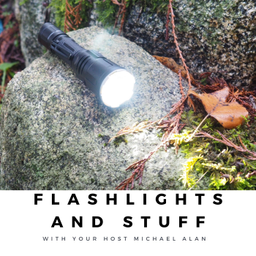
Flashlights and Stuff
Claim This Podcastby Michael Alan
3.7(3 reviews)
8 episodes
Updated Daily
Accepts GuestsHas Sponsors
Podcast Overview
I review tactical flashlights, EDC (everyday carry) gear and other outdoor related stuff. If you spend time outdoors fly fishing, hunting, mountain biking, hiking and camping you'll enjoy this podcast.
Language
🇺🇲
Publishing Since
1/28/2020
1 verified contact email on file for Flashlights and Stuff
Pitch yourself as a guest, propose sponsorships, or reach out directly to the host.
Recent Episodes
May 3, 2020
Episode 8: Everyday Carry (EDC) knives: Getting your collection started...
<p>If you need some good info on starting a knife collection this is your episode. I also mention some info on Thrunite and Olight flashlights.</p><p>Blog post associated with this episode: <a href="https://www.flashlightsandstuff.com/blog/things-to-consider-when-starting-a-knife-collection-podcast-notes-and-links" rel="nofollow">https://www.flashlightsandstuff.com/blog/things-to-consider-when-starting-a-knife-collection-podcast-notes-and-links</a></p><p>Visit the website: <a href="https://www.flashlightsandstuff.com" rel="nofollow">flashlightsandstuff.com</a></p><p>Brands mentioned in this episode: Spyderco, Kershaw, Zero Tolerance, Benchmade and Kizer.</p>
April 20, 2020
Episode 7: Fenix TK16 Tactical Flashlight Review
<p>In todays episode of the Flashlights and Stuff podcast I want to talk about a flashlight that isn’t the newest model to hit the shelves but is a tried and true flashlight that is very worthy of consideration today. If you are looking for a well built, dependable, 1000 lumens flashlight you’ll want to consider the Fenix TK16.</p> <p>Don't forget to follow Flashlights and Stuff on Instagram.</p> <p>Full transcript at my website.</p> <p>Visit the website: <a href="https://www.flashlightsandstuff.com" rel="nofollow">flashlightsandstuff.com</a></p>
April 12, 2020
Episode 6: Lumens, tactical flashlights and what you need to know
<p>Transcript: In this episode of Flashlights and Stuff I’m going to try and answer some common questions that get asked all of the time. Why does one flashlight appear brighter than another, yet they both have the same lumens rating? Do I need a flashlight rated at more than 1000 lumens? Why doesn’t a 4000 lumens flashlight appear 4 times as bright as a 1000 lumens flashlight? Ready? Let’s get going…</p> <p>So what are lumens? Essentially, lumens are a measure of brightness. Flashlights have lumens ratings to give you an indication of how much perceived brightness you can expect. But, if you buy tactical flashlights based solely on lumens ratings you’ll be disappointed.</p> <p>There are a number of factors that affect the perceived brightness of a flashlight. Lumens rating can be a starting point, but there are a bunch of other factors to consider as well. Let’s start with the reflector.</p> <p>Is it smooth? Is it orange peel? Is it narrow and deep? Is it wide? The reflector helps determine light dispersement which affects the perceived brightness of the flashlight. </p> <p>Typically, narrow, smooth reflectors produce more throw. So a narrow, pronounced beam APPEARS brighter. Just remember that flashlights deemed as “throwers” typically have a ton of light fall off on the sides. So if you want even lighting throughout your field of vision this isn’t the type of flashlight you want.</p> <p>If the flashlight has an orange peel reflector, you will typically get more flood than throw. By design the orange peel reflector disperses light in a border pattern. Typically, this flashlight reflector design will produce more even lighting across your entire field of view. So if that’s the type of lighting you’d like your flashlight to produce, this is a type of reflector design to consider.</p> <p>Obviously, the width and depth of the reflector make a difference as well. Generally, a shallow reflector distributes light in a border pattern while a deeper reflector concentrates light more effectively.</p> <p>Let’s move on to the LED. Most tactical flashlights use some model of a CREE LED. Like any technology, LEDs models change over time to use power more efficiently, yield greater brightness, etc. etc. The bottom line is the LED version your flashlight uses does affect perceived brightness. </p> <p>Take the Nitecore P12 and the Nitecore P12GT. I own both flashlights. They are mid-size everyday carry flashlights and rated at 1000 lumens. Both flashlights use the same reflector, same power source, are the same size and have the same features. Even though both are 1000 lumens rated, the Nitecore P12GT is noticeably brighter than the Nitecore P12. Why? The difference is in the LED that they use. The P12 uses a CREE XM-L2 U2 led. The P12 GT uses a newer CREE XP-L HI V3 led. The CREE XP-L HI V3 led produces more light intensity. So in this case simply swapping in a newer technology LED makes one 1000 lumens rated flashlight appear brighter than another 1000 lumens rated flashlight. Both identical in every way EXCEPT for the LED.</p> <p>Since we are on the topic of LEDs don’t forget LED tints and colors can affect your perception of brightness as well. Warmer LED tints, the ones that lean a bit more toward orangey red, have a tendency to soften the light thus making it feel less bright to your eyes. Pure white tints will make the flashlight appear to be brighter. Just remember, the whiter the tint the harsher it is on your eyes for viewing. So LED tint and color selection can get a bit snobbish, but as you purchase more flashlights you may lean toward a preference.</p> <p>In fact, the quest for the perfect flashlight for you - lumens output, LED type, LED color etc. may take you into the world of flashlight “modding.” Flashlight modification - swapping to emitters, LEDs etc. is a whole other episode, but is a reminder just how serious people can take their flashlights.</p> <p>Another thing to remember about lumens is that a 4000 lumens flashlight won’t appear four times as bright as a 1000 lumens flashlight. So this shifts us into the topic of just how many lumens do you need in a flashlight? I have flashlights with lumens ratings as low as max 300 to max 4000 lumens. I will say that my most used flashlights range from 650 lumens to 2000 lumens. Personally, for just about any lighting task I find this range to be useful. The 2000 lumens flashlight that I really like is a total thrower… narrow beam, super intense and truthfully not really useful for anything but non-lethal self-defense. It’s a Klarus XT11GT. I have it set up in tactical mode so it turns on in turbo mode or strobe mode via the dual tactical tail switch at the full 2000 lumens of output.</p> <p>If you are buying your first tactical flashlight, there are three I’d highly recommend. Two are a bit more budget friendly and one is a bit on the expensive side. Let’s start off with the budget friendly ones.</p> <p>Here is the flashlight I always recommend IF a person has never had a decent quality flashlight. It’s the Nitecore P12GT. It’s got 1000 lumens of output and as I mentioned earlier, extremely bright. It uses a dual tactical tail switch as well, another feature I prefer in my flashlights. </p> <p>Another excellent flashlight with a great reputation is the Fenix PD35. Like the P12GT, it’s a mid-size EDC flashlight with 1000 lumens of output. It’s just a great all around flashlight and Fenix just makes good flashlights. All of my Fenix flashlights have continued to work well over time.</p> <p>Lastly, I’d highly recommend the Surefire E2D Defender at 1000 lumens. Yes, it’s a bit more spendy, BUT you get excellent build quality in a made in the USA flashlight.</p> <p>So to wrap things up… here are the fine points to take away with you when it comes to understanding lumens:</p> <ul> <li><p>The lumens rating is good to help you understand what the general brightness of the flashlight will be</p></li> <li><p>Know the reflector design so you understand if the flashlight will have more flood than throw or vice versa </p></li> <li><p>LED design makes a difference so make sure you are buying a recent model utilizing the latest LED technologies and capabilities </p></li> <li><p>Be aware of the LED color or tint. Pure white LEDs will appear to be the brightest The noticeable difference in brightness between a 1000 lumens flashlight and a 3000 lumens flashlight won’t be as much as you’d expect.</p></li> </ul> <p>Lastly, be wary of cheap flashlights and their lumens output claims. No, you can’t get a flashlight with 5000 lumens of output for $19.95. </p> <p>So that just about wraps it up for my discussion of lumens. I hope this has helped demystify this topic. If you go to the website <a href="http://flashlightsansstuff.com" rel="nofollow">flashlightsansstuff.com</a> I’ll have this up as a blog post with a bunch of beam shots from various flashlights. You’ll be able to see how different flashlight designs and LEDs affect the flood and throw of a flashlight. Until next week, stay healthy and safe and don’t forget to subscribe to this podcast. Thanks for listening.</p> <p>Visit the website: <a href="https://www.flashlightsandstuff.com" rel="nofollow">flashlightsandstuff.com</a></p>
8 total episodes available
Deep-dive analytics for Flashlights and Stuff
Frequently asked questions
Have a different question and can't find the answer you're looking for? Reach out to our support team by sending us an email and we'll get back to you as soon as we can.
- What is Flashlights and Stuff?
- How often does this podcast release new episodes?
This podcast updates daily.
- Where can I listen to this podcast?
This podcast is available on 4 platforms including Apple Podcasts, Spotify, and more. You can also use the RSS feed directly.
- Does this podcast accept guests?
No, this podcast does not typically feature guests.
Legal Disclaimer
Pod Engine is not affiliated with, endorsed by, or officially connected with any of the podcasts displayed on this platform. We operate independently as a podcast discovery and analytics service.
All podcast artwork, thumbnails, and content displayed on this page are the property of their respective owners and are protected by applicable copyright laws. This includes, but is not limited to, podcast cover art, episode artwork, show descriptions, episode titles, transcripts, audio snippets, and any other content originating from the podcast creators or their licensors.
We display this content under fair use principles and/or implied license for the purpose of podcast discovery, information, and commentary. We make no claim of ownership over any podcast content, artwork, or related materials shown on this platform. All trademarks, service marks, and trade names are the property of their respective owners.
While we strive to ensure all content usage is properly authorized, if you are a rights holder and believe your content is being used inappropriately or without proper authorization, please contact us immediately at hey@podengine.ai for prompt review and appropriate action, which may include content removal or proper attribution.
By accessing and using this platform, you acknowledge and agree to respect all applicable copyright laws and intellectual property rights of content owners. Any unauthorized reproduction, distribution, or commercial use of the content displayed on this platform is strictly prohibited.