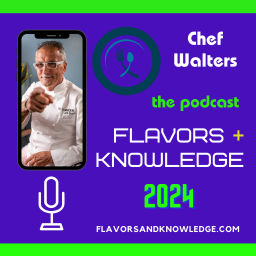
Podcast thumbnail for FLAVORS + kNOWLEDGE

FLAVORS + kNOWLEDGE

Claim This Podcast

by WALTER POTENZA

5.0(3 reviews)
286 episodes
Updated Daily
Accepts GuestsHas Sponsors
62

Podcast Authority

Beta
GoodBased on show quality, social media presence, reviews, charts, and more
Pod Engine
Quality67
Social0
YouTube76
Engagement68

Podcast Overview

Flavors and Knowledge is a captivating podcast that offers narrated, factual culinary education that explores the diverse world of flavors. With a refreshing approach, it avoids mundane interviews and minimizes opinions, delivering a concise and engaging exploration of the rich tapestry of gastronomic Knowledge.

Language

🇺🇲

Publishing Since

4/11/2020

Unlock The Full Podcast Authority Score Report

See how your podcast performs across key metrics

62

Podcast Authority

Beta
GoodBased on show quality, social media presence, reviews, charts, and more
Pod Engine
Quality67
Social0
YouTube76
Engagement68
7
Excellent Areas
3
Good Performance
9
Growth Opportunities
excellent
Episode Length
7 minutes
Performing excellently!
good
Publishing Consistency
Every 9 days

Recommendations available

Unlock the full report to see detailed tips

poor
Episode Thumbnails

Recommendations available

Unlock the full report to see detailed tips

+16 More Metrics

Unlock comprehensive insights including:

  • • YouTube presence analysis
  • • Social media reach metrics
  • • RSS compliance scoring
  • • Podcast 2.0 features
  • • Technical standards
What's Included in Your Full Report

Detailed Analytics

  • Complete breakdown of all 19 authority metrics
  • Personalized recommendations for each metric
  • Industry benchmarks and comparisons
  • Technical RSS feed analysis and compliance scoring

Growth Strategies

  • Step-by-step action plans for improvement
  • Quick wins to boost your score immediately
  • Pro tips from successful podcasters
Get your free podcast insights report

See how your show performs across every key metric

Instant delivery
No spam
Attract Better Guests

High authority scores make your podcast more attractive to industry leaders and influencers who want to appear on credible shows.

Secure Sponsorships

Sponsors look for podcasts with proven authority and engagement. Your score demonstrates your podcast's value to potential partners.

Grow Your Audience

Understanding your strengths and weaknesses helps you make data-driven decisions to expand your listener base effectively.

3 verified contact emails on file for FLAVORS + kNOWLEDGE

Pitch yourself as a guest, propose sponsorships, or reach out directly to the host.

Recent Episodes

Episode thumbnail for (283) The Toll House Legacy

July 31, 2026

(283) The Toll House Legacy

<p>In Whitman, Massachusetts, between Boston and Cape Cod, Ruth Graves Wakefield and her husband, Kenneth, transformed a modest Cape Cod-style house into the Toll House Inn in 1930 (The Toll House, Kenneth and Ruth Wakefield, Whitman, Massachusetts, 1930-1935, 2024). At a time when roadside dining options were limited and reliable hospitality was rare, the Toll House Inn rapidly became a regional landmark, serving as both a rest stop for travelers and a gathering place for the local community (Menu, “The Toll House Inn,” circa 1950, 2024). Despite the challenges of the Great Depression, the Wakefields opened their doors with determination, providing guests with warm meals, clean accommodations, and home-cooked desserts that encouraged visitors to linger. Ruth, a trained dietitian and graduate of Framingham State Normal School’s household arts program, managed the kitchen with both precision and creativity. Her tall lemon meringue pies, rich Indian pudding, and especially the thin butterscotch nut cookies served with ice cream quickly gained acclaim among guests (Matte, 2023).</p><p>In the late 1930s, most sources place the pivotal moment around 1937 or 1938, when Ruth Wakefield decided to modify her well-known cookie recipe (Rotondi, 2025). The origins of the chocolate chip cookie have been widely recounted; some details are drawn from Ruth’s later interviews, while others have become part of popular legend (Michaud, 2013). Previously, she served a popular butter drop or butterscotch pecan icebox cookie, but she sought to create something new that would surprise her guests (Rotondi, 2025). According to the most widely accepted account, when she reached for baker’s chocolate to melt into the dough, she discovered it was unavailable. Instead, she used a bar of Nestlé semi-sweet chocolate, which she chopped into small, irregular pieces with an ice pick. She incorporated these chocolate pieces and chopped walnuts into the batter, expecting the chocolate to melt and create a uniform chocolate cookie during baking (Michaud, 2013).</p><p>Upon baking, Ruth observed that the cookies emerged golden and crisp at the edges as intended, but the chocolate pieces had not fully melted. Instead, the chocolate retained its shape, softening into creamy, molten pockets within the dough. This unexpected result produced a cookie that combined a tender, crisp texture with distinct bursts of chocolate. Guests at the Toll House Inn responded enthusiastically. Ruth named the new dessert Toll House Chocolate Crunch Cookies and began serving them regularly. Demand increased rapidly, prompting her to publish the recipe in the 1938 edition of her cookbook, Toll House Tried and True Recipes. Local newspapers soon featured the recipe, and home bakers throughout New England began replicating it, leading to a significant rise in sales of Nestlé’s semi-sweet chocolate (Tucker, 2021).</p><p><a href="https://flavorsandknowledge.substack.com/" target="_blank" rel="noopener noreferer">Full Content </a></p><p><a href="https://flavorsandknowledge.com/podcast-%2B-video" target="_blank" rel="noopener noreferer">More Podcasts</a></p>

Episode thumbnail for (282) The Siena Palio

July 31, 2026

(282) The Siena Palio

<p>The Palio di Siena is far more than a horse race. It is a living medieval ritual that still defines the identity of an entire city. Twice each summer, on 2 July and 16 August, ten bareback horses thunder around the shell-shaped Piazza del Campo while thousands of Sienese scream for their contrada. The prize is a painted silk banner — the palio itself — but the real stakes are pride, rivalry, and centuries of memory.</p><p>The word palio comes from the Latin pallium, a precious cloth given as the victor’s prize. The earliest documented horse race in Siena dates to 1239, when a man named Ristoro was fined for refusing the humiliating consolation prize (a pig) awarded to the last-place finisher. Even earlier references suggest races existed by the beginning of the thirteenth century, often linked to the feast of the Assumption of the Virgin on 15 August. These early contests were known as the Palio alla lunga — the “long Palio.” Riders raced along a straight course that began outside the city walls near Porta Romana and finished in front of the cathedral. The race was dangerous, chaotic, and deeply tied to civic and religious life.</p><p>Throughout the Middle Ages and Renaissance, Siena’s public entertainments were violent and varied: fist-fighting (pugna), jousting, and especially bull hunts organized by the city’s districts, the contrade. When the Grand Duke of Tuscany banned bullfighting in 1590, the contrade needed a new outlet for their fierce competitiveness. They began staging neighborhood races with buffaloes (bufalate) and later donkeys. Gradually these contests moved into the Piazza del Campo.</p><p>The decisive shift came in the seventeenth century. In 1633, because of plague and the absence of horses normally sent by Italian nobles, authorities organized a circular horse race — a Palio alla tonda — inside the Campo itself. Five contrade took part; Tartuca won. This is widely regarded as the first true ancestor of the modern Palio. By 1656–1659 the July race in honor of the Madonna of Provenzano had become an annual event. The August race, dedicated to the Assumption, was added later and eventually fixed on 16 August so it would not conflict with other religious ceremonies.</p><p>The modern structure solidified in the eighteenth century. In 1721 the city’s governing body issued detailed regulations that still shape the race today. In 1729–1730, Princess Violante of Bavaria, governor of Siena, fixed the number of contrade at seventeen and precisely defined their boundaries, ending centuries of territorial disputes. Only ten of the seventeen run in each Palio: the seven that did not race in the previous corresponding event, plus three drawn by lot.</p><p>The old linear Palio alla lunga lingered into the nineteenth century but was finally abolished in 1874. By then the circular race in the Campo had become the undisputed heart of Sienese life. It survived wars, political upheaval, and modernization because it belongs not to the state or to tourists, but to the contrade themselves. Each district is a self-contained community with its own church, museum, fountain, and lifelong loyalties. Winning the Palio is the highest honor a contrada can achieve; losing to a hated rival is a wound that lasts for years.</p><p>Today the pageantry remains intensely medieval: the historic procession in costume, the blessing of the horse in the contrada church, the tense mossa (the chaotic start), and the three wild laps around the Campo. Yet the Palio is not a reconstruction. It is a continuous tradition that has adapted without ever losing its essential character. For the Sienese, it is not a spectacle performed for outsiders. It is the annual reaffirmation of who they are — a people whose identity is still measured in the thunder of hooves on the stones of the Campo.</p><p><a href="https://flavorsandknowledge.com/podcast-%2B-video" target="_blank" rel="noopener noreferer">More Podcasts</a></p><p><br></p><p><br></p>

Episode thumbnail for (281) World War II Rationing

July 31, 2026

(281) World War II Rationing

<p>During World War II, food rationing in the United States reshaped daily life on the home front in profound and lasting ways. After the U.S. entered the war in December 1941, the government moved quickly to control scarce resources so that troops overseas and Allied nations could be supplied. The Office of Price Administration (OPA) introduced a system of ration books and stamps beginning in the spring of 1942. Every American—adults and children alike—received ration books. To buy restricted items, shoppers needed both money and the correct stamps or points. The system was designed to prevent hoarding, limit price gouging, and ensure more equitable distribution of limited goods.</p><p>Sugar was the first food rationed, starting in May 1942, and it remained restricted until June 1947—well after the war ended. Each person was allotted roughly half a pound per week (about 26 pounds per year), roughly half of pre-war consumption. Coffee followed in November 1942. In March 1943, meats, cheese, fats and oils (including butter and shortening), canned fish, and canned milk were added. Processed and canned foods were controlled through a points system: “blue points” for canned and dried goods, “red points” for meat, fish, and dairy. Point values shifted with supply, turning grocery shopping into a careful calculation.</p><p>These restrictions hit home baking especially hard. Sugar and fats were essential to cookies, cakes, and pies. Cooks adapted with ingenuity. Honey, molasses, maple syrup, and corn syrup replaced part or all of the sugar in many recipes. Shortening or margarine often stood in for butter because they required fewer ration points. Some wartime cookie recipes used rendered bacon fat or chicken fat. Nestlé and other companies promoted adapted versions of popular treats, including the relatively new Toll House chocolate chip cookie. Home bakers still found ways to make versions of the cookies, sometimes sending them to soldiers as morale boosters. Chocolate itself was prioritized for the military; Hershey produced dense, heat-resistant “Field Ration D” bars designed more for emergency calories than pleasure, while later tropical chocolate bars improved flavor for troops in the Pacific.</p><p>Beyond individual recipes, rationing changed what Americans ate and how they thought about food. Victory gardens sprang up in backyards, vacant lots, and public parks; by 1943 an estimated 20 million gardens produced roughly 40 percent of the nation’s fresh vegetables. Home canning surged. Macaroni and cheese became a staple because it was filling, required few points, and used little meat. Meatless days and “wheatless” or “porkless” meals appeared on restaurant menus and in household planning. Propaganda posters urged citizens to “Use it up, wear it out, make it do, or do without.”</p><p>The system was imperfect. Announcements of upcoming rationing often triggered buying rushes and temporary shortages. Black markets in meat, sugar, gasoline, and tires flourished in some places. Wealthier households sometimes found ways around limits more easily than poorer ones, though the bottom third of earners actually increased their meat consumption slightly under the more equalized wartime distribution. Women, already managing households while many men were away, shouldered much of the extra labor of planning meals around stamps, points, and substitutions.</p><p>For the military, chocolate and other concentrated foods became important morale and energy sources. On the home front, the restrictions fostered a culture of thrift, experimentation, and shared sacrifice that lasted beyond 1945. When rationing finally ended, many of the habits—greater use of alternative sweeteners, interest in home gardening, and a practical approach to ingredients—lingered. Commercial products that had adapted during the war, including packaged chocolate morsels and convenient mixes, continued to grow in popularity.</p><p><a href="https://flavorsandknowledge.com/podcast-%2B-video" target="_blank" rel="noopener noreferer">More Podcasts</a></p><p><br></p>

286 total episodes available

Deep-dive analytics for FLAVORS + kNOWLEDGE

Frequently asked questions

Have a different question and can't find the answer you're looking for? Reach out to our support team by sending us an email and we'll get back to you as soon as we can.

What is FLAVORS + kNOWLEDGE?

Flavors and Knowledge is a captivating podcast that offers narrated, factual culinary education that explores the diverse world of flavors. With a refreshing approach, it avoids mundane interviews and minimizes opinions, delivering a concise and engaging exploration of the rich tapestry of gastronomic Knowledge.

How often does this podcast release new episodes?

This podcast updates daily.

Where can I listen to this podcast?

This podcast is available on 10 platforms including Apple Podcasts, Spotify, and more. You can also use the RSS feed directly.

Does this podcast accept guests?

Information about guest appearances is not available.

Legal Disclaimer

Pod Engine is not affiliated with, endorsed by, or officially connected with any of the podcasts displayed on this platform. We operate independently as a podcast discovery and analytics service.

All podcast artwork, thumbnails, and content displayed on this page are the property of their respective owners and are protected by applicable copyright laws. This includes, but is not limited to, podcast cover art, episode artwork, show descriptions, episode titles, transcripts, audio snippets, and any other content originating from the podcast creators or their licensors.

We display this content under fair use principles and/or implied license for the purpose of podcast discovery, information, and commentary. We make no claim of ownership over any podcast content, artwork, or related materials shown on this platform. All trademarks, service marks, and trade names are the property of their respective owners.

While we strive to ensure all content usage is properly authorized, if you are a rights holder and believe your content is being used inappropriately or without proper authorization, please contact us immediately at hey@podengine.ai for prompt review and appropriate action, which may include content removal or proper attribution.

By accessing and using this platform, you acknowledge and agree to respect all applicable copyright laws and intellectual property rights of content owners. Any unauthorized reproduction, distribution, or commercial use of the content displayed on this platform is strictly prohibited.