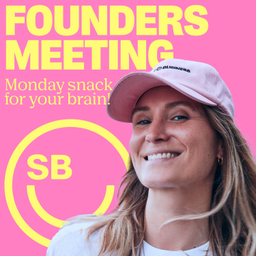
Founders-Meeting
Hosted by Helga · Helga Osk | SERIOUS.BUSINESS
5.0from 13 ratings
- 41
- Episodes
- 13
- Ratings
- Bi-weekly
- Cadence
- 2024
- First episode
About Founders-Meeting
This is the Founders-Meeting podcast—your Monday morning "snack" to kickstart the week with positivity, innovative thinking, and entrepreneurial drive. Every week, we dive into the minds of founders from around the globe, uncovering the strategies and stories behind their biggest wins and toughest challenges. Whether you're just starting out or scaling to new heights, this podcast is your weekly dose of motivation and insight. Hosted by Helga Osk Hlynsdottir, Spiritual Leader and co-founder of SERIOUS.BUSINESS, with over a decade of experience in building stronger teams, driving business growth, and crafting premium brands. Tune in every Monday for fresh inspiration—subscribe now and get inspired by your new favourite entrepreneurs.
- Publisher
- Helga Osk | SERIOUS.BUSINESS
- Category
- business · business · education
- Language
- en
- Explicit
- No
- First episode
- 21 Nov 2024
- Latest episode
- 28 Sept 2026
Latest episodes
41 episodes in the feed.
28 Sept 2026
38 | Laura / KeyPitt: Told There Was No Founder Seat, She Took the Job Anyway
Episode Overview When Laura Katzensteiner joined Keypitt, she asked whether there was room for another founder. The answer was "not currently." She took the job anyway. She had worked out that she adds the most value once a product exists and there are real problems to solve, not at stage zero with nothing but an idea. Today she's co-founder and COO, and she's leading the company's first fundraise. Keypitt was founded in Copenhagen by Karla Pitt Winther, with CTO and co-founder André Bergan. It replaces paper cloakroom tickets with the KeyPass, a reusable digital pass for nightclubs, concert venues and conferences. It sounds simple, but investors can't put the company in a box: it's not quite SaaS, not quite fintech, not quite hospitality. We get into what it took to grow from employee to co-founder, how Laura is preparing to raise DKK 2.5–3M from angels, building tech simple enough for her mother, and why AI is making every brand look the same. 🔑 In this episode, we talk about: Asking for a founder seat, hearing "not currently," and growing into the role anyway Why she didn't want to join a startup at "stage zero" Growing up between two very different parents, and a father who offered to work for free to prove his value Learning from Karla's pivots from NFC to QR codes and from tablets to phones Building a product that's deliberately "not so high tech" so her mother can use it too Why Keypitt doesn't fit neatly into SaaS, fintech, e-commerce or hospitality, and what that means for fundraising Raising DKK 2.5–3M from angel investors, and why they're looking for "smart money" with payments experience Why AI is making every brand look the same, and how to put the human back in 🧠 Key Takeaways Join where you add the most value, not where it's most glamorous. Laura knew she wouldn't add the most value at the idea stage, so she looked for a startup where her skills would count from day one. Simple beats impressive when your users are everyone. A product used across a whole society has to work for the 70-year-old concertgoer as well as the tech-savvy one. Being hard to categorise is a pitching problem, not a product problem. Investors think in verticals, so if you don't fit one, you first have to convince them you're close enough to talk to. Pitch the vision, not only the proof. Laura noticed she tends to talk about what exists today, while research suggests men pitch what's coming. Founders need both. Raise for brains as much as money. With paying customers already, Keypitt is raising to grow faster and to get strategic help from people who have built bigger things. Let AI build the draft, not the personality. Generate the website or the post, then take the time to add one thing that's unmistakably you. 🗣️ Sound Bites "When I joined, I asked whether they were open to having another founder, and the answer I received was not really, or not currently." "Most people will be met with a wardrobe in their life. They have received a paper ticket. Why have we not questioned this?" "For the guest, we want to make the experience forgettable. But for the employee who stands in the wardrobe, that's their everyday life." 📍 Chapter Highlights 00:00 – Cold open 01:00 – Welcoming Laura: the software running the cloakroom 01:43 – Growing up in Vienna, and a father who offered to work for free 04:33 – A rainy boat at Tech BBQ, and asking for a founder seat before day one 08:54 – Why Keypitt: the paper ticket nobody questioned 10:16 – Learning from Karla's pivots, and why resilience matters most 13:02 – High-tech vs. intuitive: building for her mother 15:08 – The company that fits no box, and pitching the vision vs. what exists today 20:07 – Dead phones, lost tickets, and Karla's origin story 23:31 – A last-minute payments partner over Christmas 26:11 – Preparing for a first fundraise, and raising DKK 2.5–3M from angels 31:49 – "Fundraising is a social game," and raising as a female-founded team 37:51 – Expanding abroad, and when the business case works for a venue 42:35 – The through line across customers, and backups for guests without a phone 44:11 – Proudest moments: a big nightclub launch, and happy wardrobe staff 49:56 – Branding to guests and venues at the same time 55:17 – Why Denmark, and why AI is making every brand look the same 1:02:49 – The first full-time hire, a team of Leos, and "freedom under responsibility" 1:10:04 – Where to find Laura and Keypitt, and closing thoughts 🔗 Links & Resources Keypitt: keypitt.com (https://keypitt.com/) Laura Katzensteiner on LinkedIn: linkedin.com/in/laura-katzensteiner (https://dk.linkedin.com/in/laura-katzensteiner) Keypitt on Instagram: instagram.com/keypitt_official (https://www.instagram.com/keypitt_official/) Keypitt on LinkedIn: linkedin.com/company/100185831 (https://www.linkedin.com/company/100185831) Keypitt on Facebook: facebook.com/keypitt (https://www.facebook.com/share/161g5HyUHy/?mibextid=wwXIfr) 🏢 Companies / Organisations Mentioned Keypitt: Copenhagen startup behind the KeyPass, a reusable digital cloakroom pass for venues Supervillain: one of Copenhagen's biggest nightclubs and Keypitt's first major customer Clue: the period-tracking app whose founder, Ida Tin, called fundraising "a social game" in a past Founders-Meeting interview Tech BBQ: the Copenhagen event where Helga and Laura first met SERIOUS.BUSINESS host Helga's company 🧡 Why You'll Love This Episode Laura was told there was no founder seat, took the job anyway, and made herself so useful that the seat came to her. If you're a founder wondering when to bring in a co-founder, or an employee wondering if you could become one, this conversation shows how it can happen. 📣 Connect with Us This podcast is brought to you by SERIOUS.BUSINESS (https://serious.business/). If you're scaling fast but your messaging, your story, your brand haven't caught up—let's fix that 👇🏻 👉 Apply for your FREE Brand Masterplan (https://masterplan.serious.business/) 🦄
14 Sept 2026
37 | Frederik / Interhuman AI: Building the Machine That Could Replace His Mother's Career
Frederik Sally is trying to teach machines to read the parts of a conversation that never make it into words: the hesitation before an answer, the confidence behind a claim, the nervous energy under a smile. If he and his team succeed, one of the first careers their technology could make obsolete is his own mother's. She has spent her life running a communication consultancy and writing books on how people talk to each other. Frederik tells her as much, and she jokes that he might just put her out of a job. He isn't sure the two things are connected. He suspects it's more coincidence than inheritance. But it's hard to ignore that he also has a grandfather still launching ventures at almost 90 and a biological father who ran one of Denmark's first commercial radio stations. Something in the family clearly likes building things other people said couldn't be built. That instinct led him and two co-founders, Paula Petcu and Line Clemmensen, to found Interhuman AI, a Copenhagen startup building what Frederik calls a "social intelligence layer" for AI. The idea didn't start where it is now. It began as a therapist app, failed to find buyers, and pivoted hard once the founders noticed that companies were far more interested in the underlying technology than in the product itself. That pivot has since raised a €2 million pre-seed round, and Interhuman AI is now betting on sales training and user research as the use cases that prove the technology works before the bigger, harder problems (cultural nuance, healthcare, therapy) are ready to tackle. Whatever stage you're building at, this conversation will land somewhere familiar: being early to a market that isn't ready yet, discovering your actual business by watching what customers ask for instead of what you set out to sell, and using story and branding to buy yourself time while the technology catches up. 🔑 In this episode, we talk about: What Interhuman AI's "social intelligence layer" actually reads (tone, hesitation, confidence, body language) and why today's LLMs miss all of it Growing up in a family of entrepreneurs: a grandfather still starting companies near 90, a mother who built a career teaching communication, and a biological father who ran early commercial radio in Denmark The pivot from a failed therapist app to licensing the underlying tech to sales-training and user-research platforms Raising a €2 million pre-seed round, and why deep tech is a harder sell to European investors than American ones How they collect training data: Creative Commons sources, synthetic data, and recording their own lives, including a rose party, with Meta smart glasses Competing with hyperscalers like OpenAI and Anthropic and specialists like Hume AI, and why depth beats general intelligence for this problem Turning down an investor who wanted the technology used for defense and lie detection Building the company's ethical guardrails around the EU AI Act A pilot with the Region of Copenhagen helping parents practice hard conversations with kids who have additional needs Why Frederik thinks a single homemade video did more to open investor doors than any slide deck The 93%-nonverbal statistic he's been told by his own behavioral scientists to stop quoting 🧠 Key Takeaways Sell what the market is asking for, not what you set out to build. Interhuman AI's therapist app flopped, but the underlying technology kept generating inbound interest. That signal, not the original plan, became the business. Being early means testing constantly, not waiting to be proven right. With no playbook to follow, the team treats every week as a chance to pivot, informed by pilots and customer feedback rather than a fixed roadmap. Sometimes speed beats accuracy. Their new "real-time experimental" model trades some precision for instant feedback, on the theory that a rough first read (much like meeting a stranger) can still be useful while a fuller picture builds over the conversation. Draw your ethical line before you need the money. The founders turned down a defense-focused investor before they had funding secured, so there was never a moment where the answer might have been different. Branding can open doors the technology hasn't earned yet. A short, well-made video of signals overlaid on a conversation did more to get early investor meetings than research slides, and the team kept using it for almost two years. People remember the trust a conversation created, not what was said in it. Two years after meeting at a conference, neither Frederik nor Helga can recall their actual conversation, only that it built enough trust to stay in touch, which is itself the thesis Interhuman AI is built on. Specialization can beat scale for narrow, deep problems. Frederik doesn't think general models will out-compete focused ones on things like cultural nuance and personal baseline, because that depth isn't what the big labs are optimizing for. A mismatched skill set among co-founders can be the real fundraising asset. Investors backed the combination of Frederik's storytelling, a technical AI researcher, and a data scientist, not any one of those alone. 🗣️ Sound Bites "She tells me that if we succeed in teaching this AI the things we are trying to do, it could potentially take over what she's been doing her whole life." "You're nodding right now, for example. That is a signal that is important in this conversation. You're understanding what I'm saying, you're acknowledging, you're listening. All these signals we're trying to teach a model to pick up on." "I can remember you, and I can remember maybe two more, out of the maybe fifty people I talk with at these conferences. So that's definitely something." "We turned down an investor that wanted us to go the defense route. Because to the bone, we want to do AI for good." "Once they saw this very short video clip, they immediately understood it. From that, we just learned that it means something, what you show." 📍 Chapter Highlights 00:03 – Kicking off, and checking the clock before diving in 00:31 – Welcoming Frederik, founder of Interhuman AI: teaching machines to read what's beneath the words 03:07 – Frederik's childhood and a family of entrepreneurs 04:03 – A grandfather still launching ventures near 90, and a mother who teaches communication for a living 07:03 – The original idea: a therapist app 09:23 – The pivot: companies wanted the underlying tech, not the app 10:26 – The €2 million pre-seed round, and why deep tech is a harder sell in Europe 11:51 – The biggest current challenge: data, research, and a field moving week to week 13:55 – Collecting data with Creative Commons sources, synthetic data, and Meta glasses at a rose party 15:28 – Positioning against hyperscalers and specialists like Hume AI 20:29 – Choosing sales training as the first commercial use case 23:11 – Explaining Interhuman AI to someone hearing it for the first time 24:34 – Why it's not a lie detector, and turning down a defense-focused investor 25:41 – The risk of young people leaning on chatbots for emotional support 27:52 – The 93%-nonverbal statistic, and why he's been told to retire it 29:32 – Do companies know how much of their message gets lost beyond the words? 34:48 – Staying motivated and pivoting weekly when the market isn't ready yet 36:18 – Trading accuracy for speed: building an instant "real-time experimental" model 39:56 – Callback to the Tech BBQ in Copenhagen, two years on 41:45 – "We don't remember the words. We remember the trust." 42:56 – Cultural differences, personal baselines, and reading the same signal differently 46:43 – The real-world stakes of getting it wrong: AI interviewers, healthcare, therapy 47:13 – Where Frederik draws the ethical line, and building around the EU AI Act 51:14 – Piloting with the Region of Copenhagen to help parents of kids with additional needs 57:26 – Advice to his younger self, and the sales lessons learned the hard way 1:00:51 – Why demos, not decks, win meetings 1:01:39 – The two-year-old video that opened investor doors 1:06:28 – The co-founder mix that actually got them funded, and growing to 12 people 1:11:58 – Where to find Frederik and Interhuman AI, and closing thoughts 🔗 Links & Resources Interhuman AI: Interhuman AI (https://www.interhuman.ai/) Frederik Sally on LinkedIn: linkedin.com/in/frederiksally (linkedin.com/in/frederiksally) Interhuman AI's €2M pre-seed coverage: EU-Startups, Sifted 🏢 Companies / Organisations Mentioned Interhuman AI (https://www.interhuman.ai/): Copenhagen startup building a social intelligence layer that reads nonverbal social signals for AI systems Hume AI (https://www.hume.ai/): competitor building emotion-focused AI models, referenced as working from a different (basic-emotions) framework Region of Copenhagen: Danish regional government piloting an Interhuman AI app to help parents of kids with additional needs Tech BBQ (https://techbbq.dk/): the Copenhagen event where Helga and Frederik first met, two years before this recording SERIOUS.BUSINESS (https://serious.business/): host Helga's company 🧡 Why You'll Love This Episode This one has a twist most founder stories...
31 Aug 2026
36 | Aurore / Goodvest: Why Scaling Feels Like Grieving
Aurore Pinon-Jacques has built and let go of things twice over. She shut down her first company after a co-founder partnership fell apart. Four years into Goodvest, she stepped back from the CMO title she'd held since day one. And in between, she had to grieve an entire era of the company itself — the 10-person "family" that a €12M Series B and a 40-person team have now replaced. This episode is about what that letting go actually costs a founder, and what it makes possible. Aurore is co-founder of Goodvest, a French sustainable investment platform reimagining wealth management for people who want their money to do good, not just grow — now with a sharpened focus on founders who've exited or are about to. Her path there wasn't a straight line: a childhood dream of becoming a war journalist, a detour into luxury marketing, then a first company — sustainable, recycled-fiber tights — built and lost alongside a close friend. Every step forward came with something she had to release. Whatever stage you're at as a founder, this conversation will feel familiar: the version of your company you're currently grieving, and the one you haven't grieved yet. 🔑 In this episode, we talk about: Why "Goodvest" trips up almost every non-native English speaker (and how Aurore turned that into an icebreaker) What Goodvest actually does, and why it's now built specifically for exited and exiting founders Growing up wanting to be a war journalist, then chasing the glamour of luxury marketing Founding — and shutting down — her first company, a sustainable fashion label using recycled fibers What she learned about mixing friendship with business after her first co-founder split Running two companies and planning a wedding at the same time How Goodvest's three co-founders handle conflict, and the compatibility questionnaire she wishes she'd used the first time Scaling from a 10-person "family" to a 40-person team after a €12M Series B — and grieving what got left behind Recruiting, bias, and onboarding once you're past the early "generalists who can do five things" stage Why she stepped back from her CMO role to write a graphic novel about sustainable finance Why branding gets more valuable, not less, in the age of AI The real problem Goodvest exists to solve, and why sustainable investing is a rational bet, not just an ethical one 🧠 Key Takeaways: Shared vision isn't enough. Compatibility in values and working style matters just as much as agreeing on the mission — and a simple written questionnaire can surface a mismatch before it costs you a company. Similarity between co-founders is its own risk. When communication feels effortless, you stop working at it. Real differences force you to build transparency deliberately, from day one. Odd numbers of co-founders break ties. Two people can only push and pull; three (or four) can actually resolve a disagreement. Shutting a company down isn't failure — it's an experience. Giving yourself a hard deadline (Aurore gave hers a year) protects you from staying in a broken partnership on hope alone. Scaling means grieving what worked before. The intimacy of a small founding "family" has to be let go, on purpose, for the company to grow past it. Your value shifts from doing the work to building what outlasts you. Legacy — not daily tasks — is what lets a founder step back and start something new. Recruiting bias is real and unconscious. We default to people who feel familiar — same background, same communication style. Naming that bias is step one to hiring well, not just comfortably. AI raises the floor on brands, which raises the ceiling on authenticity. When anyone can generate a "clean" brand, the human, personal ones become the ones people actually choose. 🗣️ Sound Bites: "Once you tell yourself my value is not in my everyday tasks anymore, my value is in what I gave as a legacy, you can move on and do other projects." "It's not sufficient to share the same vision. It's not sufficient to have good communication. You also have to be compatible on some levels." "You can't do lazy branding with AI. People are going to give value to that." "In let's say 10, 20 or 30 years, do you think you will be happy that you invested in oil companies?" "The more personal an experience, the more universal it becomes." 📍 Chapter Highlights: 00:04 – Kicking off, and getting "Goodvest" pronounced correctly 04:55 – What Goodvest does, and its 2026 focus on exited/exiting founders 06:24 – The emotional weight of an exit, and why founders need somewhere to turn 09:51 – Childhood dreams of becoming a war journalist 11:04 – The pivot into luxury marketing, and The Devil Wears Prada pull of it 14:02 – Why the luxury job stopped fitting her values 14:34 – Founding her first company: recycled-fiber sustainable tights 15:38 – The co-founder conflict that ended it, and the hard lesson on friendship + business 16:58 – Why being too similar to a co-founder is its own risk 18:41 – Running two companies and planning a wedding at once 27:02 – How Goodvest's three co-founders resolve conflict 30:09 – The co-founder compatibility questionnaire she wishes she'd used sooner 33:22 – The €12M Series B, and scaling from 10 people to 35–40 36:59 – "Grieving" the early, family-like team culture 38:37 – Protecting culture through hypergrowth with transparency 43:27 – What role branding plays as you scale past your first customers 45:39 – Why AI raises the bar for brands, and the return of "love brands" 50:38 – Writing a graphic novel about sustainable finance 54:04 – Stepping back from the CMO role, and finding value in legacy over daily tasks 57:54 – Why recruiting is the hardest part of scaling, and staying aware of bias 1:01:53 – Goodvest's onboarding process 1:07:00 – The core problem Goodvest exists to solve 1:10:36 – Her pitch to a founder deciding what to do with exit capital 1:12:19 – Challenging the unicorn obsession 1:14:00 – Her forecast for how brands need to evolve over the next 12 months 1:19:08 – Closing thoughts on imperfection, oversharing, and authenticity as a founder's edge 🔗 Links & Resources: Goodvest — https://www.goodvest.fr Aurore Pinon-Jacques on LinkedIn — https://fr.linkedin.com/in/aurore-jacques Goodvest's €12M Series B coverage (Tech.eu) — https://tech.eu/2025/09/24/goodvest-raises-eur12m-to-expand-economic-and-social-impact-offerings/ Aurore's graphic novel on sustainable finance — extended edition currently in progress with a publisher; release date not yet public 🏢 Companies / Organisations Mentioned: Goodvest — sustainable investment platform for individuals and, increasingly, exited/exiting founders SERIOUS.BUSINESS — host Helga Osk's company, referenced in the co-founder-count discussion 🧡 Why You'll Love This Episode: This one goes places most founder interviews don't. Aurore names something most founders feel but rarely say out loud: that growth isn't just building — it's a string of small losses you have to let yourself grieve, from a co-founder partnership to a 10-person "family" to a title you built with your own hands. If you've ever wondered whether letting go of a version of your company is a failure or the thing that finally lets it grow, this conversation will stay with you. 📣 Connect with Us This podcast is brought to you by SERIOUS.BUSINESS (https://serious.business/). If you're scaling fast but your messaging, your story, your brand haven't caught up—let's fix that 👉 Apply for your FREE Brand Masterplan (https://masterplan.serious.business/) 🦄
Who has been a guest on Founders-Meeting
Names identified in recent episode analyses. Showing up to five guests.
- Ahana Banerjee
- Georg Molzer
- Zhuoyan Jin
- Joseph Nimoson
- Ann-Sophie Czech
Reach and audience
Public platform figures. Ratings count people who left a rating, not total listeners.
- Spotify
- 5.0 / 5
- 13 ratings
Podcast Authority Score: 23 / 100
A composite of feed quality, social presence, YouTube performance and engagement. Read the methodology.
- Quality
- 46
- Social presence
- 0
- YouTube
- 0
- Engagement
- 0
Contact Founders-Meeting
- Guest appearances
- Does not typically book guests
Based on episode analysis; this does not confirm that the show is currently accepting guests.
Questions about Founders-Meeting
Who hosts Founders-Meeting?
Helga host the show. Published by Helga Osk | SERIOUS.BUSINESS.
How often do new episodes come out?
The show publishes bi-weekly, based on its RSS feed.
Does Founders-Meeting take guests?
The show does not typically feature guests, based on episode analyses.
Host of Founders-Meeting?
Claim your podcast to manage its listing and keep your show details accurate.
Pod Engine is an independent podcast discovery and analytics service and is not affiliated with or endorsed by this podcast. Artwork and show content belong to their owners. Full legal notice.
Explore this show
Podcast research with Pod Engine