- 85
- Episodes
- Daily
- Cadence
- 2026
- First episode
About Fraud in a Moment
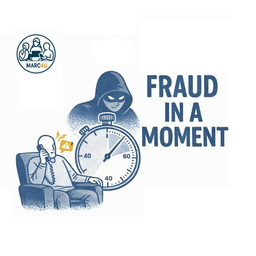
Fraud in a Moment is the sharing of quick and dramatic stories based on real scams perpetrated on seniors. Shared in the dramatic narrative style of old-time '50s radio broadcasts, these tales 'in a moment' are meant to quickly educate and entertain those who want to protect our revered class of citizens or simply protect themselves. With the hundreds of types of frauds being perpetrating on our elderly and the thousands of scammer perpetrating them… best we learn how they target us. Take a listen, we think you'll enjoy.
- Publisher
- MARC4U.org
- Category
- business · education · society & culture
- Language
- en
- Explicit
- No
- First episode
- 27 May 2026
- Latest episode
- 21 Oct 2026
Latest episodes
85 episodes in the feed.
21 Oct 2026
FIAM - The Kickback Carousel: Specialists Spinning Patients for Four Years
Welcome to Fraud in a Moment - This 8-minute story shares the scamming of a perfectly healthy 78-year-old — who leaves a routine physical with four specialist referrals. Every specialist finds something. Eleven appointments. Seven procedures. $31,400 billed to Medicare. His son, a retired insurance adjuster, spots the billing pattern and blows the whistle on a $4.1 million kickback ring. If you like this story - please click the SHARE button above and share with an important senior in your world! BE SURE TO SUBSCRIBE TO KEEP MORE STORIES LIKE THIS ONE COMING! Check out our other stories: www.youtube.com/@FIAM4U00 (www.youtube.com/@FIAM4U00 ) Check out the https://MARC4U.org (https://MARC4U.org) website for all things Fraud Awareness for Seniors and Retirees including our full-length episodes of Fraud on the Front Porch http://www.youtube.com/@FraudontheFrontPorch (http://www.youtube.com/@FraudontheFrontPorch) discussing the ocean of fraud plaguing Seniors and Retirees. Intro Liner: It started with a routine checkup. Walter Briggs, age seventy-eight, went in for his annual physical. He left with four referrals. A cardiologist. A neurologist. A pulmonologist. And a sleep specialist. His primary care doctor — a man named Dr. Felix Harmon — assured him it was all precautionary. Standard protocol for a man his age. Nothing to worry about. What he didn't know was that he was a revenue stream on a referral carousel generating thousands of dollars in Medicare claims. This is Fraud in a Moment and the truth starts now. Lessons Learned for Senior Audiences 1. Multiple Referrals From a Single Visit Is a Red Flag Worth Questioning One or two referrals from a primary care visit can be appropriate. Four referrals from a routine physical — especially when you feel fine — warrants a second opinion before you make a single appointment. 2. Ask Your Doctor Directly: "Do You Have a Financial Relationship With This Specialist?" Under federal law, doctors are prohibited from receiving kickbacks for referrals. But the law only works if patients ask the question. A legitimate physician will answer honestly. A fraudulent one will deflect. 3. Every Specialist Should Be Able to Explain Why You Specifically Need Their Services If a specialist's findings seem to appear out of nowhere — especially when you have no symptoms — ask for a written explanation of the diagnosis and request a second opinion from a specialist you find independently. 4. Track Your Medicare Statements Across All Providers Fraud rings depend on patients not connecting the dots between multiple providers. Keep a simple log of every appointment, every test, and every Medicare billing. Patterns of over-testing become visible when you see them together. 5. A Trusted Family Member With Financial or Medical Experience Is Invaluable Marcus caught what Walter couldn't see because he was trained to recognize billing patterns. Invite someone you trust to review your medical bills — especially if you are seeing multiple specialists simultaneously. 6. Report Kickback Schemes to the HHS Office of Inspector General Call 1-800-HHS-TIPS (1-800-447-8477) or file online at oig.hhs.gov. The federal Anti-Kickback Statute makes physician referral arrangements for financial gain a serious federal crime — but only prosecuted cases that are reported.
19 Oct 2026
FIAM - The Diagnosis Factory - The Bills for Tests You Never Had
Welcome to Fraud in a Moment - This 7-minute story shares the scamming of an unsuspecting Senior who almost throws away her Medicare statement — until her daughter, who works in hospital administration, spots $4,847 billed for tests that never happened. The doctor had been billing for phantom procedures across 847 patients for six years. He's arrested, sentenced to 4 years in federal prison, and ordered to repay $2.3 million. If you like this story - please click the SHARE button above and share with an important senior in your world! BE SURE TO SUBSCRIBE TO KEEP MORE STORIES LIKE THIS ONE COMING! Check out our other stories: www.youtube.com/@FIAM4U00 (www.youtube.com/@FIAM4U00 ) Check out the https://MARC4U.org (https://MARC4U.org) website for all things Fraud Awareness for Seniors and Retirees including our full-length episodes of Fraud on the Front Porch http://www.youtube.com/@FraudontheFrontPorch (http://www.youtube.com/@FraudontheFrontPorch) discussing the ocean of fraud plaguing Seniors and Retirees. Intro Liner: The waiting room smelled like antiseptic and old magazines. Norma Castellano, age seventy-three, had been coming to the same medical office for eleven years. She trusted Dr. Raymond Voss the way you trust a mechanic who has kept your car running — not because you understand what he does, but because nothing has broken yet. So, when he told her she needed a comprehensive metabolic panel, a cardiac stress screening, a pulmonary function test, and a bone density scan — all in the same visit — she nodded. She was a senior. Seniors needed tests. That was simply how it worked. But what she didn't know was that Dr. Raymond Voss had been doing this with his patients for six years. This is Fraud in a Moment and the truth starts now. Lessons Learned for Senior Audiences 1. Always Read Your Medicare Explanation of Benefits Statement This document — mailed after every Medicare-covered visit — lists every procedure billed in your name. If you see a test you don't remember having, call Medicare immediately at 1-800-MEDICARE (1-800-633-4227). 2. You Have the Right to Ask What Every Test Is and Why You Need It Before consenting to any diagnostic procedure, ask your doctor: What is this test? What will it tell you? What happens if I don't have it? A legitimate physician will answer every question. A fraudulent one will rush you past them. 3. Consent Forms Are Not Blank Checks Signing a general consent form does not authorize a doctor to bill for procedures never performed. Read what you sign. Ask for a copy. Keep it. 4. Medicare Fraud Costs Every American When doctors steal from Medicare, they steal from the program that protects every senior in this country. Reporting fraud is not just your right — it is your responsibility to every other patient. 5. A Trusted Family Member Can Be Your Best Defense Norma almost missed the fraud entirely. Her daughter, Rosa…caught it. Invite a trusted family member or friend to review your Medicare statements with you — especially after any visit involving multiple tests. 6. Report Suspected Medicare Fraud Immediately Call 1-800-MEDICARE (1-800-633-4227), contact the HHS Office of Inspector General at 1-800-HHS-TIPS (1-800-447-8477), or file online at oig.hhs.gov. Your report could stop a fraudulent doctor from victimizing hundreds more patients.
17 Oct 2026
FIAM - Gone By Monday: The Fake Employer Who Vanished With Her Life
Welcome to Fraud in a Moment - This 8-minute story shares the scamming of a retired office manager who prepared for three days, aced the video interview, and recognized every piece of the onboarding paperwork — provides her SSN, bank account, and driver's license to a company that doesn't exist. Then pays a $350 "onboarding fee" via Zelle. By Monday, the company is gone. Within two weeks, someone is opening credit cards in her name across the country. If you like this story - please click the SHARE button above and share with an important senior in your world! BE SURE TO SUBSCRIBE TO KEEP MORE STORIES LIKE THIS ONE COMING! Check out our other stories: www.youtube.com/@FIAM4U00 (www.youtube.com/@FIAM4U00 ) Check out the https://MARC4U.org (https://MARC4U.org) website for all things Fraud Awareness for Seniors and Retirees including our full-length episodes of Fraud on the Front Porch http://www.youtube.com/@FraudontheFrontPorch (http://www.youtube.com/@FraudontheFrontPorch) discussing the ocean of fraud plaguing Seniors and Retirees. Intro Liner: She had prepared for three days. She had updated her resume. She had pressed her blazer. She had practiced her answers in the bathroom mirror the way she used to before parent-teacher conferences. At seventy-one, Beverly Okafor was ready to go back to work. A bookkeeping position with a small accounting firm. Remote. The interview was conducted over video. The offer letter arrived by email. The background check form asked for her Social Security number, her bank account number, and a copy of her driver's license. They asked for a $350 "onboarding fee" to cover her software license and equipment deposit. She paid. This is Fraud in a Moment and the truth starts now. Lessons Learned for Senior Audiences 1. No Legitimate Employer Charges You to Start Working Onboarding fees, equipment deposits, software license fees, background check fees — if a new employer asks you to pay anything before your first paycheck, it is a scam. Period. No exceptions. 2. A Professional Website and a Video Interview Do Not Prove a Company Is Real Scammers build convincing websites and conduct video interviews using stolen photos and scripted personas. Always verify a company through the Secretary of State's business registry, the Better Business Bureau, or LinkedIn — independently, not through links they provide. 3. Never Provide Your Social Security Number, Bank Account Number, and Driver's License to an Employer You Have Not Independently Verified These three pieces of information together are everything an identity thief needs. Provide them only after you have confirmed — through your own research — that the company and the job are legitimate. 4. Zelle, Venmo, and Wire Transfers Are Irreversible Unlike a credit card payment, money sent via Zelle or wire transfer cannot be recalled once it leaves your account. Scammers specifically request these payment methods because the money disappears instantly and permanently. 5. Search the Job Listing Itself — Not Just the Company Copy a sentence from the job description and paste it into Google with the word "scam." Fraudulent job listings are often reused across multiple fake companies, and previous victims frequently post warnings online. 6. If You Suspect Identity Theft, Act Within Hours — Not Days Contact your bank immediately. Place a fraud alert with all three credit bureaus — Equifax at 800-685-1111, Experian at 888-397-3742, and TransUnion at 888-909-8872. File a report at identitytheft.gov for a personalized recovery plan. Every hour matters.
Contact Fraud in a Moment
- Guest appearances
- Does not typically book guests
Based on episode analysis; this does not confirm that the show is currently accepting guests.
Host of Fraud in a Moment?
Claim your podcast to manage its listing and keep your show details accurate.
Pod Engine is an independent podcast discovery and analytics service and is not affiliated with or endorsed by this podcast. Artwork and show content belong to their owners. Full legal notice.
Explore this show
Podcast research with Pod Engine