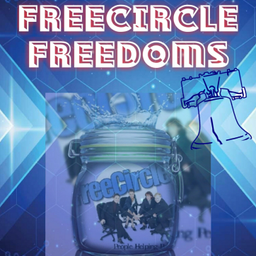
FreeCircle Freedoms is a podcast that covers my thoughts and opinions on freedom, the direction of our nation and the world.
The shows Season 2 will release each week on Sunday starting in January 2020
Please feel free to send us a message. We play messages on the next podcast. Find all of our great Podcasts on Our website:
Dead America
https://www.deadamerica.website
Social media: We are mainly on Twitter, So lovers find us @freecircle3
We are STRONGER as ONE! Support this podcast:
And all of our great Podcasts!
Listen Notes
https://www.deadamerica.website (https://www.deadamerica.website)
The message of the campaign contains the ideas that the candidate wants to share with the voters. It is to get those who agree with their ideas to support them when running for a political position. The message often consists of several talking points about policy issues. The points summarize the main ideas of the campaign and are repeated frequently in order to create a lasting impression with the voters. In many elections, the opposition party will try to get the candidate "off message" by bringing up policy or personal questions that are not related to the talking points. Most campaigns prefer to keep the message broad in order to attract the most potential voters. A message that is too narrow can alienate voters or slow the candidate down with explaining details. For example, in the 2008 American presidential election John McCain originally used a message that focused on his patriotism and political experience: "Country First"; later the message was changed to shift attention to his role as "The Original Maverick" within the political establishment. Barack Obama ran on a consistent, simple message of "change" throughout his campaign. However, even if the message is crafted carefully, it does not assure the candidate a victory at the polls. For a winning candidate, the message is refined and then becomes his or her in office.
1 Mar 2020
Party Machinery
https://www.deadamerica.website (https://www.deadamerica.website)
A political machine is a political group in which an authoritative boss or small group commands the support of a corps of supporters and businesses (usually campaign workers), who receive rewards for their efforts. The machine's power is based on the ability of the boss or group to get out the vote for their candidates on election day.
Although these elements are common to most political parties and organizations, they are essential to political machines, which rely on hierarchy and rewards for political power, often enforced by a strong party whip structure. Machines sometimes have a political boss, often rely on patronage, the spoils system, "behind-the-scenes" control, and longstanding political ties within the structure of a representative democracy. Machines typically are organized on a permanent basis instead of a single election or event. The term may have a pejorative sense referring to corrupt political machines.[1]
The term "political machine" dates back to the 20th century in the United States, where such organizations have existed in some municipalities and states since the 18th century. Similar machines have been described in Latin America, where the system has been called clientelism or political clientelism (after the similar Clientela relationship in the Roman Republic), especially in rural areas, and also in some African states and other emerging democracies, like postcommunist Eastern European countries. The Swedish Social Democrats have also been referred, to a certain extent, as a "political machine", thanks to its strong presence in "popular houses".[2]
23 Feb 2020
Vote Splitting
https://www.deadamerica.website (https://www.deadamerica.website)
even though 60% of the voters prefer either candidate A1 or A2.
Cardinal voting methods are immune to vote splitting, since each candidate is rated independently of each other.[2] Pairwise-counting Condorcet methods minimize vote splitting effects.[3][1] Plurality-runoff voting methods (like Exhaustive ballot, Two-round system/Top-two primary,[1] Instant-runoff voting,[2] Supplementary vote, and Contingent vote) still suffer from vote-splitting in each round, but can somewhat reduce its effects compared to single-round plurality voting.[3]
A well-known effect of vote splitting is the spoiler effect, in which a popular candidate loses an election by a small margin because a less-popular similar candidate attracts votes away from the popular candidate, allowing a dissimilar candidate to win. As a result, the notion of vote splitting is controversial because it can discourage third party candidates.
Strategic nomination takes advantage of vote splitting to defeat a popular candidate by supporting another similar candidate.
Vote splitting is one possible cause for an electoral system failing the independence of clones or independence of irrelevant alternatives fairness criteria.
Reach and audience
Public platform figures. Ratings count people who left a rating, not total listeners.
Apple Podcasts (US)
5.0 / 5
1 ratings
Contact FreeCircle Freedoms
Guest appearances
Does not typically book guests
Based on episode analysis; this does not confirm that the show is currently accepting guests.
Host of FreeCircle Freedoms?
Claim your podcast to manage its listing and keep your show details accurate.
Pod Engine is an independent podcast discovery and analytics service and is not affiliated with or endorsed by this podcast. Artwork and show content belong to their owners. Full legal notice.
Explore this show Podcast research with Pod Engine