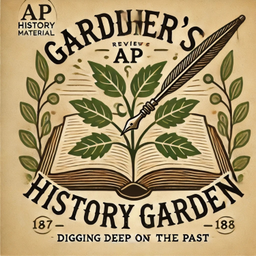
Welcome to Gardner’s History Garden, the podcast where history comes to life! Whether you’re an AP student, a history enthusiast, or just someone who loves a good story, this podcast provides clear and engaging overviews of major historical events, figures, and concepts. Each episode breaks down key moments in world and U.S. history—helping you connect the past to the present with insightful analysis and easy-to-remember takeaways.
From ancient civilizations to modern revolutions, Gardner’s History Garden cultivates knowledge, one episode at a time! 🎙️✨
AP WH Episode ^ Global Conflict in the 20th Century
Welcome to Episode 7 of our AP World History podcast! In this episode, we dive into one of the most transformative periods in global history: the global conflicts of the 20th century (1900-1945). From the assassination of Archduke Franz Ferdinand to the trenches of World War I, the rise of totalitarian leaders, and the devastation of World War II, we explore the causes, key events, and lasting effects of these conflicts.📌 Topics Covered:✔️ Causes of World War I – Militarism, Alliances, Imperialism, Nationalism (MAIN)✔️ The assassination of Franz Ferdinand & the start of WWI✔️ Trench warfare & new military technology✔️ The Treaty of Versailles & its consequences✔️ The Great Depression & the rise of totalitarian leaders✔️ The road to World War II – Appeasement, Expansion, and Aggression🎯 Perfect for students preparing for the AP World History exam! Don’t forget to like, subscribe, and hit the notification bell for more history deep dives.
7 Mar 2025
AP World Episode 6 Consequences of Industrialization
In this episode, we explore the far-reaching consequences of industrialization (1750-1900). From the rise of imperialism fueled by the need for raw materials to global migrations and cultural transformations, industrialization reshaped economies, societies, and power structures worldwide. We break down key topics like economic exploitation, resistance movements, and the impact of migration—plus memory tricks and exam tips to help you ace the AP World History test!
3 Mar 2025
AP World Episode 5 Revolutions
This episode explores the transformative revolutions between 1750-1900, from the American and French Revolutions to the Haitian Revolution and the Industrial Revolution. Listeners experience key moments like the storming of the Bastille, the drafting of the Declaration of Independence, and the burning plantations of Saint-Domingue. The episode also examines the rise of new ideologies—liberalism, nationalism, and communism—and how industrialization reshaped economies and societies. With memory tricks and test-taking strategies, this episode helps students connect revolutionary movements to long-term global change.
26 Feb 2025
AP World Episode 4 Transoceanic Interconnection
In this episode, we dive into the transoceanic interconnections of 1450-1750, a period that reshaped the world through exploration, trade, and cultural exchange. We’ll explore the motivations behind European exploration, the technological advancements that made it possible, and the global impacts of the Columbian Exchange. From the spread of goods and ideas to the devastating consequences of disease and the transatlantic slave trade, this era marked the beginning of globalization. Stay tuned for key takeaways, memory tricks, and AP exam tips to help you master this topic!
26 Feb 2025
AP World Episode 3 Land Based Empires
In this episode we explore the rise and dominance of land-based empires from 1450 to 1750, including the Ottoman, Safavid, Mughal, Qing, and Russian Empires. These empires expanded through military innovation, strong bureaucracies, and strategic cultural policies, shaping world history and laying the foundations for modern states.
26 Feb 2025
AP World Episode 2 Networks Works of Exchange
In this episode of the AP World History podcast, we explore the vibrant trade routes that connected the medieval world. From the bustling Silk Roads to the spice-laden Indian Ocean and the gold-rich Trans-Saharan trade routes, we uncover how goods, technology, religions, and even diseases shaped global interactions. We’ll discuss the Mongol Empire’s role in facilitating trade, the cultural diffusion that emerged along these routes, and the devastating spread of the Black Death. Plus, we provide memory tricks and test strategies to help you ace your AP exam. Get ready to travel back in time and discover how networks of exchange transformed societies!
26 Feb 2025
AP World Episode 1 The Global Tapestry 1200-1450
In this episode, we kick off our journey through AP World History with Unit 1: The Global Tapestry. This period (1200-1450) was marked by the rise and expansion of major civilizations across Afro-Eurasia and the Americas. We explore key states and empires, including the Song Dynasty in China, the Islamic Caliphates, the Delhi Sultanate, the Mongol Empire, and various African and Mesoamerican civilizations.Beyond political structures, we dive into economic systems, cultural developments, and technological advancements that shaped societies during this era. From the spread of Islam and Confucianism to innovations like Champa rice and advanced irrigation techniques, this unit sets the stage for understanding global interactions.Whether you're prepping for an exam or just love history, this episode will help you break down essential themes, including state-building, cultural diffusion, and the foundations of trade networks that would later define the early modern world. Stick around for key study tips and strategies to ace this unit!
Podcast Authority Score: 9 / 100
A composite of feed quality, social presence, YouTube performance and engagement. Read the methodology.
Quality
17
Social presence
0
YouTube
0
Engagement
0
Host of Gardner's History Garden?
Claim your podcast to manage its listing and keep your show details accurate.
Pod Engine is an independent podcast discovery and analytics service and is not affiliated with or endorsed by this podcast. Artwork and show content belong to their owners. Full legal notice.
Explore this show Podcast research with Pod Engine