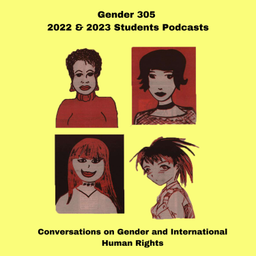
Gender 305 Gender and International Human Rights
Tamara Gonsalves, Students of Gender 305
- 20
- Episodes
- 2024
- First episode
About Gender 305 Gender and International Human Rights
Gender 305 Human Rights Conversation is a podcast by the University of Victoria Gender 305 students of 2022 and 2023. Topics span Abortion Rights, LGBTQ2S+ rights, gender-based discrimination, and gender-based violence through the lens of human rights. Thank you to Tamara Gonsalves and all the students of Gender 305, who have spent much time and effort to educate and bring these critical topics to the community. Tune in weekly for more conversations on human rights and international human rights developments. Music used in the introduction and outro is the track Wonder by respectful child recorded during CFUV's 2017 Basement Closet Session. https://cfuv.bandcamp.com/track/wonderSession
- Publisher
- Tamara Gonsalves, Students of Gender 305
- Category
- education
- Language
- en
- Explicit
- No
- First episode
- 10 Jul 2024
- Latest episode
- 20 Nov 2024
Latest episodes
20 episodes in the feed.
20 Nov 2024
Women in Focus: Human Trafficking in Canada Targeting Marginalized Women
Students and experts discuss how human trafficking in Canada disproportionately affects marginalized women, including Indigenous women, migrants, and 2SLGBTQI+ persons, highlighting the need for awareness and support.
13 Nov 2024
Sex Work in Thailand/ Thai Sex Industry
Summary of the episode: In this episode, students discuss Thailand as an example of how sex workers are treated in the global south. They compare Thailand’s illegal sex work industry to Canada’s, which operates under the Nordic model. We present jarring facts and statistics about the Thai sex industry, like the fact that the Thai sex industry contributes to an estimated 10%-12% of Thailand’s Gross Domestic Product (GDP) (Garrick, 2005). We will take an intersectional feminist approach to discuss different types of sex work protection and how their implementation creates a safer work environment for sex workers. The UN does recommend the nordic model in order to protect sex workers human rights and we will discuss how it would change the sex work industry in Thailand. The sex work industry is inherently gendered; therefore, we are taking a feminist and gender approach in order to fully understand the complexities of the industry. We will also take a decolonial approach to the history of the Thai sex industry to fully comprehend the impacts of the global North imperial project on Thailand. Further materials to be explored on this topic: If our audience wishes to learn more about Thailand’s sex industry after listening to our podcast, our group has found several interesting resources to recommend. First, we recommend Miss Bangkok: Memoirs of a Thai Prostitute by Bua Boonmee and Nicola Pierce. This is about the author's experience of being a Thai sex worker. In addition, we recommend listening to the podcast episode “Exploring Thailand’s Sex Industry” from Sex with Strangers. This episode includes interviews from Thai sex workers as well as interviews from the EMPOWER Foundation, an organization in Thailand dedicated to the education of sex workers and the empowerment of sex workers. Finally, we recommend watching “The Third Gender”, which is a documentary available on YouTube that explores Thailand’s transgender sex workers, which is an important topic that we were unable to discuss in depth. Sources: The Prostitution Problem: C. Benoit, M. Smith, M. Jansson, P. Heally, and D. Magnuson (article) (https://www.google.com/url?q=https://link-springer-com.ezproxy.library.uvic.ca/content/pdf/10.1007/s10508-018-1276-6.pdf&sa=D&source=apps-viewer-frontend&ust=1731550727149769&usg=AOvVaw0UjvOJaBMnIG4CAPaompi0&hl=en) Thailand's sex worker petition to decriminalize prostitution (article) (https://www.google.com/url?q=https://www.reuters.com/article/thailand-law-sexworkers-idINL5N2GJ06C&sa=D&source=apps-viewer-frontend&ust=1731550727149804&usg=AOvVaw3R9T8KKNjlppZtdoMocurG&hl=en) UN Statement to Thailand (2018) (https://www.google.com/url?q=https://www.ohchr.org/en/statements/2018/04/statement-end-visit-thailand-united-nations-working-group-business-and-human&sa=D&source=apps-viewer-frontend&ust=1731550727149813&usg=AOvVaw1iASNX8QPmYsisxHaFZM4P&hl=en) Decriminalize Sex Work - Debunking the Nordic Model (article) (https://decriminalizesex.work/why-decriminalization/briefing-papers/debunking-the-entrapment-model/) Decriminalize Sex Work - Why Decriminalize (article) (https://decriminalizesex.work/why-decriminalization/) Decriminalization vs. Legalization; L. Shrage (article) (https://www.google.com/url?q=https://onlinelibrary-wiley-com.ezproxy.library.uvic.ca/doi/pdfdirect/10.1002/sgp2.12041&sa=D&source=apps-viewer-frontend&ust=1731550727149842&usg=AOvVaw0qJFLzG4PIefUYbpfI2Xt_&hl=en) Why Not Amend CEDAW: L. Baldez (article) (https://genderpolicyreport.umn.edu/why-not-amend-cedaw/) Global Network of Sex Work Projects: Guide to CEDAW (article) (https://www.nswp.org/sites/default/files/smart_guide_to_cedaw_-_nswp_2018_0.pdf) Amnesty International publishes policy and research on protection of sex workers' rights (article) (https://www.amnesty.org/en/latest/news/2016/05/amnesty-international-publishes-policy-and-research-on-protection-of-sex-workers-rights/) Convention for the Suppression of the Traffic in Persons and of the Exploitation of the Prostitution of Others (1949) (https://www.ohchr.org/en/instruments-mechanisms/instruments/convention-suppression-traffic-persons-and-exploitation) Convention on the Elimination of All Forms of Discrimination against Women (1979) (https://www.ohchr.org/en/instruments-mechanisms/instruments/convention-elimination-all-forms-discrimination-against-women) Convention for the Suppression of the Trafficking in Persons and of the Exploitation of the Prostitution of Others (1950) (https://www.ohchr.org/en/instruments-mechanisms/instruments/convention-suppression-traffic-persons-and-exploitation) Brown, G. D. A., Lewandowsky, S., & Huang, Z. (2022). Social sampling and expressed attitudes: Authenticity preference and social extremeness aversion lead to social norm effects and polarization. Psychological Review, 129(1), 18–48. https://doi-org.ezproxy.library.uvic.ca/10.1037/rev0000342.supp (https://supp.apa.org/psycarticles/supplemental/rev0000342/rev0000342_supp.html)(Supplemental) ExodusCryKC. (2020, March 13). Prostitution in Thailand | nefarious documentary clip. YouTube. Retrieved November 22, 2022, from https://www.youtube.com/watch?v=iIJ9dxtiv3g (https://www.youtube.com/watch?v=iIJ9dxtiv3g) Jamnarnwej, W. (n.d.). Family law of Thailand. Thailand Law Forum: Family law of Thailand. Retrieved November 23, 2022, from http://thailawforum.com/articles/familywimol2.html (http://thailawforum.com/articles/familywimol2.html) OUYYANONT, P. (2012). Underdevelopment and Industrialisation in Pre-War Thailand. Australian Economic History Review, 52(1), 43–60. https://doi-org.ezproxy.library.uvic.ca/10.1111/j.1467-8446.2012.00340.x (https://doi-org.ezproxy.library.uvic.ca/10.1111/j.1467-8446.2012.00340.x) REYES, C. A. Z. Z. I. E. (n.d.). History of prostitution and sex trafficking in Thailand. End Slavery Now. Retrieved November 23, 2022, from https://www.endslaverynow.org/blog/articles/history-of-prostitution-and-sex-trafficking-in-thailand (https://www.endslaverynow.org/blog/articles/history-of-prostitution-and-sex-trafficking-in-thailand) T. (2022, May 10). Thailand's sex industry - A brief history. Thaiger. Retrieved November 22, 2022, from https://thethaiger.com/video-podcasts/thailands-sex-industry-thaiger-stories (https://thethaiger.com/video-podcasts/thailands-sex-industry-thaiger-stories) Thailand. Hofstede Insights. (n.d.). Retrieved November 23, 2022, from https://www.hofstede-insights.com/country/thailand/#:~:text=With%20a%20score%20of%202 0%20Thailand%20is%20a%20highly%20collectivist%20country (https://www.hofstede-insights.com/country/thailand/#:~:text=With%20a%20score%20of%202%200%20Thailand%20is%20a%20highly%20collectivist%20country). Walker, W. C. (n.d.). Contagion how the sian RISIS pread - asian development bank. Asian Development Bank. Retrieved November 24, 2022, from https://aric.adb.org/pdf/edrcbn/edrcbn03.pdf (https://aric.adb.org/pdf/edrcbn/edrcbn03.pdf) Journal, T. A. P. (12AD). Military prostitution and the U.S. military in Asia. The Asia-Pacific Journal: Japan Focus. Retrieved November 23, 2022, from https://apjjf.org/-Katharine-H.S.-Moon/3019/article.html (https://apjjf.org/-Katharine-H.S.-Moon/3019/article.html) PGTVPhuket. (2022, May 10). Thailand's sex industry - A brief history. YouTube. Retrieved November 23, 2022, from https://www.youtube.com/watch?v=Lzp145ImERM (https://www.youtube.com/watch?v=Lzp145ImERM) U.S. Department of State. (2022, July 9). The United States...
6 Nov 2024
Gender-Based Violence: Where are the Laws Protecting Women in War?
This podcast discusses gender-based violence against women in war-time, using the war in Ethiopia as an example. On 4 November 2020, war erupted in the Tigray, the war in Tigray resulted in a massive humanitarian crisis. Preliminary reports have shown that Tigrayan women and girls have experienced deliberate and organized widespread war-related gender-based violence, in which some were subjected to severe violence including gang-raping, and the insertion of foreign objects to their reproductive organs. According to the report of the Human Rights Watch (HRW), 2,204 survivors sought services for sexual violence at health facilities across Tigray. More than 10 thousand women and girls were victims of gender-based violence. Gender-based violence disproportionately impacts women and girls in violent conflict. Conflict can lead to higher rates of gender-based violence, such as arbitrary executions, torture, sexual assault, and forced marriages against women and girls. Sexual violence, including using it as a weapon of war, increasingly targets women and girls as its primary targets. Conflicts and unstable conditions worsen pre-existing discrimination practices against women and girls, putting them at greater risk for human rights abuses. Increased gender-based violence is a result of the general breakdown of the rule of law, the availability of small arms, the breakdown of social and family structures, and the "normalization" of gender-based violence as an additional component of pre-existing discrimination in conflict and post-conflict zones. Following a report in March of 2021 of persistent reports of grave human rights violations in Tigray, Ethiopia, the UN called for pointed urgent action to stop violence against women in the Tigray war in December of 2021. Despite this, little action has been taken and the abuse persists. The Ethiopian human rights commission-organization of the high commissioner of human rights released a joint report on the abuses, ensuring that victims would have the full support of the Ethiopian government and perpetrators would be brought to justice, with 2,204 women reporting abuses and many more going unreported. The report described women being raped in both rural and urban areas, in places of residence and shelter for the purpose of information extraction or revenge. This topic is linked to a history of female oppression in times of war and the fight against this, from the implementation of the Universal declaration of human rights following world war II and its evolvement as well as effectiveness to the Vienna declaration. Students explore classic feminist scholarship, such as Mackinnon’s argument that perpetrators use rape and forced reproduction with the purpose of forced ethnic cleansing due to ethnic aggression, with rape as a form of genocide projected on women. The term "violence against women" means any act of gender-based violence that results in, or is likely to result in, physical, sexual, or psychological harm or suffering to women, including threats of such acts, coercion or arbitrary deprivation of liberty, whether occurring in public or in private life. (Article 1). There are no geographic, cultural, societal, economic, or other limitations on sexual and gender-based violence against women and girls. It is a sort of violence committed because of gender disparities. Sexual and gender-based violence associated with war has a profoundly damaging impact on society both during and after a conflict. In an armed conflict situation, women are frequently the victims of widespread acts of sexual and gender-based abuse. In other words, women and girls are disproportionately targeted in conflicts, routinely raped, threatened, sexually and physically mistreated, coerced into having unwanted pregnancies, and/or killed. Globally, war-related sexual violence and violations of human rights are still common. During a conflict woman often experience violence, forced pregnancy, abduction, sexual abuse and slavery. Although the United Nation has designated Sexual and gender-based violence as war crimes in Article 8 of the Rome Statute of the International Criminal Court, the situation of women in armed conflicts has been systematically neglected. Women's rights were significantly impacted by the suppression of dissent and conflicting approaches to human rights. References: Fisseha, G., Gebrehiwot, T. G., Gebremichael, M. W., Wahdey, S., Meles, G. G., Gezae, K. E., Legesse, A. Y., Asgedom, A. A., Tsadik, M., Woldemichael, A., Gebreyesus, A., Abebe, H. T., Haile, Y. A., Gezahegn, S., Aregawi, M., Berhane, K. T., Godefay, H., & Mulugeta, A. (2023). War-related sexual and gender-based violence in Tigray, Northern Ethiopia: a community-based study. BMJ Global Health, 8(7), e010270–. https://doi.org/10.1136/bmjgh-2022-010270 (https://doi.org/10.1136/bmjgh-2022-010270) What we do: Peace and security | UN Women – Headquarters Corradi, C., Marcuello-Servós, C., Boira, S., & Weil, S. (2016). Theories of femicide and their significance for social research. Current Sociology, 64(7), 975–995. https://doi.org/10.1177/0011392115622256 (https://doi.org/10.1177/0011392115622256) Accountability as Prevention, Ending Cycles of Sexual Violence in Conflict (Women and peace and security) - Security Council, 9016th Meeting | UN Web TV2 https://media.un.org/en/asset/k1d/k1dwkjiigx (https://media.un.org/en/asset/k1d/k1dwkjiigx) https://www.unwomen.org/sites/default/files/Headquarters/Attachments/Sections/Library/ Publications/2013/12/UN%20Women%20EVAW-ThemBrief_US-web-Rev9%20pdf.pdf (https://www.unwomen.org/sites/default/files/Headquarters/Attachments/Sections/Library/%20Publications/2013/12/UN%20Women%20EVAW-ThemBrief_US-web-Rev9%20pdf.pdf) Maphosa, R. (2021). The unreported war: tackling denialism and social stigma towards victims of armed conflict-related sexual and gender based violence. Stellenbosch Law Review, 32(1), 155–168. https://doi.org/10.47348/SLR/v32/i1a7 (https://doi.org/10.47348/SLR/v32/i1a7)
Contact Gender 305 Gender and International Human Rights
- Guest appearances
- Books guests
Based on episode analysis; this does not confirm that the show is currently accepting guests.
Host of Gender 305 Gender and International Human Rights ?
Claim your podcast to manage its listing and keep your show details accurate.
Pod Engine is an independent podcast discovery and analytics service and is not affiliated with or endorsed by this podcast. Artwork and show content belong to their owners. Full legal notice.
Explore this show
Podcast research with Pod Engine