- 10
- Episodes
- Daily
- Cadence
- 2026
- First episode
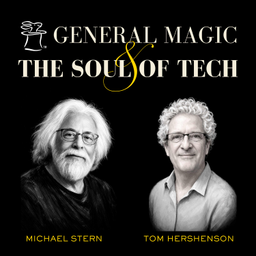
About General Magic & The Soul of Tech
Our documentary told the story of General Magic—the most influential tech company you’ve never heard of. Now, we’re exploring the lessons it left behind and what they reveal about the future of technology, culture, and human ambition. spellboundproductions.substack.com (https://spellboundproductions.substack.com?utm_medium=podcast)
- Publisher
- Michael Stern
- Category
- society & culture · technology
- Language
- en
- Explicit
- No
- First episode
- 29 Jun 2026
- Latest episode
- 7 Oct 2026
Latest episodes
10 episodes in the feed.
7 Oct 2026
Ep. 10 | The Internet’s Last True Believer Defends Section 230 | Eric Goldman
Our guest, Eric Goldman, professor and Associate Dean for Research at Santa Clara University School of Law, was dubbed The Internet’s Last True Believer (https://magazine.scu.edu/magazines/2023/spring-2023/the-internets-last-true-believer/) in a Santa Clara Magazine profile in 2023. Eric Goldman has spent three decades in internet law as a Cooley associate, a general counsel, and now a professor and Associate Dean at Santa Clara University School of Law. He is one of the leading authorities on Section 230, the 1996 law that says websites aren’t liable for their users’ content. He is also one of the last people still making the case for the open internet he fell in love with in the early 1990s. Mike and Hersh came to this conversation with strong views on age gating, platform liability and regulating social media. Eric took them apart, politely and with rigor. He explains what Section 230 (https://en.wikipedia.org/wiki/Section_230) really does, why he doesn’t buy the claim that platforms are “intentionally designed to cause harm,” and the five ways age authentication online is different from checking ID at a liquor store. He argues that regulators reach for the light switch (ban it or leave it) when they should be looking at the dimmer, and he warns that the real threat to generative AI is the government deciding what chatbots are allowed to say. It is also a conversation about how the General Magic generation’s faith in technology has aged. Eric talks about how his own view has changed: a clearer sense of why the rule of law matters, a lost presumption of good faith in tech companies, and a classroom in which half his Gen Z students would turn shut internet down if they could. Along the way: what he learned from the Trust & Safety community he helped build, why he bristles at the term “surveillance capitalism,” and the bumper sticker on his desk. In this episode * 01:10 – What is Section 230? Why Congress passed it in 1996, and how it let services host conversations without being liable for them * 03:05 – The printing-press analogy, and why publishing other people’s content was risky for centuries * 04:10 – The two choices without Section 230: a cesspool or publishers exit * 05:01 – Mike’s challenge: after 30 years, is it time to retire Section 230? Platforms, harm by design and the Meta trials * 06:23 – Eric pushes back: Section 230 isn’t what is holding back those lawsuits, and “product marketing” isn’t the same as designing to harm * 07:30 – The tobacco comparison, teenagers and body image, and Meta facing competing groups of users * 09:03 – Can a technology be neutral? Hersh’s “kinder, gentler gun,” and how to think about AI’s likely social effects * 10:18 – Eric’s scissors example, the limits of what technology makers can fix, and why the answer is “why not both?” * 12:54 – “Generative AI Is Doomed”: why the biggest threat is partisan control of what chatbots say * 15:53 – Mike asks about age gating: we restrict cars, voting and alcohol by age, so why not AI? * 16:21 – Eric’s five differences between online and offline age authentication: privacy, security, friction, cost and surveillance, plus the First Amendment * 21:07 – What’s on the other side of the scale? Teaching kids to cross the “digital street” (danah boyd’ (https://www.danah.org)s analogy), and a detour into jaywalking laws * 24:01 – Can anyone test Section 230’s absence? What the rest of the world’s internet tells us * 26:14 – “Content Moderation Remedies”: think of a dimmer, not an on/off switch, and why governments reach for bans * 29:10 – Financial consequences inside platforms, and how demonetization works * 31:10 – Has Eric changed his mind? The rule of law, the end of presumed good faith in tech companies, and General Magic * 33:49 – His Gen Z students: half would switch off the internet, and many arrive anti-AI * 35:36 – How Eric actually uses generative AI, and Mike’s PowerPoint experiment * 37:22 – Hersh’s profanity rule and the bumper sticker on Eric’s desk * 38:31 – Why Eric doesn’t do much policy work anymore, and the Trust & Safety Professional Association * 39:44 – His nightmare outcome: governments using AI to lie, and the DOGE example * 40:44 – “Surveillance capitalism” or just capitalism? A closing disagreement, and a thank-you from an old Cooley colleague About Eric Goldman Eric Goldman is a professor and Associate Dean for Research at Santa Clara University School of Law, where he also co-directs the Datta Center for High Tech Law. His work focuses on internet law, intellectual property and advertising and marketing law. He earned a JD-MBA from UCLA in 1994 and got his first email account in 1991, which he calls the moment his “mind got blown.” He practiced at Cooley Godward, where he built an internet law practice during the dot-com boom, and was general counsel at Epinions before teaching at Marquette University Law School (from 2002) and joining Santa Clara in 2006. He is widely regarded as one of the leading authorities on Section 230 of the Communications Decency Act. He has testified before Congress and state legislatures, filed amicus briefs in Supreme Court cases including Gonzalez v. Googleand Twitter v. Taamneh, and helped create the Santa Clara Principles on content moderation. He also helped found the Trust & Safety Professional Association and the Trust & Safety Foundation in 2020. He writes about internet law several times a week at blog.ericgoldman.org and describes himself as a “cyber-libertarian,” a view he says has “gone virtually extinct.” Santa Clara Magazine profiled him in 2023 as “The Internet’s Last True Believer.” Resources & Links * Personal website: https://www.ericgoldman.org (https://www.ericgoldman.org/) * Blog (internet law analysis, several posts a week): https://blog.ericgoldman.org (https://blog.ericgoldman.org) * Eric on Bluesky: https://bsky.app/profile/ericgoldman.bsky.social (https://bsky.app/profile/ericgoldman.bsky.social) * Santa Clara Magazine profile, “The Internet’s Last True Believer” (2023): https://magazine.scu.edu/magazines/2023/spring-2023/the-internets-last-true-believer/ (https://magazine.scu.edu/magazines/2023/spring-2023/the-internets-last-true-believer/) Papers and Law Discussed * “Generative AI Is Doomed” (SSRN): https://papers.ssrn.com/sol3/papers.cfm?abstract_id=4802313 (https://papers.ssrn.com/sol3/papers.cfm?abstract_id=4802313) * “Generative AI Is Doomed” (published version, Marquette Intellectual Property & Innovation Law Review, 2025): https://scholarship.law.marquette.edu/cgi/viewcontent.cgi?article=1069&context=ipilr (https://scholarship.law.marquette.edu/cgi/viewcontent.cgi?article=1069&context=ipilr) * “Content Moderation Remedies” (Michigan Technology Law Review, 2021): https://repository.law.umich.edu/mtlr/vol28/iss1/2/ (https://repository.law.umich.edu/mtlr/vol28/iss1/2/) * Section 230 of the Communications Decency Act (47 U.S.C. § 230): https://www.law.cornell.edu/uscode/text/47/230 (https://www.law.cornell.edu/uscode/text/47/230) * Careless People by Sarah Wynn-Williams: https://us.macmillan.com/books/9781250391230/carelesspeople/ (https://us.macmillan.com/books/9781250391230/carelesspeople/) * danah boyd (the “cross the street” analogy): https://www.danah.org (https://www.danah.org) Eric’s work * Trust & Safety Professional Association (TSPA): https://www.tspa.org (https://www.tspa.org) * Trust & Safety Foundation (TSF): https://www.tsf.foundation (https://www.tsf.foundation) Keywords Eric Goldman, Section 230, Communications Decency Act, internet law, age verification, age gating, content moderation, platform liability, generative AI regulation, free speech, First Amendment, Trust and Safety, Santa Clara Law, cyber-libertarian, social media regulation, General Magic, Michael Stern This is a public episode. If you would like to discuss this with other subscribers or get access to bonus episodes, visit spellboundproductions.substack.com (https://spellboundproductions.substack.com?utm_medium=podcast&utm_campaign=CTA_1)
30 Sept 2026
Ep. 9 | Unintended Consequences: Taking Responsibility for What We Build | Tony Fadell
At General Magic, we naively believed that if we built elegant tools and put them in people’s hands, the rest would take care of itself. Tony Fadell was there at the beginning, a young engineer with an uncommon gift for making technology disappear into the life of the person holding it, and he went on to help build the iPod, the iPhone, and Nest. So when he says that every barrier to our vision has since been knocked down—“the pipes are open and they’re flooding right to your eyeballs and your fingertips”—he is describing a demolition he took part in. He does not flinch from that. He calls what followed a frictionless flow of everything, for better and for worse, and he declines to pretend the worse was an accident. What distinguishes this conversation is where Tony locates the failure: not in a few bad actors, but in structure. Cars became safe when government forced the issue and people had stopped dying; a hands-off posture toward AI and social media is an abdication, and the missing ingredient is political will, in a system where money decides whose voice is heard. He sees the next trap plainly. Consumers will not pay $30 a month for an AI assistant, which means the business model will drift, as it did before, toward ads and data, and we will once again be the product. He also says what few of his peers will say aloud: that the centi-billionaires who now set the tone for an entire industry have forgotten the society and its ethical norms which made their fortunes possible, and that Fortune 500 CEOs, once answerable to their employees and to the outside world, now seem answerable to no one. The phrase that stuck with us is cognitive surrender. Tony describes people who supervise a hundred software agents but end up like quality-control workers on an Amazon conveyor, moving bins from one machine to the next, at the speed of the system rather than the speed of humans, until the craft is gone and burnout is all that remains. There is grief in that image—the ache of watching work that once carried a person’s whole attention reduced to throughput. His solution is modest and historically grounded: Microsoft once sent salespeople to sit across from customers who disliked the company, because it is very hard to hate someone face to face. Build technology that gathers people in person and amplifies what they say. Put the phone down at dinner. Back only companies that make the world a better place. Tony admits he feels alone in this, a humanistic technologist in a Valley that has moved on. The unedited episode of our interview with Tony is on YouTube. This post is public so feel free to share it. In this episode * 01:10 – The remorse question: as one of the architects of today’s technology immersion, what does he want to prevent this time? * 01:43 – Unintended consequences: from splitting the atom to the smartphone platform, why creators must “be the voice of reason,” and why app stores should do age gating * 04:59 – Privacy as a selling point, giving families real tools, and why trusted identity matters in the age of AI * 06:44 – Safe cars took government. What about AI? Rule-making in China and why “hands off” isn’t the answer * 08:13 – What Build Collective (https://www.buildc.com/) invests in: clean farms, fusion energy, AI plus recycling, AI plus textiles, and what it won’t touch * 10:00 – Is there a straight line from General Magic to today? Why users were never “the product,” and how kids and the climate crisis deepened his view * 12:03 – The iPod, the Walkman and the personal sound bubble * 14:03 – Analog vs. digital convenience vs. digital connectivity, and how the iPhone became a “notifications engine” * 16:49 – In Build (https://www.buildc.com/the-book): from Nest CEO to Google, and the culture clash * 19:39 – Near-death experiences from General Magic through Philips to Apple and Nest, and why he calls himself “Tony 4.0” * 20:29 – Founders around the world: what changes from India to Thailand, and why local talent and right-sized technology matter * 22:46 – Moving his family to Indonesia: a “long vacation from tech” that wasn’t * 23:44 – The App Store’s genesis: General Magic apps, Steve Jarrett, Philips’s Velo and Nino, and electronic distribution over a phone line * 27:07 – Will consumers pay for AI assistants? Why he worries the answer is ads and “you’re gonna be the product again” * 29:25 – Where AI works: domain-specific tools in drug discovery at Orionis Biosciences (https://www.orionisbio.com/) and why experienced humans stay in the loop * 32:24 – His biggest AI worry: “cognitive surrender” * 34:54 – AI and education: the New York Times story about a Stanford grad, and what he hears teaching at MIT * 36:08 – Does he feel alone as a humanistic technologist? The “centi-billionaires” and who today’s heroes are * 39:34 – Reasons for hope: up-and-comers in London, Paris and San Francisco, including the Stripe (https://stripe.com/) Collison brothers * 40:22 – Why he’d make a bad politician, and a General Magic story about a four-day infrared data-protocol committee * 41:21 – What government could do about social media: age gating across states, federal standards, and why voters over 65 “control everything” * 44:26 – Why having kids is an inflection point, and how younger voters can find their voice sooner * 45:43 – Can technology make us kinder? Physical interaction, the Microsoft salespeople story, and Deb Roy’s small-group project at MIT * 48:07 – Tony’s digital habits: phones away from the table, and the case for “nutritional facts” for digital consumption About Tony Fadell Tony Fadell joined General Magic in December 1991 as a hardware/software systems architect straight out of the University of Michigan (B.S. Computer Engineering, 1991), where he built the Magic Bus peripheral-bus technology. After taking his product concepts to Philips and a startup that ran out of funding, he went to Apple in 2001 to lead iPod development, became SVP of the iPod division, and led iPhone hardware, firmware and accessories through its first three generations. In 2010 he co-founded Nest Labs with Matt Rogers, creating the Nest Learning Thermostat and Nest Protect; Google acquired the company for $3.2 billion in 2014. Today he is a principal at Build Collective, which invests in and advises deep-tech startups — in this conversation, companies working on clean farming, fusion energy, and AI applied to recycling, textiles and healthcare. He is the author of Build: An Unorthodox Guide to Making Things Worth Making (2022), a frequent speaker on AI, hardware and product culture, and a Designer in Residence at MIT. Resources & Links * Tony on LinkedIn: https://www.linkedin.com/in/tonyfadell/ * Tony's book: https://www.buildc.com/the-book * Build Collective: https://www.buildc.com * Wikipedia biography: https://en.wikipedia.org/wiki/Tony_Fadell * Orionis Biosciences: https://www.orionisbio.com * An Inconvenient Truth (2006 film, Al Gore): https://en.wikipedia.org/wiki/An_Inconvenient_Truth * Tim Ferriss interview (2019): https://tim.blog/2019/12/23/tony-fadell/ * Wisdom 2.0 with Anderson Cooper (2017), "Take Control of Your Digital Life": * CogX 2024 Leadership Summit keynote on AI: This is a public episode. If you would like to discuss this with other subscribers or get access to bonus episodes, visit spellboundproductions.substack.com (https://spellboundproductions.substack.com?utm_medium=podcast&utm_campaign=CTA_1)
18 Sept 2026
Ep. 8 | From General Magic Idealism to the White House | Megan Smith
Before she was Employee #12 at General Magic, Megan Smith grew up in Buffalo, studied mechanical engineering at MIT, and was working in Tokyo on multimedia projects for Apple Japan when a chance meeting with Bill Atkinson brought her into the company building the first mobile communication devices. She went on to an eleven-year run at Google — leading the acquisitions of Google Earth and Google Maps — before President Obama appointed her the third Chief Technology Officer of the United States in 2014. In this conversation with Mike and Hersh, Megan makes the case for an optimism she’s carried since General Magic: that the world’s hardest problems — climate, AI safety, equity in tech — don’t get solved by any one person or technology, but by connecting the right people to each other. She traces that thread from General Magic’s apprentice-journey-mastery culture through her civic-tech company Shift7 and its “Scout & Scale” approach, the UN Sustainable Development Goals Solutions Summit’, and a career-long rule borrowed from Diane von Furstenberg. Along the way, she reflects on the erasure of women like Ada Lovelace and Grace Hopper from computing history, revisits the safety-first design philosophy behind Telescript’s agentic design in the 1990s, and debates what it would take to build “kindness by design” into today’s AI. In this episode * 01:29 – “Go where there’s tons of us, and go where you’re rare” — the 2015 MIT commencement advice behind her civic-tech focus; Shift7 and her board work (Think of Us, Planet Read, Earth Conservation Corps, MIT, LA28) * 04:31 – The “three-layer cake” of policy, law, and tech innovation; President Obama, the Army Corps of Engineers, and the history of science advisors in government * 06:57 – Why “harder than self-driving cars” problems don’t get tech’s top talent * 09:02 – What General Magic — Steve Jobs’s original Mac team gone mobile — taught her about apprentice-journey-mastery; the original vision for a “dashboard” device vs. today’s attention economy; the Google Earth/Maps acquisitions and the Mapmaker crowdsourcing story * 14:53 – Weighing models for AI regulation * 15:17 – Dr. Joy Buolamwini, Gender Shades, and the Algorithmic Justice League; ROOST and open child-safety tools * 17:12 – Telescript’s “should we?” vs. AI’s “can we?” — picking up the design-philosophy thread from the Rich Miller episode * 18:20 – AI companions, “aggregated” intelligence, and Megan’s “Scout & Scale” approach * 23:00 – The UN Sustainable Development Goals Solutions Summit: 800 submissions from 131 countries * 25:45 – Remembering mentor Wendell Sanders and General Magic’s first hardware team * 27:44 – Stanford, venture capital, and the fight for the university’s civic mission * 30:11 – The American Research Enterprise, teaching kids to “cook” with electronics, and pioneering environmental scientist Ellen Swallow Richards * 35:24 – Early AOL, Steve Case, and the quilters who met through chat rooms; her own time running PlanetOut * 41:17 – “Kindness by design,” Pope Leo XIV, and Cathy O’Neil’s Weapons of Math Destruction * 41:58 – The Blueprint for an AI Bill of Rights and colleague Alexander Macgillivray * 43:22 – The grassroots data-center backlash, and watching Texas’s ERCOT grid run on solar * 46:36 – Women erased from tech history: Bletchley Park, ENIAC’s six programmers, Grace Hopper, and Ada Lovelace’s hidden signature “A.A.L.” * 50:08 – Her trajectory from Employee #12 at 23 to U.S. CTO * 50:20 – Diane von Furstenberg’s rule: Connect two people every day About Megan Smith Megan Smith joined General Magic in 1990 as Employee #12, recruited by Bill Atkinson and Marc Porat after a chance meeting in Tokyo, and served as VP of New Business Development — as well as a product design manager and hardware partnerships manager — on the team building some of the first mobile communication devices. She holds a B.S. in Mechanical Engineering (1986) and an S.M. from the MIT Media Lab (1988). After General Magic, she was CEO of PlanetOut in the late 1990s, then spent 1999–2014 at Google, where she led the acquisitions of Google Earth, Google Maps, and Picasa, served as VP of Google X, and ran Google.org. In 2014, President Obama appointed her the third Chief Technology Officer of the United States, where she focused on data-driven policy, STEM equity, and broadband access. Today she is founder and CEO of Shift7, a civic-tech company connecting technologists to systemic social and environmental problems, and she serves on the boards of MIT and Vital Voices. Her career traces the arc from General Magic’s idealism to Silicon Valley scale to public service — and reflects a lifelong effort to make sure women’s contributions to technology, including her own, are not written out of the record. Resources & Links * Megan Smith on LinkedIn: https://www.linkedin.com/in/msmith21 (https://www.linkedin.com/in/msmith21) * Obama White House bio: https://obamawhitehouse.archives.gov/administration/eop/ostp/about/leadershipstaff/smith/ (https://obamawhitehouse.archives.gov/administration/eop/ostp/about/leadershipstaff/smith/) * Shift7: https://shift7.com (https://shift7.com) * Think of Us (foster-care tech innovation): https://www.thinkofus.org/ (https://www.thinkofus.org/) * Planet Read (same-language subtitling for literacy): https://www.planetread.org/ (https://www.planetread.org/) * Earth Conservation Corps (Washington, DC): https://www.earthconservationcorps.org/ (https://www.earthconservationcorps.org/) * LA28 (Los Angeles Olympic & Paralympic Games): https://la28.org/ (https://la28.org/) * MIT Solve: https://solve.mit.edu/ (https://solve.mit.edu/) * Journey to Lead (women’s leadership network — Megan Smith is a listed “Champion”): https://journeytolead.org/ (https://journeytolead.org/) * Vital Voices Global Partnership: https://www.vitalvoices.org/ (https://www.vitalvoices.org/) * Entrepreneurship for All (E for All): https://eforall.org/ (https://eforall.org/) * 99Degrees Custom (Lowell/Lawrence, MA apparel manufacturer referenced as an E for All success story): https://www.rsiapparel.com/99-degrees/ (https://www.rsiapparel.com/99-degrees/) * PlanetOut — the LGBT online media company Megan led in the late 1990s; the company was acquired and dissolved in the 2000s (merged into Here Media): https://en.wikipedia.org/wiki/PlanetOut (https://en.wikipedia.org/wiki/PlanetOut) * Future of Privacy Forum (source of the 2017 AI-harms taxonomy): https://fpf.org/ (https://fpf.org/) * Algorithmic Justice League: https://www.ajl.org/ (https://www.ajl.org/) * Gender Shades (Joy Buolamwini’s research project): http://gendershades.org/ (http://gendershades.org/) * ROOST (Robust Open Online Safety Tools): https://roost.tools/ (https://roost.tools/) * United Nations Sustainable Development Goals / SDG Solutions Summit: https://sdgs.un.org/ (https://sdgs.un.org/) * ColdHubs (solar-powered cold storage, Nigeria — cited as a Solutions Summit submission): https://coldhubs.com/ (https://coldhubs.com/) * Cathy O’Neil / Weapons of Math Destruction: https://www.penguinrandomhouse.com/books/241363/weapons-of-math-destruction-by-cathy-oneil/ (https://www.penguinrandomhouse.com/books/241363/weapons-of-math-destruction-by-cathy-oneil/) * Blueprint for an AI Bill of Rights (White House OSTP, 2022): https://digitalgovernmenthub.org/library/blueprint-for-an-ai-bill-of-rights/ (https://digitalgovernmenthub.org/library/blueprint-for-an-ai-bill-of-rights/) * ERCOT (Electric Reliability Council of Texas): https://www.ercot.com/ (https://www.ercot.com/) * Bletchley Park (WWII codebreaking, home of the Colossus): https://www.bletchleypark.org.uk/ (https://www.bletchleypark.org.uk/) * University of Pennsylvania (built the ENIAC): https://www.upenn.edu/ (https://www.upenn.edu/) * NVIDIA chips names after women in Tech: https://www.nvidia.com/ (https://www.tradingview.com/news/invezz:27404c2f1094b:0-a-list-of-nvidia-chips-named-after-women-in-science/) This is a public episode. If you would like to discuss this with other subscribers or get access to bonus episodes, visit spellboundproductions.substack.com (https://spellboundproductions.substack.com?utm_medium=podcast&utm_campaign=CTA_1)
25 Aug 2026
Ep. 7 | The Agent Safety Architecture We Abandoned | Rich Miller
What do you get when you cross a New Mexico cowboy with the early days of email and telecommunications? Answer: Rich Miller, one of the OGs of email and, with his colleague and close friend Jim White, the force behind General Magic’s communications language, Telescript. Amidst today’s talk of agentic AI, Rich Miller recollects the original agentic concept and how, from the start, safety considerations like identification, authentication, and authorization were front and center rather than relegated to the “we’ll fix it in post” attitude rife among today’s purveyors of a new class of agents. Rich is measured and thoughtful yet does not mince words. “The notion of complete autonomy of agents is a recipe for a disaster and how big a disaster is the only question.” He offers a nuanced approach for heading off the worst possibilities, discussing considerations across economics, public policy, legal frameworks, and more. So, saddle up for a deep dive into the deep issues at the heart of whether a technology will ultimately serve us well or run amok. Show notes Before Rich Miller was CEO of Telematica and Executive Chairman of Provenant Data, he spent roughly fifteen years building electronic mail into a real industry — running early ARPANET messaging work at Infomedia Corporation, serving as Chairman of the Electronic Mail Association, and representing the U.S. as a delegate to the international CCITT standards body. That’s the résumé he brought to General Magic in 1990 as VP of Strategic Partners, where he and his longtime collaborator Jim White architected Telescript, the agent-based network technology GM built years before “agentic AI” was a phrase anyone used. Telescript didn’t just let software agents travel across a network to act on your behalf — it fenced them in: agents needed explicit credentials, defined authorities, and permits before they could do anything, with the guardrails built in from day one rather than bolted on after the fact. In this conversation, recorded after the passing of Jim White — Telescript’s co-architect and, by Rich’s account, its moral center — Rich joins Michael Stern and Tom “Hersh” Hershenson to walk through how Telescript worked, why AT&T forced General Magic to build for safety before scale, and why he believes the AI industry is now rebuilding what Telescript already had, minus the accountability — plus what he’s building now at Provenant Data to give AI a memory of where its facts actually came from. In this episode * 01:35 – Rich Miller’s path: ARPANET messaging, chairing the Electronic Mail Association, and building email into an industry — plus the MagicCap vs. Telescript culture divide inside General Magic * 05:33 – Jim White — Telescript’s co-architect and moral center, remembered in detail * 08:47 – What is Telescript? The PostScript analogy for sending intent to an “engine” * 10:49 – Software agents in the wild — the 1994 travel-booking use case * 13:35 – Deterministic safety-by-design vs. today’s constrain-after-the-fact approach * 18:11 – The “architect of spam” & lessons from early email standards * 19:35 – Constitutional AI, alignment, and human-in-the-loop for autonomous systems * 23:24 – AT&T’s enforced guardrails as a model for accountable infrastructure * 30:59 – Governance, treaties, and who pays for AI’s externalities * 36:01 – Provenant Data and the case for data lineage and provenance in AI * 44:33 – Closing reflections & remembering Jim White About Rich Miller Rich Miller spent roughly 15 years building electronic mail into an industry — at Infomedia Corporation on early ARPANET messaging, as Chairman of the Electronic Mail Association, and as a U.S. delegate to the CCITT standards body — before co-founding Rapport Communication with Jim White and Ted Myer, where Telescript was conceived. He joined General Magic in 1990, building the AT&T PersonaLink service and the NTT Japan partnership. Today he is CEO of Telematica and Executive Chairman of Provenant Data, writing publicly about the parallels between Telescript’s agent-safety architecture and the unconstrained rise of agentic AI. About Jim White Jim White co-founded Rapport Communication with Rich Miller and Ted Myer in the late 1980s and, with Rich, conceived Telescript — the agent-based network technology that General Magic built years ahead of its time. White brought the deep network-architecture thinking behind Telescript’s PostScript-inspired design and its built-in safety model, work that remains sparsely documented online despite its influence on what would later become agentic AI. He passed away in March 2025. Rich considers him Telescript’s moral center, and this episode is in part an effort to put Jim White’s contribution on the record. Resources & Links * Rich Miller on LinkedIn: https://www.linkedin.com/in/richmiller * Pender Fund podcast, “Technology Disruption: A Front Row Seat” (2018): https://penderfund.com/fr/podcasts/technology-disruption-a-front-row-seat/ * Jim White tribute / Telescript retrospective: https://www.linkedin.com/pulse/should-we-tell-them-telescript-generalmagic-legacy-dopmc As always, our full, unedited interview appears on YouTube (link below) and our audio-only version is at the top of this post and pushes to Spotify and Apple Podcasts as well. If you are enjoying our week, please share this podcast liberally. Thanks for listening to General Magic & The Soul of Tech! Subscribe for free to receive new posts and support our work. This is a public episode. If you would like to discuss this with other subscribers or get access to bonus episodes, visit spellboundproductions.substack.com (https://spellboundproductions.substack.com?utm_medium=podcast&utm_campaign=CTA_1)
11 Aug 2026
Ep. 6 | Superintelligence, Fusion, and Faith | Marc Porat
Our special guest for Episode 6 is one of Silicon Valley’s most influential and persuasive visionaries. Marc Porat’s Ph.D. thesis at Stanford created the very definition of what he called the Information Society, predicting with startling accuracy how data was to become the oil of the post-industrial economy. Marc joined Apple from the Aspen Institute in 1989, tasked with charting the company’s path into the post-destktop computing future. He did far more than that. With Bill Atkinson and Andy Hertzfeld, co-creators of the Macintosh, he founded General Magic, which Apple spun out jn 1990 to create what became the first smartphone. But Magic was the incubator for far more than just a mobile communication device. Marc’s farseeing vision embraced the entire ecosystem of social, mobile, anytime, anywhere communication, smart networks hosting software agents, app stores, digital currency and ecommerce that we now take for granted 35 years later as the infrastructure of our daily lives. Hersh and I talk with Marc about what sort of future he now envisions as the age of AI dawns. In his usual dexterous fashion, Marc honors both AI’s potential dystopian impact as a destroyer of employment and human ingenuity and augmenter of authoritarianism and its promise of abundance as a cognitive amplifier and enabler of new forms of human creativity and democratized wealth creation. The three of us worked together at Magic, and it’s a pleasure to reconnect to speculate on what the emergent AI revolution portends. As always, the uncut episode is on YouTube (below) and the edited version, audio-only, is here on Substack, on Apple Podcasts, and on Spotify. Subscribe for free to instantly receive notifications of new podcast episodes. Episode Description Marc Porat is the original smartphone visionary — he co-founded General Magic in 1990 and dreamed up the smartphone, the app store, and autonomous software agents nearly fifteen years before the iPhone existed. Today he’s one of the most sought-after voices on AI and superintelligence — advising governments, insurers, and institutional investors on what an abundant AI future could look like, and what could go catastrophically wrong along the way. In this conversation, Marc, Michael Stern, and Tom “Hersh” Hershenson dig into the AI safety debate that pits Eliezer Yudkowsky’s extinction-level doomerism against Peter Diamandis’s radical abundance, unpack Marc’s “digital twin” concept and his Alexandria Federation project to democratize AI for the non-English-speaking world, argue over who should fund and govern this transformation, and land on a remarkable story: a closed-door meeting with DeepMind’s Demis Hassabis and Vatican representatives about nothing less than “the mind of God.” In This Episode * Honoring both sides of the AI safety debate — doomerism and abundance * The “digital twin” vision: a personalized AI * Alexandria Federation and the fight against AI’s English-language monopoly * Business models for democratizing AI access in the developing world * Government’s proper role in AI guardrails and the coming jobs disruption * Distributed micromodular fusion as the unlock for energy abundance * A dystopian role-reversal debate on cheap energy and cheap intelligence * Demis Hassabis, the Vatican, and science as “the mind of God” Timestamps (1:33) Chasing another “Aspen moment”: has Marc found his future again?(4:16) Honoring both sides: Yudkowsky’s doom vs. Diamandis’s abundance(9:22) Ten years to do what took industrialization a century: the velocity problem(12:59) Market failure: AI wealth concentration and the new tech aristocracy(19:22) Alexandria Federation: democratizing AI for 50+ countries(23:59) Mia, Rosetta & Contienza: a blueprint for a global AI commons(36:35) Funding models: venture capital vs. utility vs. single-payer AI(42:29) Government’s role: guardrails, criminals, and the coming jobs bomb(1:05:48) Demis Hassabis, the Vatican, and “the mind of God”(1:09:09) Full circle: General Magic’s legacy and getting AI right this time About Marc Porat Marc Porat is the original smartphone visionary — co-founder and former CEO of General Magic, the 1990 Apple spinout whose Magic Link device and Telescript software anticipated the smartphone, the app store, and autonomous software agents more than a decade before the iPhone. After General Magic, he spent nearly two decades in cleantech, co-founding Serious Materials, CalStar Cement, and Zeta Communities to bring sustainability to windows, cement, and net-zero housing. Today he’s Chief AI Advisor at Access Holdings (appointed October 2025), Senior Advisor to SandboxAQ, and Senior Advisor to Pegasus Capital, and speaks and consults globally on AI and superintelligence — working on projects including the Alexandria Federation, an effort to democratize frontier AI for non-English-speaking countries, and distributed micromodular fusion energy. He engages actively across the AI safety spectrum, from Eliezer Yudkowsky’s extinction-risk warnings to Peter Diamandis’s abundance thesis. Resources & Links - Marc Porat on LinkedIn (https://www.linkedin.com/in/marc-porat-1343296) - Marc’s Summit Detroit keynote, “A Techno-Visionary’s AI Forecast (https://www.youtube.com/watch?v=EliY4JjiTgc)” (June 2025, 52 min.)— the fullest public statement of his current AI worldview, including Sovereign AI, superintelligence, and digital twins - Access Holdings announces Marc Porat as Chief AI Advisor (https://accessholdings.com/access-holdings-announces-the-appointment-of-marc-porat-as-chief-ai-advisor/)(October 2025) - Marc Porat on Wikipedia (https://en.wikipedia.org/wiki/Marc_Porat) - General Magic documentary (2018) (http://www.generalmagicthemovie.com) Thanks for reading General Magic & The Soul of Tech! Subscribe for free to receive new posts and support our work. This is a public episode. If you would like to discuss this with other subscribers or get access to bonus episodes, visit spellboundproductions.substack.com (https://spellboundproductions.substack.com?utm_medium=podcast&utm_campaign=CTA_1)
4 Aug 2026
Ep. 5 | General Magic’s “Gatekeeper” on Vision as a Double-Edged Sword | Kris Rodriguez
Kris Rodriguez was one of the original HR people at General Magic — the person who decided who got hired, and who didn’t, at one of Silicon Valley’s most mythologized companies. She now runs Clear Path Communications, a leadership coaching and organization-development consultancy focused on change management and executive coaching, largely in biotech. In this conversation, she traces a direct line from her days as Magic’s “gatekeeper” to the leadership philosophy she teaches today: dispelling the old instruction-manual model of leadership, helping people connect to their own purpose, and reckoning honestly with the double-edged nature of bold vision. She also weighs in candidly on AI anxiety, Amara’s Law, and why the most compelling visions can blind us to their own risks. In This Episode * General Magic’s hiring philosophy: integrity, enthusiasm, and the space to play * From Digital Equipment Corporation to the “graduate school experience” * The heartbreak of the company’s collapse and the pivot to Portico * Amara’s Law and the anxiety of living through another technological inflection point * Dispelling the “textbook” of leadership — coaching as a return to purpose * Vision as a double-edged sword: the “ice wall” metaphor * The discipline of saying no and making trade-offs explicit * AI’s own creators sounding the alarm — and what that should tell us * Gene editing, biotech ethics, and believing in the good * Her bumper-sticker answer: “Human… and Mom” Timestamps 01:29 — What General Magic screened for: integrity, enthusiasm, and play 10:32 — Amara’s Law and the anxiety of the AI moment 17:15 — Dispelling the leadership “textbook” — coaching’s real starting point 22:39 — “The thing I’ve been trying to get back to for 30 years” 24:57 — Vision as a double-edged sword: the “ice wall” metaphor 26:59 — The art of saying no: trade-off decisions in coaching 29:33 — AI’s own creators sounding the alarm 37:51 — Why coaching isn’t a turnaround tool — integrity as a filter 41:50 — Gene editing, biotech ethics, and believing in the good About Kris Rodriguez Kris Rodriguez was one of the original HR people at General Magic, where she helped build the team and served as the company’s “gatekeeper” during hiring. She previously worked at Digital Equipment Corporation and has spent the last 25 years in biotech, most recently as founder of Clear Path Communications, a leadership coaching and organization-development consultancy specializing in change management, org design, and executive coaching. Resources & Links * Clearpath Communications (https://www.clearpathcommunications.com) * Contact Kris: kris@clearpathcommunications.com (mailto:kris@clearpathcommunications.com) * General Magic documentary (https://www.generalmagicthemovie.com/) This is a public episode. If you would like to discuss this with other subscribers or get access to bonus episodes, visit spellboundproductions.substack.com (https://spellboundproductions.substack.com?utm_medium=podcast&utm_campaign=CTA_1)
28 Jul 2026
Ep. 4 | One of Tech’s OGs on Why AI Feels Like Magic | Andy Hertzfeld
Andy Hertzfeld wrote much of the original Macintosh operating system, co-founded General Magic, later worked at Google, and created Folklore.org, the definitive oral history of early Apple. In this 46-minute audio edit, he opens up more candidly than ever about why using AI coding tools and AI music generation feels, in his words, “thrilling” and “like magic” — the same joy he felt writing code as a teenager — while also delivering a clear-eyed reckoning with what went wrong at General Magic, how Apple’s Newton team secretly raced to beat them to market, why he thinks the AI industry “is poisoned by money,” and, in a closing conversation, what it will take for Silicon Valley — and the country — to rediscover its soul. In This Episode 04:17 - “It’s actually thrilling”: Andy on using AI coding tools 04:51 - Suno, poetry, and rediscovering creative joy through AI music 07:54 - Why Andy trusts Gemini over ChatGPT 12:04 - Is the AI industry idealistic, or “poisoned by money”? 14:57 - Andy’s biggest regret at General Magic26:10 - The Newton betrayal38:45 - Andy’s bumper-sticker answer and his Tesla regret 41:04 - Silicon Valley’s political turn, and finding tech’s soul again 43:58 - The Steve Jobs/Steve Wozniak kindness distinction that still guides him About Andy Hertzfeld: Andy Hertzfeld was a key member of the original Apple Macintosh team, where he wrote much of the system software that defined personal computing. He went on to co-found General Magic, the legendary Silicon Valley startup that envisioned the smartphone 15 years before the iPhone. He later worked at Google, where he contributed to Google+. Hertzfeld is also the creator of Folklore.org, a widely cited living archive of stories from the early days of Apple, and co-author of the book Revolution in the Valley. Now retired, he spends his time on personal creative projects — including AI-assisted music composition through Suno — and remains one of the most respected and beloved figures in Silicon Valley history. Resources & Links: * Andy Hertzfeld on Wikipedia: https://en.wikipedia.org/wiki/Andy_Hertzfeld (https://en.wikipedia.org/wiki/Andy_Hertzfeld) * Folklore.org (created by Andy Hertzfeld): https://www.folklore.org * Revolution in the Valley by Andy Hertzfeld: https://www.oreilly.com/library/view/revolution-in-the/9780596007195/ (https://www.oreilly.com/library/view/revolution-in-the/9780596007195/) Thanks for reading General Magic & The Soul of Tech! Subscribe for free to receive new posts and support our work. This is a public episode. If you would like to discuss this with other subscribers or get access to bonus episodes, visit spellboundproductions.substack.com (https://spellboundproductions.substack.com?utm_medium=podcast&utm_campaign=CTA_1)
21 Jul 2026
Ep. 3 | What Orange’s Chief AI Officer Learned from General Magic | Steve Jarrett
Steve Jarrett is one of the rare technologists who has built products at every stage of the mobile revolution — from General Magic and Audible to Philips and the iPod team at Apple, to Chief AI Officer at Orange, where he oversaw AI strategy for 300 million customers across 26 countries. In this conversation, he brings that depth to the questions that matter most right now: how AI should be governed, who gets left behind when it isn’t, and what the EU AI Act gets right and wrong. He also shares hard-won lessons on innovation methodology, why simpler models often beat complex ones, and his thoughts on future societal impacts of AI. In this episode: * What it was like inside General Magic — and the lesson Steve carried with him: “The world is built by people.” * Building the first app store at Philips with Tony Fadell — years before Apple’s App Store existed * Creating Audible’s first mobile audio player and the first mobile web browser * Joining the iPod team at Apple and building the first version of CarPlay * The AI digital divide: what happens when AI reaches places where people earn five euros a month and speak languages no model understands * Open-weight vs. closed AI models — and the national security trade-offs Europe is navigating * EU AI Act: what it gets right, what it gets wrong, and why governance matters * “Don’t use AI if you don’t have to” — why simpler methods are more explainable, more repeatable, and generate less CO2 * On-device AI, privacy, and the future of the smartphone * Tony Fadell’s innovation methodology and what Steve Jobs actually taught the people around him About Steve Jarrett:Steve Jarrett is a serial technology innovator who began his career at General Magic and went on to help build the first commercial app store (at Philips, with Tony Fadell), the first mobile audio app (at Audible), and the first mobile web browser. He later joined the iPod team at Apple and supported the first version of CarPlay. Most recently, he served as Chief AI Officer at Orange Group, in Paris, overseeing AI strategy for 300 million customers across 26 countries.Resources & Links:Steve Jarrett on LinkedIn: https://www.linkedin.com/in/stevejarrett/Steve Blank's Customer Development: https://steveblank.com/Eric Ries's Lean Startup Methodology: https://leanstartup.co/ The audio-only link of the interview here in Substack, on Spotify, and in Apple Podcasts is edited for length. The full-length version of the interview is the video we post on YouTube …which also includes some fun bits between Steve and Hersh, who were quite the pranksters back at Magic. Enjoy! This is a public episode. If you would like to discuss this with other subscribers or get access to bonus episodes, visit spellboundproductions.substack.com (https://spellboundproductions.substack.com?utm_medium=podcast&utm_campaign=CTA_1)
14 Jul 2026
Ep. 2 | The Soul from Every Side | Scott Knaster
Welcome to our second episode of General Magic & The Soul of Tech. This was a nostalgic conversation with one of our early colleagues at General Magic. Scott Knaster is one of the few people who worked at Apple, General Magic, and then Microsoft and Google—which means he’s seen the soul of tech from just about every angle. In this conversation, he talks about what made each of those cultures different, and why Magic’s still stands apart in his memory. It’s a warm, honest, and sometimes funny look at what happens when a company is built around people rather than products—and what gets lost when that stops being the priority. The full uncut video is below on YouTube for those nostalgia buffs who want to hear our full conversation. This is a public episode. If you would like to discuss this with other subscribers or get access to bonus episodes, visit spellboundproductions.substack.com (https://spellboundproductions.substack.com?utm_medium=podcast&utm_campaign=CTA_1)
29 Jun 2026
Ep. 1 | The Soul of Tech: Jobs, Musk, and the Next Inflection Point | Michael Stern & Tom Hershenson
Thirty years ago, the team at General Magic invented the smartphone concept — and helped usher in a revolution that reshaped how we work, communicate, and relate to each other. They also didn't see the dark side coming. In this first episode of General Magic and the Soul of Tech, hosts Michael Stern and Tom Hershenson sit down with the General Magic documentary co-director Sarah Kerruish for a wide-ranging conversation about what General Magic got wrong the first time — and why the rise of AI may be humanity's only chance to get it right. They cover the original vision at General Magic, the invention of software agents (yes, before AI agents were a thing), why “Jobs vs. Musk” is the title of their upcoming book, and what a "call to conscience" for technologists, policymakers, and investors looks like in 2026. This isn't despair. It's a summons. Topics in this episode:• Why General Magic matters now, not just as history• The soul of tech: Steve Jobs vs. Elon Musk• How GM invented agents — and what that means for AI today• Safety-first architecture: what Telescript got right that modern AI hasn't• The K-shaped economy and who benefits from the AI boom• What social movements teach us about the road ahead Join the conversation: Substack → spellboundproductions.substack.com (http://spellboundproductions.substack.com) General Magic documentary → generalmagicthemovie.com (http://generalmagicthemovie.com) General Magic and the Soul of Tech is produced by Spellbound Productions II LLC. #GeneralMagic #SiliconValley #Innovation #Technology #Ethics #FutureOfAI #HumanCenteredDesign #TheSoulOfTech #Podcast #spellboundproductions This is a public episode. If you would like to discuss this with other subscribers or get access to bonus episodes, visit spellboundproductions.substack.com (https://spellboundproductions.substack.com?utm_medium=podcast&utm_campaign=CTA_1)
Contact General Magic & The Soul of Tech
- Guest appearances
- Books guests
Based on episode analysis; this does not confirm that the show is currently accepting guests.
Host of General Magic & The Soul of Tech?
Claim your podcast to manage its listing and keep your show details accurate.
Pod Engine is an independent podcast discovery and analytics service and is not affiliated with or endorsed by this podcast. Artwork and show content belong to their owners. Full legal notice.
Explore this show
Podcast research with Pod Engine