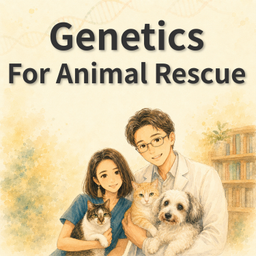
About Genetics For Animal Rescue ~The Surprising Science Behind the Dogs and Cats We Love~
What if understanding the dog or cat beside you started with their DNA? Dr. Doc, an animal geneticist , and Penny, his curious co-host, turn genetics, ancient origins, and behavior into something you can actually feel. Across friendly, story-driven episodes they decode where dogs and cats came from, why they act the way they do, and what welfare science reveals. No prior knowledge needed — just curiosity and a love of the animals we live with. The through-line: the more we understand them, the more shelter animals find their way home.
The front door closes, the adoption papers are signed, and the dog looks up at a room it has never seen. What actually happens in the days and weeks after that handover? For a long time the answer was just anecdote. Now there are numbers.
In this episode, Doc and Penny dig into "Shelter to Home" (Slater, Weiss, Levy & Greenberg, 2026), a landmark study that followed more than 22,000 adopters across 40 US states and 112 organizations, checking in at Day 1, Week 1, and Month 1. The two headline figures sit side by side: over 94% of dog adopters called the experience positive, yet more than 78% hit at least one behavior challenge. We walk through the four most common bumps, reframe each with kinder eyes, and show why the same rates appear in dogs from breeders and pet shops too.
We also look at the 3-3-3 transition, why returns peak around day 8, and how honest expectations and a simple Week 1 check-in can keep dogs and people together. Whether you have adopted, volunteer, or are just curious, you'll leave knowing that an early stumble is normal, not a failure.
For the full story, I dig into the sciencein more depth in the companion article on Substack — give it a read!
https://open.substack.com/pub/kojiondogscatsgenes/p/why-do-78-of-adopters-struggle-the?r=8lnr5c&utm_campaign=post&utm_medium=web&showWelcomeOnShare=true
13 Sept 2026
Why Do Black Cats Wait Longest for a Home?
A black cat crosses your path and something whispers "bad luck." Where does that flicker really come from? In this episode, Doc and Penny trace it back to a single line in a papal decree from June 13, 1233, and follow the thread all the way to a shelter cage today.
The numbers are stark: in one large Kentucky shelter study (Carini and colleagues, 2020), black cats had a 74.6% euthanasia rate and just a 10.0% adoption rate, roughly half the rate of white cats. Doc explains what "black" actually is genetically, two missing DNA letters in the ASIP gene (c.123delCA), first mapped by Eduardo Eizirik's team in 2003. Same tiny change, sacred in ancient Egypt, "satanic" in medieval Europe.
There's hope, too: a surprising "photo problem" that better lighting can fix today, and a gentle reminder that coat color says nothing about whether a cat, or a dog, can be happy.
For the full story, I dig into the sciencein more depth in the companion article on Substack — give it a read!
https://open.substack.com/pub/kojiondogscatsgenes/p/why-do-black-cats-wait-longest-for?r=8lnr5c&utm_campaign=post&utm_medium=web&showWelcomeOnShare=true
13 Sept 2026
27,254 Dogs: Are Mixed Breeds Really Tougher?
"Mutts are hardy — they don't get sick." Is that just kennel-side folklore, or is there real science under it? In this episode, Penny puts the old saying to Doc, our animal geneticist, and the answer turns out to be backed by some surprisingly cold, hard numbers.
We dig into a 2013 UC Davis study of 27,254 dogs, where purebreds showed higher rates of disease in 10 of 24 inherited disorders. Then Doc unpacks the why: we all carry two copies of every gene, dozens to hundreds of "broken" recessive variants, and trouble only when both copies match. That's the homozygous trap closed breeding falls into — and the heterozygous backup that gives mixed breeds their edge, even a slightly longer median lifespan.
Along the way: the popular sire effect, hybrid vigor from cornfields to cat towers, and a gentle reframe — a mutt doesn't lack a pedigree, it carries many ancestors at once. No guilt, no slogans, just a fresh way to see the animal looking back at you from the shelter cage.
For the full story, I dig into the sciencein more depth in the companion article on Substack — give it a read!
https://open.substack.com/pub/kojiondogscatsgenes/p/27254-dogs-are-mixed-breeds-really?r=8lnr5c&utm_campaign=post&utm_medium=web&showWelcomeOnShare=true
Contact Genetics For Animal Rescue ~The Surprising Science Behind the Dogs and Cats We Love~
Guest appearances
Does not typically book guests
Based on episode analysis; this does not confirm that the show is currently accepting guests.
Host of Genetics For Animal Rescue ~The Surprising Science Behind the Dogs and Cats We Love~?
Claim your podcast to manage its listing and keep your show details accurate.
Pod Engine is an independent podcast discovery and analytics service and is not affiliated with or endorsed by this podcast. Artwork and show content belong to their owners. Full legal notice.
Explore this show Podcast research with Pod Engine