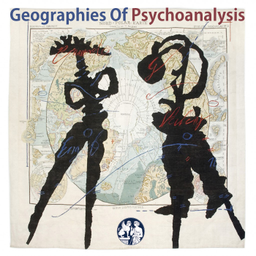
Podcast thumbnail for Geographies of Psychoanalysis

Geographies of Psychoanalysis

Claim This Podcast

by Lorena Preta

5 episodes
Updated Daily
Accepts GuestsHas Sponsors

Podcast Overview

More and more, psychoanalysis has to deal with cultures different from that belonging to its foundations and initial diffusion and with the problems posed by the transformations of the contemporary world. The intent of Geographies of Psychoanalysis is to draw a map of the psyche that takes into account the interconnections and differences that occur in a now globalized reality The focus of this first cycle is the problematic theme of death in different cultures and religions, and the ways of dealing with it in the event of the pandemic. This podcast series is created by Lorena Preta and the Geographies of Psychoanalysis group. Editing by Massimiliano Guerrieri. Podcast Image: William Kentridge, North Pole Map, 2003

Language

🇺🇲

Publishing Since

1/22/2021

Reach the team behind Geographies of Psychoanalysis

Verified contact details for this show aren't on file yet — sign up to get notified when they land.

Recent Episodes

Episode thumbnail for #5 Furui Hiroaki - Japanese View of Life and Death

November 8, 2021

#5 Furui Hiroaki - Japanese View of Life and Death

With The  COVID-19 pandemic in Japan, the government was unable to impose a lockdown, but asked people instead to do same thing voluntarily.  Incorporated in this, sacrificial rituals can be seen .The book “Voluntary death in Japan” (1984) written by Maurice Pinguet was very helpful to Furui Hiroaki in thinking about the Japanese view of life and death. Pinguet's idea of seeing vitality in voluntary death seems to be a suggestion with which to overcome the current pandemic. He picks up on two recent topics that have been talked about on the theme of saving people: The movie "MINAMATA" and The movie version of Demon Slayer- Kimetsu no Yaiba “Infinity Train”. Unlike suicide, voluntary death is, so to speak, a story of rebirth.     Furui Hiroaki is a psychiatrist specialized in psychoanalysis. For some decades he was dedicated to the treatment of in-hospital patients, then 15 years ago, he opened his own clinic and has to date treated  over 6000 patients there.  Within his career, he has spent  2 years, from 1997 to 1999, in the US for training as an international fellow at the Karl Menninger School in the United States. At that time, he also received training analysis. He is currently working as a full-time clinician in his psychiatric clinic, he also dedicates as much time as possible to doing psychoanalysis. In June of 2020, He was admitted as Member of the International Psychoanalytical Association. His major studies in psychoanalysis include: countertransference to aggression in patients with obsessive-compulsive disorder,and psychotherapy processes in patients with borderline personality disorders who have experienced sibling sexual abuse.   I am a psychiatrist specialized in psychoanalysis. I have been dedicated to the treatment of in-hospital patients for decades, and after that, I open a clinic by myself 15 years ago.  During my career, I stayed in the US for 2 years at Menninger Clinic for training, and it is my great pleasure to have this opportunity to do podcast.  I have a clinic as a psychiatric practitioner. During COVID-19 pandemic, I saw patients under various situations.  Some patients have implied suicide to escape from the hardships of their life.  Despite the severalty of their claim, their tone of expressions is very calm as if they are talking about daily conversation or a joke. COVID-19 has killed many people. Since the therapist and the patient share the social situation of being next to death. It may be changing the treatment space shared by the two. There may be a special sense of solidarity between the two. Such a special relationship and environment gave me the opportunity to reconsider the Japanese view of life and death. This pandemic revealed that our government cannot use the method of “lockdown” in the Peace Constitution of Japan. Therefore, the government demanded that the people voluntarily refrain from going out in consideration of their surroundings. Most people obediently followed government instructions of “Jishuku”, which means voluntary restriction of oneself, despite confusion and contradiction. It seems that we can no longer think of the word as a volunteering to choose on our own initiative. In the history of Japan, we don’t prohibit suicide so strictly. I think that one aspect of the Japanese view of life and death is expressed in people's words and deeds for this pandemic. We can't just take it as a pathological mental condition. French philosopher Roland Barthes discussed the characteristics of Japanese culture, using the example of his observation of eating habits of Sukiyaki in his “Empire of Signs”. For Westerns, forks are an extension of hunting, reminiscent of spears. For Japanese people, what they use are “hashi” chopsticks in Japanese, and it means the little thing and a tool to play. Freshly cut raw vegetables and thin slices of meat are prepared on a table, with the heated frying pan at the center.  People gather and surround the table, picked up the prepared v

Episode thumbnail for #4 Mariano Horenstein - Worse Than Death

May 3, 2021

#4 Mariano Horenstein - Worse Than Death

Latin America’s particular relation with death implies something even worse: the practice of disappearing people in connection with State terrorism. The disappearance of rituals, which has reached an unprecedented extent, further exacerbated in times of pandemic, only increases contemporary anxiety. In this context, the analyst’s role is to function less as archaeologists—as Freud imagined—than as forensic anthropologists.”     Mariano Horenstein has published three books (Psicoanálisis en lengua menor; The compass and the couch. The necessary strangeness of Psychoanalysis; and Funambulistas. Travesía adolescente y riesgo). He has received some awards, among them Lucian Freud, Ángel Garma, Elise Hayman and FEPAL. He has given seminars and conferences in institutions  from Latin America, Europe, EEUU and Asia. Former chief editor of Calibán-Revista Latinoamericana de Psicoanálisis. Current Training Director of the Asociación Psicoanalítica de Córdoba.   I If we had to pick just two words as the focal points of an ellipse that might serve as an approach to comprehend the subjects comprising the human species—at least the human species as conceived by psychoanalysis—they would be sex and death. Not only are these words focal points in terms of two points equidistant from the center of the ellipse; they are also sources of illumination that shed light on a large part of the phenomena that psychoanalysis has always engaged with, those inherent to clinical practice, and to daily life.    The center of the ellipse can remain empty. There we can put Lack, Castration, and the hole that sex is insistent on refuting, only to encounter it again and again. There also can go death, almost a mute echo of that hole, an impossible representation of the only certainty that inhabits within us. Although psychoanalysis has usually been identified with sex, almost to the point of caricature, death is no less present in its theoretical structure. With his habitual insight regarding psychoanalysis, Woody Allen once said “There are only two important things in life. The first is sex and the second I don’t remember.” Of course he doesn’t remember the second one. And the artist himself offers a clue when he says “My relationship with death remains the same. I’m strongly against it.”It’s well worth approaching the topic of death with humor, because there is nothing funny about what I’m going to discuss.   II Sex and death then: Psychoanalysis’ Two Crucial Themes There is no place here for generalizations, because what matters from a psychoanalytical standpoint are the particularities—even more so in a project that emphasizes the value of a Geography of Psychoanalysis, like the one that Lorena Preta imagined—the place where enunciation occurs. Although I have the good fortune to work in different geographical contexts, I speak from one in particular: Latin America, a continent that has proven to be fertile ground for psychoanalysis.Unfortunately, the same has shown to be true for death, to the point that we can consider Latin America to have a certain particularity in relation to death.Here I do not refer to folklore of any kind or to how the Extreme West—as we have sometimes been named—may look through European eyes, from a perspective habitually tinged with a degree of ethnocentrism.This has nothing to do, then, with the greater or lesser visual impact of Mexican culture’s festivities or with the extreme melancholy in some our tango or zamba music, or with sacrificial rituals or anthropophagy practiced by some of this land’s original inhabitants.I want to talk about a particular contribution—if you will permit me a bit of irony—that Latin America’s recent history has made to the human species, showing that it is as capable of committing marvelous gestures as it is of committing abhorrent crimes. Here I am referring to something even worse than death: disappearance. Specifically, I mean the forced disappearance of people, which became a spec

Episode thumbnail for #3 Gohar Homayounpour - Persian Blues

March 24, 2021

#3 Gohar Homayounpour - Persian Blues

Upon any discussion on the elaboration of “death” in Iran, one inevitably comes face to face with the often argued and examined notion that Iranians symptomatically suffer within a culture that is obsessed with the celebration of death, nostalgia and mourning. Many interdisciplinary scholars in recent decades have examined and provided data which proves such tendencies and their disastrous consequences for Iranians. Here, Gohar Homayounpour attempts to delve deeper into the various palettes of the “Persian Blues”, in the name of integration and a continuous re-examination of our comfortably established notions, she attempts to add a but, referring to the various derivatives of Eros’s footsteps upon the Persepolis of Persia, dreaming that this but might become a possibility for “linking”, a sense of orientation, inspiration, out of these particularly destructive and melancholic aspects of the Iranian culture, orienting us towards a voyage from melancholia to mourning.     Dr. Gohar. Homayounpour is an author and psychoanalyst and member of the International Psychoanalytic Society, American Psychoanalytic Association, the Italian Psychoanalytic Society and the National Association for the Advancement of Psychoanalysis. She is the Training and Supervising psychoanalyst of the Freudian Group of Tehran, where she is also founder and former director.Homayounpour has published various psychoanalytic articles, including in the International and Canadian Journals of Psychoanalysis. Her book, Doing Psychoanalysis in Tehran, published by MIT Press in August 2012, won the Gradiva award and has been translated into many languages.Homayounpour is a member of the scientific board at the Freud Museum in Vienna and a board member of the IPA group Geographies of psychoanalysis.   The first thing that comes to mind when one is asked to elaborate on “death” in my geography is the often discussed and examined notion that Iranians symptomatically suffer within a culture that is obsessed with the celebration of death, nostalgia and mourning. Many scholars in recent decades have examined and provided data which proves such tendencies and their disastrous consequences for Iranians.I have also written about this exact notion in my book Doing Psychoanalysis in Tehran, with reference to our famous myth, “Rustam and Sohrab”, from Ferdousi’s Book of Kings (Shahnameh, the most celebrated Iranian source of mythology), which has a storyline quite similar to that of Oedipus Rex, the main difference being that it is the father who unknowingly kills his son in the end. My extensive research shows that Greek mythologies appear to be populated with myths about the actual killing of fathers, while it is impossible to escape the common patterns of killing sons right across Iranian mythology. The wish to kill each other between fathers and sons is common across both mythologies, but who actually gets killed at the end and who gets rescued and is granted the right to life, is where the culturally specific element can be observed across these mythologies.I am convinced of the universality of the Oedipus complex, and the struggle for power and control it represents while embodying within it the universal fear of castration; the culturally specific element seems to be the reaction to this fear. My premise is that the Iranian collective fantasy is anchored in an anxiety of disobedience that wishes for an absolute obedience. The son desiring to rebel knows unconsciously that if he does so he might be killed, and so, in a way, he settles for the fear of castration.Is this not also seen in the differences between Catholicism and Islam? Islam means submission and demands absolute obedience to God the father, while in Christianity the demarcation between God the father and Christ the son is not quite as clear. This is clearly a very complicated and nuanced discourse, beyond the scope of this podcast. However, it appears that religions were socially constructed to

5 total episodes available

Deep-dive analytics for Geographies of Psychoanalysis

Frequently asked questions

Have a different question and can't find the answer you're looking for? Reach out to our support team by sending us an email and we'll get back to you as soon as we can.

What is Geographies of Psychoanalysis?

More and more, psychoanalysis has to deal with cultures different from that belonging to its foundations and initial diffusion and with the problems posed by the transformations of the contemporary world. The intent of Geographies of Psychoanalysis is to draw a map of the psyche that takes into account the interconnections and differences that occur in a now globalized reality The focus of this first cycle is the problematic theme of death in different cultures and religions, and the ways of dealing with it in the event of the pandemic.

This podcast series is created by Lorena Preta and the Geographies of Psychoanalysis group. Editing by Massimiliano Guerrieri.

Podcast Image: William Kentridge, North Pole Map, 2003

How often does this podcast release new episodes?

This podcast updates daily.

Where can I listen to this podcast?

This podcast is available on 4 platforms including Apple Podcasts, Spotify, and more. You can also use the RSS feed directly.

Does this podcast accept guests?

Yes, this podcast regularly features guests.

Legal Disclaimer

Pod Engine is not affiliated with, endorsed by, or officially connected with any of the podcasts displayed on this platform. We operate independently as a podcast discovery and analytics service.

All podcast artwork, thumbnails, and content displayed on this page are the property of their respective owners and are protected by applicable copyright laws. This includes, but is not limited to, podcast cover art, episode artwork, show descriptions, episode titles, transcripts, audio snippets, and any other content originating from the podcast creators or their licensors.

We display this content under fair use principles and/or implied license for the purpose of podcast discovery, information, and commentary. We make no claim of ownership over any podcast content, artwork, or related materials shown on this platform. All trademarks, service marks, and trade names are the property of their respective owners.

While we strive to ensure all content usage is properly authorized, if you are a rights holder and believe your content is being used inappropriately or without proper authorization, please contact us immediately at hey@podengine.ai for prompt review and appropriate action, which may include content removal or proper attribution.

By accessing and using this platform, you acknowledge and agree to respect all applicable copyright laws and intellectual property rights of content owners. Any unauthorized reproduction, distribution, or commercial use of the content displayed on this platform is strictly prohibited.