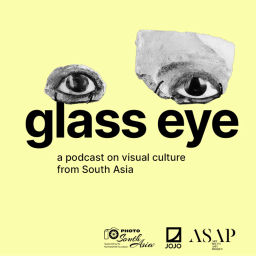
Glass Eye: A Podcast on Visual Culture from South Asia
Claim This Podcastby Adira Thekkuveettil, Akshay Mahajan, Kaamna Patel
Podcast Authority
Beta
Podcast Overview
<p>‘Glass Eye: A Podcast on Visual Culture from South Asia’ talks to photographers, critics, publishers, educators and other professionals contributing to the evolution of contemporary visual culture, exploring the ways in which images shape our understanding of South Asia. Hosted by three visual artists - Adira Thekkuveettil, Akshay Mahajan & Kaamna Patel - it delves into the story of photographic practice in South Asia, exploring its unique concerns, vocabulary, and possible trajectories. <br>This podcast has been made possible by PhotoSouthAsia & by Art South Asia Project's publications grant. <br><br><br></p><p>Sound Design & Editing : Rahul Nadkarni<br>Artwork: Pavithra Ramanujam<br><br></p>
Language
🇺🇲
Publishing Since
8/30/2023
Unlock The Full Podcast Authority Score Report
See how your podcast performs across key metrics
Podcast Authority
BetaRecommendations available
Unlock the full report to see detailed tips
Recommendations available
Unlock the full report to see detailed tips
Unlock comprehensive insights including:
- • YouTube presence analysis
- • Social media reach metrics
- • RSS compliance scoring
- • Podcast 2.0 features
- • Technical standards
Detailed Analytics
- Complete breakdown of all 19 authority metrics
- Personalized recommendations for each metric
- Industry benchmarks and comparisons
- Technical RSS feed analysis and compliance scoring
Growth Strategies
- Step-by-step action plans for improvement
- Quick wins to boost your score immediately
- Pro tips from successful podcasters
See how your show performs across every key metric
High authority scores make your podcast more attractive to industry leaders and influencers who want to appear on credible shows.
Sponsors look for podcasts with proven authority and engagement. Your score demonstrates your podcast's value to potential partners.
Understanding your strengths and weaknesses helps you make data-driven decisions to expand your listener base effectively.
Reach the team behind Glass Eye: A Podcast on Visual Culture from South Asia
Verified contact details for this show aren't on file yet — sign up to get notified when they land.
Recent Episodes
May 1, 2025
Glass Eye Episode 4: What Is A Photobook? with Lesley Martin & Varun Nayar
Send us a text In this episode, we interrogate the photobook, while discussing the various challenges in production and distribution that undergird the still-nascent photobook phenomenon in South Asia. The episode features a candid, free-flowing conversation where Akshay Mahajan, Adira Thekkuveettil & Kaamna Patel explore the origins and evolution of the photobook, as also their own struggles with this ambivalent form, across questions of radical experimentation, genre, dissemination, lon...
March 4, 2024
Glass Eye Episode 3: Active Listening with Gauri Gill
<p>In Episode 3, we meet the eminent photographer <a href='https://www.gaurigill.com/bio.html'>Gauri Gill</a>, recent winner of the prestigious Prix Pictet. We also meet <a href='https://mapacademy.io/article/rajesh-vangad/'>Rajesh Chaitya Vangad</a>, renowned Warli artist & Gauri's collaborator on the body of work <a href='http://surl.li/rfmsp'><em>Fields of Sight</em></a> , which is shortlisted for the Deutsche Börse Photography Foundation Prize prize 2024. Touching upon two recent publications with <a href='https://www.editionpatrickfrey.com/en/gauri-gill'>Patrick Frey</a>, Gauri opens up to Adira about her life's work and process, thinking through collaboration, representation and what she calls active listening. <b><br/><br/>Translations:<br/><br/>Excerpt 02: 14:14 - 15:42</b></p><p>Before anyone else, my parents were like gurus to me; you might say even beyond that. Later on, I learned from Jivya Somha Mashe, a Padma Shri award winning local artist who has done a lot of work for the Warli artfrom and presented it across the world. So I joined him. We had no money in those days, I couldn’t afford to go to school. My parents were poor and I had to abandon the traditional Warli way of life to go work for a company outside, which was a very difficult decision for me to make. I depict some of those experiences in my paintings and in this way connect our communal life with my lived experiences. My paintings feature traditional motifs as well as new ones like the company, trains, planes, the city and pollution; this is how we have evolved the art form. We want to say that we are not against education or progress but given the world’s present condition, humans need to understand the issues we are grappling with and seek out the right solutions. We try to address this through our artform. </p><p><b>Excerpt 03: 17:15 - 17:39</b></p><p>(referring to one of his paintings) You can see the fire god, the flies and the butterflies which are all very important to the Warli way of life. Without the animals we share our spaces with, our way of life is impossible. Here you see the peacock and Hirva, one of our gods that lives in the <em>Kuldev </em>(shrine). In this painting that depicts our communal life, it’s written that there is no distinction between us and them - all the animals are sacred. </p><p><b>Excerpt 04: 18:27 - 18:55</b></p><p>We (Gauri and I) traced my personal stories, the stories of my parents, the stories of the village school, stories of moneylenders here, stories of battles, stories from the company I worked for. We went and saw the temple here, the jungle here - the deforestation that’s taking place. We revisited all of these relevant locations in the village, took pictures and did many tests before I started to paint over them. </p><p><b>Excerpt 05: 23:40 - 24:25</b></p><p>It was very difficult to paint over the photographs - If I drew a line with ink, it would sometimes create a tear. I had to be very careful when creating the works - each line was final, we did not redraw or modify a line. Each line had to be painted directly with a stick (I didn’t have a brush). It was hard to manage all these aspects in the beginning - drawing the line, thinking about it & keeping my patience - but with time, it started to feel more natural.</p><p>Hosted by <br/>Adira Thekkuveettil - <a href='https://www.adirathekkuveettil.com/'>https://www.adirathekkuveettil.com</a> <br/>Akshay Mahajan - <a href='https://akshaymahajan.in/'>https://akshaymahajan.in</a> <br/>Kaamna Patel - <a href='https://kaamna.com/'>https://kaamna.com</a> </p> <p><b>Supported by PhotoSouthAsia and Art South Asia Project <br/>Produced by Editions JOJO<br/><br/>Special thanks to Dayanita Singh </b></p> <p><b>This podcast is meant to serve as an educational resource and all the recordings used in the episodes are for the purpose of supporting the research.</b></p>
December 4, 2023
Episode 2: Family to Nation
<p><b>For Episode 2 we travel to Indonesia and revisit a conversation between Arif Furquan and Akshay Mahajan which was recorded during the 3rd edition of the Jakarta International Photo Festival(JIPFEST). Arif takes us through his exhibition ‘Family to Nation’ and his collaborative project with Reza Kutjh titled ‘Unhistoried’ which aims to activate the Indonesian family archive, as a means to re-examine, challenge, and decenter history writing.</b></p><p><br/></p><p><b>About Arif Furqan</b></p><p><b>Arif Furqan, educator and researcher working with photography and visual art. He has been experimenting various approaches utilizing photography and other mediums exploring the issue of family, memory, history, and mobility. He is also a part of Flock Project, a collective exploring the possibilities of photographic works through printed matters. In 2021, he received the Prince Claus Seed Award on the project </b><b><em>Unhistoried</em></b><b>—an archive-based project on Indonesian family photograph and archive during the New Order Regime (1960-1990s). Now, he is currently doing research and artistic project on the vernacular memory and memory landscape on Indonesian New Order era.</b></p><p><br/></p><p><b>2:05</b></p><p><a href='https://www.editionsjojo.com/product-page/dori'><b>Dori</b></a><b> and </b><a href='https://akshaymahajan.in/People-of-Clay'><b>People of Clay</b></a><b> </b></p><p><b>3:52</b></p><p><a href='https://www.instagram.com/afurqannn/'><b>Arif Furqan</b></a><b> </b></p><p><b> 4:04</b></p><p><b> </b><a href='https://jipfest.com/'><b>JIPFEST</b></a></p><p><b>4:49</b></p><p><a href='https://unhistoried.com/publication/Family%20to%20Nation%20-%20Jakarta%20International%20Photo%20Festival'><b>Family to Nation</b></a></p><p><b><br/>5:22</b></p><p><a href='https://www.youtube.com/watch?v=DRIch247vb8'><b>President Sukarno's speech at the Bandung Conference (1955)</b></a><b> </b></p><p><b>13:18</b></p><p><a href='https://youtu.be/167LMeLw7FQ?si=-hurKzqVrP2f8mqt'><b>Indonesian Massacre and Coup of 1965</b></a></p><p><b>15:44</b></p><p><a href='https://www.youtube.com/watch?v=HMCNQMMjxdY'><b>Abri Masuk Desa - Endang S Taurina (1982)</b></a></p><p><b>22:09</b></p><p><a href='https://www.vernacularsocialclub.org/'><b>Vernacular Social Club</b></a></p><p><b>22:20</b></p><p><a href='https://open.spotify.com/show/1yoa5XGlWijypnq06UDgsI?si=fd5b30286b984087'><b>Photo Vault Podcast</b></a></p><p><b>22.36</b></p><p><a href='https://www.editionsjojo.com/library'><b>JOJO Library</b></a></p><p><b> 23:12</b></p><p><a href='https://www.youtube.com/watch?v=r9qwuyhpkQQ&t=1s'><b>Indonesian Embassy's video letter to the United States (1955)</b></a></p><p><b><br/><br/><br/><br/><br/><br/><br/><br/><br/><br/></b><br/></p><p>Hosted by <br/>Adira Thekkuveettil - <a href='https://www.adirathekkuveettil.com/'>https://www.adirathekkuveettil.com</a> <br/>Akshay Mahajan - <a href='https://akshaymahajan.in/'>https://akshaymahajan.in</a> <br/>Kaamna Patel - <a href='https://kaamna.com/'>https://kaamna.com</a> </p> <p><b>Supported by PhotoSouthAsia and Art South Asia Project <br/>Produced by Editions JOJO<br/><br/>Special thanks to Dayanita Singh </b></p> <p><b>This podcast is meant to serve as an educational resource and all the recordings used in the episodes are for the purpose of supporting the research.</b></p>
4 total episodes available
Deep-dive analytics for Glass Eye: A Podcast on Visual Culture from South Asia
Frequently asked questions
Have a different question and can't find the answer you're looking for? Reach out to our support team by sending us an email and we'll get back to you as soon as we can.
- What is Glass Eye: A Podcast on Visual Culture from South Asia?
<p>‘Glass Eye: A Podcast on Visual Culture from South Asia’ talks to photographers, critics, publishers, educators and other professionals contributing to the evolution of contemporary visual culture, exploring the ways in which images shape our understanding of South Asia. Hosted by three visual artists - Adira Thekkuveettil, Akshay Mahajan & Kaamna Patel - it delves into the story of photographic practice in South Asia, exploring its unique concerns, vocabulary, and possible trajectories. <br>This podcast has been made possible by PhotoSouthAsia & by Art South Asia Project's publications grant. <br><br><br></p><p>Sound Design & Editing : Rahul Nadkarni<br>Artwork: Pavithra Ramanujam<br><br></p> - How often does this podcast release new episodes?
This podcast updates inactive.
- Where can I listen to this podcast?
This podcast is available on 8 platforms including Apple Podcasts, Spotify, and more. You can also use the RSS feed directly.
- Does this podcast accept guests?
Yes, this podcast regularly features guests.
Legal Disclaimer
Pod Engine is not affiliated with, endorsed by, or officially connected with any of the podcasts displayed on this platform. We operate independently as a podcast discovery and analytics service.
All podcast artwork, thumbnails, and content displayed on this page are the property of their respective owners and are protected by applicable copyright laws. This includes, but is not limited to, podcast cover art, episode artwork, show descriptions, episode titles, transcripts, audio snippets, and any other content originating from the podcast creators or their licensors.
We display this content under fair use principles and/or implied license for the purpose of podcast discovery, information, and commentary. We make no claim of ownership over any podcast content, artwork, or related materials shown on this platform. All trademarks, service marks, and trade names are the property of their respective owners.
While we strive to ensure all content usage is properly authorized, if you are a rights holder and believe your content is being used inappropriately or without proper authorization, please contact us immediately at hey@podengine.ai for prompt review and appropriate action, which may include content removal or proper attribution.
By accessing and using this platform, you acknowledge and agree to respect all applicable copyright laws and intellectual property rights of content owners. Any unauthorized reproduction, distribution, or commercial use of the content displayed on this platform is strictly prohibited.