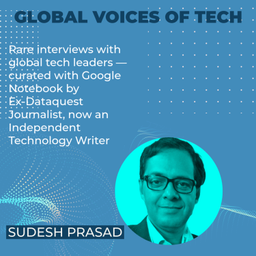
The forces shaping India's digital future. Sudesh explores AI, enterprise technology, cybersecurity, government and policy, with conversations with the people building and shaping the digital world.
Gene Hodges on Cybersecurity's Shift: From Infrastructure to Data Protection (Websense CEO, 2008)
In this episode, I revisit my 2008 interview with Gene Hodges, then CEO of Websense, conducted during my time as a journalist at Dataquest.
Hodges made a striking observation that feels even more relevant today: cybersecurity threats were shifting from attacking infrastructure to targeting data itself.
The conversation explores:
Why attackers no longer wanted systems to fail—but wanted them to run quietly while stealing data
The limitations of perimeter and device-centric security models
The early rise of data-centric and information assurance strategies
Web security challenges emerging from Web 2.0 and user-generated content
How enterprises and governments needed to rethink security architectures
Websense’s own journey mirrors this shift. Founded in 1994 and public by 2000, the company was later acquired by Vista Equity Partners in 2013 and subsequently by Raytheon in 2015, leading to its evolution and rebranding as Forcepoint a data-first security company.
This episode is part of my ongoing effort to curate and revive archival interviews with global technology leaders, originally published in Dataquest, and reinterpret them for today’s digital and AI-driven era using Google NotebookLM.
Disclaimer: This episode is an AI-curated interpretation based on my original Dataquest interview, recreated using Google NotebookLM; views reflect the context of the time, and minor transcription or interpretation errors may exist.
21 Nov 2025
SAP’s Jim Hagemann Snabe on Best Practices, Business Suite 7 & the Mobile Explosion
In this episode, I revisit my 2009–2010 interview with Jim Hagemann Snabe, then Member of the Executive Board at SAP AG, during my time as a journalist at Dataquest.
This conversation offers a rare snapshot of how one of the world’s largest enterprise software companies viewed the global slowdown, Asia’s emergence, and the explosive rise of mobile technologies.
Snabe discusses:
How SAP interpreted the global economic uncertainty of the time
Why Asian enterprises were more willing to adopt best practices
SAP’s product strategy — including Business Objects integration and Business Suite 7
How enterprises were shifting IT priorities to reduce cost, improve efficiency, and accelerate ROI
Early signs of the coming mobile revolution in Asia
Security, infrastructure, and application challenges as mobile devices entered the enterprise
SAP’s push with All-in-One and how Asia became a major growth engine
This curated audio version has been recreated using Google NotebookLM, blending the original interview with contextual insights so listeners can understand the relevance of these ideas in today’s digital transformation era.
This audio episode is an AI-curated interpretation created using Google NotebookLM based on my original Dataquest interview and some current reliable sources including LinkedIn. Some minor inaccuracies or reconstruction artifacts may occur.
1 Sept 2025
The CIO Who Transformed Cisco: Lessons from Rebeca Jacoby
In this episode, I revisit my 2007 interview with Rebeca Jacoby, then the CIO of Cisco Systems, as a Voice & Data journalist, and enrich it with context from her later career. Jacoby shares how Cisco viewed IT not just as a support function, but as a strategic driver of productivity and business alignment.
The discussion explores:
* How Cisco measured IT’s impact through metrics like revenue per headcount and cycle times.
* The challenges of adopting new technologies while balancing innovation with stability.
* Cisco’s nuanced approach to outsourcing and internal capability building.
* Jacoby’s transition from CIO (2006–2015) to Senior Vice President, Operations, where she oversaw IT, supply chain, and global business processes.
Her career exemplifies how Cisco integrated technological innovation with operational excellence, ensuring that IT remained a partner in business growth rather than just a back-end function.
Voice&Data Interview: https://www.voicendata.com/cisco-productivity-enhancement-systems-innovation/
Disclaimer
This podcast episode is based on my 2007 interview with Rebeca
Jacoby and additional research from her professional profile. It represents a Google's NotebookLM interpretation of these sources and is not a verbatim record of her views today.
13 Aug 2025
Roy Singham: The Visionary Who Built Thoughtworks and Took on Big Software
In this episode, I revisit my 2007 interview with Neville “Roy” Singham, the founder of Thoughtworks, Inc. Roy shares the story behind the company’s name, his belief in flat organisational structures, and his innovative approach to software development. He challenges the inefficiencies of large software corporations and reflects on the philosophy that made Thoughtworks a global force. We also trace his journey beyond 2017, when he sold the company, and explore his legacy in technology and executive leadership.
This is a Google NotebookLM's AI-generated summary, reviewed and edited for accuracy. All rights belong to the original publication, Dataquest India (CyberMedia).
30 Jul 2025
Reimagining Citizen Services: UK’s Cloud Vision & IT Leadership — A Conversation with John Suffolk
In this episode of Global Voices of Tech, we revisit a forward-looking conversation from 2010 with John Suffolk, then Chief Information Officer of the UK Government. Suffolk outlined an ambitious vision to modernize public services with cloud infrastructure, data transparency, and efficient IT governance.
This curated episode explores:
🔹 The UK’s early cloud-first government strategy
🔹 Reducing 500+ data centers to a handful
🔹 The launch of data.gov.uk (http://data.gov.uk) for open data
🔹 Lessons in IT leadership and vendor governance — still relevant today
The material was sourced from an archival interview originally published in Dataquest, (https://www.dqindia.com/it-has-lowered-the-cost-of-delivering-citizen-services/) curated using Google’s NotebookLM, an AI-powered research tool that helped reconstruct key insights for the audio format.
Disclaimer
This episode features curated excerpts from an interview originally published in Dataquest in 2010. The curation process involved automated transcription, AI summarization, and reconstruction via NotebookLM, and while we strive for factual accuracy, minor errors or omissions may exist. The views expressed remain those of the original speaker and are shared here for archival and educational purposes
17 Jul 2025
René Penning de Vries on NXP, India’s R&D Rise, and the Semiconductor Future
In this special archival episode of Global Voices of Tech, I bring you a conversation from January 2010 with René Penning de Vries, then CTO of NXP Semiconductors, done during his visit to Bangalore and originally published in Dataquest magazine.From investing in high-performance mixed-signal innovation to driving automotive electronics and NFC adoption, René outlined NXP’s strategy for technology leadership and meaningful impact, especially in collaboration with Indian R&D. He spoke passionately about India’s potential beyond cost arbitrage and how its teams were beginning to take on end-to-end product ownership, a vision that continues to resonate today.We have also included an updated segment outlining René’s contributions post-NXP, particularly his role in integrated photonics (as Chairman of PhotonDelta) and quantum technology (via Orange Quantum Systems), where he continues to shape the future of semiconductors globally.DisclaimerThis episode is part of a curated podcast series that brings back insightful conversations with top global tech leaders from the 2000s. Originally published in Dataquest, these archival interviews offer timeless lessons on leadership, innovation, and transformation. This episode is generated from original published content and curated using AI (NotebookLM). While best efforts have been made to ensure accuracy, some minor errors or voice artifacts may occur. The episode has been updated with recent career highlights for better context.
9 Jul 2025
Wim Elfrink on Cisco’s India Strategy & Globalisation Playbook (2007)
In this 2007 interview, Wim Elfrink, then newly appointed Chief Globalisation Officer at Cisco, lays out a bold strategy that positioned India as the company's second global headquarters. Speaking to Dataquest during a pivotal era, Elfrink explained how Cisco’s shift wasn’t driven by cost but by growth, innovation, and access to world-class talent.
He shared how India would anchor R&D, support, and strategic functions, ushering in a new model of co-creation with local partners to better serve emerging markets. This episode offers rare insight into how global tech giants adapted for scale and relevance beyond their home turf—and how Cisco saw India not just as a market, but as a full-fledged innovation hub.
Disclaimer:This episode is based on an archival interview originally published in Dataquest in 2007. It has been curated using Google’s NotebookLM to preserve historical context and accuracy. Some commentary has been updated for clarity, but no new facts have been added.
NotebookLM (Google NotebookLM) is a research and note-taking online tool developed by Google Labs that uses AI, specifically Google Gemini, to assist users in interacting with their documents
3 Jul 2025
Jay Kerley on IT Transformation & Green Tech at Applied Materials (2010)
In this episode, we revisit a 2010 interview with Jay Kerley, then Deputy CIO and Corporate VP of Applied Materials, recorded during his visit to Bangalore. At the time, Kerley was leading one of the most ambitious IT transformations in the semiconductor industry — consolidating 17 decentralized IT groups, cutting vendors from 50 to just two, and building a global platform to support 3D CAD-led product development.
Key insights include:
Applied’s shift to global collaboration through MPLS, Teamcenter, and unified CAD environments
The impact of IT on the India R&D center, empowering local teams to drive innovation
Their move to video-first communication via Cisco Telepresence and Webex integration
Early discussions on remote work and high-performance computing from home (in 2010!)
How IT contributed to 20% of Applied’s goal to reduce 50,000 tons of carbon footprint globally
A nuanced take on why telecom was outsourced globally but IT infrastructure was retained in-house
Jay’s comments on sustainability, mobility, and the evolution of enterprise IT still resonate deeply today. This interview was conducted by Sudesh Prasad for Dataquest magazine.
About the Podcast
Global Voices of Tech brings to life rare, archival interviews with global tech leaders — curated using Google’s NotebookLM , and hosted by Sudesh Prasad, ex-Dataquest journalist and independent technology writer.
Disclaimer:This episode is generated from original published content and curated using AI (NotebookLM). While best efforts have been made to ensure accuracy, some minor errors or voice artifacts may occur.
26 Jun 2025
Tech Leadership in 2010: Alex Pilar on DHL's Global IT Strategy & Telecom Outsourcing
A rare look back at DHL’s global IT transformation with Alex Pilar, then CIO of DHL Supply Chain. In this 2010 interview, he shares how DHL consolidated global IT, built major tech centers in Prague and Cyberjaya, and outsourced telecom services to AT&T and Telefonica for major savings.
Originally published in Dataquest (https://www.dqindia.com/we-have-outsourced-all-our-telecom-infrastructure-and-services/). Curated with Google Notebook LM.
Disclaimer: This interactive audio is AI-generated using Google Notebook LM based on archived interviews and may contain minor inaccuracies.
17 Jun 2025
Tech Leadership in 2008: Warren East on ARM's Role in the Mobile Future
Tech Leadership in 2008: Warren East on ARM’s Mobile Strategy and Global Vision
Flashback to a Key Interview: Warren East, then CEO of ARM, on the company's Mobile Future (2008)
In this episode, we revisit my 2008 interview with Warren East during his tenure as CEO of ARM. He spoke candidly about ARM’s dominance in mobile processors, highlighting that the company powered about 90% of the world’s phones at the time.
Notably, he welcomed Intel's entry into the handset space, saying it would "spur competition." Looking back, it's fascinating to see how the mobile processor landscape has evolved in response.
East also made sharp predictions, such as enhanced mobile browsing and real-time phone speech translation. More than a decade later, those predictions have come true, underscoring his vision for the mobile future.
Warren East's Career Snapshot:
Before joining ARM in 1994, East spent 11 years at Texas Instruments. He became CEO of ARM in 2001 and led the company until 2013. Later, he took the helm at Rolls-Royce, guiding it through significant challenges, including the COVID-19 crisis.
Disclaimer
This podcast episode is based on a 2008 interview originally published in Dataquest (https://www.dqindia.com/intels-push-in-the-handset-space-will-spur-competition/) magazine. The audio overview is generated by AI via Notebook LM and may contain minor inaccuracies.
11 Jun 2025
Tech Leadership in 2007: Abhi Talwalkar on LSI’s Strategy and Vision
Guest: Abhi Talwalkar, CEO of LSI Corp (at the time of this interview in Bangalore on Sept 11, 2007).
In this archival episode, curated with Google Notebook LM, we revisit LSI’s bold transformation under Talwalkar: going fabless and focusing on storage + networking.
Originally published in Dataquest (https://www.dqindia.com/lsi-has-a-2-pillar-focus-storage-and-networking/)
Abhijit highlighted LSI’s strategic transformation, marked by its bold decision to go fabless and focus on two core pillars: storage and networking. LSI’s two-pillar strategy continues to resonate today.
With data consumption and storage needs growing exponentially and networking technologies underpinning advancements like AI, cloud computing, and IoT, the synergy between these domains is more critical than ever. LSI Corporation was acquired by Avago Technologies (now known as Broadcom Inc.) for $6.6 billion. (On May 6, 2014).
Abhijit succeeded Wilfred J Corrigan (a British engineer and entrepreneur), LSI’s founder. Abhijit currently serves as Chairman of the Board at LAM Research, a global supplier of innovative wafer fabrication equipment and services to the semiconductor industry.
Podcast Authority Score: 26 / 100
A composite of feed quality, social presence, YouTube performance and engagement. Read the methodology.
Quality
52
Social presence
0
YouTube
0
Engagement
0
Contact Global Voices of Tech with Sudesh Prasad
Guest appearances
Books guests
Based on episode analysis; this does not confirm that the show is currently accepting guests.
Host of Global Voices of Tech with Sudesh Prasad?
Claim your podcast to manage its listing and keep your show details accurate.
Pod Engine is an independent podcast discovery and analytics service and is not affiliated with or endorsed by this podcast. Artwork and show content belong to their owners. Full legal notice.
Explore this show Podcast research with Pod Engine