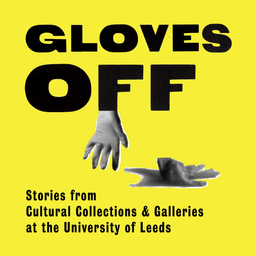
Gloves Off: Stories from Cultural Collections & Galleries at the University of Leeds
University of Leeds Cultural Collections & Galleries
5.0from 1 ratings
- 13
- Episodes
- 1
- Ratings
- Weekly
- Cadence
- 2025
- First episode
About Gloves Off: Stories from Cultural Collections & Galleries at the University of Leeds
Documentaries, panel discussions, interviews with artists and writers, and more from Cultural Collections & Galleries at the University of Leeds.
- Publisher
- University of Leeds Cultural Collections & Galleries
- Category
- arts · history
- Language
- en
- Explicit
- No
- First episode
- 11 Dec 2025
- Latest episode
- 23 Sept 2026
Latest episodes
13 episodes in the feed.
23 Sept 2026
Death of a Poet Episode IV: A Poet-Poacher
John Nicholson takes an epic trip through space and time in his first book of poetry, Airedale in Ancient Times. Amid riots and shootings in Bradford, The Bingley Byron also seems to have perfected the knack of writing for more than one audience at a time. His celebrations of beer and the outlaw life satisfy the pub crowd, while he courts a wealthy mill owner with his sensational morality tales. But how long can he keep them all happy? We’ll return with Season 2 of Death of a Poet in March 2027, leading up to a symposium to mark what would have been Tony Harrison’s 90th birthday, and the anniversary of John Nicholson’s death, in April. Series credits Presented by Dr RJ Wade with Paul BennettDr Adam BridgenDr Vic ClarkeFelix CryerAlex DuxburyTom DuxburyKarl GraveAllan MirfieldConrad NelsonHadley NicholsonSarah PrescottCatherine RobinsonElaine RobinsonHarold RobinsonBarrie RutterSiân ThomasDom Basil Watkins OSBGlyn WatkinsProfessor John Whale The Bellringers of All Saints Church, BingleyJane CallaghanAnn CossavellaKarl GraveJane LynchHelen Mitchell-HallMary PickenGary PickenPeter Tedder Hydrophone recordings made on location in the River Aire, Saltaire by Daniel Skevington Produced and edited by Rowland Thomas Music The Farmer’s Boy(Traditional) Air: ‘O, much lov'd Son, if Death’, from Artaxerxes(Thomas Arne) Arranged and performed by Alice Gilmour and The Infernal CauldronSound design by The Infernal Cauldron Trailer edit by Alex Ramseyer-Bache. Wildlife footage by Tom Duxbury.
16 Sept 2026
Death of a Poet Episode III: The Summer of his Life
The Bingley Byron is the toast of the Bradford arts scene, but trouble’s brewing as he sets out his stall as an establishment rhymer. And back in the present, a descendant of the poet meets his likeness at the University of Leeds. Also known as The Orpheus of Bradford and The Airedale Poet, John Nicholson was a Methodist preacher and a tormented drinker, a rambler on Rombald’s Moor and a champion of industry, a conservative and a radical, a woolsorter and a classically-inclined poet. He got arrested in London for arguing with a bust of Shakespeare; became a pawn in one of the great political scraps of the 19th century; played the oboe; fathered nine children; and ad-libbed untold quantities of rhyme for his pals in the pub, most of which has been lost to intoxication and the passage of time. In 1993 Northern Broadsides legend Barrie Rutter brought him back to life on the stage in Tony Harrison’s play Poetry or Bust. We’ve used Harrison’s archive, held here in Cultural Collections at the University of Leeds, to retrace his steps, in the steps, in turn, of John Nicholson. Only a brief biography on The Bingley Byron survives, but we’ve gathered a cast of poets, actors, artists, bellringers, historians, enthusiasts – and a direct descendant – to return to the poems that Nicholson did write down, and the places where he lived and died, to unearth his chaotic, charismatic story. Through his life and work, we think about art, joy, memory, grief, and what we leave behind us. From the meadow pipits, skylarks and standing stones of Ilkley Moor to the river at Saltaire where he met his end, join us in the footsteps of The Bingley Byron. Series credits Presented by Dr RJ Wade with Paul BennettDr Adam BridgenDr Vic ClarkeFelix CryerAlex DuxburyTom DuxburyKarl GraveAllan MirfieldConrad NelsonHadley NicholsonSarah PrescottCatherine RobinsonElaine RobinsonHarold RobinsonBarrie RutterSiân ThomasDom Basil Watkins OSBGlyn WatkinsProfessor John Whale The Bellringers of All Saints Church, BingleyJane CallaghanAnn CossavellaKarl GraveJane LynchHelen Mitchell-HallMary PickenGary PickenPeter Tedder Hydrophone recordings made on location in the River Aire, Saltaire by Daniel Skevington Produced and edited by Rowland Thomas Music The Farmer’s Boy(Traditional) Air: ‘O, much lov'd Son, if Death’, from Artaxerxes(Thomas Arne) Arranged and performed by Alice Gilmour and The Infernal CauldronSound design by The Infernal Cauldron Trailer edit by Alex Ramseyer-Bache. Wildlife footage by Tom Duxbury.
9 Sept 2026
Death of a Poet Episode II: Life is Wasting, Death is Hasting
Grief pulls John Nicholson back to his family’s devout Methodism – for now – as The Bingley Byron turns the loss of his young bride into art that retains the power to console the bereaved. Also known as The Orpheus of Bradford and The Airedale Poet, John Nicholson was a Methodist preacher and a tormented drinker, a rambler on Rombald’s Moor and a champion of industry, a conservative and a radical, a woolsorter and a classically-inclined poet. He got arrested in London for arguing with a bust of Shakespeare; became a pawn in one of the great political scraps of the 19th century; played the oboe; fathered nine children; and ad-libbed untold quantities of rhyme for his pals in the pub, most of which has been lost to intoxication and the passage of time. In 1993 Northern Broadsides legend Barrie Rutter brought him back to life on the stage in Tony Harrison’s play Poetry or Bust. We’ve used Harrison’s archive, held here in Cultural Collections at the University of Leeds, to retrace his steps, in the steps, in turn, of John Nicholson. Only a brief biography on The Bingley Byron survives, but we’ve gathered a cast of poets, actors, artists, bellringers, historians, enthusiasts – and a direct descendant – to return to the poems that Nicholson did write down, and the places where he lived and died, to unearth his chaotic, charismatic story. Through his life and work, we think about art, joy, memory, grief, and what we leave behind us. From the meadow pipits, skylarks and standing stones of Ilkley Moor to the river at Saltaire where he met his end, join us in the footsteps of The Bingley Byron. Series credits Presented by Dr RJ Wade with Paul BennettDr Adam BridgenDr Vic ClarkeFelix CryerAlex DuxburyTom DuxburyKarl GraveAllan MirfieldConrad NelsonHadley NicholsonSarah PrescottCatherine RobinsonElaine RobinsonHarold RobinsonBarrie RutterSiân ThomasDom Basil Watkins OSBGlyn WatkinsProfessor John Whale The Bellringers of All Saints Church, BingleyJane CallaghanAnn CossavellaKarl GraveJane LynchHelen Mitchell-HallMary PickenGary PickenPeter Tedder Hydrophone recordings made on location in the River Aire, Saltaire by Daniel Skevington Produced and edited by Rowland Thomas Music The Farmer’s Boy(Traditional) Air: ‘O, much lov'd Son, if Death’, from Artaxerxes(Thomas Arne) Arranged and performed by Alice Gilmour and The Infernal CauldronSound design by The Infernal Cauldron Trailer edit by Alex Ramseyer-Bache. Wildlife footage by Tom Duxbury.
2 Sept 2026
Death of a Poet Episode I: Birth of a Poet
Also known as The Orpheus of Bradford and The Airedale Poet, John Nicholson was a Methodist preacher and a tormented drinker, a rambler on Rombald’s Moor and a champion of industry, a conservative and a radical, a woolsorter and a classically-inclined poet. He got arrested in London for arguing with a bust of Shakespeare; became a pawn in one of the great political scraps of the 19th century; played the oboe; fathered nine children; and ad-libbed untold quantities of rhyme for his pals in the pub, most of which has been lost to intoxication and the passage of time. In 1993 Northern Broadsides legend Barrie Rutter brought him back to life on the stage in Tony Harrison’s play Poetry or Bust. We’ve used Harrison’s archive, held here in Cultural Collections at the University of Leeds, to retrace his steps, in the steps, in turn, of John Nicholson. Only a brief biography on The Bingley Byron survives, but we’ve gathered a cast of poets, actors, artists, bellringers, historians, enthusiasts – and a direct descendant – to return to the poems that Nicholson did write down, and the places where he lived and died, to unearth his chaotic, charismatic story. Through his life and work, we think about art, joy, memory, grief, and what we leave behind us. From the meadow pipits, skylarks and standing stones of Ilkley Moor to the river at Saltaire where he met his end, join us in the footsteps of The Bingley Byron. Series credits Presented by Dr RJ Wade with Paul BennettDr Adam BridgenDr Vic ClarkeFelix CryerAlex Duxbury Tom DuxburyKarl GraveAllan MirfieldConrad NelsonHadley NicholsonSarah PrescottCatherine RobinsonElaine RobinsonHarold RobinsonBarrie RutterSiân ThomasDom Basil Watkins OSBGlyn WatkinsProfessor John Whale The Bellringers of All Saints Church, BingleyJane CallaghanAnn CossavellaKarl GraveJane LynchHelen Mitchell-HallMary PickenGary PickenPeter Tedder Hydrophone recordings made on location in the River Aire, Saltaire by Daniel Skevington Produced and edited by Rowland Thomas Music The Farmer’s Boy (Traditional) Air: ‘O, much lov'd Son, if Death’, from Artaxerxes (Thomas Arne) Arranged and performed by Alice Gilmour and The Infernal CauldronSound design by The Infernal Cauldron Trailer edit by Alex Ramseyer-Bache. Wildlife footage by Tom Duxbury.
16 Jul 2026
Contemporary Conversations: AI and the Creative Industries – Brace or Embrace?
Chaired by writer and broadcaster Nick Ahad, a panel of AI specialists explores the rapid rise of artificial intelligence (AI) and the urgent questions the technology is raising about skills, ethics, the future of work and what it means to be creative. Who controls the pace of its evolution? What can we expect to see in the coming months and years? How can we keep human judgement and imagination at the centre of creative practice?
8 Jul 2026
Curating Class 5: Them & [uz]
How does the art world invite, or restrict, the expression of working-class identity? What are the advantages and disadvantages of being a “fugitive” from the mainstream? How might you make art outside “the system”? In the final instalment of Curating Class, Curator Dr Laura Claveria hears from artists Simeon Barclay, Kedisha Coakley, Will Hughes, Sam Metz, Beth Smith and Bethany Stead.
28 May 2026
Curating Class 4: Samantha Manton on ‘Lives Less Ordinary: Working-class Britain Re-seen'
“This wasn’t an exhibition of ‘working-class art’, but an attempt to reframe working-class experience by utilising a gaze from within, bringing together a plurality of working-class voices”. Samantha Manton, curator of ‘Lives Less Ordinary: Working-Class Britain Re-seen' at Two Temple Place in 2025 talks about her methodologies and the decisions she made – consciously and unconsciously – in initiating and putting together the exhibition. “I had a rolling list of the ways in which I felt working-class artists and subjects have had their nuanced experiences, perspectives and contributions misinterpreted, misrepresented and dismissed completely in the service of sustaining narrow, simplistic and derogatory views of working-class life. “In some cases I narrated these oppressions directly, but in others it was simply about actively resisting the oppressive tendencies that artists had been subject to in the past.” https://twotempleplace.org/exhibitions/lives-less-ordinary/ This content has been adapted from an illustrated talk, introduced by curator, researcher and founder of the Working Class British Art Network Beth Hughes, and recorded in front of a live audience at Curating Class: Rethinking Art Exhibitions Methodologies. This day of talks and discussions was hosted by the University of Leeds Cultural Collections & Galleries in spring 2026 to coincide with the 2025-26 exhibition ‘[uz], [uz], [uz]: Artists from Working-Class Backgrounds’ at The Stanley & Audrey Burton Gallery. Co-produced by University of Leeds Cultural Collections & Galleries and the Working Class British Art Network. Image: A visitor to the exhibition ‘Lives Less Ordinary: Working-Class Britain Re-seen' at Two Temple Place, London. Credit: Richard Eaton. Biography Samantha Manton is a London-based curator, researcher and cultural producer with over fifteen years of experience across the creative sector. She spent six years as part of the team developing the V&A’s two new east London sites — the V&A East Storehouse and the recently opened V&A East Museum — and curated the latter’s Why We Make collection galleries. As an independent practitioner, she recently curated Lives Less Ordinary: Working-class Britain Re-seen for Two Temple Place, an exhibition which challenged stereotypical and reductive representations of working-class lives in art and ran from January to April 2025. Drawing on her own working-class background, Samantha’s practice centres underrepresented perspectives within museums and cultural institutions. She will shortly be embarking on a 'New Narratives' research fellowship with the Paul Mellon Centre to deepen her research into class and museum collections.
20 May 2026
Curating Class 3: Beth Hughes on Class Biases in Curatorial Practices
“The role of an organisation is not to force the artwork to adapt to the conventions of the institution, but to adapt its methods to the needs of the artwork… “Curating can itself become a class-conscious methodology.” How do curatorial practices reproduce or challenge class-based inequalities, and what practical changes might make the art world more equitable? Curator, researcher and founder of the Working Class British Art Network Beth Hughes discusses her experiences of institutional and curatorial class bias, and her own sense of responsibility for changing how class is represented in collections and exhibitions. The institutional reception for works such as Jo Spence’s Beyond the Family Album (1979), or Sean Edwards’ 2020 film Maelfa exemplifies how class is so frequently “softened, displaced, washed over or under-articulated” in curatorial practices and institutions. With reference to the sociologist Pierre Bourdieu’s concept of habitus – ingrained patterns of thought, behaviour and taste – Hughes identifies historic and contemporary prejudices, omissions and blind spots relating to class in art. These can range from critical tendencies to minimise the importance of class in art practices, to concerns about the conservation and care of works made with non-traditional materials, and the effect of this in turn on acquisitions. She discusses the practices of three artists featured in our exhibition ‘[uz], [uz], [uz]’ – Conor Rogers, Charlotte Dawson and Grace Clifford – and talks about her aspirations for ‘The Way We Live’, a group exhibition that she is currently preparing for The Box, Plymouth. Introduced by Dr Laura Claveria, University of Leeds Library Galleries Exhibitions Curator (Art), this was the third paper in Curating Class: Rethinking Art Exhibitions Methodologies. Hosted by the University of Leeds Cultural Collections & Galleries, this day of talks and discussions coincided with the 2025-26 exhibition in The Stanley & Audrey Burton Gallery, ‘[uz], [uz], [uz]: Artists from Working-Class Backgrounds’. Co-produced by University of Leeds Cultural Collections & Galleries and the Working Class British Art Network. http://www.bethhughescurator.com/ Image: Beth Hughes In Conversation with Joe Tucker, Manchester International Festival, 2025.
13 May 2026
Curating Class 2: Laura Claveria and Simon Marginson on Curating and Researching [uz], [uz], [uz]
“Being faithful to the diversity of the artists involved; avoiding tropes; challenging stereotypes... Celebrating the enormous vitality and creativity of artists from working-class backgrounds...” Exhibitions Curator at The Stanley & Audrey Burton Gallery Dr Laura Claveria gives a brief introduction to the process of curating the 2025-26 exhibition [uz], [uz], [uz]: Artists from Working-Class Backgrounds. Dr Simon Marginson discusses how he researched the University of Leeds’ Art Collection in preparation for the exhibition, and the methodology he developed for what’s thought to be the first full class audit attempted by a gallery or collection. Recorded in front of a live audience at Curating Class: Rethinking Art Exhibitions Methodologies, a day of talks and discussions hosted by the University of Leeds Cultural Collections & Galleries in spring 2026 to coincide with the 2025-26 exhibition ‘[uz], [uz], [uz]: Artists from Working-Class Backgrounds’ at The Stanley & Audrey Burton Gallery. Co-produced by University of Leeds Cultural Collections & Galleries and the Working Class British Art Network. Image: Mary Lord, Sunset (detail), oil on board, 1964. Orphan work. Cultural Collections and Galleries, University of Leeds Libraries, Art Collection
7 May 2026
Curating Class 1: Dr Rebecca Starr on Working Class Art Histories
Dr Rebecca Starr, Lecturer in History of Art in the School of Fine Art, History of Art and Cultural Studies, University of Leeds, gives an overview of art history’s relationship with class, which she traces back to the discipline’s origins in Enlightenment philosophy.
9 Apr 2026
Contemporary Conversations: Cultures of Memory
How can art resist forgetting, or question state-endorsed histories? Can memories articulated through art enable us to think about and create possible futures? How does art enable us to understand the histories and the challenges of diaspora? For the second of our talks on themes of the Turner Prize 2025, we’re joined by Shanaz Gulzar MBE, artist and Creative Director of Bradford 2025 UK City of Culture; contemporary international art curator and current Exhibitions Curator at Serpentine Tamsin Hong; multidisciplinary artist Rudy Loewe; and artist and filmmaker Karanjit Panesar.
22 Jan 2026
Contemporary Conversations: Notions of Care - A Response to the Turner Prize 2025
Recorded at the University of Leeds, a panel of artists, curators and academics discuss explores the complexities of care in and of art, with reference to the Turner Prize 2025 and contemporary artistic practice. Curated by Yorkshire Contemporary in partnership with the University of Leeds.
11 Dec 2025
Selling Sentiment 1: Comfort and Joy
Take a twinkling trip back to Christmas Past with the first podcast in a new series from our 2024 Bedford Fellow Dr Ruby Rutter. Ruby leaves the festive bustle of Leeds’ arcades behind to discover how a Victorian candlemaker harnessed the ancient association of light and magic to invent fairy lights. Looking closely at a 19th-century advert in The John Evan Bedford Library of Furniture History, Ruby and fellow historian Joanna Beaufoy trace the hidden heritage of hygge, and the darkness and danger that it guards us from. Each instalment of Selling Sentiment explores what a trade card or advert in the Bedford Collection can tell us about the time and place it came from.
Reach and audience
Public platform figures. Ratings count people who left a rating, not total listeners.
- Spotify
- 5.0 / 5
- 1 ratings
Contact Gloves Off: Stories from Cultural Collections & Galleries at the University of Leeds
- Guest appearances
- Books guests
Based on episode analysis; this does not confirm that the show is currently accepting guests.
Shows with a similar audience



Host of Gloves Off: Stories from Cultural Collections & Galleries at the University of Leeds?
Claim your podcast to manage its listing and keep your show details accurate.
Pod Engine is an independent podcast discovery and analytics service and is not affiliated with or endorsed by this podcast. Artwork and show content belong to their owners. Full legal notice.
Explore this show
Podcast research with Pod Engine