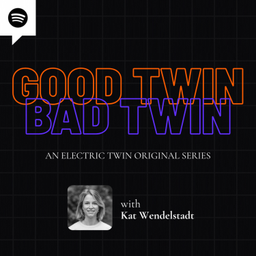
Good Twin Bad Twin | An Electric Twin original series
Electric Twin
5.0from 2 ratings
- 8
- Episodes
- 2
- Ratings
- Weekly
- Cadence
- 2026
- First episode
About Good Twin Bad Twin | An Electric Twin original series
Good Twin, Bad Twin is a podcast where marketing, insight and product leaders argue with themselves. Each guest brings two picks per round: the work their good twin defends in public, and the one their bad twin loved and could never justify. Then they make the case for both. Hosted by Kat Wendelstadt, CMO at Electric Twin.
- Publisher
- Electric Twin
- Category
- business
- Language
- en
- Explicit
- No
- First episode
- 7 Sept 2026
- Latest episode
- 29 Oct 2026
Latest episodes
8 episodes in the feed.
29 Oct 2026
EP 8 - Elena Bersadschi (Rotageek)
Summary Elena Bersadschi, Chief Marketing Officer at Rotageek and Breathe, leads marketing, partner marketing and sales across PE-backed B2B SaaS businesses. She shares how to run bold, market-moving campaigns, build trust for brand investment in private equity, find overlooked audiences, and learn from both successful and failed creative work. Keywords B2B SaaS marketing, private equity marketing, CMO, brand investment, GTM strategy, demand generation, campaign strategy, audience research, marketing leadership Key topics Elena’s route from finance studies and a Facebook marketing science internship into data-driven marketing leadership. Her approach to running marketing, partner marketing and sales together around commercial outcomes. Breathe’s market moment campaign: product launches, an online event with 3,000 sign-ups and about 2,000 attendees, and customer retention signals. Why she wants to test verticalised messaging in care, manufacturing and construction, and explore managers as an end-user audience. How to secure private equity support for brand investment through shared definitions, bounded experiments, weekly signals and tailored readouts. What Elena admires in Legora’s human, customer-centred brand and HubSpot’s audience understanding. Lessons from KFC’s candid chicken-shortage campaign and Bumble’s culturally misjudged campaign, including the need for diverse perspectives in decision-making. Her advice to stop waiting for perfection, launch, learn, and improve by 1% each day. Takeaways Choose roles by whether the work will be fun and give you something new to learn. Marketing gets more useful when it is data-driven. When marketing alone can’t move market share, treat it as a GTM problem the whole business solves together. Bold B2B campaigns take bravery, and talking with other marketers builds the courage to try them. With AI tools, limited resources are no longer an excuse not to personalise. Regular readouts are what most marketers miss when testing new spend. Framing is the most important thing to get right when seeking buy-in. Brands that keep the customer at the centre earn trust. Diverse voices in the room help campaigns avoid cultural missteps. Aim to be 1% better every day. Key frameworks Market moment campaign Brand investment as a bounded experiment with weekly readouts One-percent-better learning loop Action items Name the campaign’s strategic ambition so teams understand the market change it is meant to drive. Align finance and leadership on what brand investment means before proposing spend. Frame brand activity as a time-limited experiment with a clear hypothesis, budget and outcome measures. Review early signals weekly and share readouts in the formats decision-makers use. Test verticalised messaging and manager-focused journeys when budget and business stage support longer conversion paths. Launch work before it feels perfect, then use evidence and outside perspectives to improve the next iteration. Sound bites “We had 2,000 attendees online on the day” “But it takes bravery to do it.” “Framing is number one most important thing to get right when trying to get the buy in.” Chapters 00:00 Elena Bersadschi’s remit across PE-backed SaaS 01:26 From finance to marketing science and the CMO seat 04:34 Balancing directness with empathy as a leader 07:04 The Breathe market moment: 3,000 sign-ups and 2,000 attendees 13:38 A bold HR brand idea built around breathing 15:20 Verticalisation, managers, and overlooked audience needs 19:23 Making the case for brand investment in private equity 24:12 Why Elena admires Legora and HubSpot 27:31 KFC’s candid response and Bumble’s campaign misstep 32:12 Stop waiting for perfect: improve by 1% and launch Guest links Elena Bersadschi on LinkedIn: https://www.linkedin.com/in/elenabersadschi/ (https://www.linkedin.com/in/elenabersadschi/) Rotageek: https://www.rotageek.com (https://www.rotageek.com) Breathe: https://www.breathehr.com (https://www.breathehr.com)
28 Oct 2026
EP 7 - Mark Edwards (Thriva)
Summary Mark Edwards leads brand and product marketing at UK healthcare company Thriva and has worked across EA, Starbucks, Zillow and Redpin. He explains how to reposition established brands, evaluate customers outside the ideal customer profile, and use customer truth and simple brand principles instead of rigid playbooks. Keywords product marketing, brand strategy, brand repositioning, ideal customer profile, ICP possibles, customer insight, brand principles, marketing leadership, Monzo, Liquid Death Key topics Edwards argues that diverse category experience builds curiosity, while domain expertise can become outdated or constrain innovation. Across Starbucks, Zillow and Thriva, his recurring challenge has been expanding what a leading brand means without abandoning its existing strengths. He describes “ICP possibles”: fringe customers who do not match the ideal customer profile but may still be profitable or strategically important. To assess fringe audiences, consider profitability, competitor ability to serve them, lifetime value through sub-segmentation, and effects on target-customer perception. Edwards rejects neat, one-size-fits-all product marketing and brand playbooks. Start with the business problem, explore it with stakeholders and customers, and build solutions against measurable goals. Product marketers should examine direct competitors, indirect alternatives and doing nothing, then use customer conversations and the five whys to uncover differentiated value. A core responsibility is communicating consumer truths internally so teams can make informed product, positioning and brand decisions. He recommends clear brand principles as a practical decision filter, citing Thriva’s “focus, real life and momentum” and Zillow’s “possibilities, understanding, and progress.” Edwards admires Monzo’s consistent brand expression and Liquid Death’s bold differentiation in a commoditised category. Takeaways “at best there is a shelf life for domain expertise” “your best work comes when you have massive amounts of energy, of passion, of commitment, of engagement.” “how do we try to get this brand meaning more without meaning less” “they don’t show up as your target today on the slide decks that you’re creating in the strategic documents.” “can you profitably serve the needs of this audience?” “the work is messier than any clean framework can convey.” “identifying the business problem, exploring that problem with an open mind” “telling that consumer truth to the rest of the organisation.” “a clear set of brand principles which serve as the filter through which all decisions are ideally made.” “marketing beyond anything is a team sport” Key frameworks ICP possibles Thriva brand principles: focus, real life and momentum Zillow brand principles: possibilities, understanding and progress The five whys Action items For an audience outside the ICP, test whether you can serve it profitably, whether competitors can, whether sub-segments have healthy lifetime value, and whether serving it affects target-customer perceptions. Start strategy work by defining the business problem, exploring it with customers and stakeholders, and grounding solutions in quantitative goals. Clarify a small set of brand principles and use them to guide campaigns, product decisions and partnerships. Sound bites “I love motion, I like innovation, I like action” “at best there is a shelf life for domain expertise” “marketing beyond anything is a team sport” Guest links Mark Edwards on LinkedIn: https://uk.linkedin.com/in/medwards84 (https://uk.linkedin.com/in/medwards84) Thriva: https://thriva.co (https://thriva.co)
28 Oct 2026
EP 6 - Barry Hott (URL Love It)
Summary Barry Hott has managed more than $600 million in paid social since 2008, and he still works inside the ad account. He explains why going deep in one channel beats being a generalist, why “ugly” ads win on relevance, and how letting the algorithm find buyers turned up audiences he would never have targeted by hand. He also talks about asking “why” until inherited rules fall apart, getting comfortable with failure, and the Disaronno ad that changed his behaviour years after he saw it. Keywords performance marketing, paid social, ugly ads, Meta ads, creative testing, audience targeting, algorithmic targeting, niche expertise, brand strategy Key topics Why niche expertise beats being a generalist What “ugly” ads are and why they work Letting the algorithm find audiences you would miss Questioning inherited marketing rules Relevance as the core of social advertising Creative diversity and placing more bets Comfort with failure as a growth habit Why some ad impact can never be attributed Takeaways Going deep in one channel builds expertise that generalists can’t match. Ugly ads are about matching what your audience already watches, not about looking bad for its own sake. Broad targeting lets the algorithm find buyers you would never pick manually, such as women buying men’s jeans as gifts. Keep asking why until you find the real reason behind a habit. Often there isn’t one. Judge ads by where the system spends, not by CPA or ROAS at ad level. Negative ad comments show you why people don’t buy. Sound bites “Making ugly ads isn’t about making the ugliest possible ad. It’s about making ads less pretty than you want to as a marketer.” “This is all a game of relevance. Marketing and advertising. This is all just about relevance now.” “It’s not just about why did people buy, it’s about why did people not buy and how do I go and listen to that and fix that.” “Harnessing that like desire to fail and that comfort with failure, that is like what I’m all about.” Chapters 00:00 Introduction to Barry Hott and his background 01:12 Why Barry stays in ad accounts and his passion for marketing 03:28 The value of niche expertise versus being a generalist 04:04 Good twin, bad twin: Barry’s self-awareness in marketing 06:16 The importance of challenging marketing norms and beliefs 08:14 How to rip up the rule book and find the truth 12:14 Defending the concept of ugly campaigns and their success 15:20 Maintaining brand authenticity at scale 16:38 The power of algorithmic audience discovery 20:37 The influence of social media bubbles and relevance 22:51 Balancing mass and personalised advertising 24:16 The importance of testing, failure and iteration 25:41 Challenging beliefs about brand and product perception 30:16 Favourite brands and guilty pleasures 36:17 A memorable ad: Disaronno on the rocks 39:38 Recommendations for further learning and resources Guest links Barry Hott on LinkedIn: https://www.linkedin.com/in/binghott/ (https://www.linkedin.com/in/binghott/) Barry Hott on YouTube: https://www.youtube.com/BarryHott (https://www.youtube.com/BarryHott) URL Love It: https://urlloveit.com (https://urlloveit.com) Electric Twin: https://www.electrictwin.com/ (https://www.electrictwin.com/)
20 Oct 2026
EP 5 - Ekaterina Gamsriegler (DataCamp)
Summary Ekaterina Gamsriegler shares her journey from interpreting to growth marketing. She explains why research and user intent matter, and why ethical growth tactics pay off. The episode covers how to build an authentic brand, put user insights to work, and compete in a crowded market. Keywords growth marketing, user research, brand building, ethical tactics, user onboarding, campaign strategy, product growth, user segmentation, brand storytelling, marketing ethics Key topics Transferable skills from interpreting to growth marketing The importance of research and understanding user intent Ethical growth tactics and their impact on conversion Strategies for optimising onboarding and paywalls The role of brand storytelling and design in marketing Identifying and targeting key user segments The influence of company culture on growth strategies The challenges of measuring brand impact and virality Practical advice for hiring growth and marketing leaders Guest name Ekaterina Gamsriegler Sound bites “Most companies do that and it backfires” “Partnerships should be more about collaboration than rivalry” “You can’t copy someone else’s brand and make it yours” Chapters 00:00 Introduction to Ekaterina Gamsriegler and her background 01:50 Skills from interpreting that influence growth marketing 04:31 The good and bad sides of personality in growth 06:51 Playing by the rules and its effect on conversion 09:21 Defending successful campaigns and learning from failures 13:23 Understanding different user segments and their behaviours 17:22 Ekaterina’s favourite research methodology 20:22 Brands Ekaterina admires and their storytelling 23:17 A piece of work that Ekaterina would take to a desert island 26:08 Mentoring and advice for growth and marketing leaders Guest links LinkedIn: https://www.linkedin.com/in/ekaterina-shpadareva-gamsriegler/ (https://www.linkedin.com/in/ekaterina-shpadareva-gamsriegler/)
20 Oct 2026
EP 4 - Nick Baines (Nara Communications)
Summary In this episode, Nick Baines, CEO and co-founder of Nara Communications, talks about building impact-driven organisations, why simple campaign ideas work, and why trust in media matters. We get into how ambition shapes success, what he learned from campaigns that worked and ones that didn’t, and where trusted sources fit in a noisy information landscape. Keywords PR, impact-driven, campaigns, trust, AI, storytelling, branding, media, marketing, leadership Key topics Impact-driven organisations Simplicity in campaign ideas Trust in media and journalism Lessons from successful and failed campaigns The role of ambition and risk in marketing Takeaways Simple ideas are often the most effective in campaigns. Trust in established media sources still matters. Ambition can drive success but can also lead to overreach. Understanding local market nuances is vital for campaign success. Meaningful marketing requires taking risks. Sound bites “Overambition can be both a strength and a weakness.” “Simplicity is underrated in creativity.” “A dislike button could balance how we measure impact.” Chapters 00:00 Introduction to Nick Baines and his background 01:40 Why Nick built his own agency instead of working inside an existing one 03:48 The concept of the good and bad selves and the trait of overambition 07:32 A campaign Nick is proud of: AI text verification and exposing white paper fraud 08:59 A campaign that didn’t succeed: 3D printing guns from confiscated firearms 10:39 How to evaluate good and bad campaign ideas 12:13 The importance of trust and trusted sources in a noisy information environment 15:07 The role of hunches and principles in decision-making 18:18 A brand Nick loves: Patagonia and impact-driven business principles 19:41 A guilty pleasure brand: LinkedIn as a marketing tool 21:12 A memorable piece of work: The remote attendance of a child via a robot in football 22:55 Nick’s advice for founders and upcoming journalists 24:25 Details about the upcoming journalism prize with Sifted Guest links Nick Baines on LinkedIn: https://www.linkedin.com/in/nicholasbaines/ Nara Communications: https://www.naracommunications.com (https://www.naracommunications.com)
25 Sept 2026
EP 3 - Amir Jirbandey (Personio)
Summary Amir Jirbandey, Head of International Marketing at Personio, joins Kat Wendelstadt, CMO at Electric Twin, to talk about his path from a computer science degree into demand generation. He explains how he decides when to be a player and when to be a coach, and walks through the ABM playbook his team is about to launch. He also covers why UK and Ireland became a priority market, how PR helped Papercup sell AI dubbing before the category existed, and why he won't scale a motion without two or three solid case studies. Keywords Demand Generation, B2B Marketing, Campaign Strategy, Data-Driven Marketing, Startup Growth, Demand Generation Campaigns, Market Segmentation, AI in Marketing, Demand Generation Hunches, Marketing Best Practices Key topics Amir's journey from computer science to demand generation The player-coach mental model in team management Successful demand generation campaigns and their strategies Using data and AI to inform marketing decisions Market segmentation and identifying high-potential territories The importance of proof points and case studies before scaling The role of PR and brand awareness in demand generation Methodologies for understanding ICP and messaging Rules in B2B marketing and received wisdom Favourite content and lessons learned from industry research Sound bites "Knowing when to be the coach or the player" "Never go in with a GTM motion until you have at least two or three solid case studies" "Getting underneath the skin of the customer" Chapters 00:00 Introduction to Amir Jirbandey and his background 01:25 Amir's journey from computer science to demand generation 04:13 The good twin and bad twin: self-management in teams 08:25 Defending a successful campaign and learning from failures 09:03 Building and executing high-impact ABM campaigns 11:00 Curated marketing: less is more in demand generation 12:35 Market segmentation: proven and potential markets 15:07 Launching AI-driven demand generation at Papercup 18:57 Methodologies for understanding ICP and messaging 20:38 Rules and received wisdom in B2B marketing 23:20 Favourite content: Jobs to be Done research 25:22 Advice for startups and demand generation experts Guest links Amir Jirbandey on LinkedIn: https://www.linkedin.com/in/ajirbandey/ (https://www.linkedin.com/in/ajirbandey/) Personio: https://www.personio.com (https://www.personio.com/)
11 Sept 2026
EP 2 - Lisa Kennelly (Klarna)
Summary Lisa Kennelly has run growth at Clue, Fishbrain, and now Klarna, after starting out as a sports journalist. She talks through what customer insight actually looks like in practice, why the data only takes you so far, and the role serendipity plays in finding an audience you weren't looking for. Keywords growth marketing, customer insights, product marketing, consumer psychology, brand strategy, startup growth, mobile apps, community, serendipity in marketing Key topics From journalism to product marketing How serendipity surfaces new audiences Data-driven decisions versus gut instinct Customer insight and its effect on product development Testing hypotheses and learning from failures Brand building and storytelling Community and social proof as growth levers How AI is changing discovery channels Sound bites "If there's no organic traction, there's no spark." "People who split their payments feel more in control." "You never own a Patek Philippe, you take care of it for the next generation." Chapters 00:00 Introduction and background 01:15 An unconventional route from journalism to startups 02:30 The twin analogy: good self versus bad self 06:06 Case studies: Clue and Fishbrain 07:12 Understanding the core problem you're solving 12:15 Finding new audiences through influencers 13:46 Creating room for serendipity in large organisations 15:00 Methodologies for audience discovery 16:26 Why customer interviews are harder than they look 17:19 Customer discovery at Klarna and what surprised her 20:11 The limits of data and the role of intuition 21:52 Brand campaigns and the power of storytelling 23:23 Guilty pleasures and admired brands 24:49 Memorable campaigns and past lessons 27:11 Getting mentorship and outside perspective 28:32 Closing thoughts
7 Sept 2026
EP 1 - Sara Gordon (Mother Root)
Summary Sara Gordon, Chief Growth Officer at Mother Root, unpacks brand positioning, creative systems, and what it takes for a challenger brand to get noticed. She explains why she leans contrarian, and why execution velocity beats a perfect plan. Keywords brand positioning, creative systems, marketing strategy, growth, challenger brands, campaigns versus systems, AI in marketing, women's health, semiotics, marketing innovation Key topics Why positioning matters and how to align leadership around it Creative systems versus one-off campaigns Using customer insight and semiotics to build distinctiveness Balancing data-driven and intuitive decisions How AI and trend-driven creativity are reshaping marketing Case studies: Bloom & Wild's Mother's Day campaign, Flo's repositioning The good twin / bad twin dichotomy in decision-making Culture and taste as creative inputs Laying systematic foundations before the big campaign Controversy and attention in modern marketing Sound bites "Positioning is fundamental in marketing because it frames your business." "Creative is having its moment again, driven by AI flooding the market." "Attention in marketing is becoming more extreme and divisive." Chapters 00:00 Introduction and background 02:07 Why positioning matters and how to align leadership 03:20 Positioning in a fast-moving AI market 04:30 Using customer insight to define your position 06:10 The good twin and the bad twin 08:35 Creative systems versus campaigns 17:16 Attention versus communication 20:19 Repositioning Flo from period tracker to women's health platform 24:59 Admired brands and guilty pleasures 30:16 Desert island work: the ZOE podcast 31:33 Sara's offerings and advice for brands
Reach and audience
Public platform figures. Ratings count people who left a rating, not total listeners.
- Spotify
- 5.0 / 5
- 2 ratings
Contact Good Twin Bad Twin | An Electric Twin original series
- Guest appearances
- Books guests
Based on episode analysis; this does not confirm that the show is currently accepting guests.
Host of Good Twin Bad Twin | An Electric Twin original series?
Claim your podcast to manage its listing and keep your show details accurate.
Pod Engine is an independent podcast discovery and analytics service and is not affiliated with or endorsed by this podcast. Artwork and show content belong to their owners. Full legal notice.
Explore this show
Podcast research with Pod Engine