“Gradient Descent" is a podcast that delves into the depths of artificial intelligence and data science. Hosted by Vishnu Vettrivel (Founder of Wisecube AI) and Alex Thomas (Principal Data Scientist), the show explores the latest trends, innovations, and practical applications in AI and data science. Join us to learn more about how these technologies are shaping our future.
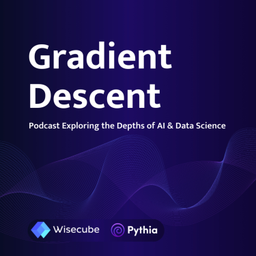
Gradient Descent - Podcast about AI and Data
Claim This Podcastby Wisecube AI
2.0(2 reviews)
6 episodes
Updated Daily
Accepts GuestsHas Sponsors
26
Podcast Authority
BetaPoorBased on show quality, social media presence, reviews, charts, and more

Quality51
Social0
YouTube0
Engagement0
Podcast Overview
“Gradient Descent" is a podcast that delves into the depths of artificial intelligence and data science. Hosted by Vishnu Vettrivel (Founder of Wisecube AI) and Alex Thomas (Principal Data Scientist), the show explores the latest trends, innovations, and practical applications in AI and data science. Join us to learn more about how these technologies are shaping our future.
Language
🇺🇲
Publishing Since
3/6/2025
Unlock The Full Podcast Authority Score Report
See how your podcast performs across key metrics
26
Podcast Authority
BetaPoorBased on show quality, social media presence, reviews, charts, and more
Quality51
Social0
YouTube0
Engagement0
6
Excellent Areas
2
Good Performance
11
Growth Opportunities
excellent
Episode Length
36 minutes
Performing excellently!
good
Publishing Consistency
Every 15 days
Recommendations available
Unlock the full report to see detailed tips
poor
Episode Thumbnails
Recommendations available
Unlock the full report to see detailed tips
+16 More Metrics
Unlock comprehensive insights including:
- • YouTube presence analysis
- • Social media reach metrics
- • RSS compliance scoring
- • Podcast 2.0 features
- • Technical standards
What's Included in Your Full Report
Detailed Analytics
- Complete breakdown of all 19 authority metrics
- Personalized recommendations for each metric
- Industry benchmarks and comparisons
- Technical RSS feed analysis and compliance scoring
Growth Strategies
- Step-by-step action plans for improvement
- Quick wins to boost your score immediately
- Pro tips from successful podcasters
Get your free podcast insights report
See how your show performs across every key metric
Instant delivery
No spam
Attract Better Guests
High authority scores make your podcast more attractive to industry leaders and influencers who want to appear on credible shows.
Secure Sponsorships
Sponsors look for podcasts with proven authority and engagement. Your score demonstrates your podcast's value to potential partners.
Grow Your Audience
Understanding your strengths and weaknesses helps you make data-driven decisions to expand your listener base effectively.
1 verified contact email on file for Gradient Descent - Podcast about AI and Data
Pitch yourself as a guest, propose sponsorships, or reach out directly to the host.
Recent Episodes
June 3, 2025
A History of NLP and Wisecube’s AI Journey
Vishnu and Alex recount Wisecube's AI journey, highlighting milestones in NLP development, knowledge graphs, and healthcare applications, while reflecting on the evolution of AI; this is an interview.
May 13, 2025
LLM Fine-Tuning: RLHF vs DPO and beyond
<p>In this episode of Gradient Descent, we explore two competing approaches to fine-tuning LLMs: Reinforcement Learning with Human Feedback (RLHF) and Direct Preference Optimization (DPO). Dive into the mechanics of RLHF, its computational challenges, and how DPO simplifies the process by eliminating the need for a separate reward model. We also discuss supervised fine-tuning, emerging methods like Identity Preference Optimization (IPO) and Kahneman-Tversky Optimization (KTO), and their real-world applications in models like Llama 3 and Mistral. Learn practical LLM optimization strategies, including task modularization to boost performance without extensive fine-tuning. </p><p><br></p><p>Timestamps:</p><p>Intro - 0:00</p><p>Overview of LLM Fine-Tuning - 00:48</p><p>Understanding RLHF</p><p>Deep Dive into RLHF - 02:46</p><p>Supervised Fine-Tuning vs. RLHF - 10:38</p><p>DPO and Other RLHF Alternatives - 14:43</p><p>Real-World Applications in Frontier Models - 22:23</p><p>Practical Tips for LLM Optimization - 25:18</p><p>Closing Thoughts - 36:05</p><p><br></p><p>References:</p><p>[1] Training language models to follow instructions with human feedback https://arxiv.org/abs/2203.02155</p><p>[2] Direct Preference Optimization: Your Language Model is Secretly a Reward Model https://arxiv.org/abs/2305.18290 </p><p>[3] Hugging Face Blog on DPO: Simplifying Alignment: From RLHF to Direct Preference Optimization (DPO) https://huggingface.co/blog/ariG23498/rlhf-to-dpo</p><p>[4] Comparative Analysis: RLHF and DPO Compared https://crowdworks.blog/en/rlhf-and-dpo-compared/</p><p>[5] YouTube Explanation: How to fine-tune LLMs directly without reinforcement learning https://www.youtube.com/watch?v=k2pD3k1485A</p><p><br></p><p>Listen on:</p><p>• Apple Podcasts: </p><p>https://podcasts.apple.com/us/podcast/gradient-descent-podcast-about-ai-and-data/id1801323847</p><p>• Spotify: </p><p>https://open.spotify.com/show/1nG58pwg2Dv6oAhCTzab55</p><p>• Amazon Music: </p><p>https://music.amazon.com/podcasts/79f6ed45-ef49-4919-bebc-e746e0afe94c/gradient-descent---podcast-about-ai-and-data</p><p><br></p><p>Our solutions:</p><p>- https://askpythia.ai/ - LLM Hallucination Detection Tool</p><p>- https://www.wisecube.ai - Wisecube AI platform for large-scale biomedical knowledge analysis</p><p><br></p><p>Follow us: </p><p>- Pythia Website: https://askpythia.ai/</p><p>- Wisecube Website: https://www.wisecube.ai</p><p>- LinkedIn: https://www.linkedin.com/company/wisecube/ </p><p>- Facebook: https://www.facebook.com/wisecubeai</p><p>- Twitter: https://x.com/wisecubeai</p><p>- Reddit: https://www.reddit.com/r/pythia/</p><p>- GitHub: https://github.com/wisecubeai</p><p><br></p><p>#FineTuning #LLM #DeepLearning #RLHF #DPO #AI #MachineLearning #AIDevelopment</p>
April 29, 2025
The Future of Prompt Engineering: Prompts to Programs
<p>Explore the evolution of prompt engineering in this episode of Gradient Descent. Manual prompt tuning — slow, brittle, and hard to scale — is giving way to DSPy, a framework that turns LLM prompting into a structured, programmable, and optimizable process. </p><p>Learn how DSPy’s modular approach — with Signatures, Modules, and Optimizers — enables LLMs to tackle complex tasks like multi-hop reasoning and math problem solving, achieving accuracy comparable to much larger models. We also dive into real-world examples, optimization strategies, and why the future of prompting looks a lot more like programming. </p><p><br></p><p>Listen to our podcast on these platforms: </p><p>• <a href="https://youtube.com/@WisecubeAI/podcasts" target="_blank" rel="ugc noopener noreferrer">YouTube</a>: https://youtube.com/@WisecubeAI/podcasts </p><p>• <a href="https://podcasts.apple.com/us/podcast/gradient-descent-podcast-about-ai-and-data/id1801323847" target="_blank" rel="ugc noopener noreferrer">Apple Podcasts</a>: https://apple.co/4kPMxZf </p><p>• <a href="https://open.spotify.com/show/1nG58pwg2Dv6oAhCTzab55" target="_blank" rel="ugc noopener noreferrer">Spotify</a>: https://open.spotify.com/show/1nG58pwg2Dv6oAhCTzab55 </p><p>• <a href="https://music.amazon.com/podcasts/79f6ed45-ef49-4919-bebc-e746e0afe94c/gradient-descent---podcast-about-ai-and-data" target="_blank" rel="ugc noopener noreferrer">Amazon Music</a>: https://bit.ly/4izpdO2 </p><p><br></p><p>Mentioned Materials: </p><p>• <a href="https://youtube.com/@WisecubeAI/podcasts" target="_blank" rel="ugc noopener noreferrer">DSPy Paper</a> - https://arxiv.org/abs/2310.03714 </p><p>• <a href="https://dspy.ai/ " target="_blank" rel="ugc noopener noreferrer">DSPy official site</a> - https://dspy.ai/ </p><p>• <a href="https://github.com/stanfordnlp/dspy" target="_blank" rel="ugc noopener noreferrer">DSPy GitHub</a> - https://github.com/stanfordnlp/dspy </p><p>• <a href="https://www.twosigma.com/articles/a-guide-to-large-language-model-abstractions/" target="_blank" rel="ugc noopener noreferrer">LLM abstractions guide</a> - https://www.twosigma.com/articles/a-guide-to-large-language-model-abstractions/ </p><p><br></p><p>Our solutions: </p><p>- https://askpythia.ai/ - <a href="https://askpythia.ai/ " target="_blank" rel="ugc noopener noreferrer">LLM Hallucination Detection Tool</a> </p><p>- https://www.wisecube.ai - <a href="https://www.wisecube.ai" target="_blank" rel="ugc noopener noreferrer">Wisecube AI</a> platform for large-scale biomedical knowledge analysis </p><p><br></p><p>Follow us: </p><p>- <a href="https://askpythia.ai/" target="_blank" rel="ugc noopener noreferrer">Pythia Website</a>: https://askpythia.ai/ </p><p>- <a href="https://www.wisecube.ai" target="_blank" rel="ugc noopener noreferrer">Wisecube Website</a>: https://www.wisecube.ai </p><p>- <a href="https://www.linkedin.com/company/wisecube/" target="_blank" rel="ugc noopener noreferrer">LinkedIn</a>: https://www.linkedin.com/company/wisecube/ </p><p>- <a href="https://www.facebook.com/wisecubeai" target="_blank" rel="ugc noopener noreferrer">Facebook</a>: https://www.facebook.com/wisecubeai </p><p>- <a href="https://x.com/wisecubeai" target="_blank" rel="ugc noopener noreferrer">Twitter</a>: https://x.com/wisecubeai </p><p>- <a href="https://www.reddit.com/r/pythia/" target="_blank" rel="ugc noopener noreferrer">Reddit</a>: https://www.reddit.com/r/pythia/ </p><p>- <a href="https://github.com/wisecubeai" target="_blank" rel="ugc noopener noreferrer">GitHub</a>: https://github.com/wisecubeai </p><p><br></p><p>#AI #PromptEngineering #DSPy #MachineLearning #LLM #ArtificialIntelligence #AIdevelopment</p>
6 total episodes available
Deep-dive analytics for Gradient Descent - Podcast about AI and Data
Frequently asked questions
Have a different question and can't find the answer you're looking for? Reach out to our support team by sending us an email and we'll get back to you as soon as we can.
- What is Gradient Descent - Podcast about AI and Data?
- How often does this podcast release new episodes?
This podcast updates daily.
- Where can I listen to this podcast?
This podcast is available on 4 platforms including Apple Podcasts, Spotify, and more. You can also use the RSS feed directly.
- Does this podcast accept guests?
Yes, this podcast regularly features guests.
Legal Disclaimer
Pod Engine is not affiliated with, endorsed by, or officially connected with any of the podcasts displayed on this platform. We operate independently as a podcast discovery and analytics service.
All podcast artwork, thumbnails, and content displayed on this page are the property of their respective owners and are protected by applicable copyright laws. This includes, but is not limited to, podcast cover art, episode artwork, show descriptions, episode titles, transcripts, audio snippets, and any other content originating from the podcast creators or their licensors.
We display this content under fair use principles and/or implied license for the purpose of podcast discovery, information, and commentary. We make no claim of ownership over any podcast content, artwork, or related materials shown on this platform. All trademarks, service marks, and trade names are the property of their respective owners.
While we strive to ensure all content usage is properly authorized, if you are a rights holder and believe your content is being used inappropriately or without proper authorization, please contact us immediately at hey@podengine.ai for prompt review and appropriate action, which may include content removal or proper attribution.
By accessing and using this platform, you acknowledge and agree to respect all applicable copyright laws and intellectual property rights of content owners. Any unauthorized reproduction, distribution, or commercial use of the content displayed on this platform is strictly prohibited.