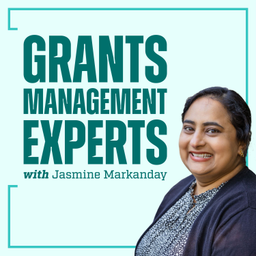
Grants Management Experts
Claim This Podcastby Jasmine Markanday
Podcast Authority
Beta
Podcast Overview
<p>If you're looking to excel in grant management and maximize your grant funds' potential, then you should definitely check out Jasmine Markanday's podcast. In the Grants Management Expert Podcast, Jasmine shares her insights and expertise on various aspects of grant management, including tips, tricks, and best practices. Tune in to learn how to navigate the world of grants management and take your grant funding to new heights.</p>
Language
🇺🇲
Publishing Since
10/4/2023
Unlock The Full Podcast Authority Score Report
See how your podcast performs across key metrics
Podcast Authority
Beta
Recommendations available
Unlock the full report to see detailed tips
Recommendations available
Unlock the full report to see detailed tips
Unlock comprehensive insights including:
- • YouTube presence analysis
- • Social media reach metrics
- • RSS compliance scoring
- • Podcast 2.0 features
- • Technical standards
Detailed Analytics
- Complete breakdown of all 19 authority metrics
- Personalized recommendations for each metric
- Industry benchmarks and comparisons
- Technical RSS feed analysis and compliance scoring
Growth Strategies
- Step-by-step action plans for improvement
- Quick wins to boost your score immediately
- Pro tips from successful podcasters
See how your show performs across every key metric
High authority scores make your podcast more attractive to industry leaders and influencers who want to appear on credible shows.
Sponsors look for podcasts with proven authority and engagement. Your score demonstrates your podcast's value to potential partners.
Understanding your strengths and weaknesses helps you make data-driven decisions to expand your listener base effectively.
1 verified contact email on file for Grants Management Experts
Pitch yourself as a guest, propose sponsorships, or reach out directly to the host.
Recent Episodes

October 8, 2025
Ep.8 - From Suspension to Termination: The Realities of Grant Noncompliance
In this season finale of Grants Management Experts, Jasmine Markanday wraps up Season 2 with one of the most crucial and often daunting areas of federal grant management: when things go wrong in federal grants.Under 2 CFR 200.339–343, Jasmine explains the federal remedies available when a recipient or subrecipient fails to comply with grant requirements from temporary suspensions to full terminations and how you can protect your organization through proactive compliance, strong internal controls, and effective communication.What You’ll Learn in This Episode The consequences of non-compliance:How federal agencies can withhold payments, disallow costs, or suspend/terminate awardsThe impact of termination listings in SAM.gov and how it affects future funding opportunities Understanding termination:The three ways termination can occur: by the agency, mutual consent, or by the recipientWhat a termination notice must include reasons, effective dates, and scopeWhy transparency and procedural fairness (2 CFR 200.341–.342) matter in the appeals process The financial impact:What happens to costs incurred during suspension or termination (hint: most are unallowable)The two limited exceptions that may apply How suspension or termination halts your ability to charge costs to the award How to protect your organization: Strengthening internal controls and training staffDocumenting compliance, communication, and corrective actionsUnderstanding your right to object, appeal, and provide evidence before termination decisions are finalKey TakeawaysKnow the risks: Non-compliance can lead to more than disallowed costs; it can result in termination, SAM.gov reporting for five years, and future funding loss.Act quickly: If you receive a notice, respond immediately and explore corrective actions.Prevention is everything: Strong internal controls, policies, and staff training are your best defense.Resources & Links2 CFR 200.339–343: Remedies for Non- ComplianceLearn more at markanday.consultingConnect with UsInstagram: @markandayconsultingLinkedIn: @markandayconsultingIf this episode was helpful, please share it with your colleagues and leave a review to help other grant professionals find the show. That’s a wrap for Season 2! Join Jasmine next season as she continues unpacking practical insights, compliance strategies, and expert guidance to help you stay informed and stay compliant.Quote to Remember: “Grants management isn’t just about going after the money, it's about protecting your organization, the communities you serve, and the trust they’ve placed in you.” - Jasmine Markanday

September 25, 2025
Ep. 7 - From Micro-Purchases to Formal Solicitations: 2 CFR 200 Procurement Standards
In this episode of Grants Management Experts, Jasmine dives into one of the most practical — and often misunderstood — areas of federal grant management: procurement standards under 2 CFR 200.320. Whether you’re a recipient, subrecipient, or grants professional supporting compliance, understanding procurement methods is critical for both cost allowability and audit readiness.What You’ll Learn in This EpisodeThe three procurement methods:Informal (micro-purchases & simplified acquisitions)Formal (sealed bids & proposals)Non-competitive (sole source under limited circumstances)Key thresholds you must know:Micro-purchase threshold: $10,000, increasing to $15,000 on October 1, 2025Simplified acquisition threshold: $250,000, rising to $350,000 in October 1, 2025Self-certification option to raise micro-purchase thresholds up to $50,000 — and the conditions requiredHow to apply each method:When micro-purchases are appropriate and how to document price reasonablenessConditions for sealed bids versus proposals under the formal methodSituations where sole sourcing is allowed — and the documentation requiredSpecial considerations:Procurement of architectural and engineering services through qualifications-based selectionState, local, or tribal rules that may further limit thresholdsThe importance of self-certification and internal risk assessmentsKey TakeawaysAlways align procurement decisions with written procedures that match both federal rules and your organization’s policies.Documentation is everything: from price reasonableness to risk assessments and self-certifications.Understand thresholds now — and prepare for the upcoming October 2025 changes.Remember: in grants management, fairness, competition, and compliance are the foundations of procurement.Resources & Links:2 CFR 200 Procurement StandardsLearn more at markanday.consultingConnect with Us:Instagram: @markandayconsultingLinkedIn: @markandayconsultingIf this episode was helpful, please share it with your colleagues and leave a review to help other grants professionals find the show.Stay tuned for next week’s SEASON FINALE episode, where Jasmine will continue breaking down essential compliance topics in federal grants management.Quote to Remember:“As a grant professional, it is your job to help your organization find the right method, apply it consistently, and document, document, document” — Jasmine Markanday

September 10, 2025
Ep. 6 - Drawing the Line: Understanding Direct Costs in Federal Grants
In this episode of Grants Management Experts, Jasmine Markanday breaks down one of the most critical concepts in federal grant compliance: direct costs. Guided by 2 CFR 200.413, Jasmine explains what qualifies as a direct cost, when certain costs can shift from indirect to direct, and why consistency is the cornerstone of compliance.From administrative staff salaries to minor purchases, unallowable costs, and nonprofit-specific considerations, this episode equips you with the clarity to correctly classify expenses and avoid compliance pitfalls. Whether you’re writing a grant budget or managing one post-award, this deep dive will help you protect your organization’s resources and credibility.What You’ll Learn:The definition of direct costs under 2 CFR 200.413 and how they differ from indirect costs.Key questions to ask when deciding if an expense is a direct cost.Special conditions for charging administrative and clerical salaries directly.How to handle minor items and apply consistent treatment.The role of unallowable costs in calculating indirect cost rates.Nonprofit-specific rules for member and client service activities.Key Takeaways:A cost is direct if it can be specifically tied to a grant’s objectives with accuracy.Consistency is non-negotiable—similar costs must be treated the same way across funding sources.Some typically indirect expenses (like cybersecurity upgrades) can be charged directly if they clearly support one grant.Administrative salaries may only be charged directly if they meet all three CFR conditions.Unallowable costs, while not chargeable, must still be included in the direct cost base for rate calculations.Pro Tip:Train your staff on cost classification policies—misclassification can lead to audit findings, repayment of funds, and loss of credibility.Connect with Us:Instagram: @markandayconsultingLinkedIn: @markandayconsultingEnjoyed this episode? Leave a review, subscribe, and share it with your grants team!Quote to Remember:“Direct costs aren’t just about accuracy—they’re about fairness to your organization, your funders, and the federal government.” — Jasmine Markanday
16 total episodes available
Similar Podcasts
Discover related shows you might enjoy
Deep-dive analytics for Grants Management Experts
Frequently asked questions
Have a different question and can't find the answer you're looking for? Reach out to our support team by sending us an email and we'll get back to you as soon as we can.
- What is Grants Management Experts?
<p>If you're looking to excel in grant management and maximize your grant funds' potential, then you should definitely check out Jasmine Markanday's podcast. In the Grants Management Expert Podcast, Jasmine shares her insights and expertise on various aspects of grant management, including tips, tricks, and best practices. Tune in to learn how to navigate the world of grants management and take your grant funding to new heights.</p> - How often does this podcast release new episodes?
This podcast updates inactive.
- Where can I listen to this podcast?
This podcast is available on 4 platforms including Apple Podcasts, Spotify, and more. You can also use the RSS feed directly.
- Does this podcast accept guests?
Yes, this podcast regularly features guests.
Legal Disclaimer
Pod Engine is not affiliated with, endorsed by, or officially connected with any of the podcasts displayed on this platform. We operate independently as a podcast discovery and analytics service.
All podcast artwork, thumbnails, and content displayed on this page are the property of their respective owners and are protected by applicable copyright laws. This includes, but is not limited to, podcast cover art, episode artwork, show descriptions, episode titles, transcripts, audio snippets, and any other content originating from the podcast creators or their licensors.
We display this content under fair use principles and/or implied license for the purpose of podcast discovery, information, and commentary. We make no claim of ownership over any podcast content, artwork, or related materials shown on this platform. All trademarks, service marks, and trade names are the property of their respective owners.
While we strive to ensure all content usage is properly authorized, if you are a rights holder and believe your content is being used inappropriately or without proper authorization, please contact us immediately at hey@podengine.ai for prompt review and appropriate action, which may include content removal or proper attribution.
By accessing and using this platform, you acknowledge and agree to respect all applicable copyright laws and intellectual property rights of content owners. Any unauthorized reproduction, distribution, or commercial use of the content displayed on this platform is strictly prohibited.