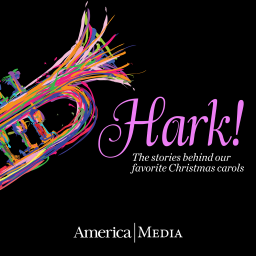
It’s the most wonderful time of the year! The cookies, the mistletoe, the lights...oh, and the music! For Christians, Christmas carols mark a season of hope and the celebration of Jesus’ birth. Even in popular culture, these iconic jingles capture a warmth, a cheer and a nostalgia that transcends religious belonging. But where do these beloved yuletide songs come from? What inspired the people who composed them? How did they become popular and even mainstream? And what impact do their ancient Christian messages have on an increasingly post-Christian culture? America Media presents “Hark!” a podcast on the meaning and the making of our most beloved Christmas carols and their time-honored traditions.

Hark! The stories behind our favorite Christmas carols
Claim This Podcastby America Media
Podcast Overview
It’s the most wonderful time of the year! The cookies, the mistletoe, the lights...oh, and the music! For Christians, Christmas carols mark a season of hope and the celebration of Jesus’ birth. Even in popular culture, these iconic jingles capture a warmth, a cheer and a nostalgia that transcends religious belonging. But where do these beloved yuletide songs come from? What inspired the people who composed them? How did they become popular and even mainstream? And what impact do their ancient Christian messages have on an increasingly post-Christian culture? America Media presents “Hark!” a podcast on the meaning and the making of our most beloved Christmas carols and their time-honored traditions.
Language
🇺🇲
Publishing Since
11/16/2021
1 verified contact email on file for Hark! The stories behind our favorite Christmas carols
Pitch yourself as a guest, propose sponsorships, or reach out directly to the host.
Recent Episodes

December 21, 2025
O Little Town of Bethlehem
“O Little Town of Bethlehem” has shaped how millions of English speakers imagine the Palestinian town where Jesus was born: a small place, still and peaceful, resting under the stars. The wars and struggles of recent decades invite us to question whether that image is true. And yet, “Bethlehem is still a very little town,” says Stephanie Saldaña, a writer and mother raising her family in this religiously and culturally diverse place. “It is a small place where everybody knows each other.” Still more striking is how closely the need that gave rise to the carol echoes the present moment. In 1865, after the Civil War devastated the United States, Philadelphia rector Phillips Brooks was broken by grief—Lincoln’s assassination and the loss of his younger brother to cholera while serving in the Union Army. Seeking solace, Brooks traveled to Bethlehem. What he found there—peace, stillness, God present in a small community—he later put into words and set to music as a carol for children who had lost fathers to war. [Is there a carol you'd love to hear on “Hark!”? Let us know in our listener survey.] Now, more than 150 years later, that same carol reaches those in the Holy Land today, reeling from pandemic and war—and far beyond—to offer us what it has always offered: stillness, God's presence, enduring hope. In this fifth season finale, host Maggi Van Dorn speaks with: Stephanie Saldaña, a writer, wife, and mother in Bethlehem, reflects on life in the place where Jesus was born—and on discovering the carol’s deepest truths amid war, COVID-19, and economic collapse. Rachel Wenner Gardner, rector of the Church of the Holy Trinity in Philadelphia where Phillips Brooks served, on his pilgrimage to the Holy Land and why he wrote this carol for children in the aftermath of Civil War. John French, former organist at Holy Trinity for 28 years, on the brilliance of Lewis Redner’s original tune and Ralph Vaughan Williams’s folk arrangement. Karen Swallow Prior, poet and retired English professor, on the theological depth hidden in Brooks’s poem. The music featured in this episode was generously gifted to “Hark!” Our thanks to Frank Tuson, Richard Gilewitz, Salt of the Sound, Smalltown Poets, St. Paul’s Boys Choir School, Cambridge, Mass., The Choir of King’s College, Cambridge, U.K., The Roches, and Tony Alonso, courtesy of GIA Publications, Inc. Our theme music was produced by Frank Tuson. Want short, inspiring Bible reflections every day during Advent and Christmas? This year, our Scripture Reflections are free for Hark! listeners—sign up at AmericaMagazine.org/hark. Love a good holiday brain-teaser? Our weekly Christmas carol trivia is exclusively for America subscribers. Take the fourth and final quiz of the season here! Or visit, AmericaMagazine.org/hark. Learn more about your ad choices. Visit megaphone.fm/adchoices

December 14, 2025
The First Noel
Did you know that when a ewe rejects her newborn lamb, the shepherd has only hours to convince her to nurse it—or the lamb will die? This is the work of shepherds—staying awake through the night when lambs are being born, watching closely, ready to step in and save them. It gives new meaning to the good shepherd. In this episode, host Maggi Van Dorn travels to a farm in Herefordshire, near the Welsh border, to understand shepherding, and discovers why God might have chosen shepherds to be the first to hear the good news. But shepherding is not all Maggi learned about for this episode. She has a firsthand learning experience too. After 30 years, she once again took up the fiddle, working with her teacher to discover why “The First Noel”—with its simple, stepwise melody—is the perfect carol for those just starting out or returning to music. She speaks with: Luke Timothy Johnson, a leading scholar of Luke’s Gospel and former Benedictine monk, on why God announces the incarnation first to shepherds—the poor and overlooked—who notice what others miss. Colin Britt, conductor and director of choral activities at Mount Holyoke College, on the word “Noel” (or “Nowell” in its original Cornish spelling) and why this carol’s repetitive structure helped it survive and spread through folk tradition. Austen Ivereigh, a papal biographer and writer who, with his wife Linda, tends sheep on a regenerative farm in Herefordshire, on what it takes to care for a flock and keep vigil through the night awaiting birth. The music featured in this episode was generously gifted to “Hark!” Our thanks to Colin Britt, Matt Isaac, The Grant High School Royal Blues directed by John Eisemann, Quincas Moreira, Salt of the Sound, The Maine All-Student Theater Project, Tony Alonso and GIA Publications, and Maggi’s fiddle teacher Nic Coker. Our theme music was produced by Frank Tuson. Want short, inspiring Bible reflections every day during Advent and Christmas? This year, our Scripture Reflections are free for Hark! listeners—sign up at AmericaMagazine.org/hark. Love a good holiday brain-teaser? Our weekly Christmas carol trivia is exclusively for America subscribers. Take the quiz here! Or visit, AmericaMagazine.org/hark. Learn more about your ad choices. Visit megaphone.fm/adchoices

December 7, 2025
Angels We Have Heard on High
We often imagine angels as gentle and serene. But in Scripture they arrive in blinding light and overwhelming sound—so much so that their first words are almost always “Do not be afraid.” These are the messengers who burst into the night sky to meet a group of poor, worn-out shepherds—outsiders who become the first to hear the news of Christ’s birth. “Angels We Have Heard on High” draws us into that holy night. Encounters with the divine rarely stay within the bounds of one language, and this carol embodies that truth. Born in French, welcomed into English, yet always held by one steady constant: the Latin refrain “Gloria in excelsis Deo.” According to French legend, shepherds sang that proclamation from field to field on Christmas Eve, their voices reaching person to person, place to place, echoing the angels announcing Christ’s birth to all. Maggi speaks with: Candida Moss, the Edward Cadbury Professor of Theology at the University of Birmingham, who explains why angels in Scripture inspire awe and fear, how the idea of guardian angels emerged later in Christian history and why God chose marginalized shepherds as the first recipients of the good news. Christopher Walker, an internationally renowned Los Angeles-based composer, conductor, choir director and liturgist, returns to his hometown in Bristol, England, where he directed music at Clifton Cathedral for years. From a friend’s recording studio, he deconstructs the carol’s musical architecture, showing how a single word in the Latin refrain unfurls across sixteen soaring notes to evoke the motion, echo and lift of angels in flight. Our thanks in this episode go to Armonico Consort; Vox Turturis and Andrew Gant of Signum Records; the Choir of King's College, Cambridge; Ricardo da Silva, S.J.; Derek Fiechter; the Gothard Sisters; Richard Gilewitz; Malukah; The Grant High School Royal Blues and John Eisemann; The Roches; Christopher Walker and OCP; Simon Wester; John Weston; and Anna, Fae, Frank and Genevieve Tuson. Our theme music was produced by Frank Tuson. Want short, inspiring Bible reflections every day during Advent and Christmas? This year, our Scripture Reflections are free for Hark! listeners—sign up at AmericaMagazine.org/hark. Love a good holiday brain-teaser? Our weekly Christmas carol trivia is exclusively for America subscribers. Take the second quiz here! Or visit, AmericaMagazine.org/hark. Learn more about your ad choices. Visit megaphone.fm/adchoices
24 total episodes available
Similar Podcasts
Discover related shows you might enjoy

The Spiritual Life with Fr. James Martin, S.J.
America Media

Another Name For Every Thing with Richard Rohr
Center for Action and Contemplation

Wait Wait... Don't Tell Me!
NPR

The Rest Is History
Goalhanger

The Moth
The Moth

Gastropod
Cynthia Graber and Nicola Twilley

Pod Save America
Pod Save America

Up First
NPR
Deep-dive analytics for Hark! The stories behind our favorite Christmas carols
Frequently asked questions
Have a different question and can't find the answer you're looking for? Reach out to our support team by sending us an email and we'll get back to you as soon as we can.
- What is Hark! The stories behind our favorite Christmas carols?
- How often does this podcast release new episodes?
This podcast updates weekly.
- Where can I listen to this podcast?
This podcast is available on 9 platforms including Apple Podcasts, Spotify, and more. You can also use the RSS feed directly.
- Does this podcast accept guests?
Information about guest appearances is not available.
Legal Disclaimer
Pod Engine is not affiliated with, endorsed by, or officially connected with any of the podcasts displayed on this platform. We operate independently as a podcast discovery and analytics service.
All podcast artwork, thumbnails, and content displayed on this page are the property of their respective owners and are protected by applicable copyright laws. This includes, but is not limited to, podcast cover art, episode artwork, show descriptions, episode titles, transcripts, audio snippets, and any other content originating from the podcast creators or their licensors.
We display this content under fair use principles and/or implied license for the purpose of podcast discovery, information, and commentary. We make no claim of ownership over any podcast content, artwork, or related materials shown on this platform. All trademarks, service marks, and trade names are the property of their respective owners.
While we strive to ensure all content usage is properly authorized, if you are a rights holder and believe your content is being used inappropriately or without proper authorization, please contact us immediately at hey@podengine.ai for prompt review and appropriate action, which may include content removal or proper attribution.
By accessing and using this platform, you acknowledge and agree to respect all applicable copyright laws and intellectual property rights of content owners. Any unauthorized reproduction, distribution, or commercial use of the content displayed on this platform is strictly prohibited.