

Harvesting the Truth shares true stories about our food. It's for people who want to know what are we eating and what it does it do to us. What exactly is in our food? What should we be eating to be healthiest? Can we heal with food? Can we prevent disease? Podcast host Michelle Adams is on a mission to discover the truth. As a former medical litigator who exited the system to dive into a food business, she realized that her family's chronic illnesses were caused by toxins in our food, personal care and household products. Join Michelle each week as she interviews the experts to find answers.
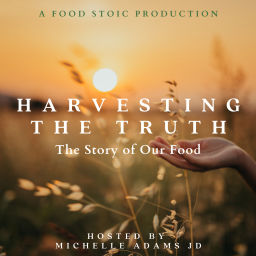
Harvesting the Truth
Claim This Podcastby Michelle Adams, J.D.
5.0(12 reviews)
21 episodes
Updated Inactive
Accepts GuestsHas SponsorsLocation 🇺🇸
Podcast Overview
Harvesting the Truth shares true stories about our food. It's for people who want to know what are we eating and what it does it do to us. What exactly is in our food? What should we be eating to be healthiest? Can we heal with food? Can we prevent disease? Podcast host Michelle Adams is on a mission to discover the truth. As a former medical litigator who exited the system to dive into a food business, she realized that her family's chronic illnesses were caused by toxins in our food, personal care and household products. Join Michelle each week as she interviews the experts to find answers.
Language
🇺🇲
Publishing Since
8/28/2023
1 verified contact email on file for Harvesting the Truth
Pitch yourself as a guest, propose sponsorships, or reach out directly to the host.
Recent Episodes
April 5, 2024
S1E20 Season One Wrap Up
<p>It's been a great season of harvesting the truth. My summation entails One sentence:</p> <p>Eat real food, mostly organic, that we cook at home.</p> <p>Send me a message at hello@foodstoic.com and leave a review on where you're listening!</p> <p><br></p>
March 27, 2024
S1E19 How We Got Here: A Conversation With Marion Nestle of Food Politics
<p>Today I am honored to feature Marion Nestle on the show. Marion is one of the most highly regarded voices in food nutrition and marketing. She has a Ph.D. in Molecular Biology and MPH in Public Health Nutrition. Her experience in this space is unmatched. She has taught at the university level since the 1960's, recently retiring from teaching in 2017. However, "retiring" means she now has more time to write--over 15 books and a daily blog called Food Politics.</p> <p>Here's the highlights of our conversation:</p> <p>Food companies market their products similar to how cigarette companies do.</p> <p>Food companies are businesses for profit. Thus, they need to continually grow their profit margins. That's hard to do in a competitive food environment where there's too much food--way more than the population needs.</p> <p>Thus, food companies focus on ultra processed foods. These are industrialized "foods" made from ingredients not real food. They are made cheap and sold for a high profit. They can stay on the shelf for a long time since they aren't real food. </p> <p>In the 1980's the shareholder value movement started. Deregulation started too. So food companies started to produce more food and found ways to get people to eat more. Bigger portions and an increased calorie count helped. Their junk food is so cheap to make because of corn and soybean subsidies. Know what's not subsidized? Healthy food. Organic Food. Know why? Because our federal entities are captured by the companies they are supposed to regulate. BUT then again, deregulation started in the 80's.</p> <p>So now 70% of Americans are overweight. 40% are obese. </p> <p>There is a direct correlation between bad food and poor health. </p> <p>What does this mean? Ultra-processed food is bad. Avoiding it is the one thing you can do that will have a big and positive impact on your health. </p> <p>There are not enough studies to show pesticides won't harm us. Additives too. So eat organic when possible.</p> <p><br></p> <p>If you want to read Marion's blog: www.foodpolitics.com</p> <p>@marionnestle</p> <p>To send me a message: hello@foodstoic.com</p> <p>Follow along on social at @thefoodstoic</p> <p><br></p>
March 12, 2024
S1E18 Lessons From Ancestral Ways of Eating With Mary Ruddick
<p>In today's episode I talk with Mary Ruddick. Dubbed the "Sherlock Holmes of Health" for her unique ability to expeditiously asses and remediate rare neuromuscular conditions that others have deemed impossible, Mary Ruddick is an ancestral nutritionist and experiential anthropologist who specializes in neuromuscular disorders, infertility, and disabling chronic disease. She can regularly be found endangering herself in the untouched corners of the world to learn from and distill the wisdom from the last remaining traditional cultures. She shares her findings and knowledge via her sought after keynote speeches, 100+ podcast appearances, her published articles, and her work both in front and behind the camera.</p> <p>Mary and I talk about her findings from visiting ancestral communities. Why are the members so healthy and happy? (compared to Americans where chronic illness is more common than good health and unhappiness is on the rise). Why do they live so long? (100 plus years is common, where here in America our life expectancy is declining). Is it the food, or something else? What do they eat? How do they eat? We delve into all of this in this episode.</p> <p>You can get in touch with Mary at www.maryruddick.com. If you have dysautonomia or another chronic illness and want to discuss your health with her, her website is enableyourhealing.com. Also follow her adventures on Instagram at @maryqueenofheart</p> <p>Sign up for The Food Stoic newsletter on Substack at https://msmichelleadams.substack.com/</p> <p>Every week I send out the Food Stoic newsletter. On Mondays I send out my Five For Food with five things about food to help you live a more intentional eating lifestyle.</p> <p>Send me an email at hello@msmichelleadams.com or follow me on social @thefoodstoic</p> <p> </p>
21 total episodes available
Similar Podcasts
Discover related shows you might enjoy
Deep-dive analytics for Harvesting the Truth
Frequently asked questions
Have a different question and can't find the answer you're looking for? Reach out to our support team by sending us an email and we'll get back to you as soon as we can.
- What is Harvesting the Truth?
- How often does this podcast release new episodes?
This podcast updates inactive.
- Where can I listen to this podcast?
This podcast is available on 2 platforms including Apple Podcasts, Spotify, and more. You can also use the RSS feed directly.
- Does this podcast accept guests?
No, this podcast does not typically feature guests.
Legal Disclaimer
Pod Engine is not affiliated with, endorsed by, or officially connected with any of the podcasts displayed on this platform. We operate independently as a podcast discovery and analytics service.
All podcast artwork, thumbnails, and content displayed on this page are the property of their respective owners and are protected by applicable copyright laws. This includes, but is not limited to, podcast cover art, episode artwork, show descriptions, episode titles, transcripts, audio snippets, and any other content originating from the podcast creators or their licensors.
We display this content under fair use principles and/or implied license for the purpose of podcast discovery, information, and commentary. We make no claim of ownership over any podcast content, artwork, or related materials shown on this platform. All trademarks, service marks, and trade names are the property of their respective owners.
While we strive to ensure all content usage is properly authorized, if you are a rights holder and believe your content is being used inappropriately or without proper authorization, please contact us immediately at hey@podengine.ai for prompt review and appropriate action, which may include content removal or proper attribution.
By accessing and using this platform, you acknowledge and agree to respect all applicable copyright laws and intellectual property rights of content owners. Any unauthorized reproduction, distribution, or commercial use of the content displayed on this platform is strictly prohibited.