- 30
- Episodes
- Bi-weekly
- Cadence
- 2025
- First episode
About Herding Squirrels
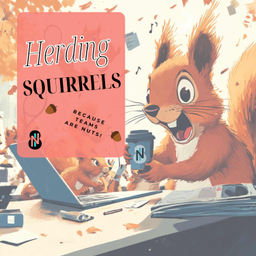
Ever tried to get a group of squirrels to move in the same direction? Welcome to modern teamwork! Herding Squirrels is a podcast that explores the chaotic, wonderful, and sometimes maddening world of teams in our hyperconnected age. From Slack notifications pinging like acorns falling from a tree to the constant scatter of competing priorities, we dive into what makes teams tick. herdingsquirrels.substack.com (https://herdingsquirrels.substack.com?utm_medium=podcast)
- Publisher
- Created and Hosted by Brandon Wetzstein
- Category
- business · society & culture
- Language
- en
- Explicit
- Yes
- First episode
- 1 Apr 2025
- Latest episode
- 25 Sept 2026
Latest episodes
30 episodes in the feed.
25 Sept 2026
Being Liked Won't Carry Your Team Through Change. Trust Will.
Dennis Richter is the Chief Business and People Officer at Fullscript, a billion-dollar healthcare platform, with prior leadership roles at Meta, Google, Deloitte, and 12 years in the Army. In this episode of Herding Squirrels, Dennis explains why people aren’t actually tired of change. They’re tired of change that feels disconnected, unfinished, or poorly explained. He shares why information travels down an organization far faster than it travels up, what a live town hall teaches that a scripted one can’t, and why the people holding your company together rarely show up as critical on the org chart. If you’re leading a team through change and wondering what isn’t reaching you, this conversation gives you practical ways to get the real story sooner. Guest Bio Dennis is an architect of high-growth organizations with 25 years of experience building and scaling global teams at the intersection of operations, technology, and people.He currently serves as Chief Business Officer at Fullscript, an intelligent healthcare platform pioneering whole-person care, where he owns the internal operating system of an enterprise that has recently surpassed $1 billion in annual revenue. Prior to this role, Dennis served as Chief People Officer, leading the company through significant growth and organizational evolution. Dennis’s career spans industry-defining companies and high-growth startups, including senior leadership roles at Google and Deloitte, as well as five years at Meta. At Meta, he served as Head of Global People Operations and as a Special Consultant to the Office of the CEO, partnering closely with senior leadership to scale complex global operations and drive enterprise-wide transformation. He has also served as Chief People Officer for the venture-backed startup Ad Hoc.His leadership philosophy was forged through 12 years of distinguished service in the U.S. Army, including work within Special Forces and multiple international commands. There, he developed a deep foundation in operational rigor, leadership development, and strategy under conditions of complexity and consequence.Today, Dennis brings this experience forward by mentoring veterans and military spouses, helping them translate their service into meaningful civilian careers and ensuring those who served have a clear and empowered path to success. Episode Highlights [00:01:02] Why every role is a people business, and the balance of giving more than you take [00:03:23] What makes a culture enduring: one that can scale without losing who you are [00:05:40] People aren’t tired of change. They’re tired of endless ambiguity. [00:08:11] The game of professional telephone, and why leaders need to circle back [00:13:29] Live Q&A versus pre-baked answers, and the power of “I’m not sure” [00:15:14] Individual contributors as the real influence without authority [00:22:02] Managers as the translation layer between tactical and strategic [00:25:10] Protect trust over optics Key Insights * Ambiguity Is the Real Fatigue: Your team can carry hard news. What wears them down is change that never gets explained, finished, or connected to what came before. Name what’s stopping, what’s different this time, and why it matters. (00:06:01) * Information Flows One Way: What you say travels down fast. What your team knows travels up slowly, if at all. If you aren’t actively pulling feedback back up, assume you’re missing most of it. (00:07:00) * Close the Loop in Cycles: Don’t trust that a message landed because your VPs delivered it. Check back in a week or two, ask where clarity fell short, adjust, and do it again. Two or three cycles builds muscle memory and trust. (00:08:30) * Defensiveness Ends the Conversation: The first time someone tells you your communication missed and you push back, you’ve taught them not to tell you again. Thank them, fix it, and follow up. (00:09:37) * Go Live, Not Scripted: A town hall with pre-screened questions and polished answers teaches your team that leaders never say “I don’t know.” Taking real-time questions, and admitting when you need to find out, makes it safe for everyone else to be honest too. (00:14:00) * Your Team Is Watching: Employees notice far more than leaders give them credit for. How you handle a hard question in front of the room shapes what people say about you at lunch. (00:18:53) * Map Relationships, Not Reporting Lines: Most companies run on human glue and spreadsheets. The people who carry institutional knowledge and quietly resolve conflict rarely look critical on the org chart. Find them before you need them. (00:23:17) Key Quotes “People carry hard things. What they cannot continue to carry is endless ambiguity.”Dennis “That information you thought traveled well rarely travels upward as fast as it travels down.”Dennis “They’re held together by human glue and spreadsheets.”Dennis “Protect trust over optics. Tell people the truth earlier than it feels comfortable.”Dennis Resources Mentioned * Fullscript: fullscript.com (https://fullscript.com) * Dennis Richter on LinkedIn (https://www.linkedin.com/in/dennisrichter1/) * After action reviews (the Army practice Dennis applies to leading teams through change) About Herding Squirrels Herding Squirrels is a podcast about modern teams and change, where we uncover the nuts and bolts of what makes teams actually work. Subscribe wherever you listen, and leave a review if this conversation was useful. This is a public episode. If you would like to discuss this with other subscribers or get access to bonus episodes, visit herdingsquirrels.substack.com (https://herdingsquirrels.substack.com?utm_medium=podcast&utm_campaign=CTA_1)
23 Sept 2026
M&A Is Financial. Integration Is Human.
Sachin Gulati is an M&A integration leader at HP with almost 14 years of deal experience across HP, Google, and management consulting. In this episode of Herding Squirrels, Sachin explains why M&A gets sold as a financial transaction but wins or loses as a human transition, and why even a good playbook only gets you 50 to 60 percent of the way there. He shares the three things he listens for on day one (fear, pride, and uncertainty) and the three habits that build employee trust during a merger. If you’re leading a team through an acquisition, a divestiture, or any big organizational change, you’ll leave with the conversations to stop avoiding and a way to make change painful but predictable. Guest Bio Sachin Gulati is currently an M&A Integration Leader at HP, with close to 14 years of experience in M&A spanning HP, Google, and management consulting. Throughout his career, he has led and advised on a broad range of acquisitions and divestitures, partnering with organizations and clients to navigate complex transactions, drive successful integration and separation, maximize value realization, and build scalable, repeatable processes and playbooks where needed. Find Sachin online: https://linkedin.com/in/sachin-gulati (https://linkedin.com/in/sachin-gulati) Episode Highlights [00:00:42] Why every deal is a new problem to solve, and why that keeps Sachin in M&A [00:01:31] Why a playbook covers only 50 to 60 percent of an integration, and when it covers 90 [00:05:13] Integration is a human transition, and what to listen for first: fear, pride, and uncertainty [00:09:04] How trust gets built during a merger through clarity, consistency, and follow through [00:12:20] The three conversations leaders avoid: people, power, and priorities [00:14:49] What first-time leaders miss about how different M&A is from any other program [00:17:29] The two roles AI plays in integration, productivity and decision making [00:19:59] One piece of advice for leaders: make the change painful but predictable Key Insights * Playbooks Get You Halfway: Buy a company like the last one and a playbook can cover 80 to 90 percent of the work. Change the deal type, the size, or the geography and it drops to 50 or 60. Use the playbook as a head start, then plan for the part it can’t cover. (00:01:31) * Integration Is Human: The deal is a financial transaction. The integration is a human transition, and that is what decides whether you get the value you paid for. (00:05:13) * Fear, Pride, Uncertainty: On day one, Sachin listens for three things. Where is the fear about roles, bosses, and jobs? Where is the pride, meaning what this team is good at and what you should protect? And where is the uncertainty, and how will you reduce it? Start there before you write a single announcement. (00:05:48) * Clarity, Consistency, Follow Through: Trust comes from telling people why the deal happened and what role they play, showing up again and again, and doing what you said you would do. A leadership session on day one followed by 180 days of silence doesn’t work. (00:09:04) * Say What You Don’t Know: You don’t need every answer. Tell people you haven’t thought about it, name the day you’ll come back to them, and then come back that day, even if all you have is what you’ve found so far. Let people ask the tough questions instead of talking them down. (00:10:24) * People, Power, Priorities: These are the three conversations leaders put off. Whose role might go? Who makes the final call when two leaders come together? What matters most? Sachin’s view is that priorities are priorities. Name the North Star early, phase the harder news, and accept that not everyone will get on board. (00:12:20) * Find Your Change Agents: Look for the well-respected people in the organization who believe in the change. They help guide others, and they double as your ears, telling you what uncertainty people are actually talking about. (00:20:54) * AI Tests Assumptions: AI already saves time on document review and diligence questions, so a target isn’t asked the same thing 100 times. Sachin thinks the bigger payoff is decision making, like giving it your strategy and business case and asking which assumptions have data behind them and which are guesses. (00:18:35) Key Quotes “M&A is often presented as a financial transaction, but integration is a human transition. And that’s what makes it win or lose.” Sachin “Integration is not a linear line. You have to adapt.” Sachin “You cannot have a leadership session at the start of the deal and then just don’t talk to them for 180 days. That doesn’t work.” Sachin Sachin’s advice for any leader putting people through major change: “Make sure it’s not painless, but predictable.” Sachin Where to Find Sachin * LinkedIn: https://linkedin.com/in/sachin-gulati (https://linkedin.com/in/sachin-gulati) About Herding Squirrels Herding Squirrels is a podcast about modern teams and change, where we uncover the nuts and bolts of what makes teams actually work. New episodes drop every two weeks. Subscribe wherever you listen, and leave a review if this conversation was useful. This is a public episode. If you would like to discuss this with other subscribers or get access to bonus episodes, visit herdingsquirrels.substack.com (https://herdingsquirrels.substack.com?utm_medium=podcast&utm_campaign=CTA_1)
6 Aug 2026
Why First-Time PE Acquisitions Fail
Kit Lisle is the founder of operators.pe, the world’s leading peer community for private equity backed executives and operating partners, and a fractional operating partner with 30 years in the PE ecosystem. In this episode of Herding Squirrels, Kit breaks down why roughly 80 percent of founder led companies acquired by private equity for the first time go off the rails, and the five specific failure points that cause it. If you’re leading a team through a PE acquisition, a board transition, or any high stakes change, this conversation gives you the exact questions to ask and the timeline to ask them on. Guest Bio Kit Lisle runs operators.pe, a collaborative peer community he built from scratch after discovering no formal network existed for PE backed executives and operating partners. With three decades in the private equity ecosystem, he now works as a fractional operating partner, coach, and advisor, helping boards and management teams align after a first time acquisition. He’s spent his career aggregating best practices from experienced operators and sharing them in writing, on stage, and on podcasts like this one. Find Kit online: LinkedIn (https://www.linkedin.com/in/kit-lisle/) | kit@theoperators.pe (mailto:kit@theoperators.pe) Episode Highlights [00:00:10] Introducing Kit Lisle and operators.pe [00:02:38] Why Kit built the community himself after finding nothing like it existed [00:03:07] The 80 percent failure rate when PE acquires a founder led company for the first time [00:04:59] The “wait and see” mindset that sets the failure in motion [00:06:50] The five questions every management team needs answered: who, why, when, where, what [00:09:00] Fixing the 80 percent with onboarding and organizational due diligence in the first 100 days [00:10:22] The five risk factors, walked through one by one [00:15:42] Why the first 100 days should target two quick, visible wins [00:21:50] Kit’s advice to any leader guiding a team through change Key Insights * The wait and see approach backfires: Most PE firms default to watching quietly for a year before acting, hoping to sort out who’s swimming and who’s sinking. Kit argues this is simply inefficient, because it leaves capable people without the tools, like the investment thesis and value creation plan, they need to actually do their jobs. (00:04:59) * Five questions close the information gap: Management teams stepping into board oversight for the first time should be asking why the deal happened, who holds which decision rights, when the exit is targeted, where the company stands against the plan, and what leadership style the moment calls for. Most of this never gets asked because nobody’s used to a board relationship. (00:06:50) * Misalignment starts inside the room: A CRO chasing price increases, a CFO cutting costs, and a CEO chasing new logos can each be doing their job well and still be rowing the canoe in three different directions. Alignment has to happen internally, with the board, and with outside stakeholders, not just at the top. (00:10:22) * “Line of sight” breaks down in the middle: A CEO can hold a clear town hall and still lose the message by the time it reaches a plant manager or regional sales VP. Deployment isn’t complete until the person furthest from the boardroom understands what’s changing, what’s stopping, and what’s in it for them. (00:11:43) * South to north feedback takes repetition, not a memo: CEOs often assume they have an open channel for hearing what isn’t working. In practice it can take a leader saying “tell me what’s broken” three, four, five times before people actually believe it and start talking. (00:13:12) * The first 100 days needs visible wins: Kit’s benchmark for early success isn’t a strategy document, it’s small, tangible results the CEO can point to internally and with the board to build credibility fast. (00:15:42) * A good board meeting isn’t a report, it’s a conversation: Incumbent management teams often walk into board meetings expecting to explain themselves or ask permission. Kit reframes the healthy version: reporting happens beforehand, and the meeting itself is for genuine, candid collaboration on decisions that are still unresolved. (00:15:42) * Willingness to learn is the real filter: Past the first test of capability, the people who succeed after an acquisition are the ones who ask for feedback with humility instead of waiting for permission. Kit says demonstrating that genuine interest in getting better is half the battle. (00:20:34) Key Quotes * “A good board meeting is not a good readout or report. It’s not about getting permission. It’s not about sharing something that you’re doing. It’s really an intellectually stimulating conversation.” * “If we don’t have alignment, we don’t have good governance and understanding of decision rights or deployment or accountability or the appropriate leadership style, value creation is simply not going to happen.” * theoperators.pe (https://theoperators.pe/) — Kit Lyle’s peer community for PE backed executives and operating partners * Kit Lisle on LinkedIn (https://www.linkedin.com/in/kit-lisle/) * Email: kit@theoperators.pe (mailto:kit@theoperators.pe) About Herding Squirrels Herding Squirrels is a podcast about modern teams and change, where we uncover the nuts and bolts of what makes teams actually work. Subscribe wherever you listen, and leave a review if this conversation was useful. This is a public episode. If you would like to discuss this with other subscribers or get access to bonus episodes, visit herdingsquirrels.substack.com (https://herdingsquirrels.substack.com?utm_medium=podcast&utm_campaign=CTA_1)
Podcast Authority Score: 7 / 100
A composite of feed quality, social presence, YouTube performance and engagement. Read the methodology.
- Quality
- 14
- Social presence
- 0
- YouTube
- 0
- Engagement
- 0
Contact Herding Squirrels
- Guest appearances
- Does not typically book guests
Based on episode analysis; this does not confirm that the show is currently accepting guests.
Host of Herding Squirrels?
Claim your podcast to manage its listing and keep your show details accurate.
Pod Engine is an independent podcast discovery and analytics service and is not affiliated with or endorsed by this podcast. Artwork and show content belong to their owners. Full legal notice.
Explore this show
Podcast research with Pod Engine