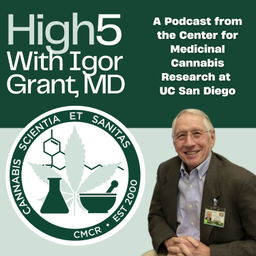
High5 with Dr. Igor Grant, MD
Hosted by Dr Igor Grant and Dr Igor Grant MD and Igor Grant · Igor Grant, MD
5.0from 9 ratings
- 19
- Episodes
- 9
- Ratings
- Monthly
- Cadence
- 2025
- First episode
About High5 with Dr. Igor Grant, MD
Welcome to High5 with Dr. Igor Grant, Distinguished Professor of Psychiatry and Director of the Center for Medicinal Cannabis Research (CMCR) at UC San Diego. Each month, we’ll take you on a fascinating journey into the evolving world of medicinal cannabis. From groundbreaking research to candid conversations with top scientists and clinicians across the globe. In each episode, Dr. Grant poses five thought-provoking questions to his guest, uncovering their personal journey and unique contributions to the field of medicinal cannabis.
- Publisher
- Igor Grant, MD
- Category
- science
- Language
- en
- Explicit
- No
- First episode
- 25 Jan 2025
- Latest episode
- 1 Oct 2026
Latest episodes
19 episodes in the feed.
1 Oct 2026
Football, Cannabis, and Following Your Heart with Ricky Williams
In this episode, former NFL running back and Heisman Trophy winner Ricky Williams discusses his experiences with cannabis, social anxiety, and recovery during his football career. He describes how therapy and self-reflection while using cannabis helped him understand his anxiety, and how cannabis became part of a broader approach to recovery that included yoga, stretching, and meditation. He also reflects on the psychological burden of injuries when an athlete’s livelihood depends on physical performance. The conversation explores his experiences with the NFL’s drug-testing program, the shift he sees toward a wellness-focused approach to cannabis, and barriers to research involving athletes. Drawing on his forthcoming memoir, The Long Run, Williams discusses finding meaning beyond others’ expectations. A central message is his call for researchers to listen to people who use cannabis and approach their experiences with curiosity when developing research questions. Chapters: 00:56 Introduction to Ricky Williams and Medicinal Cannabis 02:14 Ricky's Journey with Anxiety and Cannabis 04:15 The Role of Cannabis in Pain Management 06:49 NFL's Changing Perspective on Cannabis 09:29 The Impact of Injuries on Mental Health 12:09 Research and Understanding of Cannabis Use 14:56 Ricky's Upcoming Memoir and Life Lessons 17:16 Stigma and the Future of Cannabis Research 20:26 Stigma and the Future of Cannabis Research 20:26 Outro
31 Jul 2026
Cannabis, the Gut and the Metabolic Paradox with Nicholas DiPatrizio, PhD
In this episode, Dr. Nicholas DiPatrizio discusses how the endocannabinoid system helps regulate appetite, nutrient sensing, metabolism, and communication between the gut and brain. He describes findings from mouse studies showing how cannabinoid signaling in the intestinal lining may promote preferences for foods high in fat and sugar and interfere with signals that normally tell the brain when to stop eating. He also explores the “cannabis paradox,” in which cannabis can stimulate appetite while chronic users tend to have lower body weight and a reduced likelihood of type 2 diabetes. The conversation examines research comparing pure delta-9 THC with whole-cannabis extract, including evidence in obese mice that both reduced body weight but only the whole extract reversed diabetes-like metabolic dysfunction. A central message is that therapies targeting cannabinoid receptors specifically in the gut may one day improve metabolic health while limiting unwanted effects on the brain.
1 Jun 2026
Cannabis, Brain, and Aging with Kent Hutchison PhD
In this episode, Dr. Kent Hutchison discusses how his research on cannabis grew from a background in alcohol and nicotine studies into a broader effort to understand both the risks and potential benefits of cannabis use. He describes findings from large brain-imaging datasets suggesting that lifetime cannabis use was associated with larger regional brain volumes and better performance on some cognitive tests in older adults. He also discusses why cannabis may affect adolescents and older adults differently, including age-related changes in the endocannabinoid system. The conversation explores possible neuroprotective effects of cannabinoids, the use of cannabis among older adults for pain, sleep, and anxiety, and emerging research on cannabis and exercise. A central message is that cannabis effects depend on the product, dose, route of administration, age, health status, and reason for use. Chapters 00:54 Introduction to Cannabis Research and Personal Journey 04:04 Exploring Cannabis and Brain Function 09:14 Adolescent Cannabis Use and Cognitive Effects 12:31 Neuroprotective Effects of Cannabinoids 14:25 Understanding the Endocannabinoid System 16:23 Cannabinoids in Older Adults 19:03 Cannabis Use in Relation to Other Medications 20:01 Cannabis and Exercise: Subjective Experiences 24:24 Future Research Directions and Closing Thoughts
1 May 2026
Cannabis Smoke & Cardiovascular Health with Matthew Springer, PhD
Summary In this episode of High5 with Dr. Igor Grant, Dr. Matt Springer explains how inhaling smoke from combusted products such as tobacco and cannabis, as well as inhaling aerosol from e-cigarettes and cannabis vaping devices, may impair endothelial function, an early marker of cardiovascular risk. Drawing on rodent and human studies, he reports that chronic tobacco smokers, e-cigarette users, and cannabis smokers all show reduced vascular function. He also discusses evidence that chronic THC edible users may have impaired vascular function through a different mechanism than inhaled products. A central message is that “cannabis use” is too imprecise a term, because smoking cannabis and ingesting THC are very different exposures. His public health takeaway is simple: be aware of cardiovascular risks, practice moderation, and avoid exposing others to secondhand smoke. Key Topics Endothelial function and its role in cardiovascular health Effects of tobacco, cannabis, and e-cigarette smoke on blood vessels Mechanisms of smoke-induced vascular impairment Differences between inhaled and ingested cannabis effects Public health implications of secondhand smoke exposure Chapters 00:00 Preview 01:24 Dr. Springer's Background 03:43 Exploring Cardiovascular Effects of Cannabis 03:43 Personal Anecdote - Paul McCartney Concert 05:13 Understanding Endothelial Function 09:33 The Role of Endothelial Cells in Cardiovascular Health 09:58 Understanding Vascular Health and Flow Mediated Dilation 12:03 Translating Rodent Studies to Human Health 14:20 The Impact of Cannabis and Tobacco Smoke on Vascular Function 16:53 Chronic Use: Comparing Cannabis, Tobacco, and E-Cigarettes 20:15 The Science Behind Smoke and Its Effects 24:48 Distinguishing Cannabis Use from Smoking Effects 29:08 Moderation and Public Health Messaging 34:31 Secondhand Smoke: Risks and Recommendations
1 Apr 2026
Cannabis for Migraine Headache with Nat Schuster, MD
Summary: In this episode, Nathaniel Schuster, MD, Professor and Medical Director of the Center for Pain Management at UC San Diego Health, explores the potential role of cannabinoid therapy in migraine care. Join us as Dr. Schuster shares insights into the benefits, limitations, and practical considerations of this approach, and discusses his latest research on vaporized cannabis for acute migraine treatment, including clinical trial findings and future directions. Key Topics: Overview of the first placebo-controlled trial of vaporized cannabis for migraineThe scientific rationale behind using THC and CBD in migraine treatmentStudy design: crossover methodology, dosages, and use of research-grade cannabisPrimary and secondary outcomes: pain relief, pain freedom, and bothersome symptomsSurprising findings on nausea, photophobia, and sound sensitivity improvementsSide effects, safety profile, and optimal dosing strategiesPractical considerations: vaporized vs. oral formulations and patient preferencesRecommendations for patients with refractory migraines considering cannabinoid therapyFuture research directions: preventive treatments and guidelines incorporation Timestamps: 00:03 - Introduction to Cannabis Study 00:56 - Welcome Dr. Nathaniel Schuster 01:41 - Dr. Schuster's Background 02:29 - Understanding Migraine 03:18 - Current Migraine Treatments 04:14 - Defining Migraine 05:11 - Genetic Factors in Migraine 06:01 - Cannabis as a Treatment Option 07:54 - Study Hypothesis and Design 10:45 - Study Design Details 13:41 - Crossover Study Explanation 16:51 - Study Findings 20:36 - Most Bothersome Symptom Freedom 23:01 - Side Effects and Safety 26:40 - Participant Demographics 28:34 - Future Research Directions 30:00 - Practical Considerations 32:09 - Advice for Migraine Patients 33:50 - Safety Considerations 34:03 - Closing Remarks Read Dr. Schusters's study (https://pubmed.ncbi.nlm.nih.gov/38405890/). Bio: Dr. Nathaniel Schuster is a pain and headache neurologist and is Professor and Medical Director at the UC San Diego Center for Pain Management. He has served as Treasurer of the American Academy of Pain Medicine, Senior Vice President of the World Headache Society, and as Vice Chair of the Guidelines Committee for the International Pain and Spine Intervention Society. He has received the American Academy of Pain Medicine’s Rollin “Mac” Gallagher Award, the American Academy of Pain Medicine’s Distinguished Service Award, the American Headache Society’s Harold G. Wolff Award, the International Pain and Spine Intervention Society’s Outstanding Volunteer Award, and the Migraine Research Foundation’s Impact Award. He is section editor for the Neuropathic Pain section for the journal Pain Medicine. He graduated from University of Michigan Medical School and completed a neurology residency at UCLA, headache fellowship at Montefiore Headache Center, and pain fellowship at Massachusetts General Hospital. He conducted the first placebo-controlled trial of cannabinoids for acute migraine and his ongoing research includes clinical trials studying treatments for migraine and neuropathic pain.
1 Mar 2026
Terpenes in Cannabis: Are they therapeutic? with Catherine Cahill, MD
In this episode, Catherine M. Cahill, PhD, Professor of Psychiatry at the UCLA Brain Research Institute, delves into the fascinating world of terpenes—natural aromatic compounds found in cannabis and other plants—and their potential therapeutic effects, especially for pain relief. Join us as Dr. Cahill shares her expertise on the mechanisms, research findings, and regulatory status of these promising molecules.es. Key Topics Covered: The basic chemistry and role of terpenes andterpenoids in plants How terpenes differ from cannabinoids like THCand CBD The most studied terpenes in pain relief:myrcene and beta-caryophyllene Preclinical evidence for terpene analgesiceffects in nerve and inflammatory pain The endogenous cannabinoid system and howterpenes may modulate it Evidence for sex differences in terpene responseand receptor distribution The regulatory status of terpenes as foodadditives and their availability Emerging research on terpene interactions withother cannabinoids Potential for opioid-sparing effects andreducing adverse outcomes Timestamps: 00:00 - Introduction to cannabisterpenes and their therapeutic promise 02:30 - Basic chemistry: what areterpenes and terpenoids? 06:00 - The role of terpenes inattracting pollinators and plant defense 09:30 - Key terpenes studied:myrcene and beta-caryophyllene 13:00 - How terpenes influence theendogenous cannabinoid system 15:45 - Differences betweenterpenes and cannabinoids 17:30 - Conditions potentiallybenefitting from terpene treatment and current research 21:00 - Preclinical findings:analgesic effects in nerve and inflammatory pain models 26:00 - Modulation of emotionalaspects of pain through the cannabinoid system 27:30 - The entourage effect: doterpenes enhance THC and CBD efficacy? 31:00 - Regulatory status andsafety of terpenes 34:00 - Sex differences andhormonal influences on terpene receptor expression 36:00 - Future directions:combination therapies and opioid-sparing potentials 38:00 - Final thoughts
1 Dec 2025
Cannabis & Schizophrenia A causal link? with Deepak D'Souza, MD
Psychiatrist Deepak D'Souza, MD, examines the intricate connection between cannabis use and psychosis, evaluating potential causal links and environmental variables in schizophrenia as part of an interview with Igor Grant, MD.
2 Nov 2025
Delta-8 THC: A public health perspective with Eric Leas, PhD
Dr. Eric Leas examines Delta-8-THC's public health implications, including its differences from Delta-9-THC, consumer demand, regulatory challenges, and safety concerns, in an interview with Dr. Igor Grant.
30 Sept 2025
Cannabis Use Among Older Adults with Alison Moore, PhD
Dr. Alison Moore informs Dr. Igor Grant about the rising cannabis use among older adults, exploring motivations, medical uses, and comorbid conditions, while highlighting the need for more research and education in geriatric care; this is an interview.
1 Sept 2025
Digital Tools for Managing Cannabis Use with Alan Budney, PhD
Dr. Igor Grant, MD interviews Dr. Alan Budney, PhD about digital tools and contingency management for addressing problematic cannabis use and co-occurring mood disorders.
1 Aug 2025
Minor Cannabinoids and Terpenes with Ziva Cooper, PhD
Dr. Igor Grant interviews Dr. Ziva Cooper, who shares her medicinal cannabis research, revealing gender differences in cannabis response and the therapeutic potential of minor cannabinoids and terpenes.
30 Jun 2025
Cannabis Advocacy and Regulation with Dale Gieringer, PhD
Dale Gieringer, PhD, discusses his extensive work with California NORML and the historical context surrounding cannabis legalization efforts, including Propositions 215 and 64, in an interview with Igor Grant, MD.
30 May 2025
Nuances of the Endocannabinoid System with Daniele Piomelli, PhD
Dr. Daniele Piomelli explores the intricacies of the endocannabinoid system with Dr. Igor Grant, discussing its mechanisms, functions, and implications in health and medicine in this interview.
1 May 2025
Cannabis Use Disorder with Meg Haney, PhD
Summary In episode 6, Dr. Grant and Dr. Meg Haney (https://www.columbiapsychiatry.org/profile/margaret-haney-phd) delve into thecomplexities of Cannabis Use Disorder, exploring its definition, withdrawal symptoms, and the psychological dependency associated with cannabis use. They discuss the impact of cannabis on sleep and mood, the prevalence of CannabisUse Disorder among those with psychiatric conditions, and the challenges in treating cannabis dependency. The conversation also highlights the intersection of cannabis use with other substances, particularly tobacco, and emphasizes theneed for further research to understand the therapeutic benefits and risks of cannabis use. Takeaways Cannabis Use Disorder is characterized by preoccupation and disruption in life. Withdrawal symptoms include irritability, anxiety, and disrupted sleep. Cannabis can lead to psychological dependency, similar to other substances. The severity of withdrawal symptoms can vary among individuals. Cannabis withdrawal can disrupt sleep patterns and lead to nightmares. Cannabis is often used for sleep, but it may not be effective long-term. The prevalence of Cannabis Use Disorder can be higher among those with psychiatric conditions. Treatment approaches for Cannabis Use Disorder include medications like Nabilone. Tobacco use can predict worse outcomes in treatment of Cannabis Use Disorder. Future research is needed to understand the effects of cannabis on pain and tolerance. Chapters 00:00 - Intro 01:06 - Introduction of Meg Haney, PhD 01:45 - Cannabis Use Disorder Defined 03:22 - Cannabis Dependence & Withdrawal Symptoms 07:49 - Cannabis & Sleep 09:46 - Withdrawal & Anxiety 10:47 - Cannabis Withdrawal Compared to Alcohol, Tobacco& Other Substances 13:45 - The Complexity of Cannabis Use and Dependency 19:33 - Treatment Approaches for Cannabis Use Disorder 25:41 - The Intersection of Cannabis and Other Substances 32:22 - Future Research Directions in Cannabis Studies 34:25 - Closing Thoughts 36:24 - Outro
18 Mar 2025
Cannabis legalization in Canada: Lessons for the U.S. with Mark A. Ware, MD
In episode 5, Dr. Grant speaks with Dr. Mark Ware as he discusses the evolution of cannabis use in pain management, the implications of the Cannabis Act in Canada, and the differences in cannabis policies between Canada and the U.S. Dr. Ware highlights the importance of understanding the psychoactive effects of cannabis, the challenges in medical research, and the need for a cohesive regulatory framework to ensure safety and efficacy in cannabis products. Bio Mark A. Ware, MD, MBBS, MSc, MRCP Dr. Ware is an Associate Professor of Family Medicine and holds the Alan Edwards Chair in Clinical Pain at McGill University. He is also the Director of the interdisciplinary Alan Edwards Pain Management Unit at Montreal General Hospital. He was a co-founder of the non-profit Canadian Consortium for the Investigation of Cannabinoids and served as Executive Director from2007 to 2018. Dr. Ware has advised the Canadian federal government on cannabis policy since 2001, and in 2016, he served as the vice-chair of the Federal Task Force on the Legalization and Regulation of Cannabis in Canada. The task force’s report became Canadian law as the Cannabis Act in October 2018. Takeaways Patients reported that cannabis helped their pain. The Cannabis Act was developed to allow for legalization and regulation. Cannabis is not covered under most provincial drug frameworks. The sky didn't fall after legalization; no major public health issues arose. The consumer has become a lot more educated about cannabis products. There is a patchwork of cannabis regulations in the U.S. The industry didn't pick up on medical research as hoped after legalization. A federal strong policy would be a game changer for cannabis regulation. The psychoactive effects of cannabis can play a role in pain management. The narrative around cannabis is slowly changing from prohibition to acceptance. Chapters 00:00 High5 Introduction 01:09 Intro & background of Dr. Mark Ware 02:08 Early Research and Patient Experiences 05:38 Cannabis as an Analgesic 07:53 The Cannabis Act: Overview and Features 09:43 The Evolution of the Cannabis Act 10:34 Medical Use and Prescription Challenges 12:06 Insurance and Coverage for Cannabis 12:58 Patient Conversations and Treatment Frameworks 15:40 Post-Legalization Insights and Observations 19:21 Provincial Variations in Cannabis Regulation 21:16 Impact on Medical Research 24:25 GPP v. GMP 27:27 Lessons for the U.S. from Canada’s Experience 33:20 Outro
23 Feb 2025
Brain difference and early substance use: Which comes first? with Alex Miller, PhD
Dr. Grant speaks with Alex P. Miller, Ph.D. (https://medicine.iu.edu/faculty/68255/miller-alex), an Assistant Professor of Psychiatry at Indiana University School of Medicine. This conversation explores the intricate relationship between substance use, genetics, and brain structure, focusing on the ABCD study, which follows children over a decade to understand the onset of substance use and its effects on mental health. Dr. Alex Miller discusses the role of neuroimaging in identifying brain differences that may predispose individuals to substance use, the influence of genetics and environment, and the implications of these findings for understanding addiction and recovery. Takeaways The ABCD study involves nearly 12,000 children and tracks their development over time. Neuroimaging can reveal brain differences that may predispose individuals to substance use. Genetics and environment interact to influence the risk of substance use disorders. Impulsivity is linked to both personality traits and substance use initiation. The caudate plays a role in reward processing and may influence cannabis use. Brain structure can change over time, indicating resilience in recovery from substance use. Findings suggest that larger brain volumes may not correlate with better outcomes. The study highlights the importance of early environmental influences on brain development. Understanding the relationship between brain structure and substance use is complex and multifaceted. Future research will continue to explore the dynamic interplay between genetics, environment, and substance use. Chapters 00:00 -Preview 00:12 - Dr. Miller's background 01:39 - The chicken and egg problem 02:08 - Dr. Miller's research & the ABCD Study 05:18 - Genetics & epigenetics, Nature v. Nurture 07:33 - Impulsivity and Substance Use 09:19 - Neuroimaging techniques used to evaluate brain size 13:16 - Findings on brain structure and size 16:02 - Cannabis use and brain structure 21:29 - The Dynamic Relationship Between Brain and Behavior 22:11 - Implications of the research findings 25:27 - Where do brain differences come from? 27:18 - Outro Studies Neuroanatomical Variability and Substance Use Initiation in Late Childhood and Early Adolescence (https://jamanetwork.com/journals/jamanetworkopen/fullarticle/2828520)
8 Feb 2025
Cannabis use and cardiovascular risk with Jamie Corroon, ND, MPH
Summary In this episode, Dr. Igor Grant speaks with Dr. Jamie Corroon (https://profiles.ucsd.edu/james.m.corroon) about the impact of cannabis use on cardiovascular health. They explore various studies focusing on heart disease, hypertension, and atherosclerosis, discussing both acute and long-term effects of cannabis. Dr. Corroon shares insights from his research, highlighting the importance of understanding the relationship between cannabis and cardiovascular outcomes, while also addressing the need for more rigorous studies to clarify potential risks. Chapters 00:00 - Research Methodology and Data Collection 00:31 - Podcast overview 01:06 - Dr. Corroon's background 03:26 - Acute effects of cannabis use on the heart 04:13 - Chronic effects 05:39 - Research methods used to study chronic effects 07:05 - Datasets used to study cardiovascular disease 07:48 - Findings for heart attack 10:14 - Cannabis use and heart attack 12:30 - Heavy use and heart attack 13:36 Atherosclerosis & carotid artery calcification 18:22 - Findings related to carotid artery calcification 20:37 - Hypertension and Long-term Cannabis Use 21:52 - Conclusions and Future Research Directions 24:08 - Final thoughts 24:51 - Outro Additional resources: Trends in Cannabis Use, Blood Pressure, and Hypertension in Middle-Aged Adults: Findings From NHANES, 2009-2018 (https://pubmed.ncbi.nlm.nih.gov/37479221/) Associations Between Monthly Cannabis Use and Myocardial Infarction in Middle-Aged Adults: NHANES 2009 to 2018 (https://pubmed.ncbi.nlm.nih.gov/37556891/) Regular cannabis smoking and carotid artery calcification in the Multi-Ethnic Study of Atherosclerosis (MESA) (https://pubmed.ncbi.nlm.nih.gov/39439386/)
27 Jan 2025
Potential Implications of Rescheduling with Igor Grant, MD
In this episode (Recorded in December 2024), Drs. Igor Grant, MD and Jamie Corroon, ND, MPH discuss the potential implications of rescheduling cannabis from a Schedule I to a Schedule III controlled substance. They explore the current scheduling system, the medicinal value of cannabis, the challenges researchers face under Schedule I, and how rescheduling could impact research and funding. They also emphasize the need for harmonization between state and federal laws to facilitate cannabis research. Takeaways Rescheduling cannabis would acknowledge its medicinal value.Research on cannabis is heavily regulated under Schedule One.Moving to Schedule Three would ease some research restrictions.The FDA and DEA play crucial roles in cannabis research approval.More manufacturers of cannabis products for research have been approved recently.The stigma around cannabis research may decrease with rescheduling.Current cannabis products from dispensaries cannot be used in research.Standardization of cannabis products for research is challenging.Harmonization of state and federal laws is essential for effective research. Chapters 00:00 - Intro 01:08 - Conversation with Dr. Grant 17:29 - Outro
25 Jan 2025
Cannabis Impaired Driving with Tom Marcotte, PhD
In this episode, Dr. Tom Marcotte discusses a significant study on the acute effects of cannabis on driving impairment, detailing the methodology, findings, and implications for public safety and law enforcement. The conversation explores how THC levels affect driving performance, the perception of impairment among users, and the challenges of conducting cannabis research in a regulated environment. Future research directions and participant recruitment for upcoming studies are also highlighted. Takeaways The study was the largest randomized double-blind clinical trial on cannabis and driving. Participants showed similar levels of impairment regardless of THC content. Behavioral tolerance plays a significant role in driving performance among frequent users. Perception of impairment can be misleading; users may feel safer to drive before they are actually recovered. Blood THC concentrations do not correlate with driving impairment, unlike alcohol. Future studies will explore real-world cannabis products and their effects on driving. The research aims to improve understanding of cannabis use and public safety. Participants will be recruited from the community for upcoming studies. The driving simulator is designed to replicate real-world driving challenges. The study's findings have important implications for law enforcement and public policy. Chapters 00:00 - Preview 00:30 - Intro 01:15 - Cannabis & Driving Impairment 13:35 - New Observational Study - Real World Cannabis Study 18:17 - New CMCR Mobile Driving Simulator & Clinical Lab 19:22 - Outro
Who has been a guest on High5 with Dr. Igor Grant, MD
Names identified in recent episode analyses. Showing up to five guests.
- Deepak D'Souza
- Eric Leas
- Alison Moore PhD
- Dr Alan Budney PhD
- Dr Ziva Cooper
Reach and audience
Public platform figures. Ratings count people who left a rating, not total listeners.
- Apple Podcasts (US)
- 5.0 / 5
- 5 ratings
- Spotify
- 5.0 / 5
- 4 ratings
Podcast Authority Score: 14 / 100
A composite of feed quality, social presence, YouTube performance and engagement. Read the methodology.
- Quality
- 14
- Social presence
- 0
- YouTube
- 0
- Engagement
- 32
Host of High5 with Dr. Igor Grant, MD?
Claim your podcast to manage its listing and keep your show details accurate.
Pod Engine is an independent podcast discovery and analytics service and is not affiliated with or endorsed by this podcast. Artwork and show content belong to their owners. Full legal notice.
Explore this show
Podcast research with Pod Engine