80 Episodes
Daily Cadence
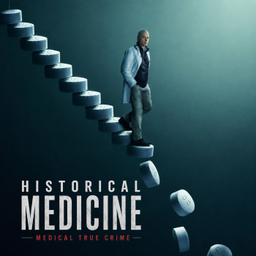
2026 First episode About Historical Medicine Historical medicine is a record of brilliant guesses, catastrophic certainties, and cures that killed. Doctors bled presidents to death with total confidence, and laughed at the first man who told them to wash their hands. This show tells the true stories of historical medicine.
Each episode reconstructs one case in full, cinematic detail: the disease as patients lived it, the treatments of the era, the physician who challenged the consensus, and the slow, bitter fight to change medical minds. No host chatting between clips, no panel debating trivia. Just one complete story, narrated start to finish, built from case notes, journals, and the archives of historical medicine.
You will walk hospital wards where historical medicine did more harm than the illness, follow surgeons racing the clock before anesthesia existed, and meet the stubborn few whose heresies became the foundations of modern care. Some episodes follow a single outbreak from first fever to final count; others trace a treatment's journey from miracle to malpractice. All of them treat historical medicine as what it really is: the story of humanity learning, painfully, how bodies actually work.
If you are drawn to historical medicine told like a slow-burning thriller, this is built for you. New episodes drop regularly, each one a self-contained case from the archives of historical medicine. Subscribe now so the next one lands the moment it goes live.
Publisher OBOMEDIA ENTERTAINMENT
Category history
Language en
Explicit No
First episode 4 Sept 2026
Latest episode 14 Oct 2026 Latest episodes 80 episodes in the feed.
14 Oct 2026
The Sodium Fluoride Poured into Grand Rapids That Made 300,000 Subjects A worker poured sodium fluoride into Grand Rapids' water on Jan 25, 1945, making residents unwitting subjects - how did that expose them?
The Sodium Fluoride Poured into Grand Rapids That Made 300,000 Subjects
In this episode, we follow the sequence of discoveries and decisions that led a city to add sodium fluoride to its water without consent and launch a long-running public-health experiment. The narrative traces the scientists, the data, and the choices that turned a cosmetic dental mystery into national policy - what questions did those early steps leave unanswered?
Person: Frederick McKay
Person: H. V. Churchill
Person: H. Trendley Dean
Date: January 25, 1945
Location: Grand Rapids, Michigan
- A 27-year-old dentist in Colorado Springs cataloged widespread “Colorado brown stain” on children’s teeth and noted unusually low cavity rates.
- A chemist for Alcoa analyzed water samples in 1931, finding elevated fluoride levels rather than aluminum and identifying fluorosis as the cause of staining.
- NIH epidemiologist H. Trendley Dean surveyed communities and proposed ~1 mg/L fluoride reduced cavities with mostly mild cosmetic fluorosis.
- Grand Rapids agreed to be the world’s first fluoridated city on that January morning, with Muskegon selected as the control for a planned 15-year study.
- Decades later the proposed mechanism - fluoride working via developmental incorporation into enamel - was abandoned, though the experiment and policy continued.
To listen to this podcast ad-free and access premium episodes, try our subscription with a 14-day free trial at obomedia.com.
© 2026 OBOMEDIA. All rights reserved.
This episode and its content (audio, text, and related materials) are the exclusive property of OBOMEDIA and are protected by applicable copyright laws. Reproduction, distribution, editing, or commercial use, in whole or in part, without prior written permission from OBOMEDIA is prohibited. For permissions, licensing, and business inquiries: business@obomedia.com.
13 Oct 2026
The NHS guideline gap that refused her TPN and let her starve A young woman in an English hospital was denied TPN while doctors admitted the NHS had no policy - how did that guideline gap expose the system?
The NHS guideline gap that refused her TPN and let her starve
In this episode, we recount the case of Maeve Boothby O'Neill and the clinical decisions, policies, and historical research that shaped her care. The episode follows the medical timeline and the institutional gaps that left a treatable route of nutrition unprovided - what led to that absence?
Person: Maeve Boothby O'Neill
Age: 27
Date of death: autumn 2021
Cause of death recorded: malnutrition
Treatment withheld: total parenteral nutrition (TPN)
- Maeve developed severe ME/CFS that progressed until her body could not tolerate oral nutrition, a documented feature of the condition.
- TPN, a standard intravenous nutrition used when oral intake is impossible, was available but not provided to her care team.
- At the Exeter and Devon coroner's inquest, NHS director Dr. Anthony Hemsley testified there was no national policy or facilities for severe ME/CFS treatment in the UK.
- The medical debate traces back decades: a 1970 paper by McEvedy and Beard declared outbreaks hysteria without examining patients, influencing later perceptions.
- Subsequent cultural and academic voices, like Elaine Showalter’s 1997 book, further propagated non-clinical framings that shaped how ME/CFS was treated in practice.
To listen to this podcast ad-free and access premium episodes, try our subscription with a 14-day free trial at obomedia.com.
© 2026 OBOMEDIA. All rights reserved.
This episode and its content (audio, text, and related materials) are the exclusive property of OBOMEDIA and are protected by applicable copyright laws. Reproduction, distribution, editing, or commercial use, in whole or in part, without prior written permission from OBOMEDIA is prohibited. For permissions, licensing, and business inquiries: business@obomedia.com.
12 Oct 2026
The Solvent Diethylene Glycol Dissolved Patients and Killed a Hundred A pharmacist’s bottle of sulfanilamide dissolved patients with a diethylene glycol solvent - who is responsible when no law requires testing?
The Solvent Diethylene Glycol Dissolved Patients and Killed a Hundred
In this episode, we trace a sequence of events from ancient antidotes to a 1937 pharmaceutical disaster to ask how societies decided who should guarantee a medicine’s safety. How did a legitimate antibiotic become a lethal elixir, and what gaps allowed it to reach pharmacy shelves?
Person: Mithridates
Event: Use and spread of Mithridatium/theriac
Date: 1937
Location: United States
Company: S.E. Massengill Company
- Mithridates ingested small doses of poisons and compiled Mithridatium, a multi-ingredient antidote later known as theriac.
- Theriac evolved into a widely sold medicine across Rome, Islamic medicine, and medieval Europe, appearing in the Leechbook of Bald.
- Market incentives led merchants to adulterate or cut corners on medicines, creating invisible risks for patients.
- Medieval and early modern authorities (Hisba, Frederick II, Florence, Spain, London) instituted standards and pharmacopoeias to inspect drug composition and makers.
- In autumn 1937 S.E. Massengill bottled “Elixir Sulfanilamide” using diethylene glycol as a solvent; no law required safety testing and over a hundred deaths from kidney failure followed.
To listen to this podcast ad-free and access premium episodes, try our subscription with a 14-day free trial at obomedia.com.
© 2026 OBOMEDIA. All rights reserved.
This episode and its content (audio, text, and related materials) are the exclusive property of OBOMEDIA and are protected by applicable copyright laws. Reproduction, distribution, editing, or commercial use, in whole or in part, without prior written permission from OBOMEDIA is prohibited. For permissions, licensing, and business inquiries: business@obomedia.com.
Research this show Explore Pod Engine's podcast research tools and transcript access.
See plans Is this your podcast? Claim your show to manage its details on Pod Engine.
Claim Historical Medicine Where this data comes from Each source has its own observation date. These dates do not mean all data was checked at once.
RSS feed Last successful check: 14 Oct 2026 .
Apple Podcasts ratings (US) Snapshot recorded: 9 Oct 2026 .
Spotify ratings Snapshot recorded: Date unavailable. Host of Historical Medicine? Claim your podcast to manage its listing and keep your show details accurate.
Claim this podcast Pod Engine is an independent podcast discovery and analytics service and is not affiliated with or endorsed by this podcast. Artwork and show content belong to their owners. Full legal notice .
Explore this showPodcast research with Pod Engine
See plans