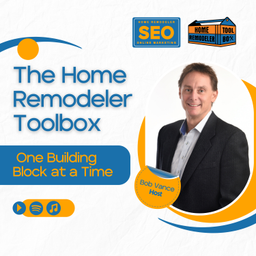
Welcome to Home Remodeler Toolbox, where your tools to success are revealed! 🚀 Diving deep into the heart of the remodeling world, we bring you exclusive interviews with top leaders from the remodeling industry. Stay tuned as these experts reveal the perfect recipe to triumph.
Home Remodeler Toolbox offers valuable insights and advice on professional development, industry standards, networking, and much more. Our content is designed to help you stay informed about the latest trends, connect with industry professionals, and access the resources you need to advance and grow your business.
Somewhere in your phone right now is a client from two years ago who absolutely loved what you built for them. Maybe even teared up at the final walkthrough.
And since then? Nothing. No referrals. Your name never mentioned to a single neighbor or coworker who brought up renovating.
Not because they didn’t love the work. Because nobody ever gave them a reason, a moment, or a mechanism to do anything about it.
That’s the gap this episode is about.
“Most of our business comes from word of mouth” gets said like a badge of honor. Bob pushes back on it hard. Word of mouth requires a past client to be in the right conversation, remember your name specifically, and feel motivated enough in that exact moment to actually recommend you. That’s a lot of variables lining up by chance — and hope is not a strategy.
A system is different. It’s the difference between hoping it rains on your lawn and installing a sprinkler.
The number that makes the case: Bob mapped out one client’s last 20 completed projects. 17 of those homeowners said they’d absolutely recommend the company. Only 2 actually had, in the entire previous year.
That gap is the whole problem in a single statistic. And it has nothing to do with the quality of the work.
In this episode:
The three predictable places referral systems break down — timing, friction, and the absence of any mechanism at all
Why the emotional peak of a remodel has a shelf life, and the two windows that actually work
The copy-and-paste text template that removes every excuse not to forward it
How one company went from roughly 2 referral-sourced consultations a quarter to 11, with 4 turning into signed projects
The client who said: “I’d been telling people about you for years. I just never thought to actually give them your number.”
Three objections Bob hears every time — including the owner who said “our clients aren’t the type who need to be bribed to say something nice about us”
The surprising discovery about which projects actually drive the most referrals (hint: it isn’t the ones in your portfolio)
Why most referral systems quietly die within two months, and the one structural fix that keeps them alive
Your one task this week: pull up your last five completed projects. Send each one a simple, easy-to-forward message. Don’t overthink it, don’t wait for the perfect system — just close the gap once and see what comes back.
Because you almost certainly don’t have a client satisfaction problem. You have a conversion problem. The goodwill is already out there, sitting quietly, waiting for a reason and a path.
This week’s job isn’t to earn more of it. It’s to go collect what’s already yours.
24 Sept 2026
EP 31: The $80,000 5-Star Review: Why Your Silence Is The Real Damage
One bad review can quietly cost you $80,000 — and you'll never see it happen.
Here's the math Bob walks through at the top of this episode: a single unanswered one-star review gets seen by two or three hundred homeowners actively shopping for a remodeler in your area over the next year. If even 15% of them quietly cross you off the list, that's 30 or 40 leads gone. No phone call, no form fill, no chance to explain. They just moved on. And that same review keeps doing the same math next year, and the year after, on a brand-new batch of people who've never heard of you.
This episode is about the single highest-leverage, lowest-cost thing in your marketing: how you handle what's already sitting on your Google profile.
The core reframe is this — reviews aren't feedback, they're inventory. Feedback is backward-looking, about a job you already closed out and got paid for. Inventory is forward-looking, sitting on your digital shelf, either winning or losing you work every single day. And nobody in this trade leaves their work unresolved. So why leave that?
Bob breaks down why an unanswered bad review does more damage than the review itself, the four-step way to respond when one lands, and how to build a system so the good ones come in fast enough that no single complaint can define you.
In this episode:
The $80,000 math behind one ignored one-star review
Why "we're sorry you feel that way" reads as dismissive — and what to write instead
Why "we'll reach out to you" beats "please call our office"
The true story of a remodeler who let a one-star sit for a year, finally answered it, and watched the homeowner update it to three stars — then watched new clients cite that exchange as the reason they called
The owner who built a 48-hour response habit before she ever needed it, and how that changed the way her first bad review landed
Three objections Bob hears constantly, and why none of them hold up
The "secret ninja hack": why you should ask for the review before final payment
What to do if you've got 15 unanswered reviews and no idea where to start
Your one task this week: find the bad review that's been sitting there longest without a response. Write a thoughtful, honest, non-defensive reply. Then see what happens.
Because homeowners aren't judging whether you're perfect. Every remodeler has had a project go sideways. They're judging whether you show up when things aren't.
Don't let silence do the talking for you.
3 Sept 2026
EP30: 4 Steps Your Business Is Missing with Bob Vance
1,500 Posts, 421 Followers: The Real Reason Your Content Isn't Generating Leads
We do marketing for remodelers and builders for a living — so why does our own Instagram have over 1,500 posts and only 421 followers? In this episode, Bob Vance shares an uncomfortable, honest audit of his own company's marketing, and the blind spot he found that almost every remodeler shares.
You'll learn the four-stage framework every marketing funnel needs to actually work — Content, Capture, Nurture, Lead — and why most businesses (including this one) are missing stage two entirely. If you're posting consistently, running ads, even getting webinar sign-ups, but still not seeing the phone ring, this episode explains exactly where the leak is happening and how to find it in your own business this week.
In this episode:
Why "just post more content" is often the wrong move
The four stages every lead has to pass through — and the one most businesses skip
How a real audit (ads, landing pages, webinars) revealed the same gap everywhere
One free, doable action item you can run on your own funnel today
If you've ever wondered why engagement doesn't translate to booked jobs, this one's for you.
Who has been a guest on Home Remodeler Toolbox
Names identified in recent episode analyses. Showing up to five guests.
Kristen Harper
Michelle Flores
John Nieuwenburg
Podcast Authority Score: 22 / 100
A composite of feed quality, social presence, YouTube performance and engagement. Read the methodology.
Quality
43
Social presence
0
YouTube
0
Engagement
0
Contact Home Remodeler Toolbox
Guest appearances
Books guests
Based on episode analysis; this does not confirm that the show is currently accepting guests.
Questions about Home Remodeler Toolbox
Who hosts Home Remodeler Toolbox?
Bob Vance host the show. Published by Bob Vance.
How often do new episodes come out?
The show publishes daily, based on its RSS feed.
Does Home Remodeler Toolbox take guests?
Yes. Guests have been identified in episode analyses.
Host of Home Remodeler Toolbox?
Claim your podcast to manage its listing and keep your show details accurate.
Pod Engine is an independent podcast discovery and analytics service and is not affiliated with or endorsed by this podcast. Artwork and show content belong to their owners. Full legal notice.
Explore this show Podcast research with Pod Engine