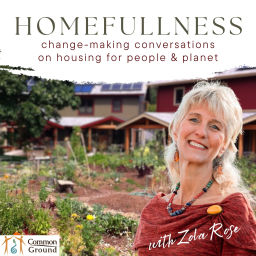
Eli Spevak on Building Climate-Friendly, Community-Oriented Housing—and Changing the Rules on Housing
Zola welcomes Eli Spevak of Orange Splot, Portland, Oregon developer-builder-advisor, who treats development as a mission by paying himself less and reinvesting in community features like common houses and public artwork.
Eli argues “housing policy is climate policy,” emphasizing smaller homes, more homes per lot, and “missing middle” housing as both greener and more affordable. He describes policy work that made Portland’s rules more predictable and enabled by-right ADUs, tiny homes on wheels, and up to four homes per lot, plus reforms to occupancy rules.
Eli explains partnering with community land trusts to keep some homes permanently affordable through long-term deed restrictions, even within condominium/unit-title projects, sometimes using public funds to buy down prices.
They discuss cohousing design elements, gardening, limits on customization, conflict management, and advice for aspiring communities: start small, secure land early, and ensure strong development and finance expertise.
04:08 Support the Show's PledgeMe fundraiser
05:12 Tiny Home for Sale
07:43 Interview with Eli Begins
10:21 Defining Homefulness
12:09 From Habitat to Developer
14:13 Mission Driven Development
17:15 Changing the Rules
19:17 Legalizing Small Homes
27:30 Cohousing Design Essentials
30:37 Designing Privacy Outdoors
30:59 Preserving Site Character
31:29 Angles and Color Variety
32:13 Tenure Models and Experiments
32:28 Gardens and Shared Harvests
33:45 Why Renters Need Gardens
34:32 Unit Titles and Condos
35:39 Land Trust Affordability Tools
39:03 Developer Challenges and Presales
41:16 Training for Community Conflict
44:16 Right Sizing the Community
45:01 Advice for New Communities
48:02 Building a Lean Team
50:34 Planning Education and Fellowship
53:01 Start Small and Scale Up
Links:
PledgeMe Homefullness Show fundraiser:
https://pledgeme.co.nz/projects/9165-homefullness-fund-a-year-of-affordable-collective-regenerative-housing-stories-that-build-a-movement
Orange Splot: https://www.orangesplot.net/
Zola's tiny home specs with photos and details:
https://drive.google.com/file/d/1qL0viFYhq63WgXUUszKFBm0Dc5-1lp0z/view?usp=sharing
13 Sept 2026
Homefullness in Motion: My Move to Auckland, Selling My Tiny Home & PledgeMe Campaign
In this episode I shine light on the behind the scenes of my own personal homefullness challenge & opportunity, and the same for the show itself.
I've got to move: My tiny home lease at the Riverside intentional community near Motueka ends on January 18.
I’m moving from Lower Moutere (South Island NZ) to Auckland (North Island NZ) to be closer to my daughter Oriah. This massive change is due to my life partnership ending along with our plans to buy a home together. And, ultimately, living near family is very important for me.
What does that mean for my mobile tiny home? I've decided to sell it as it's too expensive to transport to Auckland.
I reflect on what I love and will miss about tiny-home living (natural materials, warm lighting, spacious kitchen and bathroom, and my Clivus Multrum composting toilet) and the ongoing land/policy challenges for those owning tiny homes but not the land.
I explain my career pivot into HR due to limited funding and work opportunities in housing and community development.
My living situation (where and how) in Auckland is unknown as I need to land a job and then choose a neighbourhood not far away (traffic is horrendous in Auckland). Ideally, I would live at Earthsong Eco-Neighbourhood, West Auckland, the oldest cohousing community in New Zealand--getting to live in alignment with my housing values.
My work on the Homefullness mission is continuing work through me hosting the Women’s Revolutionising Housing Network and serving on the committee of the Housing Innovation Society (THIS) and helping organise THIS’ bi-annual hui. And, last but not least, producing this podcast.
Most importantly and urgently, this podcast cannot continue without funding, so, this coming week, I’m launching a PledgeMe fundraising campaign seeking about $6,000 to fund 12 more podcast episodes, with pledge tiers where people get “rewards” for their contribution. And, I’m inviting listeners/audience to collaborate with me as a Show and Campaign Ambassador to help raise the awareness and funds.
Links
PledgeMe campaign page: https://pledgeme.co.nz/projects/9165-keep-the-homefullness-podcast-alive-fund-a-year-of-game-changing-housing-conversations
Video tour of Zola's tiny home:
https://youtu.be/-jRhNsalIC8?si=teIJqoBSs2zY0xN5
Time stamps
00:00 Welcome to Homefullness
00:41 Big Move Announcement
01:44 Life at Riverside
02:46 Breakup and New Direction
04:58 Career Pivot to HR
06:43 Tiny Home Living
12:30 Selling the Tiny Home
13:50 Auckland Housing Concerns
15:51 Websites and Staying Connected
17:16 Networks and Upcoming Hui
21:12 Why We Need Funding
25:49 Pledge Tiers and Rewards
27:13 Ambassadors and Final Call
20 Aug 2026
Small-Scale Equitable Housing Development That Empowers Community
Zola interviews Emerging Realtor, Desmond, about building equitable neighborhoods through development, strategy, and education.
He frames “homefullness” as rebuilding true community—neighbors knowing each other, gathering informally, and designing the built environment to support that social “software,” not just housing “hardware.”
He advocates a smaller-scale, toolbelt approach to development—right-sizing projects to what a community says it needs, from single-family homes and Accessory Dwelling Units (ADUs, like Granny Flats) to 15–50 unit mixed-use, mixed-income buildings where higher-rent units can help subsidize attainable ones.
A core part of his work is education: he’s developing a practitioner-led curriculum to make it easier for everyday people to become community-minded developers, pairing training (including community engagement) with real-world funding pathways like a pitch day with lenders and potential City of Raleigh support such as donating city-owned lots.
Desmond highlights community land trusts as a key tool for keeping homeownership affordable in perpetuity.
He recommends resources including The Color of Law, The Death and Life of Great American Cities, Strong Towns, and the “Happy Urbanist”, plus learning from groups like Strong Towns and the Incremental Development Alliance.
Links:
Desmond's LinkedIn: https://www.linkedin.com/in/desmondcdunn/
r.plan: https://www.linkedin.com/company/r-planninggroup/
Timestamps:
02:57 Why Place (Southeast Raleigh) Matters
04:25 Porch Culture and Belonging
05:57 Sprawl and Social Division
07:51 From Psychology to Real Estate
09:26 Flipping vs Community Housing
11:52 Community Engagement Pivot
13:20 Small Scale Toolbelt Development
16:05 Advocacy and Accountability
19:05 Representation and Lifelong Mission
20:04 Teaching New Developers
24:50 Land Trusts and Mixed Income
27:07 Barriers Funding and City Hall
33:21 Staying the Course
37:36 Celebrations and Inspirations
40:09 Books and Learning Resources
44:14 Final Call to Community Action
45:59 Closing Reflections
Reach and audience
Public platform figures. Ratings count people who left a rating, not total listeners.
Spotify
5.0 / 5
1 ratings
Podcast Authority Score: 33 / 100
A composite of feed quality, social presence, YouTube performance and engagement. Read the methodology.
Quality
43
Social presence
0
YouTube
0
Engagement
60
Contact Homefullness
Guest appearances
Books guests
Based on episode analysis; this does not confirm that the show is currently accepting guests.
Host of Homefullness?
Claim your podcast to manage its listing and keep your show details accurate.
Pod Engine is an independent podcast discovery and analytics service and is not affiliated with or endorsed by this podcast. Artwork and show content belong to their owners. Full legal notice.
Explore this show Podcast research with Pod Engine